

Donegal’s April Martyrology1630 CE
In 1630, Ireland experienced contested government, religion and cultural memory rather than a single decisive event. Lords Justices Adam Loftus and Richard Boyle governed after Falkland’s departure, amid rivalries, plantation ambitions and uncertainty over Catholic concessions. Authorities suppressed visible Catholic houses in Dublin, although household networks sustained recusant worship. Malachy Ó Queely’s appointment as Tuam archbishop demonstrated continuing Catholic organisation. On 19 April, Franciscan scholar Mícheál Ó Cléirigh completed the Martyrology of Donegal, preserving Irish sacred learning and helping establish collaboration later associated with the Four Masters. Cork’s tomb commission highlighted elite Protestant power, Catholic insecurity, and uneven state authority.
Dateline
In 1630 Ireland was not marked by a single battle, parliament or treaty. Its most securely dated landmarks instead reveal a country in which public authority, religious allegiance and cultural memory were being contested in very different ways. In Dublin, a government led jointly by two lords justices moved against visible Catholic institutions. In the west, the Catholic hierarchy renewed itself with the appointment and consecration of an archbishop of Tuam. In the north-west, the Franciscan scholar Mícheál Ó Cléirigh completed a manuscript calendar of Irish saints whose survival preserves a striking act of learned continuity. These were not separate worlds. They formed part of the same early Stuart Ireland: a kingdom governed for Charles I, profoundly shaped by plantation and conquest, yet still sustained by Catholic household networks and Irish-language scholarship.
Government Without a Deputy
Lord Falkland had left Ireland in October 1629, leaving the administration in the hands of Adam Loftus, viscount Loftus of Ely and lord chancellor, and Richard Boyle, earl of Cork and lord high treasurer. Their joint rule continued throughout 1630. This was an awkward arrangement rather than a settled constitutional solution. Both men were enormously well connected, wealthy and ambitious; both represented the Protestant governing interest; but they had different allies and competing priorities. The absence of a resident lord deputy gave their decisions particular weight, while also making the character of government less coherent than it would become under Thomas Wentworth in 1633.
The monarchy’s wider aims supplied the background. Charles I wanted a solvent and obedient Irish kingdom, while many Catholic landholders hoped that the concessions commonly called the Graces, discussed during the 1620s, would secure land titles and ease religious pressures. By 1630 neither expectation had been safely realised. There was no Irish parliament sitting to settle these questions, and the old fear of further plantations remained alive. Cork himself advocated renewed plantation schemes, including in Ormond and Connacht, though proposals and aspirations in 1630 must not be mistaken for confiscations already carried out that year. The major Connacht plantation drive lay ahead.
At Dublin Castle, authority was also personal. In December 1630 Francis Annesley, Lord Mountnorris, Loftus’s important ally and the vice-treasurer, was suspended from office. The episode strengthened Cork’s hand within the joint administration. It did not make him sole governor, but it illustrates how court favour, finance and personal rivalry could alter the practical balance of power in Ireland without any dramatic public change in the constitution.
Dublin’s Religious Houses
The most immediate public tension of 1630 concerned Catholic worship in Dublin. The previous December, Church of Ireland archbishop Lancelot Bulkeley, the mayor Christopher Foster and soldiers had intervened against a Franciscan chapel in Cook Street. A contemporary Catholic account described a crowd resisting the raid and stressed the part played by women among the congregation. The confrontation belonged technically to 1629, but its consequences defined the opening months of 1630.
On 9 January, Cork informed Viscount Dorchester in England that Dublin contained ten houses associated with friars, nuns, Jesuits and other religious orders. His letter is valuable precisely because it records what the administration considered alarming: religious communities had returned to the capital with enough confidence to be identifiable, organised and connected to prominent Catholic families. Cork noted nuns who were daughters of peers including the earls of Westmeath and Fingall and Viscount Gormanston. Catholic renewal was therefore not confined to the poor or politically marginal; it involved urban congregations, religious orders and members of the Old English and Gaelic elite.
Orders from England in 1630 directed the suppression of such religious houses. A later administrative chronicle stated that, after a priest arrested in Dublin was rescued by local people, fifteen newly founded houses were seized for the Crown. Its language is hostile to Catholics and its precise total should be treated cautiously, but the broad course is well supported: the lords justices closed or dispersed conspicuous Catholic foundations and sought to interrupt public worship. Capuchin recollection likewise records a violent seizure of chapels, altars and devotional objects, followed by dispersal.
Yet enforcement should not be confused with conversion. Bulkeley’s 1630 visitation of the Church of Ireland diocese of Dublin is a particularly revealing official record. It assessed parishes and churches from the viewpoint of the established church, but also registered the limits of its reach. In Westpalstown, the archbishop reported an entirely recusant population, meaning people who did not conform to the established church. They attended Mass in the household of the dowager Lady Howth. Such evidence shows the everyday infrastructure of Catholic persistence: private houses, patronage, kinship, servants, travelling clergy and the protection available in a great household. Suppressing a chapel in the city did not remove the social relationships that made worship possible.
Tuam and the Catholic Clergy
Developments in Connacht made the same point from another angle. Malachy Ó Queely, previously active in the Catholic reform movement around Killaloe, was provided as archbishop of Tuam on 12/22 April 1630. The double date reflects the difference between the calendars used in Protestant Britain and Catholic Europe, not uncertainty about the event itself. He was consecrated on 10 October. These were significant acts of ecclesiastical organisation undertaken in a kingdom whose laws privileged the Church of Ireland.
Ó Queely’s appointment did not signal open toleration. Catholic bishops faced surveillance, periodic arrest and local resistance as well as official hostility. Nor should his later prominence in Confederate Ireland be projected backwards onto 1630. What can responsibly be said is that the Tuam appointment gave the province a reform-minded archbishop at a moment when Catholic structures were being pressed in Dublin. The contrast is instructive: the crown could attack visible houses in its capital, but it could not prevent all episcopal appointments, clerical travel or religious administration across the island.
A Manuscript Completed at Donegal
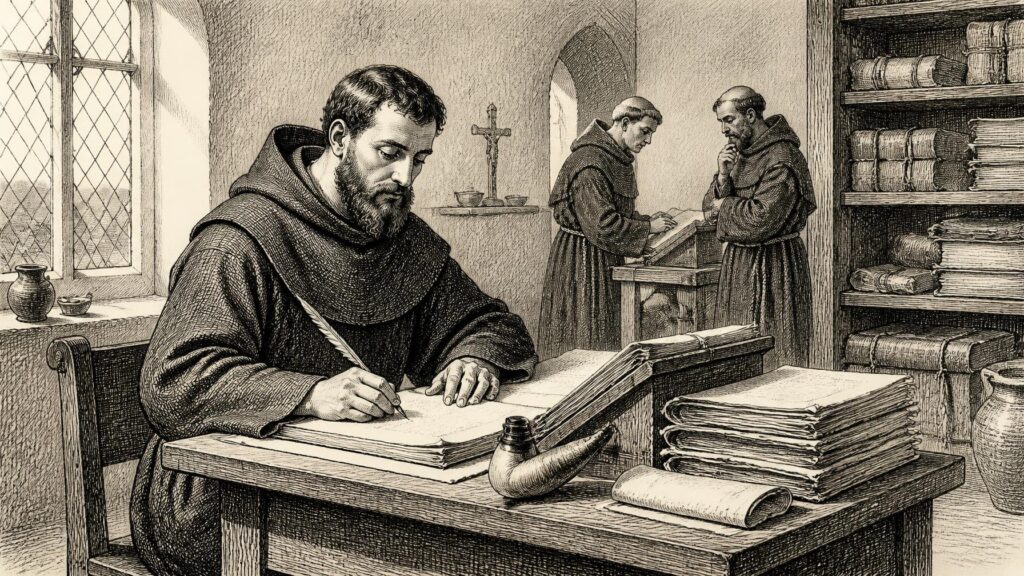
The most exact cultural date of the year is 19 April. On that day, according to the colophon in the surviving manuscript, Mícheál Ó Cléirigh completed the long recension of the Martyrology of Donegal at the Franciscan convent of Donegal. The work, also known in Irish as Félire na naomh nÉrennach, arranged the saints of Ireland across the calendar year. It was a learned compilation, drawing on earlier martyrologies, annals and hagiographical material rather than a simple devotional list.
The achievement had an importance beyond the manuscript’s individual entries. Ó Cléirigh belonged to a hereditary learned family of Tír Chonaill and had become a Franciscan lay brother. His work joined local Irish scholarship to the international Franciscan networks centred on Louvain. A shorter copy had been made at Douai in 1629; the fuller Donegal manuscript was completed in April 1630 and had reached St Anthony’s College, Louvain, by August. Paper, scribal labour and religious learning thus travelled between Ulster, the continent and back again, despite political and confessional restrictions.
The martyrology was also a statement about what counted as Ireland’s past. Its saints connected local churches, wells, islands and place-names to a sacred geography extending across the island. In an age when landholding, settlement and political authority were being reshaped by plantation, the compilation preserved another map of Ireland: one made through Irish language, genealogy, memory and holy places. It did not reverse dispossession or state power, but it helped maintain intellectual resources through which communities could understand themselves.
Later in 1630 Ó Cléirigh gathered Fearfeasa Ó Maolchonaire, Cú Choigcríche Ó Cléirigh and Cú Choigcríche Ó Duibhgeannáin at Athlone for the compilation of genealogies of saints and kings, under the patronage of Turlough MacCoghlan. These collaborators would become celebrated as the Four Masters. It is important not to claim that the Annals of the Four Masters were completed in 1630; that monumental chronicle was still in the future. But the year did see the formation of the scholarly partnership and working methods that would make it possible.
Money, Craft and Unequal Security
Evidence for a nationwide harvest, price movement or environmental crisis in 1630 is too slight to support a confident annual narrative. The surviving record is disproportionately governmental, ecclesiastical and elite. It gives a clearer view of Dublin Castle, bishops and manuscript makers than of the labour of tenants, fishers, craftsmen or cottiers. Even so, one dated transaction illuminates the material world of the governing class. On 3 June, Cork recorded that he had contracted Edmund Tingham, a stonecutter of Chapelizod, to construct an elaborate tomb for Cork and his family in St Patrick’s Cathedral, Dublin, for £300 sterling, to be finished by July 1631.
The commission points to the purchasing power of a magnate who was simultaneously one of Ireland’s two chief governors. It also indicates the place of skilled urban and suburban artisans in a society of aristocratic display. The monument’s intended setting, a Protestant cathedral, mattered politically as well as personally. Cork’s wealth, office and memorialisation stood in sharp contrast to the insecurity of Catholic religious communities whose houses were being seized in the same city.
Thus 1630 was a year of pressures rather than resolution. Joint government continued without a lord deputy. Catholic worship endured, but often in vulnerable buildings and protected households. A new Catholic archbishop took office in the west. And at Donegal, an Irish Franciscan completed a work that gathered the island’s saints into a permanent written calendar. The surviving events do not justify a tale of either settled control or simple resistance. They show a kingdom in which state power was real but uneven, and in which communities continued to create religious, familial and intellectual forms of security beyond the institutions that governed them.
Primary Sources
- MS 5095-96: Martyrology of Donegal (Long Recension)
- Irish Script on Screen: Online Access to Irish Manuscripts in the Royal Library of Belgium
- Ó Cléirigh, Mícheál (O'Clery, Michael)
- The Martyrology of Donegal: A Calendar of the Saints of Ireland
- Manuscripts: Félire Óengusso Online
- Chronology: Mícheál Ó Cléirigh Summer School
- O'Queely, Malachy
- Boyle, Richard
- Loftus, Adam
- Bulkeley, Lancelot
- Wentworth, Sir Thomas
- State Papers Ireland, 1509–1782: Government Papers on Irish Affairs
- The State of All the Parishes and Churches of the Diocese of Dublin, by L. Bulkeley, Archbp., 1630
- Gormanston Papers: National Library of Ireland List and Calendar
- Archbishop Bulkeley's Visitation of Dublin, 1630
- The Correspondence of James Ussher, 1600–1656: Preview
- Catholic Female Religious Orders in Early Modern Ireland, c.1620–c.1641
- Papers of St Mary of the Angels, Capuchin Friary, Church Street, Dublin
- The Boyle Family Monument
- The Appointment of Wentworth
- The Plantation of Connacht
- Annals from 1504 to 1639
- St Audöen's Church: St Audöen's Arch, Cook Street, Rosemary Lane