

Elinor Nugent’s Cook Street1629 CE
In 1629, Ireland experienced administrative change, religious tension and renewed Catholic confidence. Henry Cary’s recall left Richard Boyle and Adam Loftus as lords justices, committed to royal order and Protestant ascendancy. Despite pressure on recusancy, Dublin’s Catholic networks expanded, exemplified by Poor Clares returning from Flanders to found a convent. On St Stephen’s Day, officials led by Archbishop Lancelot Bulkeley raided the Franciscan chapel in Cook Street. Congregants, notably merchant widow Elinor Nugent and other women, rescued friars and drove raiders into hostile streets. The incident exposed Catholic urban solidarity, women’s agency, transnational links, and the limits of state coercion.
Dateline
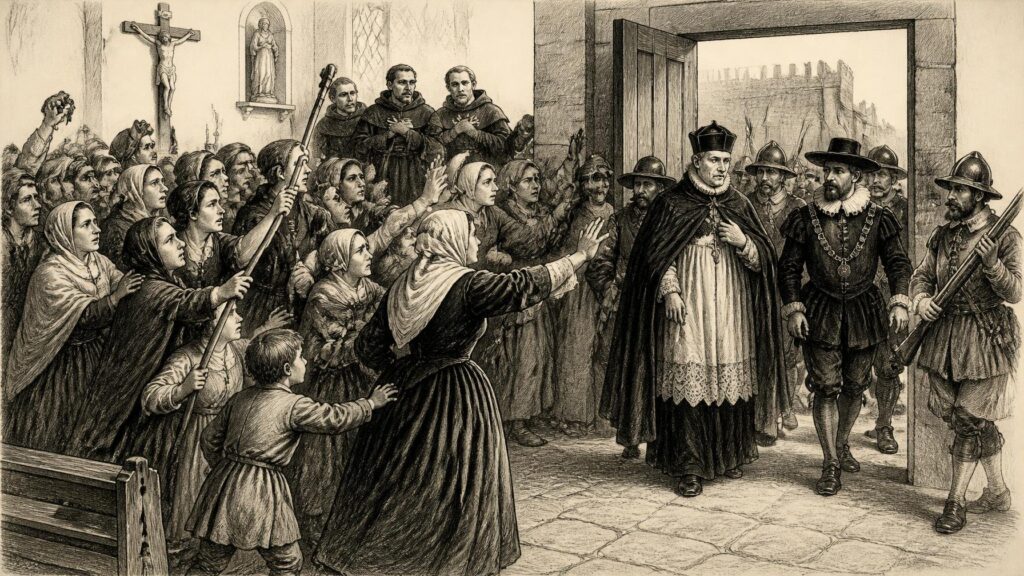
In 1629, the most revealing Irish confrontation of the year took place not on a battlefield but in a crowded Dublin chapel. On St Stephen’s Day, 26 December, civic officers, soldiers and the Church of Ireland archbishop of Dublin entered the Franciscan mass house in Cook Street to suppress Catholic worship. Their raid triggered a determined popular resistance in which women of the congregation, prominently including the Catholic merchant widow Elinor Nugent, helped force the raiders from the building and into hostile streets. The incident was local, brief and unevenly documented; yet it exposes the tension beneath a decade in which Catholic religious life had become more public while Protestant officials remained legally and politically dominant.
A Change at Dublin Castle
Ireland was ruled in the name of Charles I, whose authority extended through Dublin Castle, the Irish privy council, courts, sheriffs and borough corporations. The wider Stuart crisis mattered directly. Charles dissolved his English parliament in March 1629, beginning a period of government without an English parliament, and royal finances remained under severe pressure. Ireland was valuable as a source of revenue, customs income and military security, while its political and confessional divisions were viewed in London as potential dangers.
Within Ireland, 1629 also brought an administrative transition. Henry Cary, Viscount Falkland, lord deputy since 1622, had become embroiled in factional conflict and controversy over efforts to establish crown title to land in Wicklow associated with the O’Byrnes. He was recalled during the year. Government thereafter rested with two lords justices: Richard Boyle, earl of Cork, and Adam Loftus, Viscount Loftus of Ely and lord chancellor. Their partnership concealed rivalry, but both had reasons to demonstrate order, royal authority and Protestant ascendancy.
This was not a year of national warfare in Ireland. Its importance lay instead in administration, land, religion and the uses of public authority. The political settlement after the Nine Years’ War had made royal government more pervasive than before, but it had not remade Irish society into a uniformly Protestant or English-speaking realm. Old English Catholic families remained influential in towns and counties of the Pale; Gaelic and Gaelicised lordly networks endured elsewhere; settlers and officials held expanding estates, offices and commercial interests. The peace was real, but it rested upon competing understandings of law, property and religion.
From Limited Tolerance to Pressure
The 1620s had seen a noticeable, though insecure, easing of pressure on Catholics. Negotiations surrounding the promised concessions known as the Graces had encouraged hopes among Catholic landowners that payment to the crown might be matched by greater security of property and a less punitive religious policy. Those hopes were never straightforwardly fulfilled. Nevertheless, Catholic clergy and lay patrons used the relative space available to rebuild networks of worship, schooling and mutual support.
In Dublin this revival was visible rather than hidden. A Dublin Castle official complained in 1629 of fourteen mass houses in the city, served by Franciscans, Jesuits, Carmelites and other clergy. The figure came from an alarmed official observer, not a neutral census, but it usefully indicates why Protestant authorities believed that Catholic institutions were flourishing in the capital itself. Houses of worship were often established in private or adapted buildings, but they could be furnished with altars, vestments, images and congregations large enough to make them conspicuous.
Lord Deputy Falkland had already obtained permission early in 1629 to revive a limited campaign against recusancy, Catholic ecclesiastical jurisdiction and religious orders. An April proclamation targeted religious houses and public clerical activity. The policy should not be mistaken for continuous, effective repression across the island: local enforcement varied greatly, and Catholic worship depended upon lay hospitality, kinship, urban patronage and connections with clerics educated abroad. Yet the proclamation gave officials a legal and ideological basis for intervention. By the end of the year, under the new lords justices, enforcement in Dublin became dramatically public.
The Poor Clares Return
One development earlier in the year showed the confidence that had grown within Catholic circles. In June, a group of Irish Poor Clares arrived in Dublin from their community at Nieuport in the Spanish Netherlands. They established a house at Merchants’ Quay under the leadership of Cecily Dillon, sister of Eleanor Dillon and daughter of the first Viscount Dillon. Their journey had already taken them from Gravelines to Dunkirk and Nieuport, demonstrating how Irish Catholic renewal relied on continental convents, colleges, ports and religious orders as well as on local patrons.
The Dublin foundation was highly significant. It was the first enclosed female religious community established in Ireland since the suppressions of the sixteenth century. The women followed the strict reformed Poor Clare observance associated with St Colette: enclosure, poverty, communal prayer and the Divine Office structured their intended life. Their arrival did not mean that Catholic religious practice was safe; rather, it revealed that enough support, money, household space and confidence existed to attempt a permanent foundation in the capital.
The community’s reception into the Irish Franciscan province was recorded at a provincial chapter held at Limerick on 15 August. That act linked a small Dublin house to a wider Catholic infrastructure extending from Irish towns and noble households to Flanders, Rome and Iberian colleges. It also illustrates an important feature of religious life in 1629: women were not merely adherents of a male-led revival. The Poor Clares had crossed borders, formed a community and returned to Ireland as religious founders in their own right.
St Stephen’s Day at Cook Street
The Cook Street raid occurred against this background. Cook Street lay within the old walled city, close to Christ Church Cathedral, Dublin Castle, the Cornmarket and the Liffey quays. It was therefore not a remote refuge but part of a densely inhabited commercial district. A Franciscan community had returned to the area in 1615, and its chapel provided a focal point for Catholics who included artisans, servants, merchants, gentry visitors and members of established urban families.
The date is firmly recorded: 26 December 1629. Lancelot Bulkeley, Church of Ireland archbishop of Dublin, joined Christopher Forster, the mayor, aldermen, officers and soldiers in the attempt to close the chapel. The fullest surviving narrative was written shortly afterwards by the Catholic alderman William Bellew, and must therefore be read as a partisan eyewitness account rather than an official transcript. Even so, its basic outline is confirmed by the official concern which followed: the chapel doors were forced, its furnishings attacked, and a confrontation quickly escaped the authorities’ control.
Bellew described the congregation as assembled and ready for Mass when the party entered at about eleven o’clock. He reported that the mayor ordered an image pulled down, while Bulkeley himself pulled down the pulpit. Images were broken, and the raiders seized five sets of vestments and a chalice. Such objects mattered beyond their material value. Vestments and a chalice made sacramental worship possible; images and a pulpit made a chapel visibly Catholic. Their destruction was an assertion that official Protestant power could enter, define and reorder sacred space.
The raid did not proceed quietly. Bellew reported that two young friars were taken into custody, but women in the congregation rescued them. Accounts identify Elinor Nugent as a leading participant. A prosperous widow and member of Dublin’s Catholic mercantile world, she had family connections reaching to the Irish College at Lisbon and paid a relatively substantial local cess. Her prominence is important: she was neither an anonymous bystander nor a figure easily reduced to a later legend. The surviving account presents her as initiating resistance, after which other women joined in grappling with the raiders.
The altercation spilled out into the street. Stones were thrown, and the mayor, archbishop and soldiers withdrew amid abuse and projectiles. The sources use hostile language about the women, but their hostility is itself revealing. Officials expected a display of disciplined authority; instead they encountered a congregation capable of defending its clergy and chapel. The event was not a general rising, nor should it be treated as a simple forecast of 1641. It was a sharp urban riot arising from a particular raid, but it demonstrated the social depth of Catholic attachment in a city that housed the machinery of Protestant government.
Town, Learning and Memory
The Cook Street episode also gives a rare view of ordinary urban participation in high politics. Dublin’s Catholic life rested partly on noble patrons and clergy, but also on households, trading families, women who maintained devotional networks, and customers moving between markets, inns, quays and homes. Elinor Nugent’s world was commercial as well as religious. It was sustained by credit, taxation, family labour, overseas correspondence and the ability to find accommodation for priests, students and worshippers.
Learning likewise remained transnational. Franciscan and Jesuit education connected Irish students to continental colleges, while books, letters and religious personnel moved along the same routes as merchants. In November, the Franciscan theologian and former archbishop of Tuam, Flaithrí Ó Maolchonaire, died in Spain. He belonged to a learned Connacht family and had worked to advance Irish Catholic interests abroad after the Elizabethan wars. His death marked the passing of a major figure in the scholarly and political Catholic diaspora, even as religious communities in Ireland attempted to consolidate their position.
Late in the year, Ruaidhrí Ó Flaithbheartaigh was born at Moycullen in County Galway. Nothing in 1629 could have foretold his later career as an antiquary and historian, but his birth is a modest reminder that Irish historical learning did not disappear in the seventeenth century. It survived through manuscripts, family traditions, clerical scholarship and the efforts of people living through political dispossession and confessional division.
Thus 1629 was not defined by a single national settlement or campaign. It was a year in which royal administration changed hands, Catholic institutions tested the limits of permitted public life, and officials answered with coercion. At Cook Street, the contest became physical and immediate. The chapel raid showed both the reach of the state and its limitations: Dublin’s rulers could break in, seize religious objects and invoke the law, but they could not assume obedience from the people gathered before them.
Primary Sources
- ‘Viragos and Victims’: Women and the Seventeenth-Century Dublin
- St. Brigid’s Day: Courageous Women
- Dublin – Adam and Eve’s
- Women, Gender and Religion in Early Modern Ireland: A Study of Female Catholicism, c.1600–c.1660
- Bulkeley, Lancelot
- Cary, Henry
- Ussher, James
- Loftus, Adam
- Annesley, Francis
- O’Byrne, Aodh
- Barlow, Randolph (Randal)
- Fitzgerald, Elizabeth
- Conry, Florence
- Dillon, Cecily
- O’Flaherty, Roderick (Ó Flaithbheartaigh, Ruaidhrí)
- De Renzy, Sir Matthew
- Charles Dissolves Parliament
- Charles I and the Petition of Right
- Reintegration and Renewal: Female Religious Communities in Ireland, 1629–49
- State Intervention in Disputes Between Secular and Regular Clergy in Early Seventeenth-Century Ireland