Sackville Street’s Gaelic League1893 CE
In 1893, Gladstone’s second Home Rule Bill proposed an Irish legislature within the Union, retaining Westminster supremacy, imperial responsibilities and Irish representation. Despite Commons approval, it was overwhelmingly rejected by the Lords, exposing constitutional limits and intensifying unionist fears. On 31 July, Douglas Hyde, Eoin MacNeill and others founded the non-sectarian Gaelic League in Dublin to revive spoken Irish through classes, publications and branches, amid language decline. The year also reflected religious and social organisation: Archbishop Michael Logue became cardinal, St Mel’s Cathedral was consecrated, Margaret Lyttle began a girls’ club, and the National Labour League highlighted rural workers’ grievances.
Dateline
For Ireland, 1893 was a year in which two different answers to the national question acquired unusually clear form. One was constitutional and parliamentary: William Ewart Gladstone’s second attempt to give Ireland a legislature while retaining it within the United Kingdom. The other was cultural and voluntary: the foundation in Dublin of the Gaelic League, an organisation intended to make the Irish language a living public possession rather than a relic of scholarship or a marker of rural decline. The first project was carried through the House of Commons and then stopped by the House of Lords. The second began modestly, but proved far more durable.
A Bill for Irish Government
On 13 February Gladstone, the Liberal prime minister, sought leave in the House of Commons to introduce a Government of Ireland Bill. It was the second Home Rule bill of his career, following the defeated measure of 1886. This was not a declaration of Irish independence. Its central purpose was to establish an Irish legislature for Irish domestic business while preserving the legal supremacy of the Westminster parliament and the Crown.
The proposal was elaborate, partly because its authors tried to reconcile self-government with the Union. Ireland would have had a legislature made up of the sovereign and two chambers: a Legislative Council of 48 members and a Legislative Assembly of 103. Matters considered imperial, including the armed forces, foreign affairs, the Crown, customs and excise, would remain outside its control. The revised scheme also retained 80 Irish MPs at Westminster, rather than removing them altogether. Its finances and the boundary between Irish and imperial powers were therefore as contentious as its headline promise of a parliament in Dublin.
The bill’s introduction gave an immediate parliamentary focus to Irish political life, but it did not erase the consequences of Charles Stewart Parnell’s death in 1891 and the split in the Irish Parliamentary Party. Nationalists shared a demand for Home Rule, yet remained divided between the larger anti-Parnellite Irish National Federation and the Parnellite Irish National League led by John Redmond. The division weakened the appearance of a united national movement at the very moment when Gladstone needed Irish support to carry a complex constitutional settlement through a hostile British political system.
After prolonged debate, the Commons gave the bill its second reading on 21 April. It then spent months in committee and further debate. The process was a reminder that Home Rule was not a simple Irish measure passed in an Irish forum: Irish MPs had to argue their case in a legislature dominated by British parties, procedure and anxieties about the future shape of the United Kingdom. On 1 September the Commons passed the bill’s third reading by 301 votes to 267.
Unionist Resistance and the Lords
The Commons majority did not mean that Ireland had settled the question. Unionists in Ireland, especially but not exclusively among Protestants in the industrial north-east, regarded a Dublin legislature as a threat to their political influence, religious security and economic interests. Belfast’s manufacturing and commercial links with Britain made the prospect of separate Irish administration particularly unwelcome to many unionists there. Southern unionists, too, feared that a nationalist legislature would diminish their position. Their objections were constitutional and economic as well as sectarian, though religious identity gave the argument much of its force.
Opponents used the phrase “Rome Rule” to suggest that a Catholic-majority Ireland would be governed in the interests of the Catholic Church. Such language obscured the range of Irish political opinion, but it was effective propaganda. Supporters of Home Rule, meanwhile, argued that the bill explicitly maintained imperial supremacy and contained constitutional safeguards. Neither side was persuaded by the other. The dispute made clear that a parliamentary majority for devolution could coexist with deep disagreement within Ireland about who would exercise power and how minorities would be protected.
The House of Lords supplied the decisive obstacle. On 8 September, only a week after the Commons vote, the peers rejected the bill at second reading by 419 votes to 41. There was no immediate route around that verdict: the Lords still possessed an effective veto over legislation, and the Parliament Act that would later curb that power was nearly two decades away. The defeat did not settle Home Rule permanently, but in 1893 it ended the immediate prospect of an Irish legislature. For nationalists it was a sharp demonstration that electoral and Commons support were insufficient; for unionists it confirmed the importance of the Union’s existing institutions.
A Meeting at Number Nine
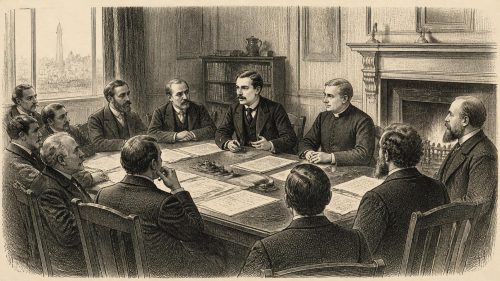
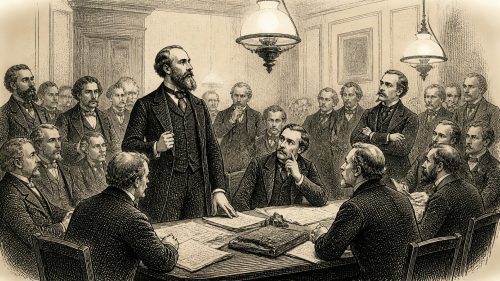
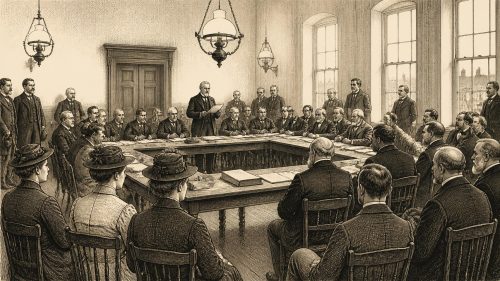
While the Home Rule bill travelled through Westminster, a smaller meeting in Dublin opened a different field of action. On 31 July, at Martin Kelly’s Civil Service Academy, 9 Lower Sackville Street, the Gaelic League was founded. The street, now O’Connell Street, was a fittingly urban location for an organisation that intended to carry Irish beyond antiquarian circles and into modern social life.
Douglas Hyde chaired the foundation meeting and became the League’s first president. Eoin MacNeill, a young civil servant and scholar, had convened the gathering and became its honorary secretary. Eugene O’Growney, the Maynooth professor whose accessible Irish lessons had reached a wide readership, and Thomas O’Neill Russell were among the leading figures associated with its establishment. Their combination mattered. Hyde was a Church of Ireland scholar from Roscommon; MacNeill came from a Catholic background in Antrim; O’Growney was a priest. From the beginning, the League could present the language as a common inheritance rather than the property of one church or party.
Its early purpose was cultural, not party-political. The organisation sought the preservation and extension of spoken Irish, the study and publication of Irish literature, and the encouragement of a modern literature in the language. It offered a practical answer to a practical problem: how could a language survive if it was admired in books but had little place in schooling, correspondence, meetings or urban sociability? Classes, publications and local branches would become its principal instruments. Later political associations should not be projected backwards too easily. In 1893 the League was deliberately non-sectarian and non-political, even if language, education and national identity could never be wholly detached from politics.
The urgency of the project was evident in the most recent official figures. The census of 1891 recorded 680,245 people able to speak Irish, including 38,192 recorded as speaking Irish only. The language remained strongest in western districts, but its overall position was fragile in a country shaped by emigration, English-medium education and the prestige of English in administration and employment. Hyde’s Amhráin Ghráidh Chúige Connacht, published in 1893 as Love Songs of Connacht, also showed what revivalists believed was at stake: not simply vocabulary, but songs, memory, local idiom and a literary tradition carried by ordinary speakers.
Church, Community and Labour
Religious institutions remained central to social authority and local life. On 16 January Archbishop Michael Logue of Armagh was named a cardinal, receiving the Roman title of Santa Maria della Pace three days later. He was the first archbishop of Armagh to attain the cardinalate. The distinction acknowledged the standing of the Catholic hierarchy in Ireland and connected the Irish church more visibly to Rome at a time when questions of religion and political representation were repeatedly entangled.
In Longford, St Mel’s Cathedral was solemnly consecrated in May. Its long building history stretched back to the eve of the Great Famine; completion and consecration therefore gave architectural expression to the institutional confidence of late nineteenth-century Catholicism. Yet religiously organised life was not confined to grand churches. In Sandymount, Dublin, Margaret Lyttle began a girls’ club at the Presbyterian church in 1893. Drill, needlework, games and dancing combined discipline, recreation and instruction in a setting that would develop into the Girls’ Brigade. The episode is a small but useful reminder that Irish associational life crossed denominations and included organised opportunities for girls as well as men.
Class and land remained equally important. In January the National Labour League was founded at Kanturk in north Cork. It emerged from a district with a longer record of agricultural labourers’ organisation and pointed towards the more sustained land-and-labour agitation of the following year. Its concerns were not abstract constitutional questions alone, but cottages, allotments, employment and the insecure position of men who worked the land without owning or securely renting it. Tenant purchase and the decline of landlord power had altered the countryside, but they had not automatically improved the lives of labourers.
Two Paths into the Future
Most people in 1893 experienced these developments indirectly: through sermons, newspapers, public meetings, schoolrooms, work, migration decisions and conversations at fairs or in town streets. The year did not deliver Home Rule, and it did not reverse the long retreat of Irish as an everyday language. It did, however, sharpen two ambitions that would shape modern Ireland. Westminster’s refusal exposed the limits of constitutional advance under the Union. The gathering at Lower Sackville Street created an institution through which culture could be learned, practised and organised from below. In that contrast lies the particular significance of 1893.
Primary Sources
- Government of Ireland
- Motion for Leave
- Second Reading [First Night]
- Second Reading [Adjourned Debate]
- Third Reading [Third Night]
- Second Reading
- Government of Ireland Bill (No. 265)
- Home Rule Bill
- Explainer: What was Home Rule?
- The Gaelic League and the 1916 Rising
- Douglas Hyde, Eoin MacNeill and the Gaelic League
- Eoin MacNeill and the Irish Volunteers
- The Gaelic League
- LÉACHT DE hÍDE
- Hyde, Douglas (de hÍde, Dubhghlas)
- Russell, Thomas O'Neill (Tomás Ó Néill Ruiséal)
- Logue, Michael
- Cardinal Michael Logue
- Focus on Irish Language Traditions
- Census 1891
- Census Records 1821–1891
- St. Mel's Cathedral
- St Mel's Cathedral, Diocese of Ardagh & Clonmacnois
- History
- Historical Directory of Trade Unions in Ireland
- The National Agricultural Labourers' Union in Ireland, 1873–9