Westport’s United Irish League1898 CE
In 1898, Ireland saw agrarian, political and cultural change. William O’Brien founded the United Irish League at Westport, seeking land redistribution and linking western congestion to self-government. The Local Government (Ireland) Act replaced landlord-dominated grand juries with elected councils, although implementation followed in 1899 and franchise limits remained. Centenary commemorations of 1798 elevated Wolfe Tone while exposing competing nationalist, unionist and regional interpretations. Cultural revival advanced through Fáinne an Lae, the Gaelic League’s Oireachtas, Pearse’s Aran visit and Irish literature. Mary Immaculate College, Belfast City Hall and Killybegs carpet manufacture reflected educational, municipal and industrial development. They reshaped public life.
Dateline
In 1898, Ireland’s public life was reshaped less by a single dramatic confrontation than by three connected developments: agrarian mobilisation in the west, the centenary of the 1798 rebellion, and a far-reaching reform of local government. Each addressed a different question. Who should control land? What history should nationalists remember? And who should manage the rates, roads, public health and local institutions of Ireland? Together they gave political organisation, historical memory and everyday administration a newly popular character.
A New League in Westport
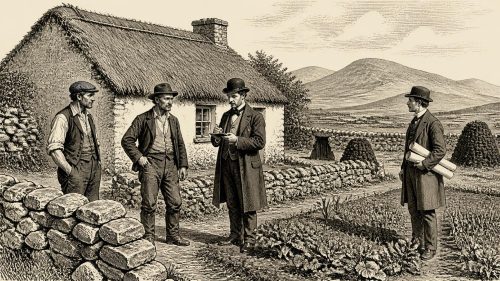
The year opened amid real anxiety in the poorer western districts. The difficult seasons of 1897 and early 1898 had exposed the fragility of many small holdings, especially in Connacht. Potato supplies mattered greatly to households with little margin for failure, while much land was still held as large grazing farms. To small farmers and labourers living on congested or uneconomic plots, the sight of extensive pasture could make the unequal distribution of land appear as immediate a hardship as rent itself.
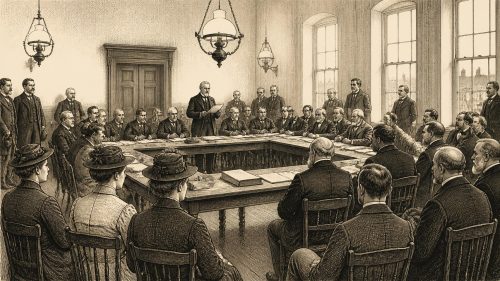
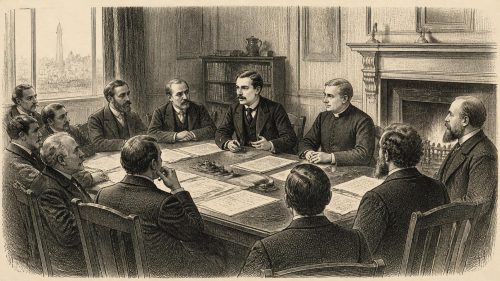
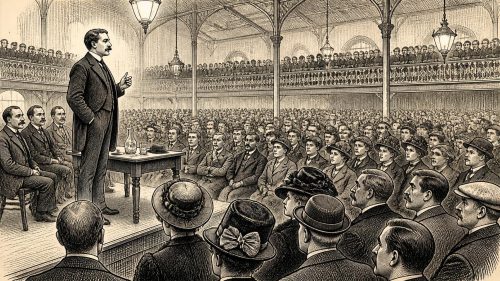
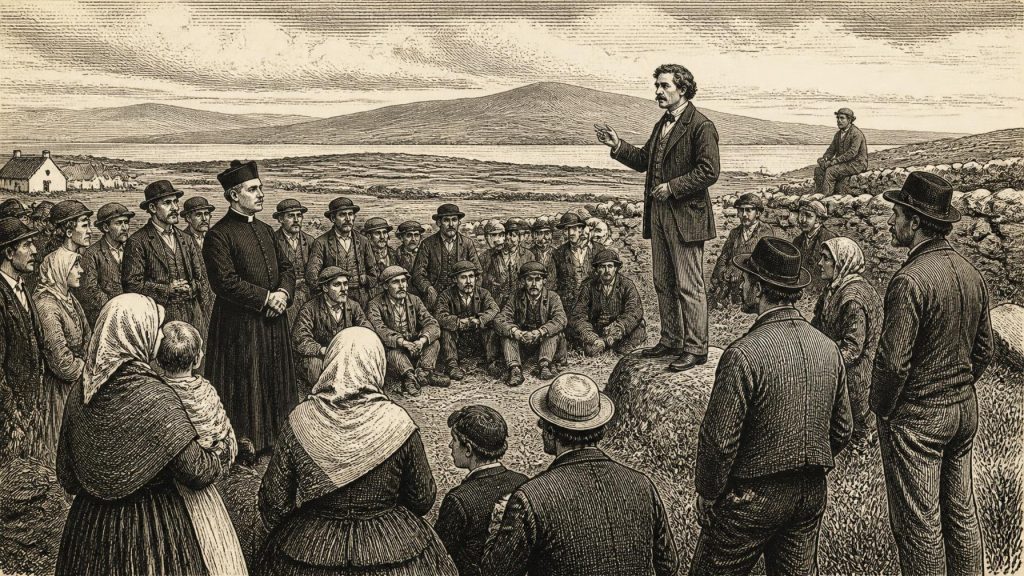
It was in this setting that William O’Brien launched the United Irish League at Westport, County Mayo, in January 1898. O’Brien had been a prominent Land League journalist and nationalist parliamentarian; Michael Davitt, John Dillon and local clerical and political supporters were associated with the initiative. Its concise slogan, “The Land for the People”, expressed a programme directed particularly against the large grass ranches of the west. The League sought redistribution of land to relieve congestion, while also tying the land question to Irish self-government.
The organisation did not emerge from nowhere. It inherited the practices and language of earlier land agitation, but it appeared after the bitterness of the Parnell split had weakened parliamentary nationalism. That gave its local branches an importance beyond agricultural grievance. Meetings, resolutions and pressure on landlords or graziers could create a new common political machinery among people who had felt remote from Westminster and divided by the factional disputes of the 1890s. In 1898, however, it remained a new movement: its later nationwide influence should not be projected back as if it had already remade Irish politics in January.
Local Power Recast
The most firmly dated constitutional event of the year came on 12 August, when the Local Government (Ireland) Act received royal assent. The measure was introduced by the Conservative–Liberal Unionist administration, with Gerald Balfour as Chief Secretary for Ireland. It did not grant Home Rule, nor did it establish an Irish parliament. Nevertheless, it transferred substantial local authority away from the landlord-dominated grand juries and towards elected bodies. In practical terms, it concerned matters that touched ordinary lives: county expenditure, roads and bridges, sanitary arrangements, rates, institutional finance and aspects of public welfare administration.
The Act created a county council for every administrative county, elected by local-government electors, and arranged for urban and rural district councils. It also rationalised the patchwork of bodies that had grown around poor-law unions, sanitary authorities and county administration. County councils were to handle administrative and financial business; district councils would have their own local functions. The statute’s technical language was therefore the framework for a major social change. Decisions previously made by magistrates, substantial property holders and officials could increasingly become subjects for electoral contest and public debate.
Its democratic reach was important but limited. The local franchise extended beyond the old elite, and qualified women could vote in local elections. Women could also stand for urban and rural district councils, though not yet for county councils or borough councils. Property and occupation conditions still mattered, and the legislation explicitly did not create new rights in parliamentary elections. Yet the prospect of women appearing on local registers, and of householders and tenants having a stronger formal voice in county affairs, marked a notable widening of civic participation.
Care is needed with the calendar here. The Act belonged decisively to 1898, but the new councils did not instantly take office that summer. Registration, boundary arrangements and administrative orders had to be prepared, while central provisions came into operation in 1899. Thus 1898 was the year in which the old order was legislatively displaced and local political expectations were transformed; the first great electoral test lay ahead. The reform’s long-term significance was that it offered nationalists, unionists, labour figures, women activists and local notables an arena in which to acquire experience of popular politics.
Remembering the Rebellion
Political change unfolded alongside a powerful act of remembrance. The year was the centenary of the rebellion of 1798, and commemorations took place across Ireland. The anniversary invited people to revisit a rising associated with the United Irishmen, with French intervention, with sectarian atrocity and repression, and with the failed attempt to unite “Catholic, Protestant and Dissenter” in a republican cause. It was not a neutral history. Different organisers selected different heroes, regions and meanings from the events of a century before.
Wolfe Tone stood at the centre of much nationalist commemoration. Memorial committees circulated notices, raised subscriptions and promoted a monument project, while an August demonstration in Dublin brought the centenary into the capital’s streets. The occasion made Tone a public emblem of Irish nationality, but the character of the 1798 story was contested. Constitutional nationalists could place it within a broader tradition of patriotic parliamentary politics; advanced nationalists stressed revolution and independence; cultural revivalists saw it as evidence of an older, plural Irish nation. In the north-east, where memories of the rebellion were also bound up with loyalist and Presbyterian experience, its legacy could not be simply claimed by one political camp.
The centenary also gave the new United Irish League an unusually resonant name. O’Brien’s organisation was not a restoration of Tone’s society, and its immediate programme concerned land and political reform rather than armed revolt. Even so, the name linked contemporary mobilisation to a revered radical past. In 1898, historical memory became an active part of political language: processions, speeches, songs, grave visits, printed appeals and proposed monuments helped make the past visible in the present.
Irish in Print and Performance
Cultural revival was similarly practical as well as symbolic. On 8 January, Fáinne an Lae began publication in Dublin. Described as a weekly bilingual newspaper for the advancement of Irish, it supplied the Gaelic League with a regular public voice and gave learners, speakers and sympathisers a shared printed space. Its existence did not mean that Irish had returned as the ordinary language of the whole country. English remained dominant in administration, commerce and much of education. But the newspaper made language revival a matter of routine reading, correspondence, local news and organised effort rather than antiquarian sentiment alone.
The Gaelic League’s second Oireachtas was held in 1898, bringing Irish-language and cultural activity into a festival setting. The year also saw the young Pádraig Pearse visit the Aran Islands; his account of the journey appeared in Fáinne an Lae in November. Such episodes reveal the revival’s mixture of study, travel, oral tradition and print. Peadar Ua Laoghaire’s Séadna was being serialised in Irish during the year, while Eleanor Hull’s English-language The Cuchullin Saga in Irish Literature brought material from the Ulster Cycle to another readership. These were not identical cultural projects, but both enlarged the public life of Irish literary inheritance.
Institutions, Industry and Cities
Other foundations and building works showed Ireland’s varied regional development. On 8 December, Bishop Edward Thomas O’Dwyer and the Sisters of Mercy established Mary Immaculate College in Limerick for the professional education of Catholic primary-school teachers. Its foundation belonged to a Catholic educational world in which teaching orders, national schools and clerical leadership remained central to social life. It also recognised that schooling required trained teachers, not simply goodwill and religious vocation.
In Belfast, building work on the new City Hall began in October. The projected building expressed the confidence of a city shaped by linen, engineering, shipbuilding, commerce and municipal ambition. Its scale stood in marked contrast to the scattered smallholdings of the Atlantic west, yet both regions were being drawn into debates over representation and public authority. Meanwhile, at Killybegs in County Donegal, Alexander Morton’s carpet enterprise began in 1898, adapting local wool-working skills to an organised commercial manufacture. Such ventures did not erase rural hardship, but they demonstrate that industrial and craft development could take forms beyond the great factories of Belfast.
By the close of 1898, no constitutional settlement had been achieved and no single Irish future had been agreed. The island remained within the United Kingdom, nationalists remained divided by strategy and unionist confidence remained strong, particularly in industrial Ulster. Yet the year altered the tools with which politics would be conducted. The United Irish League gave new energy to agrarian nationalism; the ’98 centenary made historical memory a mass political resource; and local-government reform prepared elected institutions that would soon carry unprecedented local legitimacy. In a year of meetings, newspapers, legislation and commemorative gatherings, Ireland acquired new ways to organise, remember and govern itself.
Primary Sources
- Local Government (Ireland) Act, 1898
- Women and Irish Local Government
- Local Government (Ireland) Bill, 27 April 1898
- Irish Estimates, 13 May 1898
- Agricultural Statistics (Ireland), 8 August 1898
- The Formation of the United Irish League, 1898–1900: The Dynamics of Irish Agrarian Agitation
- O'Brien, William
- United Irish League
- Pamphlet ‘Wolfe Tone and ’98 Memorial Association’
- John Sweetman Political Correspondence
- 1798, the Year of the French
- Address to the Wolfe Tone Memorial
- Fáinne an Lae
- Fáinne an Lae — Advertising to the Irish
- Texts Beginning with the Letter I: Imtheachta an Oireachtais 1898
- Céad Réamhrá (i mBéarla)
- The Cuchullin Saga in Irish Literature
- MIC History Timeline
- History of Belfast City Hall
- MS 82 Belfast City Hall: 19th Century Architectural Drawings and Documents
- Killybegs Heritage Trail Booklet
- The Local Government (Ireland) Act, 1898 and the Franchise
- Local Government Electoral Rolls
- Franchise and Elections, 1869–1954