Ashbourne, Carnarvon and the Poll1885 CE
In 1885, Ireland’s land and constitutional politics were reshaped. The first Ashbourne Act authorised £5 million for state-backed tenant purchases, advancing the shift from landlordism, while educational endowments legislation addressed school resources. Lord Salisbury’s minority Conservative government appointed Lord Carnarvon, whose private discussion with Charles Stewart Parnell indicated tentative interest, not commitment, in Irish legislative autonomy. Franchise extension and redistribution enlarged and reorganised constituencies. The Irish National League’s organisation helped Parnellites win 85 of Ireland’s 103 seats, giving their Westminster bloc decisive leverage. Unionist strength persisted in Ulster. Economic contrasts, emigration, and Gaelic Athletic Association rule-making also marked the year.
Dateline
In 1885, Irish politics moved from the aftermath of the Land War towards a constitutional contest of exceptional consequence. The year did not settle the question of Home Rule; that lay ahead. It did, however, bring together land purchase, electoral reform, a new Conservative administration’s tentative dealings with Charles Stewart Parnell, and a general election that made the Irish Parliamentary Party indispensable at Westminster. These developments were firmly rooted in the calendar year, even where their larger consequences unfolded later.
Land Purchase Becomes Policy
The most tangible Irish measure enacted in 1885 was the Purchase of Land (Ireland) Act, better known as the first Ashbourne Act. It received royal assent on 14 August. The statute enlarged the means by which occupying tenants could buy their holdings: where the Land Commission judged the security sufficient and a guarantee deposit was provided, it could advance the whole purchase price rather than the three-quarters available under the 1881 legislation. Parliament authorised advances of up to £5 million.
Its importance lay in both substance and direction. The Irish land question was still central to rural life. Most farming families remained tenants, rents and arrears continued to dominate local tensions, and the ownership of land was inseparable from questions of security, status and political power. The Ashbourne Act did not compel a landlord to sell or a tenant to buy. It was a voluntary scheme, dependent on agreement and on the Land Commission’s approval. It therefore offered no instant solution for the great majority of households. Yet it made state-backed tenant purchase a much more practical prospect and strengthened the long-term movement away from landlord ownership towards peasant proprietorship.
The Act also demonstrated that land reform could be pursued under a Conservative ministry. Lord Ashbourne, the lord chancellor of Ireland, gave his name to the measure, while the government of Lord Salisbury presented it as a conciliatory response to Irish conditions. Nationalists could welcome assistance for purchasing tenants without abandoning the wider demand for an Irish legislature. For many rural voters, indeed, land and self-government were connected rather than competing causes: control of the holding offered security at home, while Home Rule promised a more responsive political system.
A New Administration and a Private Conversation
Westminster politics changed sharply in June. William Ewart Gladstone’s Liberal government was defeated on its budget on 8 June, and Lord Salisbury accepted office on 23 June at the head of a Conservative minority administration. The change mattered greatly in Ireland. Henry Howard Molyneux Herbert, fourth earl of Carnarvon, became lord lieutenant at the end of that month. His public language was notably less coercive than that associated with earlier administrations, and he described Ireland in the House of Lords as a separate nation. Such phrasing attracted attention because Irish government was normally conducted through Dublin Castle under the Union, not through any Irish representative institution.
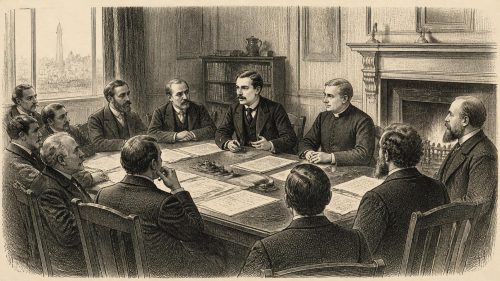
On 1 August Carnarvon met Parnell privately at 15 Hill Street, Mayfair. The meeting was not publicly disclosed at the time and its precise meaning later became controversial. It should not be represented as a firm Conservative promise of Home Rule. What can responsibly be said is that Carnarvon and Parnell discussed the desirability of some form of Irish legislative body and the protection of Irish industry. Carnarvon’s own account and later historical evidence indicate that he was exchanging views, with Salisbury’s knowledge, but without a settled cabinet commitment to an Irish parliament.
The episode nevertheless mattered in 1885 because it showed that Parnell was no longer merely an obstructionist force at Westminster. He was a leader whom ministers believed they had to engage. The possibility of constitutional accommodation, however uncertain, became part of the political atmosphere in which the election was fought.
Redrawing the Political Map
The year’s election was shaped by the Redistribution of Seats Act, which received royal assent on 25 June 1885. Together with the franchise extension enacted in 1884, it recast Irish parliamentary politics. Ireland retained 103 Westminster members, but its old mixture of counties and small boroughs was reorganised into more nearly equal single-member divisions. The legislation set out detailed boundaries from Antrim to Wexford, turning many historic county constituencies into separate electoral battlegrounds.
This was not a democratic revolution in the modern sense. Women remained excluded from parliamentary voting, and the franchise still left many adult men without a vote. Nevertheless, the enlargement of the electorate gave substantially greater weight to householders, small farmers and agricultural labourers than before. It also required nationalist politics to become more systematic. The Irish National League spent 1885 building local branches, selecting candidates and connecting parish-level organisation with Parnell’s disciplined parliamentary leadership.
The League’s expansion depended on more than central direction from Dublin and London. Local shopkeepers, farmers, publicans, schoolmasters, organisers and newspaper readers all helped sustain it. Catholic clergy played a prominent role in many nationalist conventions and campaigns, though this varied by locality and was fiercely criticised by unionist opponents. The resulting alliance of nationalist organisers and much of the Catholic clerical leadership gave Parnell’s party an electoral reach it had previously lacked.
The Election Winter
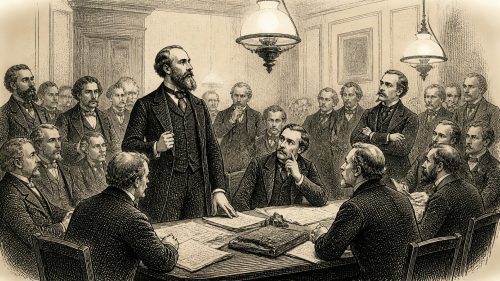
Parnell defined the campaign’s central object with unusual clarity. In October he declared that the party’s platform had one plank: legislative independence. His manifesto of 21 November, issued just before polling began, made the appeal more immediate. The Irish party would use its Westminster strength to advance self-government, while land, education and economic interests remained important parts of its programme.
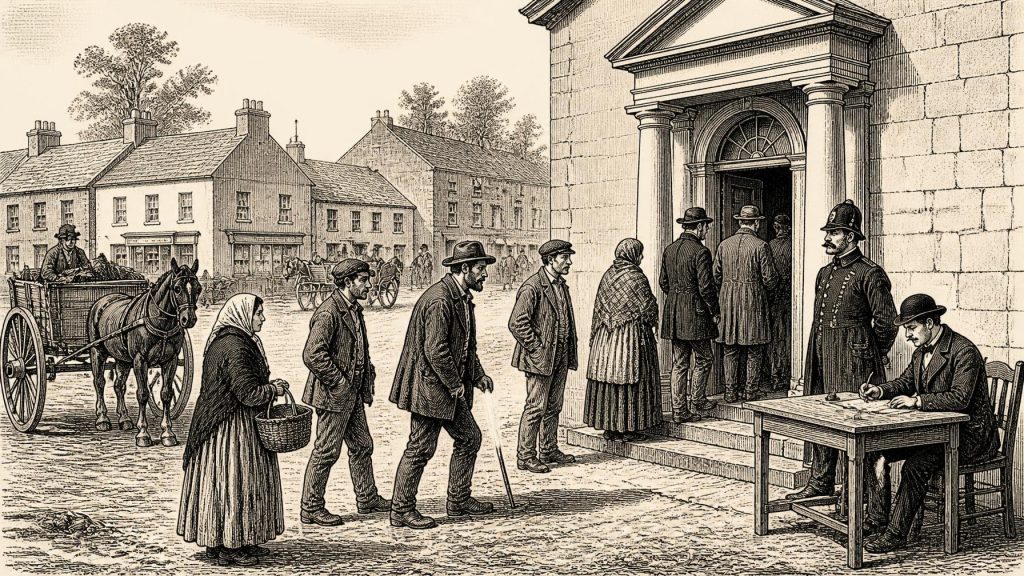
The United Kingdom general election ran from 24 November to 18 December; Irish contests began on 26 November and were conducted on differing dates. The outcome transformed Ireland’s representation. In Ireland itself, Parnellite Nationalists won 85 of the 103 seats. Conservatives and allied unionists held 16, concentrated overwhelmingly in Ulster, while the two seats of Dublin University remained Conservative. The Liberals, who had held Irish seats at the previous election, won none in Ireland. Thomas P. O’Connor’s victory in the Liverpool Scotland division added an Irish nationalist member from Britain, commonly bringing the effective Parnellite parliamentary strength to 86.
The map of the result revealed both nationalist power and the limits of its reach. Outside Ulster, the Nationalists swept nearly all constituencies apart from the university representation. In Ulster, however, unionism proved resilient, and the election entrenched a political geography in which Protestant-majority districts were increasingly represented by Conservatives or unionists while Catholic-majority districts generally returned Parnellites. This was a powerful electoral pattern, not a complete description of Irish society: there were Protestant nationalists, Catholic unionists and local contests shaped by personalities, property and religion. But the polarisation visible in 1885 would have enduring consequences.
At Westminster, no British party secured an overall majority. Gladstone’s Liberals were the largest party, Salisbury’s Conservatives remained formidable, and Parnell’s bloc held the balance between them. The Irish party had converted its disciplined organisation into leverage. It could not impose Home Rule by numbers alone, but British governments could no longer easily govern without considering its position.
Different Irelands, Shared Pressures
The political drama did not erase the everyday realities beneath it. In much of Ireland, agriculture remained the principal source of work and income. The later nineteenth century had brought falling prices and intense competition in farm produce, placing pressure on tenants and labourers even after the worst years of agrarian confrontation had passed. Emigration continued to shape family decisions and village life, binding Irish localities to Britain, North America and the wider emigrant world. The prospect of buying a farm under the Ashbourne Act could therefore carry immense emotional as well as financial weight.
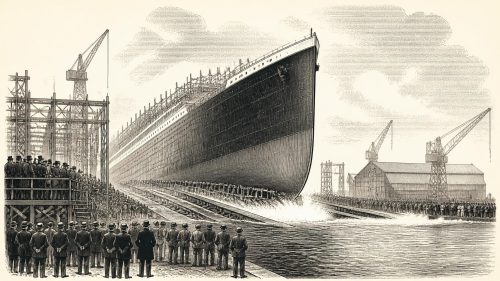
Belfast and industrial Ulster presented a different, though connected, landscape. Linen manufacture, engineering, shipbuilding and port activity made Belfast the island’s leading industrial city. Factory and yard employment tied the city closely to British markets and imperial trade, while population growth and industrial discipline produced social conditions unlike those in much of the countryside. These contrasting economies helped explain why the language of land purchase and an Irish parliament resonated differently across the country. They did not make political outcomes inevitable, but they gave unionism in the north-east a substantial social and economic base.
Schools, Endowments and Games
Education also received legislation on 14 August, when the Educational Endowments (Ireland) Act became law. It established a five-member commission empowered to frame schemes for reorganising educational endowments. Such endowments included property and funds devoted to schooling, scholarships and related charitable purposes. The Act did not resolve Ireland’s larger denominational controversy over university education, but it mattered because education remained a question of access, religious identity and social advancement. Its provisions could affect resources for poor children, apprenticeships, maintenance and bursaries as well as schools themselves.
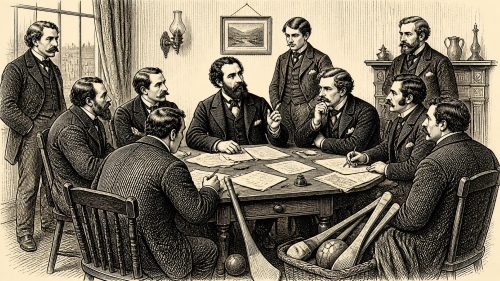
In cultural life, 1885 was an early practical year for the recently founded Gaelic Athletic Association. The Association had been formed in Thurles in November 1884, not 1885; its importance this year lay in consolidation. Maurice Davin’s rules for hurling and Gaelic football were adopted in January and published in United Ireland in February. They attempted to bring local and varied games into organised forms with agreed grounds, officials and limits on play. The rules were still rudimentary, but they made a national sporting movement more conceivable. In this sense, the same year that perfected Parnell’s political organisation also saw another Irish institution begin to standardise popular recreation.
An Altered Balance
By December 1885, Ireland had not obtained Home Rule, widespread tenant ownership or educational peace. It had instead acquired a new political balance. The Ashbourne Act made state-funded land purchase a serious instrument of policy; Carnarvon’s meeting with Parnell suggested that constitutional alternatives were being contemplated; and the election delivered a nationalist bloc with unprecedented bargaining power. The year’s significance lay precisely in that combination of limited reforms, guarded contacts and decisive votes. Ireland entered 1886 with its central questions still unresolved, but with Parnell and his party placed at the heart of British politics.
Primary Sources
- Purchase of Land (Ireland) Act 1885
- Educational Endowments (Ireland) Act, 1885
- Redistribution of Seats Act 1885
- Herbert, Henry Howard Molyneux
- Parnell, Charles Stewart
- McCarthy, Justin
- The 1885 and 1886 General Elections in Ireland
- Westminster Elections in the Future Northern Ireland, 1885–1910
- The Irish Electorate, 1868–1915
- The Franchise Factor in the Defeat of the Irish Parliamentary Party, 1885–1918
- The Political Journal of Sir George Fottrell
- Redistribution
- Parliament—Adjournment—The New Ministry—Statement of the Earl Granville
- Class IV—Education, Science, and Art
- Agricultural Statistics General Abstract, 1854–1886
- Agriculture: Statistical Yearbook of Ireland 2016
- History of the Commercial and Financial Relations Between England and Ireland: Part 17
- Chapter V: The Operation of the National League
- Introduction, The Political Journal of Sir George Fottrell
- Who Wrote the First Rules of ‘Gaelic’ Football and What Were They?
- 1 November, 1884: The Birth of a Sporting Revolution
- The Founding of the GAA
- What Was Belfast Like in the Early Twentieth Century?
- Shipbuilding in Belfast in the Early Twentieth Century: The Titanic Era and Associated Health and Safety Matters