Butt’s Unanswered Committee1876 CE
In 1876, Isaac Butt’s request for a Commons committee on Irish self-government was defeated overwhelmingly, exposing Westminster’s resistance and divisions within Home Rule, where Parnell advocated repeal of the Union. Land tenure remained contested despite the 1870 Act; parliamentary initiatives and Return of Owners of Land highlighted insecurity and concentrated property, although harvests were good. Railway consolidation created Great Northern Railway, while Dublin established an artisans’ dwellings company. The Dublin Women’s Suffrage Association, led by Anna Haslam, organised campaigning. The Society for the Preservation of the Irish Language formed, signalling cultural activism amid continuing emigration, rural dependence and British rule.
Dateline
A Constitutional Demand Meets Westminster
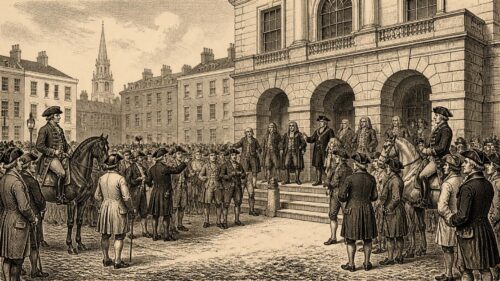
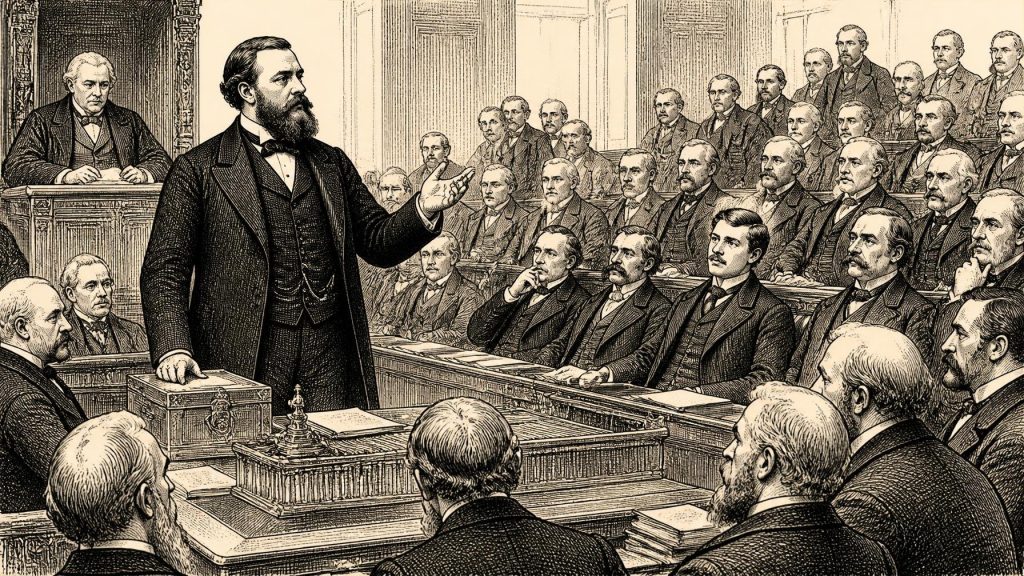
In 1876 Ireland remained part of the United Kingdom, yet the year made especially plain how incomplete that constitutional settlement felt to many Irish people. The most conspicuous political event came on 30 June, when Isaac Butt, Home Rule MP for Limerick and leader of the loose Home Rule parliamentary alliance, asked the House of Commons to appoint a select committee. It was to investigate the nature, extent and grounds of the demand for an Irish parliament empowered to manage domestic affairs. Butt did not seek an immediate break with Britain. His model was federal: Ireland would regain authority over internal concerns while the imperial parliament retained control of the Crown, defence, foreign relations and the wider empire.
The proposition was cautiously framed, but its defeat exposed the distance between Irish electoral feeling and Westminster consent. The Commons divided by 291 votes to 61 against Butt’s proposal. The scale of the majority mattered more than the procedural form of the motion. Home Rule had returned a substantial bloc of Irish MPs at the general election of 1874; still, the British legislature declined even the inquiry for which Butt asked. The debate also revealed an internal problem within Irish nationalism. Butt’s federal language, intended to reassure British opinion and preserve the union of the islands, was too restrained for some of his own allies. P. J. Smyth argued for a more explicit restoration of an Irish legislature, while Charles Stewart Parnell, then only a year into his parliamentary career, stated bluntly that Home Rule would necessarily involve repeal of the Union.
That was a firmly dated parliamentary encounter, not the arrival of a settled new programme. Parnell was not yet the dominant nationalist leader he would become. Butt remained the recognised head of the Home Rule movement, and its MPs ranged from conservative constitutionalists to men with Fenian connections and more separatist instincts. But the June debate gave public form to a division that would deepen: whether Irish self-government was best won through respectful federal argument, parliamentary disruption, or a broader alliance with forces outside conventional constitutional politics.
Land Still at the Centre
If the constitutional question occupied Westminster, land remained the daily political fact for much of Ireland. Agriculture employed and sustained a very large share of the population, while most cultivators rented rather than owned their holdings. The Landlord and Tenant (Ireland) Act of 1870 had offered compensation in specified circumstances and limited assistance for purchase, but it had not ended insecurity, debt, disputed rents or the unequal power between owners and occupiers. Its adequacy was therefore repeatedly tested in political argument.
In March, Butt introduced a Land Tenure (Ireland) Bill. In August, parliament considered a call for a royal commission into land tenure and the condition of occupiers. These initiatives did not produce a decisive settlement in 1876, but they show that land reform was already a live constitutional and social question before the agrarian crisis and mass agitation of the later 1870s. It would be misleading to project the Land War backwards into this year: the Irish National Land League did not yet exist, and the severe sequence of poor harvests lay ahead. Yet 1876 supplied a record of the structures that would make later conflict intelligible.
The Return of Owners of Land in Ireland, published in 1876, was one such record. It listed proprietors and the acreage and valuation attributed to them, creating a much-discussed statistical image of ownership. It was not a perfect social map: classifications could include very small properties and urban holdings, while the return did not show every tenant’s circumstances or the quality of any estate’s management. Nevertheless, it made the distribution of property newly visible in print. In a country where land was livelihood, status, inheritance and political influence at once, enumeration itself became part of the argument over reform.
For rural households, the year was not uniformly one of immediate distress. Historical studies identify the 1876 harvest as exceptionally good, and pig numbers, often used as an indicator of surplus in small-farm economies, rose. That favourable season should not be mistaken for lasting security. Many families depended on narrow margins, seasonal work, remittances and the potato alongside market crops or livestock. Ireland’s population had fallen to 5,412,377 in the census of 1871, reflecting the long post-Famine pattern of emigration and demographic contraction. The apparent calm of 1876 rested on a society still reshaped by loss and still exposed to fluctuations in weather, prices and credit.
Railway Ireland Takes a New Shape
On 1 April, the Great Northern Railway (Ireland) came into being through the merger of the Dublin and Drogheda Railway, Dublin and Belfast Junction Railway, Irish North Western Railway, and Ulster Railway. The new concern linked pre-existing lines rather than suddenly laying rails across untouched country, but consolidation was significant. Its network connected Dublin, Belfast, Drogheda, Dundalk, Portadown, Derry and towns across Ulster and the north-east with greater corporate coherence.
Railways altered the practical geography of Irish life. They moved livestock and farm produce towards ports and British markets, conveyed commercial travellers and newspapers, and enabled passengers to travel between towns that had previously seemed remote from one another. The benefits were uneven. A railway could strengthen a market town, serve a linen district or assist cattle exporters without transforming the lives of a cottier family in a western townland. Still, the Great Northern’s formation marked the growing importance of large-scale transport infrastructure in an island whose economy was increasingly tied to Britain and whose regional experiences were diverging sharply.
That divergence was evident in the contrast between the industrialising north-east and much of rural Ireland, but Dublin too was a city of commerce, labour and acute housing need. During 1876 a conference on housing conditions met at the Shelbourne Hotel, and the Dublin Artisans’ Dwellings Company was established later in the year. Backed by businessmen and supported by the possibility of state loans and cleared sites, it aimed to provide better dwellings for artisans and other workers in regular employment. The company’s first schemes belonged chiefly to the years immediately after its foundation; it did not solve Dublin’s overcrowding in 1876. Its creation is important precisely as an acknowledgement that the city’s housing and sanitation problems required organised intervention.
The scheme was philanthropic only in a qualified sense. It was also an investment enterprise, paying shareholders a limited return and expecting tenants to be respectable, employed and able to meet rent. Such conditions reveal both Victorian confidence in improvement through private capital and the limits of that approach. The poorest residents, casual labourers and families already living in the most precarious circumstances could not necessarily benefit. Nevertheless, the company’s foundation connected public-health concerns, municipal action and the future physical fabric of working-class Dublin.
Citizenship Beyond the Franchise
On 26 January, the Dublin Women’s Suffrage Association was formally founded at the Exhibition Palace on Earlsfort Terrace. Anna Haslam became its secretary. The association grew from earlier Dublin campaigning and pursued women’s suffrage by constitutional, educational means: meetings, petitions, explanation and the patient organisation of public opinion. Women did not obtain the parliamentary vote in 1876, and the association possessed no immediate power to change the franchise. Its significance lay in establishing a durable Dublin organisation devoted specifically to women’s political citizenship.
This was not an isolated concern imported into Ireland from elsewhere. Haslam and fellow campaigners connected votes with wider questions of education, legal status, social welfare and women’s participation in public bodies. The association’s later efforts helped prepare the ground for women’s eligibility to serve as poor-law guardians. In 1876, however, the achievement was institutional rather than legislative: a sustained Irish platform had been created at a time when formal politics was overwhelmingly male and property-based.
Language as Public Cause
At the close of the year, on 29 December, a meeting in Dublin established the Society for the Preservation of the Irish Language. Its formation was a modest event in scale but a consequential declaration of purpose. The society was not merely an antiquarian circle collecting relics of a vanished past. It sought to protect and extend the position of Irish as a living language through education, publication and public advocacy. Among those associated with the founding milieu were the editor T. D. Sullivan, the scholar Bryan O’Looney, George Sigerson and the young Douglas Hyde; Isaac Butt and the O’Conor Don were among the society’s early vice-presidents.
The society’s establishment should not be presented as the fully formed Gaelic Revival, which gathered broader force later. Rather, it was an early organised response to language shift. Irish remained spoken in extensive districts, especially in the west, but English dominated administration, much formal schooling, commercial advancement and emigration. To make Irish a subject of public preservation was therefore cultural work with social and political implications. It asserted that a language associated by many officials with poverty and backwardness could be taught, printed and valued.
Thus 1876 did not produce a single dramatic Irish turning point. Its importance lies in institutions and arguments: Butt’s rejected request for inquiry, Parnell’s sharper voice within Home Rule, the public measurement of landownership, the integration of northern railways, a new housing company, a women’s suffrage association and a language-preservation society. Together they show Ireland in transition—still governed from Westminster, still predominantly rural and emigrating, but developing organisations that would contest how people travelled, lived, spoke, owned, voted and were governed.
Primary Sources
- Motion For A Select Committee
- Address For A Royal Commission
- Land Tenure (Ireland) Bill—Second Reading
- Sitting of 30 June 1876
- Butt, Isaac
- Parnell, Charles Stewart
- Haslam, Anna Maria
- Home Rule
- An Industrial Heritage Survey of Railways in Counties Louth and Monaghan
- Responses to the Housing Crisis in Late Nineteenth Century Dublin
- The Dublin Artisans’ Dwellings Company
- The Society for the Preservation of the Irish Language, 1876–1942
- Canon Ulick Bourke: Cultural Nationalism, Popular Politics and the Irish Language, 1850–1887
- Return of Owners of Land in Ireland, 1876
- The History of Landholding in Ireland
- Land League, Land War and Cooperation in Ireland
- Social Origins of the Irish Land War
- Hunger and Poverty After the Famine
- Census Through History
- Area, Houses and Population: Census of Ireland, 1871
- Census of Ireland, 1871
- Winter Show 1876