Garvagh and the Adare Fireball1813 CE
In 1813, Catholic emancipation dominated Irish politics as Henry Grattan’s relief bill advanced at Westminster before collapsing over parliamentary admission and proposed state influence on episcopal appointments, opposed by bishops and Daniel O’Connell. Sectarian tension erupted at Garvagh, County Londonderry, where armed Protestants and Orangemen repelled Ribbonmen during a fair. An unsuccessful census initiative reflected administrative uncertainty, while observations of poverty, fever and education highlighted social pressures. Cultural life included Hugh Porter’s poetry and Glendalough’s patron festival. In September, the Limerick meteorite fell near Adare, becoming Ireland’s largest recorded meteorite fall and was preserved for scientific study as material evidence.
Dateline
In 1813 Ireland was still living under the Union, its political decisions made at Westminster, yet the year showed with unusual clarity how Irish questions could unsettle the wider United Kingdom. Catholic relief again seemed possible, only to be undone by arguments over Parliament, church authority and the limits of concession. In County Londonderry, a violent confrontation at Garvagh exposed the dangerous local force of sectarian organisation. Elsewhere, less dramatic records reveal a country being counted, taught, treated for fever, and observed in its markets, chapels and rural gathering places. Then, in September, a meteorite fell in County Limerick: a startling natural event preserved as a material reminder of the year.
Grattan’s Unfinished Relief
The most consequential national issue was Catholic emancipation. Irish Catholics had obtained important civil rights in the late eighteenth century, including the parliamentary franchise for qualifying men, but remained excluded from Parliament and many major offices. The Union of 1801 had not removed those disabilities. Since Irish representation had been transferred to Westminster, the question of political equality was now debated there, though its pressure and consequences were felt intensely in Ireland.
On 25 February 1813 Henry Grattan, the veteran Irish parliamentarian and former champion of legislative independence, brought the Catholic claims before the House of Commons. His intervention led to a committee and then to a relief bill, presented on 30 April, formally intended to remove the civil and military disqualifications suffered by Roman Catholics. Grattan’s position was significant: he argued that exclusion created an artificial division between Protestant and Catholic subjects, rather than protecting the state. Support also came from men in government, notably Lord Castlereagh, an Irishman who had helped carry the Union, and George Canning.
Yet the bill was not a simple proposal for equality. Its supporters sought to reassure the Protestant establishment through measures commonly called “securities”. The most contentious concerned Catholic bishops. A proposed Crown-approved commission would have had a role in supervising episcopal appointments and communications with Rome. To advocates, some such safeguard promised loyalty and conciliation. To many Irish Catholics, it looked like state control over the internal government of their Church. The dispute became known as the veto controversy, though the proposed arrangements were more elaborate than a straightforward royal right to reject a candidate.
This was a decisive political and religious divide. The Irish Catholic bishops opposed the securities, while Daniel O’Connell emerged as a vigorous lay opponent of accepting emancipation on those terms. O’Connell did not reject political relief; rather, he rejected the idea that it should be purchased by conceding governmental influence over bishops. His stance helped establish a pattern that would become central to his public career: national political mobilisation joined to defence of Catholic institutional independence.
The measure nevertheless advanced far enough to generate real expectations. In May, however, its parliamentary coalition fractured. Opponents would not accept Catholic admission to sit and vote in Parliament; supporters of the accompanying securities could not preserve the bill’s central purpose once that exclusion was retained. The relief bill failed in committee. No new settlement followed in 1813. For Irish Catholics, the episode was both an encouragement and a warning: Westminster could be made to consider their claims seriously, but apparent progress might dissolve when Protestant anxieties, British party manoeuvre and disagreement within Catholic opinion met in the same bill.
Garvagh’s Armed Fair
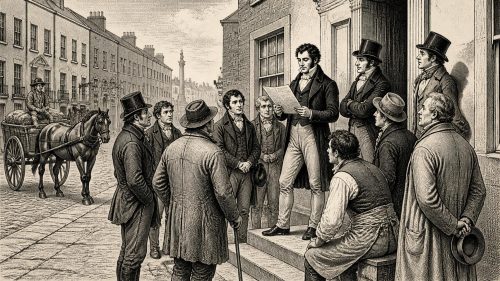
The failure of relief did not create the violence at Garvagh, but both belonged to a political climate in which religious identity was increasingly organised and publicly asserted. On 26 July, at the time of Garvagh fair in County Londonderry, Catholic Ribbonmen confronted local Protestants and Orangemen around the King’s Arms tavern, where an Orange lodge met. Accounts differ over the number of attackers and casualties, and later retellings were strongly partisan. The essentials are firmer: several hundred Ribbonmen were reported to have assembled, many armed with sticks or bludgeons; Protestants inside or around the inn had muskets and had been forewarned; gunfire dispersed the attackers and caused deaths and injuries.
The event is often remembered as the Battle of Garvagh, although it was not a battle between regular forces. It was a sharp local clash involving networks that combined political loyalty, religion, customary fair-day assembly and, in the Ribbonmen’s case, the traditions of secret rural association. The disparity in arms mattered. So did the setting. Fairs brought together traders, labourers, farmers and drinkers from a wide district; they also created occasions at which demonstrations of territorial strength could rapidly become fights.
Garvagh stood in a Plantation landscape where Protestant and Catholic communities, though economically interdependent, could understand security and power in starkly opposed terms. The incident should not be treated as proof that all relations in Ulster were permanently violent. It does, however, demonstrate that the Orange Order and Catholic resistance groups had become important vehicles for collective identity. A loyalist ballad later celebrated the Protestant side’s defence of the town. Its survival is itself revealing: memory of the encounter was shaped into song, commemoration and communal warning, not neutral local history.
Counting a Changing Country
Another undertaking begun in 1813 was quieter but ambitious: the first official attempt to take a census of Ireland. An Act passed in 1812 assigned the work to county grand juries. The scheme aimed to count a population whose size was widely discussed but poorly known. It reflected growing governmental interest in numbers as tools of administration: population, households, labour, poverty and local resources were increasingly matters that officials believed could be measured.
The attempt did not succeed. Boundaries were unclear, organisation was inadequate and the machinery of local government was ill-suited to such a large operation. After two unsuccessful years it was abandoned, before a later system produced the first completed national census in 1821. The failure is important. It warns against attaching a precise national population total to 1813, while also showing that the state recognised how little reliable information it possessed about the island it governed.
Contemporary social observation supplied a more impressionistic, and often prejudiced, picture. Published observations on Waterford in 1813 described a shortage of profitable employment among a growing population, especially where agriculture could not absorb all who depended upon it. Their author treated reliance on potatoes as a social problem and framed rural poverty in the language of “surplus” people. Such remarks should not be accepted uncritically: they carried the assumptions of property and improvement. But they record a real contemporary anxiety about subdivision, insecure work and the difficulty of sustaining households on small holdings and casual labour.
Fever gave that insecurity a human dimension in Dublin. The Cork Street Fever Hospital recorded 2,273 admissions in 1813. Its annual material noted an influx into the city that included wives and children of soldiers and sailors serving abroad, some of whom became destitute when illness struck. On 4 February, the Church of Ireland clergyman, statistician and philanthropist James Whitelaw died of typhus contracted while ministering near the hospital. Whitelaw’s death was a sobering reminder that charitable and medical institutions worked amid dangerous contagion, overcrowding and poverty, without the later public-health systems that would make urban disease more manageable.
Learning, Worship and Public Culture
Education was also under scrutiny. The commissioners investigating Irish educational foundations had completed their inquiries in 1812, and their substantial report reached Parliament in the 1812–13 session. Their work formed part of the background to the Society for Promoting the Education of the Poor in Ireland, generally known as the Kildare Place Society. Founded in Dublin in 1811, it promoted inexpensive schooling in which children of differing denominations could receive literary instruction together, accompanied by Bible reading. In 1813 it was still an experiment rather than a national system, but it represented a new aspiration: education administered through trained methods, books, inspection and voluntary association. Its claim to be non-denominational would later be disputed, especially by Catholics concerned about Bible-centred teaching.
The year’s cultural record also preserves forms of local life that formal politics could overlook. In Belfast, Poetical Attempts by Hugh Porter, a County Down weaver, appeared in print. Porter’s verse, written in Ulster-Scots-inflected language, belongs to the world of artisan reading, local sociability and vernacular authorship. Its publication shows that print culture was not confined to Dublin institutions or elite writers.
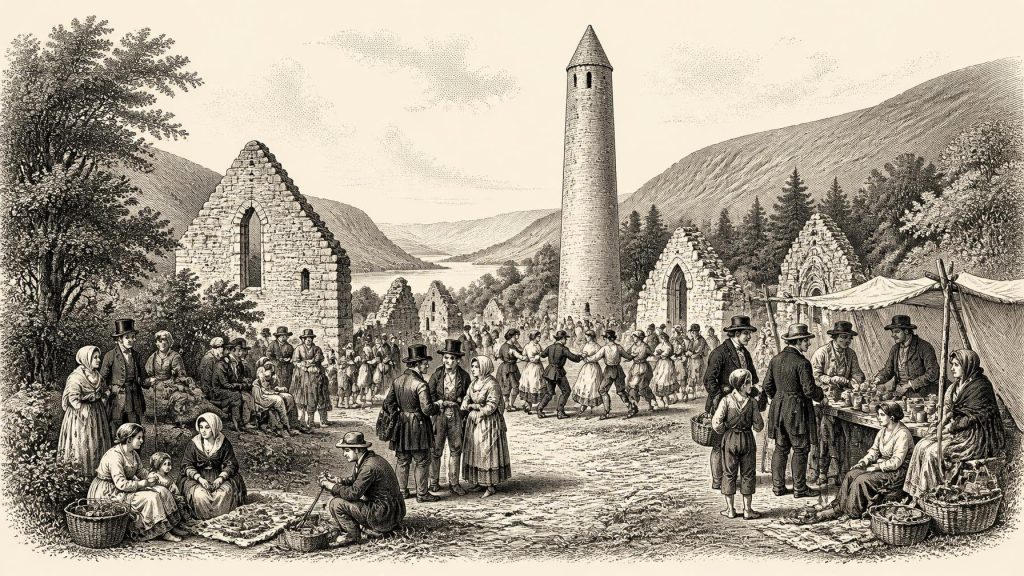
Joseph Peacock’s 1813 painting, The Patron, or the Festival of St Kevin at the Seven Churches, Glendalough, offers another valuable perspective. It portrays the annual 3 June gathering at Glendalough, County Wicklow. Although centred on the feast of the sixth-century saint Kevin, Peacock’s crowded scene gives equal prominence to trading, drinking, dancing and social display. A “pattern” or patron day could be devotional, commercial and festive at once. The painting should not be mistaken for a photograph of every Irish religious gathering, but it captures a recognisable feature of popular Catholic culture: sacred places drew pilgrims and prayer, yet also neighbours, sellers, music and recreation.
A Stone from the Sky
On 10 September an extraordinary object fell near Adare in County Limerick, in Briska townland between Patrickswell and Adare. Witnesses reported a loud detonation and saw stones descend; fragments were said to be warm when recovered. The fall is now catalogued as the Limerick meteorite, also known as Adare or Brasky, and is recognised as the largest meteorite fall recorded in Ireland. A fragment remains in Limerick Museum.
Its importance was scientific rather than political, but the event belongs to Irish history precisely because it was observed, collected and preserved. In a year of frustrated reform, local violence, imperfect enumeration and daily hardship, the Adare stone supplied a moment of shared astonishment: a physical visitor from beyond the atmosphere entering the fields of rural Limerick.
Primary Sources
- Mr. Grattan’s Motion for a Committee on the Claims of the Roman Catholics (25 February 1813)
- Mr. Grattan’s Motion for a Committee on the Claims of the Roman Catholics—Adjourned Debate (2 March 1813)
- Roman Catholic Relief Bill (30 April 1813)
- Roman Catholic Relief Bill (13 May 1813)
- Roman Catholic Relief Bill (24 May 1813)
- Catholic Emancipation
- The Royal Veto
- Reform, Religion, and Radicalism
- Rituals and Riots: Sectarian Violence and Political Culture in Ulster, 1784–1886
- The Union
- History of Irish Census Records
- Observations on the State of Waterford 1813, Page 2
- Observations on the State of Waterford 1813, Page 3
- Whitelaw, James
- Fever Part 2: 1811–1820
- Society for Promoting the Education of the Poor of Ireland: Statement
- Inspecting a Doomed Non-Denominational School System: The Inspectorate of the Kildare Place Society in Ireland, 1811–1831
- The Country Rhymes of Hugh Porter, the Bard of Moneyslane
- A Song on Marriage
- The Patron, or the Festival of St Kevin at the Seven Churches, Glendalough (1813)
- Meteoritical Bulletin: Entry for Limerick
- Natural History
- Limerick Museum
- Population and Poverty, 1815–1845: From One Waterloo to Another
- Growth in Manufacturing Output in Ireland Between the Union and the Famine: Some Evidence