

The Ranger’s Inland Passage1804 CE
In 1804, Ireland remained shaped by the legacy of 1798, the Union and war with France. James Corcoran’s guerrilla band was destroyed near Enniscorthy, while transported Irish prisoners invoked Vinegar Hill during the failed Castle Hill rebellion in New South Wales. Invasion fears prompted a gun tower at Sutton and Edgeworth’s short-lived Dublin–Galway semaphore. Economic integration advanced when The Ranger completed the commercial Grand Canal passage from the Shannon to Dublin. Cork Street Fever Hospital admitted its first patients, providing isolation and care in the Liberties. These developments reveal governance, defence, infrastructure and philanthropy amid unresolved political and social grievances.
Dateline
In 1804, Ireland’s political temperature was still set by rebellion and war, yet the year also produced unusually clear signs of connection and institutional change. A small armed band in the south-east was finally broken; Irish prisoners overseas attempted another rising under the remembered name of Vinegar Hill; coastal defences and communications were shaped by fears of French invasion. At the same time, a laden boat made the first recorded complete commercial passage from the Shannon to Dublin by the Grand Canal, and a new fever hospital admitted patients in the Liberties. These were not parts of one programme. Together, however, they reveal a country in which government, investors, charitable organisers and ordinary people all lived with the consequences of the Union, the Napoleonic war and the unresolved legacy of 1798.
Corcoran’s Last Stand
The most direct domestic political event occurred on 11 February. James Corcoran, a former Wexford rebel, and the remaining members of his small guerrilla party were found after betrayal and confronted by yeomen near Killaughrim Wood, in the country north of Enniscorthy. Corcoran died from wounds received in the encounter; other members of the group were killed or taken. The details survive through later accounts and press reporting, and should not be embellished beyond that hard core. What is certain is that the encounter ended the armed career of a man who had maintained resistance long after the main rising of 1798 had been defeated.
Corcoran’s importance lay less in the size of his force than in its persistence. His group had operated across the Wexford–Carlow–Kilkenny borderlands, using wooded and mountainous ground, local knowledge and sympathetic shelter. Its survival showed that the end of open rebellion had not meant immediate reconciliation. The government regarded such bands not merely as robbers but as a danger in the event of a French landing, especially because they attacked communications and drew in deserters. The destruction of Corcoran’s party therefore had symbolic force: it removed one of the last active armed remnants of the United Irish generation within Ireland.
That did not mean that the political arguments associated with the United Irishmen had disappeared. The Act of Union had taken effect only three years earlier, on 1 January 1801, abolishing the Dublin parliament and incorporating Ireland into the United Kingdom. Catholic political disabilities remained. Nor had the state relaxed its concern with security. The Westminster session of 1804 renewed and amended measures for preserving the peace in Irish counties, while other legislation dealt with the Irish militia, its pay, families and augmentation. Such statutes are a useful reminder that the island’s post-Union administration was still heavily preoccupied with mobilisation, policing and the reliable movement of men.
War on the Coast and in the Air
International war gave that concern a wider geography. Britain and France had resumed war in 1803, and Ireland’s coast appeared exposed to the possibility, however remote in practice, of a French descent. At Sutton, north-east of Dublin, a gun tower was constructed in 1804 to command Sutton Creek, a channel then useful to shipping seeking to avoid the difficult sands at the mouth of the Liffey. It was later known as the first of the Dublin-area Martello towers. The structure was a practical response to a specific vulnerable waterway rather than an ornamental emblem of empire: its purpose was to mount a gun and deny an enemy access.
The same climate encouraged faster communication. Richard Lovell Edgeworth’s optical semaphore line between Dublin and Galway was operational by 14 January 1804. Its function was rapid warning from the western side of the island, where an invasion scare was especially plausible in official thinking. This was a short-lived experiment: it had fallen out of use by the end of the year. Nonetheless, its brief operation is revealing. Before electrical telegraphy, information could travel by stations relaying visible signals, linking high points, technology, surveillance and wartime administration. The line was also connected to a longer Irish debate about publicity, secrecy and the state’s capacity to observe and command the country.
An English visitor touring Ireland in August registered the other side of this apparatus: troops crowded in towns. Such travel testimony is partial and coloured by the traveller’s assumptions, but it confirms the prominent military presence created by invasion fears and recent unrest. Ireland in 1804 was not a battlefield, yet military preparation was part of the everyday visual landscape, from barracks and yeomanry to coastal towers and signal stations.
A Boat from the Shannon
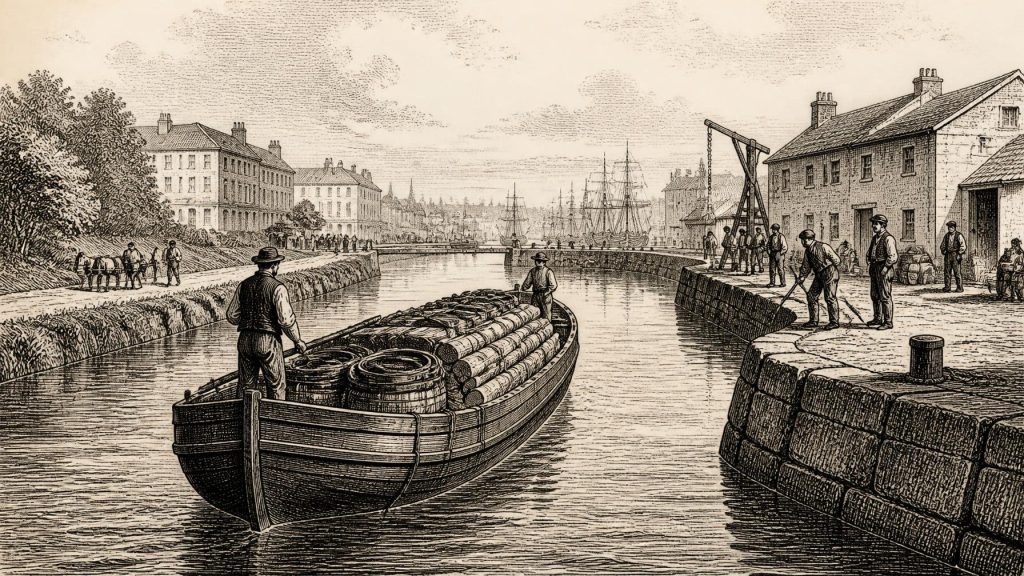
On 4 April, a more constructive form of connection was recorded in the minute books of the Grand Canal Company. The Ranger, Patrick Killeen master, arrived at James’s Street Harbour in Dublin from Meelick on the Shannon, carrying ash timber and hoops. It was the first trade boat to make the full passage through the Grand Canal from the Shannon to Dublin. The journey mattered because it demonstrated that a project begun in 1756 had at last created a practicable inland route from the Atlantic river system to the capital and the Irish Sea.
The achievement should not be mistaken for an effortless opening. The canal had been completed to the Shannon in 1803, but problems in making the channel watertight delayed traffic. Its construction had demanded years of drainage and engineering through difficult ground, notably around the Bog of Allen. Thus The Ranger was both a commercial vessel and proof of a costly infrastructure overcoming terrain that had resisted planners. The cargo itself points to the intended economy: bulk materials could now be brought eastward by water, while manufactured goods, imported commodities and urban markets could reach places along the canal and Shannon.
There was already a human transport system around this route. Waterways records indicate that the Grand Canal had twenty-two passenger boats in 1804, with company hotels at Portobello, Sallins, Robertstown, Tullamore and Shannon Harbour. These services did not erase the importance of carts, coaches and coastal shipping, nor did they make travel quick by modern standards. But they tied villages, market towns and Dublin more closely into an inland commercial corridor. For labourers, boatmen, innkeepers, carriers, timber dealers and farmers, the canal’s practical significance lay in work, freight, fares and access rather than in grand engineering rhetoric.
Fever, Poverty and Philanthropy
Urban improvement had a more urgent social face on 14 May, when Cork Street Fever Hospital and House of Recovery admitted its first patients. The institution stood in the Liberties, a densely settled working district of Dublin. Its managing committee had spent the previous years raising subscriptions, securing a site and constructing purpose-built accommodation. The surviving committee minutes show participation by merchants, bankers, medical men and philanthropic figures, alongside parliamentary financial assistance. Such mixed funding was characteristic of voluntary charitable provision at the time.
The hospital’s design embodied an early institutional response to infectious disease. Separate buildings distinguished fever patients from those recovering, attempting to remove illness from overcrowded homes and reduce the chance of transmission within families and neighbourhoods. This was not a cure for the underlying conditions that made fever so threatening: insecure work, poverty, crowded lodging and inadequate sanitation remained beyond the reach of one hospital. Still, the opening marked a significant local development in Dublin medicine and social welfare. It made organised isolation and care available on a scale not possible in domestic rooms.
The event also exposes the unequal character of urban society. Wealthy subscribers could convert money, influence and medical knowledge into a permanent institution; the poor entered it as patients whose sickness was understood as both a humanitarian emergency and a wider danger to the city. The hospital’s stated neighbourhood focus makes it especially valuable evidence for everyday Dublin: disease was not an abstract concern but a recurring household crisis, demanding beds, nurses, physicians, food, fuel and convalescence.
An Irish Rising Overseas
Ireland’s unfinished political history travelled far beyond the island. On 4–5 March, Irish convicts were central to the Castle Hill rebellion in New South Wales. Many had been transported after the 1798 rebellion or later political disturbances. Led by men including Philip Cunningham, the rising aimed to seize arms and challenge colonial authority; participants consciously invoked Vinegar Hill, the Wexford battlefield of 1798. It was defeated swiftly by colonial forces, and the subsequent punishments were severe.
Castle Hill was not an event in Ireland, but it was directly Irish history: transportation had dispersed prisoners and their political memories across the empire. The revolt brought together Irish Catholics, Protestants and dissenters in a manner resonant of United Irish ideals, while its name carried Wexford’s trauma into an Australian landscape. Read beside Corcoran’s death a few weeks earlier, it demonstrates that 1804 did not neatly close the revolutionary era. Armed resistance on Irish soil had been reduced, but the people, ideas and consequences of the 1790s continued to move through imperial systems of punishment, war and migration.
For Ireland, then, 1804 was a year of guarded consolidation rather than settlement. A guerrilla band was extinguished, but coercive security remained visible. New channels carried military signals and commercial boats; a coastal tower watched a strategic creek; a fever hospital separated the sick from the crowded city. Each development answered a different immediate problem. Taken together, they show an island being more closely governed, defended, connected and institutionalised, even as the political grievances of the recent past remained unresolved.
Primary Sources
- Journal of a Tour in Ireland Performed in August 1804
- Irish Insurrection — 7 March 1804
- Castle Hill Rebellion
- Castle Hill and Vinegar Hill: the Australian Rising of 1804
- The History of the Grand Canal
- Passenger Boats
- The History of the Shannon
- The Finest Building in Offaly: The Grand Canal: A Modest Declaration
- Martello Towers
- History
- History of Dymchurch Martello Tower
- Minutes of the Proceedings of the Managing Committee of Cork Street Fever Hospital
- Building a Hospital
- Fever
- The Optical Telegraph, the United Irish Press, and Maria Edgeworth’s ‘White Pigeon’
- An Act to Amend the Laws for the Better Regulation of the Linen Manufacture in Ireland
- United Kingdom Public General Acts, 1804
- Chronology
- Joseph Cody and James Corcoran
- Cloney, Thomas
- The Viceroy’s Post-Bag: Correspondence of the Earl of Hardwicke
- A Chronology of Ireland