Robert Emmet1803 CE
In 1803, amid post-Union discontent and renewed war with France, Robert Emmet organised a United Irish-inspired attempt to seize Dublin Castle and establish a provisional government. Conspirators produced pikes and explosives, while Anne Devlin carried messages, but weak coordination, limited firearms and absent regional support undermined the plan. On 23 July, the Thomas Street rising collapsed into confused violence; Lord Chief Justice Kilwarden and his nephew were murdered. Emmet was arrested, tried and executed, while Devlin and other suspects faced repression. Though militarily insignificant, the failure strengthened coercive government and preserved republican ideals of independence, popular sovereignty and inclusive citizenship.
Dateline
In 1803 Ireland was still adjusting to a constitutional revolution that had already happened. The Act of Union had taken effect on 1 January 1801, abolishing the Dublin parliament and incorporating Ireland into the United Kingdom of Great Britain and Ireland. By 1803, political authority was exercised through Dublin Castle, the lord lieutenant and a Westminster parliament in which Ireland had limited representation. The former Irish parliamentary world had not vanished from memory, however. Its loss was felt especially in Dublin, while the failure to accompany union with Catholic emancipation left a central grievance unresolved. Into that unsettled atmosphere came a brief but consequential attempt to overthrow the new order.
A Kingdom at War
The immediate international setting was decisive. Peace with France, secured at Amiens in 1802, had collapsed; Britain declared war on France again on 18 May 1803. The prospect of renewed French invasion made Ireland strategically important and sharpened official anxieties about surviving United Irish networks. For radical veterans of the 1790s, French war also revived a possibility that had shaped earlier plans: an insurrection in Ireland might coincide with, or prepare the ground for, a French expedition.
Robert Emmet, a 25-year-old former Trinity College student and United Irishman, had spent time on the Continent after the 1798 rebellion. He returned to Dublin in 1802 and, during 1803, helped organise a clandestine rising. This was not simply an eruption of post-Union resentment. It drew on the organisational remnants, political language and military assumptions of the United Irish movement, while attempting to exploit the vulnerability of an island at war. The intended seizure of Dublin Castle was central: capturing the seat of executive government could, Emmet hoped, disrupt command, release a signal to the counties and give an Irish provisional government credibility.
Workshops, Depots and Messengers
Preparation during the spring and summer was substantial, though uneven. Conspirators rented and used premises across Dublin for storing weapons and making military equipment. The best-known depot was in the Thomas Street area; other sites lay in the south and north of the city. Pikes were manufactured in large numbers, including folding pikes designed for concealment. Rockets, explosive devices and other improvised weapons were also prepared. These arrangements reveal both ingenuity and a serious weakness: men without firearms would still have to confront trained troops with rudimentary arms.
The conspiracy depended upon people whose names rarely dominate the later legend. Anne Devlin worked as Emmet’s unpaid housekeeper at Butterfield Lane, Rathfarnham, attended meetings and carried messages. Men with experience of 1798, including Thomas Russell, James Hope, Michael Dwyer and figures in Kildare and Wicklow, were approached or expected to assist. Contacts were sought in Ulster and Munster as well as Leinster. Yet the network was not a national army. Communications were slow, secrecy restricted coordination, and local leaders differed sharply over whether an outbreak without French troops, adequate firearms or clear orders had any prospect of success.
That limitation matters when considering ordinary life in 1803. Most people did not belong to a revolutionary inner circle. Rural households continued to depend on insecure agricultural livelihoods, local credit, markets, landlords and parish structures; urban artisans, labourers, shopkeepers and servants faced the pressures of a wartime economy. The surviving record is much fuller for officials, informers and organisers than for the majority who watched events unfold. What can be said firmly is that recruitment relied on existing local ties, on the memory of 1798 and on the hope that a dramatic success in Dublin would bring wider support.
A Programme Not Yet Enacted
Emmet’s planned proclamation, issued in the name of a provisional government, was strikingly ambitious. It called for an Irish national government and sought disciplined conduct from insurgents. It also proposed the abolition of tithes and the nationalisation of Church of Ireland lands. These were proposals for a victorious revolution, not measures put into effect in 1803. Their inclusion nevertheless shows that the projected rising addressed more than the constitutional question of union. Tithes were a deeply felt burden in a predominantly Catholic country supporting an established Anglican church, while land, rent and property were inseparable from daily security and social power.
The proclamation’s language also illustrates the United Irish aspiration to transcend sectarian division. In practice, Ireland remained structured by religious inequality and political distrust. Catholics could vote under the limited franchise created in the 1790s but could not sit in parliament; the established church retained its privileged position; and the government viewed French influence and radical reform as intertwined dangers. The rebellion’s declared programme should therefore be read as evidence of insurgent intentions, not as a description of a settled popular consensus.
The Night of 23 July
Events came to a head on Saturday, 23 July 1803. An accidental explosion at one of the arms depots and fears of discovery helped create pressure for an early rising. A conference at Windy Arbour on 16 July fixed 23 July as the date. By then, however, it was too late to establish whether regional preparations would translate into action. Some expected contingents did not arrive; others lacked weapons, instructions or confidence in the plan.
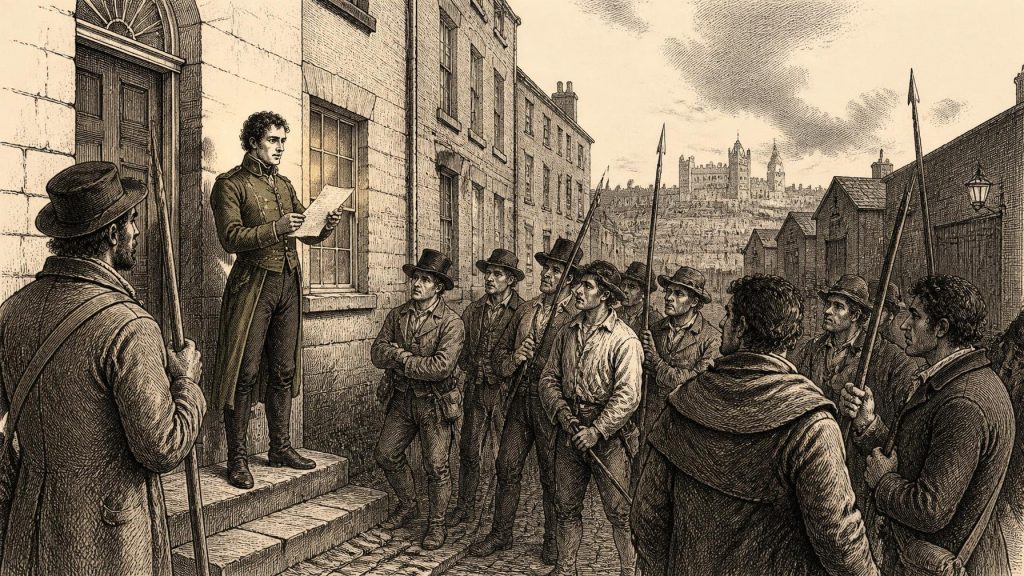
At Thomas Street, Emmet found a force far below the numbers he had expected and increasingly difficult to control. Some men had been drinking. He read portions of the proclamation and briefly moved towards Dublin Castle, but the elaborate scheme of coordinated attacks on key points in the capital had already unravelled. A signal rocket was used to countermand mobilisation, and Emmet abandoned the attempt to take the Castle. The armed disturbance became a confused, violent street episode rather than a controlled coup. Government forces restored order without facing the broad national rebellion that officials had feared.
The contrast between preparation and performance is the defining fact of the year’s rising. There had been hidden workshops, stored arms, political plans and regional contacts; there was no successful command structure capable of turning them into a sustained insurrection. Ulster, where Russell and Hope had hoped to mobilise support, did not rise. In Kildare, where former United Irishmen remained under watch and some men were poised for action, the expected signal from Dublin did not produce the anticipated movement. The rebellion was real, but its geographic reach and military effect were far smaller than its planners intended.
Kilwarden’s Death
The most shocking event of the night was the killing of Arthur Wolfe, Viscount Kilwarden, lord chief justice of Ireland, and his nephew, the Reverend Richard Wolfe. Travelling from Newlands Castle towards Dublin Castle with Kilwarden’s daughter, their carriage was stopped near Thomas Street. Kilwarden and his nephew were dragged out and fatally piked; his daughter escaped. The murder carried particular force because Kilwarden, while a senior supporter of the existing order and of the Union, had a reputation for adherence to legal procedure. His death horrified contemporaries and indelibly associated the rising with uncontrolled violence.
It is important not to turn that atrocity into Emmet’s policy. His own proclamation urged restraint, and he later insisted that he would have prevented the killing had he been present. But intention and command had separated. The episode exposed the fatal weakness of the operation: once men were armed on Dublin’s streets, a leadership unable to direct them could neither achieve its political objective nor prevent actions that discredited it.
Arrest, Trial and Coercion
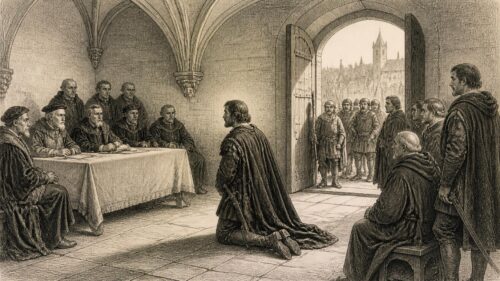
Emmet fled first towards Rathfarnham and the Dublin Mountains, but returned to the city. He was arrested at Harold’s Cross on 25 August. His trial for high treason opened at Green Street courthouse on 19 September. Convicted, he delivered the speech from the dock that became central to his later reputation, then was hanged and beheaded outside St Catherine’s Church on Thomas Street on 20 September. The familiar final appeal that his epitaph should wait until Ireland took its place among the nations belonged to this judicial setting and to a rebellion already defeated.
The state’s response extended beyond Emmet. Anne Devlin was brutally interrogated after the failure of the rising but did not disclose his whereabouts. Thomas Russell was arrested in Dublin on 9 September, tried at Downpatrick on 20 October and executed the next day. Other prisoners faced prosecution, execution, transportation or prolonged detention. Parliament also sustained exceptional coercive powers: measures permitting detention on suspicion and enabling martial-law arrangements were debated and continued. Ministers presented such powers as necessary protection against renewed conspiracy; critics warned that they violated constitutional principle. That dispute was itself part of the political reality created by 1803.
A Defeat With Consequences
By the close of the year, there had been no French landing, no Irish provisional government and no general national revolt. The Union remained intact, and the rising gave Dublin Castle and Westminster fresh grounds for surveillance, military preparation and restrictive law. It also underlined the distance between revolutionary hopes and the capacities available to their organisers.
Yet 1803 was not insignificant merely because it failed. It demonstrated that the political settlement of 1801 had not extinguished republican opposition, and it preserved a powerful vocabulary of national independence, popular sovereignty and religiously inclusive citizenship. The immediate event was a broken rising in and around Thomas Street. Its afterlife, shaped by Emmet’s execution, Devlin’s endurance and the memory of 1798, would reach far beyond the few hours of fighting in Dublin.
Primary Sources
- Emmet, Robert | Dictionary of Irish Biography
- Devlin, Anne | Dictionary of Irish Biography
- Wolfe, Arthur | Dictionary of Irish Biography
- Russell, Thomas | Dictionary of Irish Biography
- The Rising of 1803 in Dublin
- “A more general and rooted spirit of disaffection”: the 1803 rising in Kildare
- “The dog that didn’t bark”: the North and 1803
- The Rebellion, State of the Country, and Official Papers Collections
- The Office of the Chief Secretary of Ireland: Chronology
- Robert Emmet
- After the Insurrection
- Cody: The Insurrection of Twenty-Third July, 1803
- Attested copy of the record of the conviction of Robert Emmet, 1803
- Typescript copy of a letter from R. Rainey, a yeoman at Dublin, describing the trial and execution of Robert Emmet
- Parliamentary Union
- An Act for the Union of Great Britain and Ireland
- Public General Act, 39&40 George III, c. 67
- An Act to enable His Majesty more effectually to raise and assemble, in Ireland, an additional Military Force
- Martial Law in Ireland, House of Commons debate, 2 December 1803
- Proclamation of the Irish Republic, 1803
- CAIN: Background Chronology of Key Events, 1800 to 1967
- Ireland in Rebellion Online Resource