
Bile Tened’s Two Encounters1714 CE
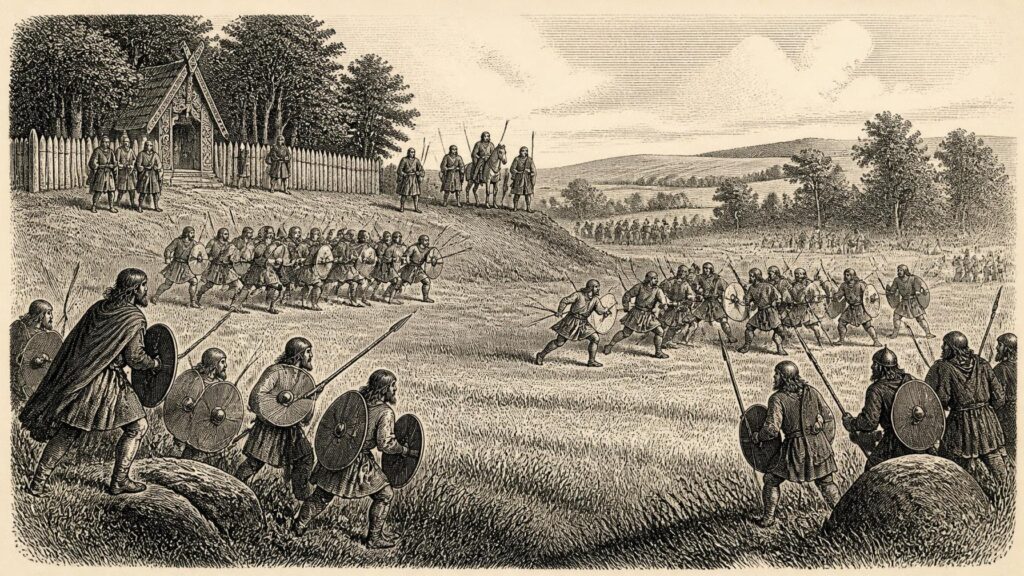
In 714, Irish annals recorded concentrated warfare, political upheaval and environmental strain. Murchad Midi of Clann Cholmáin defeated Brega rivals in two encounters at Bile Tened, while Fogartach of southern Brega was expelled to Britain and Forbassach of Uí Fhailgi was killed in Mide. Other conflicts occurred among Uí Echach and Bairche, and Munstermen killed Clárainech’s travelling religious community. Selbach rebuilt Dún Ollaig in Dál Riata, highlighting Irish Sea links. Ailén Daingen, probably a fortified lake settlement, was destroyed. A great drought and bright autumn night were also noted, revealing a fragmented society vulnerable to conflict and natural pressures alike.
Dateline
The surviving Irish annals place a striking concentration of events in 714: a decisive Midland battle, the expulsion of a Brega dynast into Britain, further killings in Meath and Ulster, the destruction of a lake settlement, a severe drought, the killing of a travelling religious community, and an unusually bright autumn night. The record is brief but unusually dense. It does not permit a complete narrative of the year, still less a view of every household in Ireland. It does, however, show political competition reaching across provincial boundaries, and it catches the material pressures under which rural communities and rulers lived.
There is one chronological caution. The annals were copied and arranged in later manuscripts, and their year-headings do not always correspond neatly across texts. Modern scholarly synchronisation places the cluster conventionally in 714. Where the evidence is no more than an annalistic sentence, it is best treated as exactly that: firm evidence that an event was recorded, but not necessarily evidence for every motive, location or consequence later historians might wish to supply.
A Midland Victory
The principal event was the battle in Mag Singite, at Bile Tened in Asal. The Annals of Tigernach explicitly say that Murchad Midi won it. The Annals of Ulster, using a more guarded formulation, calls it a battle of “varying fortunes” and preserves the deaths from two separate encounters: Colgu and Áed Cluasach son of Diarmait in the first, then Flann son of Áed son of Dlúthach and Dub Dúin, grandson of Béc, in the second. This language suggests not a single neat clash but successive engagements or renewed fighting on the same field.
Murchad Midi was head of Clann Cholmáin, a powerful branch of the southern Uí Néill whose political centre lay in Mide. His enemy Flann belonged to the Síl nDlúthaig, a lineage within the rival Síl nÁedo Sláine grouping of Brega. The feud had a personal as well as dynastic history: Flann’s father, Áed mac Dlúthaig, had killed Murchad’s father, Diarmait, in 689. The victory at Bile Tened therefore belongs to a longer struggle for authority among families claiming descent from Niall of the Nine Hostages, rather than to any simple contest between an Irish “high king” and subordinate peoples.
The exact modern site of Mag Singite and Bile Tened is not secure enough to state as fact. What matters is that the battle was associated with Murchad’s Midland power. In early medieval Ireland, kingship was exercised through kin, clientage, tribute, armed followings and control of strategic assemblies and territories. A king’s success could be registered through the deaths of named rivals; the annals’ genealogical precision identifies the political networks damaged in the fighting.
Pressure on Brega and Uí Fhailgi
In the same year Fogartach, grandson of Cernach, was expelled from his kingship and went to Britain. Fogartach was a leading member of the Uí Chernaig of southern Brega, within Síl nÁedo Sláine. The sources do not say which ruler drove him out, nor do they specify the exact kingship from which he was removed. It would be unsafe to call him king of all Ireland in 714: the contemporary-style annal notices do not do so. Yet his expulsion was politically important because Brega, north of the Liffey and close to the ceremonial landscape of Tara and Tailtiu, was central to Uí Néill competition.
The timing makes Murchad’s victory especially significant. Modern historians judge that Murchad was probably implicated in Fogartach’s removal, though this remains an interpretation rather than an explicit statement in the annals. Fogartach’s journey to Britain was not exile beyond the known world. The Irish Sea connected Irish, Dál Riatan, Pictish, British and Northumbrian religious and political worlds; rulers, clerics and exiles could cross it. Fogartach would return to rule in 716, a reminder that exile could be a temporary political manoeuvre rather than a final defeat.
Another entry places a slaughter at Garb Salach in Mide on the same day as the battle already described. Forbassach grandson of Congal, king of Uí Fhailgi, fell to the men of Mide. Uí Fhailgi occupied much of what is now County Offaly, on Mide’s southern frontier. The notice demonstrates that a king’s campaign could include linked operations against more than one neighbour. It does not reveal whether Forbassach was Murchad’s enemy, an ally caught in a shifting dispute, or the victim of a raid; such details have not survived.
Conflict Beyond Mide
Violence was not confined to the Midlands. The annals also record a battle between the two sons of Béc of Bairche and the son of Bresal, king of Uí Echach. Béc’s sons won. The terse notice offers no location, no explanation and no death-list. Its value lies in showing the scale of political life: Ireland was not governed as a unified territorial kingdom, but as a mosaic of overkingships and smaller peoples whose rivalries could be locally decisive.
At the same time, a community described as peregrini—pilgrims or religious travellers—was killed by “the Munstermen”. Its leader was Clárainech, and the annal says that his whole familia, meaning a religious household or following rather than simply a biological family, perished with him. Neither the place nor the cause is supplied. The entry should not be embellished into a known massacre or a war between church and kingdom. It does show, however, that religious mobility was real and that a travelling ecclesiastical community could be vulnerable to secular violence.
Dún Ollaig and the Sea Roads
One notice leads across the sea. Selbach constructed Dún Ollaig, generally identified with Dunollie near modern Oban in Argyll. Selbach was a ruler of Dál Riata, a Gaelic kingdom whose historic connections joined western Scotland with north-eastern Ireland. The rebuilding or construction of a fortified centre was directly relevant to Irish history because the sea channel was a corridor, not a frontier: kinship, monastic links, ships, warfare and political news moved across it.
Dún Ollaig had been destroyed earlier in Selbach’s troubled reign. Its construction in 714 can therefore be understood cautiously as the re-establishment of a royal stronghold. It should not be imagined as a stone castle of the later Middle Ages. Such a centre commanded a maritime landscape and drew authority from its defensible position, surrounding resources and the ability of a ruler to maintain followers. The annal’s decision to record it suggests that fortification and royal recovery were matters of consequence in the Irish Sea world.
Dry Weather and Fragile Settlements
The annals register a “great drought”. This is the clearest environmental notice for the year, although it gives neither duration nor a list of losses. Scholars of Irish climate history regard the drought references of the 710s as possible signs of warm, dry summers, but a single annal entry cannot yield a modern weather report. What can responsibly be said is that prolonged dryness would have mattered intensely in a mixed farming economy reliant on grazing, cereals, watercourses and seasonal labour. It could reduce pasture and water, affect milling and transport, and complicate the production of fodder and grain.
Most people lived in dispersed rural settlements rather than towns. Ringforts enclosed the homes and farm buildings of prosperous farmers and local lords, while crannogs and other lake settlements offered varied combinations of status, work, security and access to waterways. The destruction of Ailén Daingen is consequently a notable entry. The same annals record its construction in 703; archaeology-based scholarship identifies it as an otherwise unlocated fortified island or crannog. We know that it was destroyed in 714, but not by whom, how, or whether its inhabitants escaped. Its appearance in the record is a rare glimpse of how political conflict could reach a particular built environment.
Early Irish legal material, though compiled and transmitted over long periods, also illuminates the value placed on cattle, land, labour and trees. It helps explain why drought, raiding and the loss of a fortified residence were more than isolated misfortunes: they threatened the resources from which rank, food and obligations were sustained. It cannot, however, tell us the harvest yield or cattle mortality of 714 itself. The annals report drought, not famine.
An Autumn Sign
The final notice is simply “a bright night in autumn”. It may record an aurora, an atmospheric phenomenon or another unusual illumination, but the annal gives too little information for a secure identification. Medieval writers often preserved remarkable natural sights alongside battles and royal deaths, without separating what modern readers call political, environmental and religious history. For contemporaries, an extraordinary sky could invite attention precisely because it seemed to belong to the same moral and providential world as warfare, exile and drought.
Thus 714 emerges as a year of hard-won advantage rather than settled dominance. Murchad Midi’s victory injured rivals in the Midlands; Fogartach’s expulsion destabilised Brega without ending his career; other local conflicts continued; a religious travelling party was destroyed; and drought exposed the dependence of society on land and water. The fragmentary record does not yield a national story of triumph or collapse. It gives something more characteristic of early medieval Ireland: a connected island of competing lordships, religious communities, defended settlements and Irish Sea relationships, all living with the consequences of violence and weather.
Primary Sources
- The Annals of Ulster, Year U714
- The Annals of Tigernach, Annal T714
- Chronological Synchronisation of the Irish Annals: AD 488–722
- Fogartach
- Murchad Midi
- Domnall Midi
- The Annals of Ulster: Editorial and Bibliographical Information
- The Annals of Tigernach: Editorial and Bibliographical Information
- The Three Thirds of Cenél Loairn, 678–733
- I. Annals
- Making hay while the sun shines? Socio-economic change, cereal production and climatic deterioration in Early Medieval Ireland
- Agriculture, settlement and society in Early Medieval Ireland
- The Irish Annals and Climate, Fifth–Seventeenth Centuries CE
- Drought in the Dark Ages – a Catalyst for Crisis and Violence
- Exploring the Irish Annals
- Ringforts / Ráthanna
- The Earthen Rath or Lios
- Loughnacrannoge
- Cáin Lánamna
- Early Irish Law Texts: Women and the Law
- Quercus petraea
- Book of Leinster, Formerly Lebar na Núachongbála
- The Irish Version of the Historia Britonum of Nennius
- Irish Texts at CELT