Ormond Bridges1682 CE
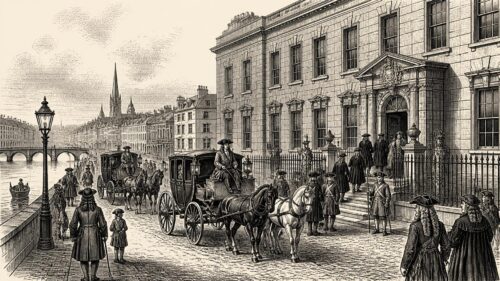
In 1682, James Butler, duke of Ormond, retained the lord lieutenancy while his son Richard, earl of Arran, governed from Dublin Castle as lord deputy, maintaining Butler influence under Whitehall’s authority. No parliament met, leaving administration to council, courts, revenue and patronage. Dublin expanded with timber Ormond and Arran Bridges across the Liffey, improving commerce and commemorating the family. Appointments included William Sheridan as bishop of Kilmore and Ardagh, John Lyndon as Third Serjeant-at-Law, and baronetcies. Beneath stability lay Protestant dominance, Catholic exclusion, land settlements, debt disputes and confessional tensions. Ormond’s dukedom affirmed favour but emphasised Ireland’s dependence on court.
Dateline
In 1682 Ireland’s public life did not turn on a battle, a parliament or a dramatic change of sovereign. Instead, the year was marked by an important transfer of day-to-day authority, visible additions to Dublin’s fabric, and smaller appointments which show how Restoration government worked. The duke of Ormond remained lord lieutenant, but spent most of the year in England. His son Richard Butler, earl of Arran, governed in Dublin as lord deputy. The arrangement made the strength of the Butler family unusually conspicuous: its name was attached both to the administration of the kingdom and, in the capital, to new crossings of the River Liffey.
That apparent stability should not be mistaken for political ease. Ireland remained shaped by the confiscations, warfare and settlement of the previous four decades. Protestant landowners and officeholders held the principal institutions of state; most of the population was Roman Catholic and excluded from national political power. The alarm generated by the supposed Popish Plot had recently intensified distrust of Catholics across the Stuart kingdoms. By 1682 the worst political fever had eased sufficiently for Charles II to permit Ormond’s journey to England, but the questions exposed by the crisis—loyalty, land, religious authority and the security of the Protestant interest—had not disappeared.
A Deputy in Dublin Castle
On 13 April Richard Butler was appointed lord deputy to act during his father’s absence. Ormond and his duchess sailed from Ireland on 3 May, and Arran was sworn in shortly afterwards. The distinction matters. Ormond did not surrender the lord lieutenancy: he remained the king’s senior representative and the decisive connection between Irish administration and the court. Arran, however, was physically present to chair government, receive petitions, oversee officials and communicate with England. His appointment was also dynastic. Since the death of Arran’s elder brother, Thomas, earl of Ossory, in 1680, Arran had become the principal adult son available to sustain the duke’s political and familial interests.
Contemporary observers noted the continuity. Michael Boyle, Church of Ireland archbishop of Dublin and primate of Ireland, judged that the deputy handled government with the ease of a son doing his father’s work. This was praise, but it also captured a limitation. Arran’s authority was exercised in the political orbit Ormond had built: through the privy council, the established church, the army, the revenue administration and a network of magnates, bishops and judges. Ireland was governed from Dublin Castle, yet major policy was still subject to decisions made at Whitehall. The deputyship therefore offered continuity rather than autonomy.
No Irish parliament met in 1682. The legislature last summoned in 1661 had been dissolved in 1666, and Ormond’s earlier preparations for another parliament had come to nothing. In 1679 and 1680 he had sent proposed bills to England, including measures aimed at Catholic clergy, but an improving revenue position reduced the crown’s immediate need to call representatives. The absence of parliament concentrated routine politics in executive government: council business, judicial appointments, revenue arrangements, military administration and the management of local interests.
Crossing the Liffey
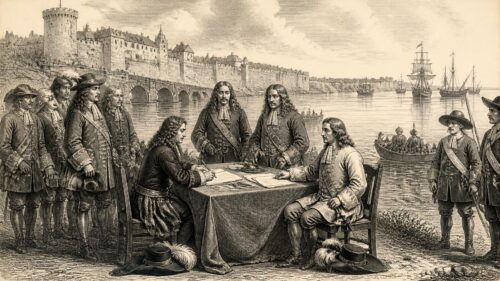
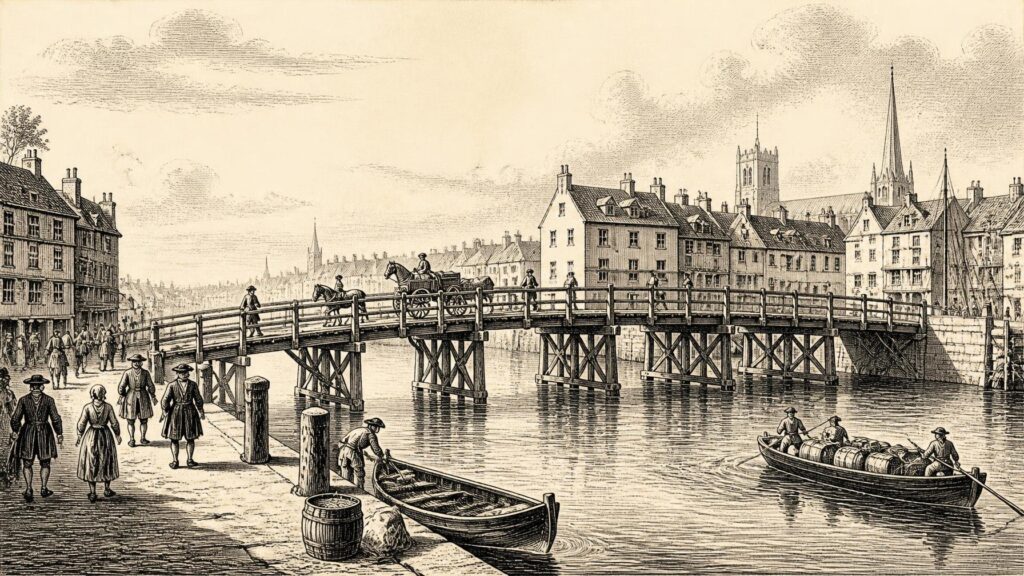
Dublin’s physical growth supplied the year’s most enduring public symbol. Later annalistic accounts date the erection of two city bridges to 1682: Ormond Bridge and Arran Bridge. Their names honoured the lord lieutenant and his deputy, making civic infrastructure a declaration of political connection. Ormond Bridge stood at the line of the later Father Mathew Bridge, while Arran Bridge was further upstream. Both were timber structures, appropriate to a city expanding rapidly but still vulnerable to fire, flood and the high cost of permanent masonry works.
A bridge was not merely an ornament. It linked developing quays and streets on opposite banks, eased the passage of people, animals and goods, and helped bind commercial districts to markets and routes beyond the old walled town. Dublin was increasingly a place of merchants, brewers, maltsters, craftsmen, lawyers, servants, soldiers and officials. Its riverside neighbourhoods mixed residences with warehouses, shops and small-scale production. A contemporary description of the city’s outer streets noted markets for leather, shoes and milk; churned milk, or bonny clabber, remained an ordinary food among poorer people in town and countryside alike.
The new bridges also belonged to an urban programme associated with Ormond and private developers such as Sir Humphrey Jervis. Quays, streets and speculative building were pressing north and south beyond medieval Dublin. Such improvements served commerce and prestige, but did not create a uniformly prosperous city. Building labour, domestic service, petty trading and casual work existed alongside the wealth of merchants and officeholders. Nor did modernisation remove older problems: the Liffey was a working river, the streets could be filthy, and timber structures were always exposed to weather and decay. Still, the bridges marked a practical enlargement of the city’s everyday geography.
Offices, Honours and Law
Government was also made visible through offices and honours. On 24 July a new post, Third Serjeant-at-Law, was created for John Lyndon. Serjeants were senior crown lawyers, expected to advise the government and appear in important litigation. The new office was in part a solution to competition for legal promotion, rather than proof that Ireland urgently required another law officer. Yet the episode shows the importance of patronage in a small governing world, where advancement at the bar depended upon professional standing, personal alliances and the favour of the lord lieutenant and lord chancellor.
Two Irish baronetcies added smaller signs of royal favour. On 21 February Simon Eaton of Dunmoylin, County Limerick, received a baronetcy; on 27 September Robert King of Boyle Abbey, County Roscommon, was similarly honoured. These grants did not transform national politics, but they reinforced the social hierarchy on which Restoration rule rested. Titles joined land, office, marriage and military service as instruments through which families connected local influence to the crown.
The ordinary business beneath such honours was extensive. Surviving accounts, petitions, leases, estate surveys and court material point to a society in which rents, tithes, debts and disputed titles were persistent concerns. Credit was particularly important where ready money was scarce. The statute staple, a formal mechanism for recording secured debts, linked borrowers and lenders through Dublin and Carrickfergus. For landowners, merchants and substantial farmers, access to credit could sustain trade or estates; for debtors, it could also bring property into jeopardy. This administrative and legal activity was less dramatic than national controversy, but it governed many more lives.
Church and Confessional Strain
On 19 February William Sheridan was consecrated Church of Ireland bishop of the united dioceses of Kilmore and Ardagh. His promotion connected the churches of Cavan, Longford and neighbouring districts to the central Protestant establishment. Sheridan was no outsider to Irish ecclesiastical life: born near Kilmore, educated at Trinity College Dublin, formerly dean of Down and once chaplain to Ormond, he combined local origins with the networks of church and government.
The appointment should not be read as evidence of a tranquil religious settlement. The Church of Ireland was established and supported by tithe income, but it ministered to a population in which Catholics formed the large majority and Presbyterian communities were important in parts of Ulster. The recent anti-Catholic agitation had brought official pressure upon Catholic clergy and sharpened sectarian suspicion. In 1682, with the immediate political temperature lower than it had been in 1679–81, administration could appear measured; the structures of unequal power nevertheless remained intact. Sheridan’s later career would demonstrate how quickly the relationship between crown, oath and church could become contested, but that belongs to the revolutions after 1688, not to this year.
An Irish Government at the King’s Court
Ormond’s absence had a second consequence: Irish affairs became entangled with his position at court. During 1682 he pursued a public dispute with Arthur Annesley, earl of Anglesey, over interpretations of the Irish wars of the 1640s. Ormond answered criticism of his conduct in a printed letter concerning Castlehaven’s memoirs. This was an argument about the past, but it spoke directly to the present. Competing accounts of rebellion, Catholic loyalty, royal authority and Protestant security were political weapons in Restoration Britain and Ireland.
In November Charles II created Ormond a duke in the English peerage. The new honour enhanced the standing of a man already duke of Ormond in the Irish peerage, and it confirmed that the king continued to value him during the royalist reaction following the exclusion crisis. For Ireland, the distinction was double-edged. A powerful lord lieutenant could defend Irish interests and keep a stable administration in place; yet his elevation also underlined that the kingdom’s senior governor operated at an English court where Irish policy could be made, altered or delayed.
Thus 1682 was a year of managed continuity. Arran’s deputyship preserved the Butler administration in Dublin; Sheridan’s consecration and Lyndon’s new legal office showed established institutions renewing themselves; and the Liffey bridges gave the capital tangible new connections. Beneath these developments lay unresolved confessional divisions, a post-conquest land order and a political system without a sitting parliament. The bridges were new, but the settlement they crossed remained precarious.

Primary Sources
- Butler, James
- Butler, Richard
- BUTLER, James (1610–88)
- BUTLER, Richard (1639–86)
- Sheridan, William
- Restoration Dublin in the Ireland of its time c. 1660–1700
- Dublin in the 1680s
- Annals from 1640 to 1704
- Some Notes on the Irish Judiciary, 1660–1685
- The Statute Staple in Early Modern Ireland
- A Letter from His Grace James Duke of Ormond
- A Letter from His Grace James, Duke of Ormond, Lord Lieutenant of Ireland
- Ormond Family Papers, 1530–1850
- National Library of Ireland Manuscript Collection List No. 17: Ormond Papers
- Letter of J. Cooke to Lord Preston concerning Ormond and Anglesey, 19 June 1682
- Irish Sources Catalogue: Records Dated 1682
- Irish Sources Catalogue: Records Dated 1683, Including 1682 Correspondence and Petitions
- Irish Sources Catalogue: Public Accounts and the Ranelagh Revenue Account, 1681–82
- Irish Sources Catalogue: Ormond Correspondence and Irish Public Affairs to December 1682
- Irish Sources Catalogue: Treasury, Council and Revenue Material Relating to Ireland, 1660–83
- A Letter from His Grace James Duke of Ormond: National Library of Ireland Author Catalogue
- The Life of James, First Duke of Ormonde, 1610–1688