
Sarsfield at Landen1693 CE
In 1693, Ireland, though no longer a battlefield after the Treaty of Limerick, remained unsettled under Williamite rule. Lord Lieutenant Henry Sydney was recalled, parliament dissolved, and lords justices governed amid English pressure. Protestant military recruitment reinforced the new settlement, while treaty claims and forfeiture investigations determined former Jacobites’ property rights. Authorities pursued suspected tories, rapparees, priests and their families. Ireland remained involved in the Nine Years’ War: Patrick Sarsfield and John Barrett died after Landen, and trade with France was banned. Dublin gained a Huguenot congregation, while Vertue Rewarded transformed war into fiction. Official thanksgiving proclaimed restoration, despite division.
Dateline
In 1693, Ireland was no longer a battlefield in the immediate sense. The Williamite war had ended with the Treaty of Limerick in October 1691, and the great Jacobite army had departed for France. Yet peace was neither settled nor gentle. The year was shaped by the difficult work of a victorious Protestant state: recruiting troops, investigating forfeited property, deciding who qualified for treaty protection, policing feared remnants of resistance, and governing a kingdom whose Catholic majority had recently fought for the defeated king, James II. At the same time, events beyond Ireland kept the island tied to a much larger war against Louis XIV’s France. The death of Patrick Sarsfield after the Battle of Landen made that connection especially vivid.
A Change of Governors
Government itself was unsettled. Henry Sydney, Viscount Sydney, had been lord lieutenant since 1692. In March 1693 the English House of Commons addressed William III about alleged mismanagement in Ireland. The complaint belonged to a wider political struggle over patronage, revenue, military appointments and the handling of former Jacobites after the war. It should not be mistaken for a neutral verdict on Irish conditions: it was an intervention by English parliamentarians, many of whom were suspicious that the Irish administration had been too accommodating towards Catholics and insufficiently protective of Protestant interests.
Sydney was recalled on 13 June. His departure marked more than a personnel change. Ireland was governed thereafter by lords justices rather than a resident lord lieutenant: Henry, Lord Capel, Sir Cyril Wyche and William Duncombe were appointed to act in the king’s absence. Such arrangements underlined where ultimate authority lay. Ireland had its own institutions, privy council and parliament, but the crown’s ministers in London could remake the Dublin administration, and Irish policy remained entangled with English parliamentary opinion and the demands of William’s continental war.
On 26 June a proclamation dissolved the Irish parliament. This was the parliament elected in 1692, the first summoned after the Williamite victory. Its dissolution meant that the urgent questions left by the war—land, religion, taxation, security and public expenditure—would continue to be handled chiefly through executive government, proclamations and commissions. For those without influence at Dublin Castle, and particularly for Catholics trying to establish entitlement under the treaty, administrative procedure could be as consequential as legislation.
Soldiers for a Protestant Settlement
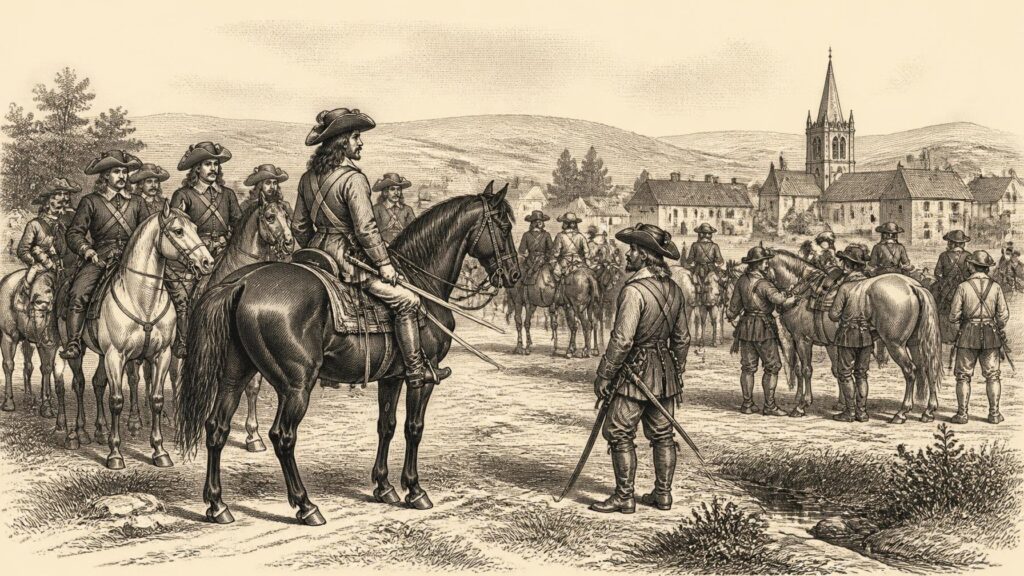
Military organisation was one immediate sign that the conquest was becoming a settlement. On 1 February, Colonel Henry Conyngham was appointed to raise a new regiment of dragoons in Ireland, later ranked as the 8th Dragoons and much later associated with the King’s Royal Irish Hussars. A royal instruction issued in January ordered the Irish authorities to favour officers from Londonderry and Enniskillen who were then out of service. Those towns had become powerful Protestant symbols through their resistance to James II in 1689.
The order was unusually explicit about confessional trust. It required care that the soldiers should be known Protestants. Recruits were to be raised, armed and mounted, then mustered at Kilkenny and Clonmel, or other suitable places. The regiment was thus not simply a military unit formed after a war; it was an institution designed within a new political order. Service offered employment, status and regular connection to the crown for men whose Protestant identity and Williamite record were regarded as guarantees of loyalty. The instruction also shows that the post-war army was not confined to Ulster: its recruitment, assembly and supply joined northern veterans to towns in the south and midlands.
Claims, Forfeitures and Fear
Land lay at the heart of the unsettled peace. The civil articles of Limerick had promised protection to specified Jacobites who submitted to William and Mary, took the required oath, and met other conditions. They also promised the restoration of qualifying estates. But entitlement was not automatic. It depended on names, dates, residence, oaths, evidence and official interpretation. On 19 June 1693 the government issued a proclamation concerning claims under the Treaty of Limerick; on 10 July it postponed the hearing of those claims. The delay mattered because property was both livelihood and political power.
On 21 July another proclamation concerned the commissioners for forfeitures and the publication of the times and places at which they would make their enquiries. These were not abstract legal exercises. Former Jacobite proprietors, Protestant purchasers, crown officials, tenants and creditors could all have a stake in the outcome. The administrative record reveals a country still being sorted into those deemed protected by capitulation and those treated as forfeited enemies. It would be misleading to say that all Catholic landholders were immediately dispossessed in 1693; the processes were uneven and claims continued. But the year plainly shows the machinery through which a major transfer of land and influence was being prepared and contested.
Security policy had a sharper edge. A proclamation of 18 August ordered justices of the peace to “take up” priests and the families of tories and rapparees. In seventeenth-century official language, “tories” and “rapparees” could denote armed robbers, irregular fighters, or men portrayed by the authorities as dangerous remnants of the defeated cause. The proclamation does not prove that clergy or relatives as a whole were insurgents. Rather, it shows a government willing to treat Catholic priests and the kin of suspected outlaws as objects of coercive surveillance in a landscape where war had recently ended but confidence had not returned.
Ireland and the French War
The island’s apparent peace was inseparable from the Nine Years’ War. William III’s struggle against Louis XIV was fought across Europe and at sea, while Ireland supplied men to opposing military systems. On 19 July in the old-style calendar used in Britain and Ireland—29 July in the Gregorian calendar—the French defeated William’s allied army at Landen, also called Neerwinden, in the Spanish Netherlands. Irish exiles who had left after Limerick fought in French service, while William’s Irish establishment was being rebuilt for his own side.
Two deaths gave the battle particular Irish resonance. John Barrett of Castlemore near Mallow, formerly a Jacobite officer and military governor of Waterford, died leading men of James II’s Royal Irish Regiment in the French attack. Patrick Sarsfield, the celebrated Jacobite commander and earl of Lucan, was fatally wounded. He died a few days later at Huy. Sarsfield’s death should not obscure the many other Irish lives bound up in the campaign, but it made him the best-known symbol of the soldiers who had exchanged a lost war in Ireland for service abroad.
For contemporaries in Ireland, Landen was not merely foreign news. Sarsfield had commanded the defence of Limerick and had helped negotiate the final Jacobite military departure. His fate demonstrated that the Jacobite cause had not vanished with the fall of Irish strongholds; it had been displaced into French service and a European conflict. Later memory would turn Sarsfield into a heroic figure of exile and resistance. In 1693, however, his death was a current political and military event, occurring while the Williamite government was still defining the terms on which former enemies might retain property at home.
War also reached commerce directly. On 19 October the Irish government prohibited all trade with France. The order followed the strategic logic of wartime embargoes, intended to deny an enemy supplies, markets and intelligence. Its practical effect would have depended on merchants, ports, ships, credit and enforcement. What can responsibly be said is that the proclamation placed Irish traders within the economic front of the Anglo-French war. It was a reminder that political allegiance could regulate the movement of goods as firmly as the movement of soldiers.
Two Religious Landscapes
The year presents a striking contrast in religious policy. While the government’s August proclamation associated Catholic priests with security concerns, a French Protestant community established a durable institutional foothold in Dublin. The nonconformist Huguenot congregation was established in 1693, after legislation of 1692 had relieved French Reformed settlers from elements of the Act of Uniformity. It first worshipped in a house in Bride Street and acquired a burial ground beside what was then the wider area of St Stephen’s Green, now remembered as the Huguenot Cemetery on Merrion Row.
This should not be flattened into a story of uncomplicated toleration. Huguenots were Protestant refugees from a Catholic monarchy at war with William III, and their settlement suited the priorities of a Protestant regime. Their cemetery nonetheless records a real addition to Dublin’s social and religious geography. The small enclosure became a place of burial for generations of a community linked with continental migration, family networks, craft skills and commerce. In a year when official policy could make Catholic clergy targets of detention, the recognition of a separate French Reformed congregation reveals how strongly political loyalty, international conflict and religion overlapped.
Clonmel in Print
1693 also produced an important, if unusual, literary landmark. An anonymous work, Vertue Rewarded; or, The Irish Princess, was published in London. It is among the earliest surviving examples of prose fiction in English with an Irish setting. Its principal action is placed around Clonmel during the Williamite war, notably in August 1690, rather than in the year of publication. It is therefore evidence for how the recent conflict was being imagined in 1693, not a source for events then occurring in Clonmel.
The book combines romance, war, purported Irish antiquity and stories reaching as far as Peru. Its Ireland is not an impartial or inclusive one: scholarship has noted its planter-Protestant perspective and its hostile treatment of the “wild Irish”. Even so, its publication matters. Only two original copies are known to survive, but the text shows that Ireland’s war had already entered commercial print as material for entertainment, moral instruction and political imagination. The recent past was being turned into story while its land claims, military consequences and religious divisions remained painfully present.
By December, the government ordered a general thanksgiving in Dublin for 10 December. The proclamation itself signals the official language of restoration: public gratitude, royal authority and a kingdom represented as secured under William and Mary. Yet 1693 was not a year of simple consolidation. It was a year in which Dublin gained a refugee congregation and a new burial ground; a Protestant military establishment took new shape; treaty protections were subjected to claims and postponements; French trade was forbidden; and Irish soldiers met one another across the battle lines of Europe. The war in Ireland had ended, but its settlement was still being made.
Primary Sources
- Statute Law Revision Act 2015
- The Treaty of Limerick, 1691
- Sarsfield, Patrick
- Barrett, John
- Coningsby, Thomas
- Reynell, Richard
- A Timeline of Ireland and the British Army
- 8th King’s Royal Irish Hussars
- The Origins of a Regiment of Dragoons
- Summary Information Document on the Irish Regiments of the British Army
- The Manuscripts of the House of Lords: New Series
- Calendar of the State Papers of William and Mary 1693: Preface
- A Jacobite Narrative of the War in Ireland
- Ratification of Treaty of Limerick: George Clarke to Sir Theobald Butler
- Huguenot Cemetery Dublin (Peter Street) Bill, 1965: Committee Evidence
- Huguenot Cemetery
- Huguenot Cemetery Audio Guide
- Vertue Rewarded; or, The Irish Princess (1693)
- Vertue Rewarded; or, The Irish Princess: Full Text
- Sarah Butler’s Irish Tales, a Jacobite Romance
- Economic Trends, 1660–91
- History of the Commercial and Financial Relations between England and Ireland: Part 7
- Papers Relating to the Revenue and Trade of Ireland, 1629–1713
- The Williamite Confiscation in Ireland, 1690–1703