Inchiquin Truce1648 CE
In 1648, the Catholic Confederation of Ireland fractured over the Dungarvan truce with Murrough O’Brien, Lord Inchiquin, newly aligned with Charles I. Exhaustion after 1647 defeats led moderates to seek a royalist coalition and negotiations with Ormond, despite Inchiquin’s destructive record. Papal nuncio Rinuccini condemned the truce, censuring supporters and joining Owen Roe O’Neill’s resistance. Rival Confederate armies campaigned without decisive battle, burdening civilians suffering requisition and scarcity. The Kilkenny assembly marginalised O’Neill, while Ormond’s return and Rome’s limited aid strengthened accommodation. O’Neill’s ceasefire with parliamentarian Michael Jones revealed division. Winter brought coalition, not peace, before the 1649 Ormond settlement.
Dateline
In 1648, Ireland’s central political fact was not a decisive battle or a settled treaty, but the disintegration of the Catholic Confederation that had governed much of the country from Kilkenny since 1642. A truce agreed at Dungarvan in May between the Confederate leadership and Murrough O’Brien, Lord Inchiquin, opened a route towards a wider royalist alliance. It also produced a rupture so bitter that Irish Catholics who had fought together against common enemies turned their weapons, censures and political machinery against one another. By the year’s end, the prospect of reconciliation with the king’s lord lieutenant, James Butler, marquess of Ormond, had gained ground; but unity had been purchased neither easily nor completely.
A Kingdom Exhausted by War
The crisis belonged to a landscape already devastated by more than six years of conflict. The 1641 rising had developed into a many-sided war: Catholic Confederate armies, English royalists, English parliamentarians, Scottish covenanters in Ulster, and local Protestant forces all held territory or maintained garrisons. Their alliances had repeatedly shifted. Kilkenny was the Confederation’s political centre, but its authority depended on provincial councils, noble networks, clerical support and armies which often lacked regular pay, food, ammunition and discipline.
The defeats suffered by Confederate forces in 1647 made compromise appear urgent to many lay leaders. Thomas Preston’s Leinster army had been crushed by the parliamentarian Michael Jones at Dungan’s Hill in August 1647, while Inchiquin’s Munster army destroyed the Confederate force of Lord Taaffe at Knocknanuss in November. Inchiquin’s preceding campaign had been exceptionally destructive, including the sack of Cashel. These were events of 1647, not 1648, but they explain why the Supreme Council entered the new year under intense military and financial pressure. A renewed war against Inchiquin, who commanded experienced Protestant troops in Munster, appeared dangerous to leaders whose estates, towns and remaining forces were already exposed.
In February 1648 Owen Roe O’Neill, commander of the Confederate Ulster army, prevented a junction between Jones and Inchiquin. This was a useful military success, but it did not cure the Confederation’s strategic weakness. O’Neill’s army was formidable but under-supplied, and its presence in Leinster imposed heavy demands on districts expected to feed men, horses and the mobile civilian camps known as creaghts. For inhabitants, the distinction between a friendly army and a hostile one could be painfully limited: quartering, compulsory contributions, seized livestock and interrupted cultivation accompanied both.
The Dungarvan Calculation
The political opening came when Inchiquin broke with the English parliament and declared for Charles I in April. His decision was shaped by the wider Wars of the Three Kingdoms: Parliament was increasingly dominant in England, while royalists sought to combine their remaining forces in England, Scotland and Ireland. To Confederate moderates, Inchiquin’s change of allegiance offered a chance to turn a feared local enemy into a partner against parliamentarian power. It also pointed towards the return of Ormond, the king’s lord lieutenant, and fresh negotiations with the crown.
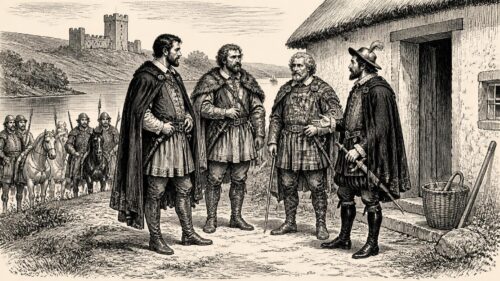
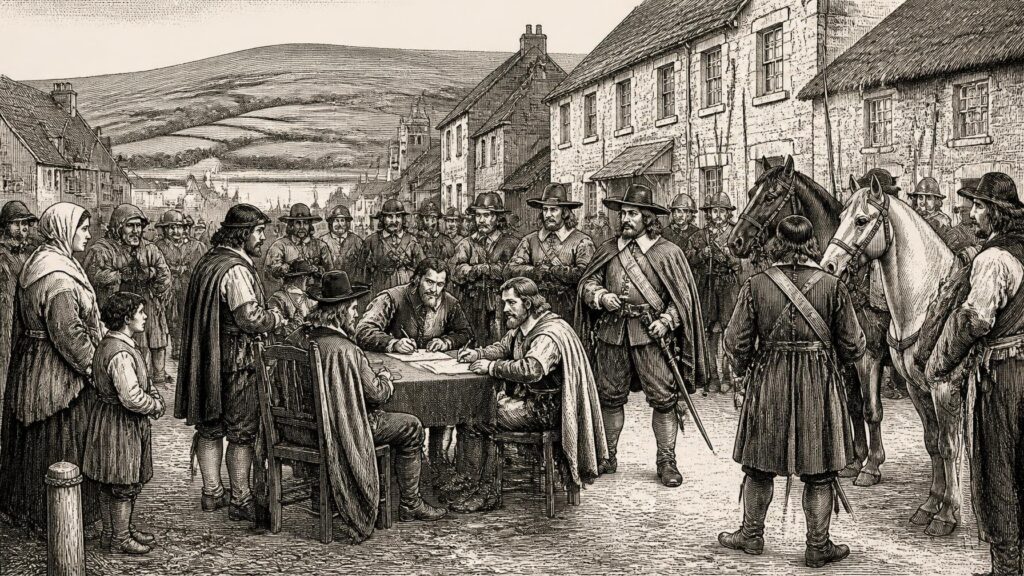
On 20 May the Confederate Supreme Council and Inchiquin agreed a cessation at Dungarvan. The agreement was a truce, not a comprehensive peace settlement. Its immediate purpose was to stop fighting in Munster and allow co-operation between the two sides. It contained protections for Catholic possession and worship during its term, though with important exceptions in Inchiquin’s garrisons and quarters. Its supporters could argue that it bought indispensable breathing-space and prevented further losses. They also hoped that a coalition of Catholic Confederates and Protestant royalists could recover Ireland from parliamentarian influence.
Yet the very identity of the new partner made the bargain explosive. Inchiquin had recently commanded parliamentarian forces and was associated in Catholic memory with ravaged communities and the killings at Cashel. More fundamentally, the truce appeared to opponents as the preliminary to another Ormond settlement which would restore royal authority without securing the full public position for Catholic worship, churches and landholders that they believed the Confederation had been created to obtain. For them, military necessity could not justify abandoning the religious and constitutional purposes of the war.
Rinuccini’s Censure
Giovanni Battista Rinuccini, papal nuncio in Ireland since 1645, gave this resistance an institutional and spiritual force. He had arrived with money, arms and hopes that the Confederates would establish Catholic rights on terms stronger than those previously offered by the crown. By 1648 his influence had waned, foreign help had failed to meet expectations, and the lay peace party had recovered much of its position. Nonetheless, Rinuccini judged the Inchiquin truce to be both morally unacceptable and politically dangerous.
In late May he withdrew from Kilkenny to O’Neill’s camp near Maryborough, now Portlaoise. There he issued censures against supporters of the truce, excommunicating leading adherents and placing places that accepted it under interdict. This was not simply a theological gesture. In a predominantly Catholic political association, exclusion from the sacraments challenged an office-holder’s legitimacy and invited clergy and laity to withhold obedience. The censures divided bishops as well as nobles and soldiers. Edmund O’Dempsey, bishop of Leighlin, rigorously enforced them in his diocese; other churchmen and Catholic politicians instead sought a settlement with the royalists.
Rinuccini’s flight linked his cause closely to O’Neill and the Ulster army. The connection was politically costly for both men. O’Neill shared the nuncio’s distrust of a weak royal peace, but he also had his own priorities: the security of his unpaid army, the interests of dispossessed Ulster landholders, and the restoration of Catholic rights. Many former Ulster insurgent landowners, including Sir Phelim O’Neill and Miles O’Reilly, chose the Supreme Council and the prospective Ormond alliance instead. Their decision reflected a practical hope that a royal settlement might preserve or recover estates. The split was therefore never a simple contest between ‘Irish’ and ‘English’, clergy and laity, or religion and politics; family interests, provincial rivalries and military command mattered throughout.
Confederates at War
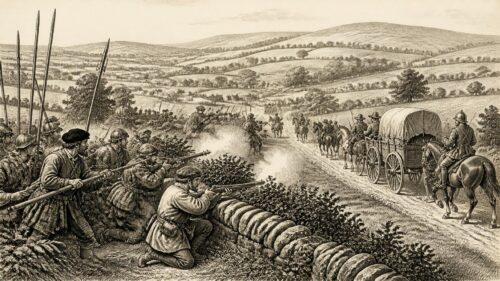
The disagreement became an armed civil conflict within the Confederate cause. Preston and Taaffe aligned with Inchiquin and the royalist Ulick Burke, marquess of Clanricarde, against O’Neill’s force. During the summer and early autumn, O’Neill marched through the midlands and Munster borderlands while rival armies shadowed one another. His troops captured Banagher and stormed Nenagh; a detachment relieved Athy when it was under pressure from Preston’s side. These operations were consequential but did not produce a decisive field battle. O’Neill generally avoided a full encounter with fellow Catholics, knowing that a victory over them could destroy the very cause he claimed to defend.
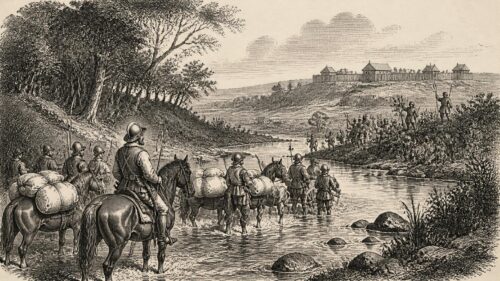
Campaigning nonetheless brought hardship. A contemporary account from O’Neill’s side records marches, scarce provisions, skirmishes and the dispersal of inhabitants from threatened districts. Around Ballaghmore, opposing forces faced one another for about a fortnight, but food shortages helped compel movement rather than battle. Such episodes show the material limits beneath high politics. Armies survived by drawing cattle, grain, labour and shelter from nearby communities. When rural people fled with their animals or abandoned a district, commanders lost the means to keep men together. The conflict’s geography followed roads, river crossings, castles, market towns and usable pasture as much as formal provincial boundaries.
Kilkenny, Cork and Rome
A new Confederate general assembly met at Kilkenny in September. By then Rinuccini’s opponents possessed the advantage. The assembly’s supporters of accommodation treated O’Neill’s defiance as rebellion; in October he was effectively outlawed by the Confederate political establishment. The pressure extended to clergy who upheld the nuncio’s censures. O’Dempsey was summoned to Kilkenny and threatened with the confiscation of diocesan property, but refused to attend, saying that he feared for his safety. The episode illustrates how far the Confederation’s original claim to Catholic unity had broken down.
Ormond landed at Cork on 30 September 1648 and soon proceeded to Kilkenny to negotiate. His return was a major achievement for the truce party, but it did not instantly resolve the crisis. Confederate agents Nicholas Plunkett and Nicholas French had spent most of the year seeking support in Rome; they returned in November having received honour but little practical aid. Their experience strengthened the argument that an agreement with the royalists, however imperfect, was the only realistic alternative to isolation. News from England also darkened the calculations: Charles I was a prisoner, and the movement to bring him to trial made royalist co-operation appear increasingly urgent.
By late 1648, O’Neill was isolated but not defeated. Seeking arms and supplies, he opened contact with Michael Jones, the parliamentarian commander in Dublin, and reached an effective local ceasefire in exchange for cattle. This was a striking expedient, not evidence that O’Neill had embraced parliamentarian rule. It exposed how broken the Confederate position had become: an army committed to Catholic and Irish interests had to bargain with a parliamentary enemy because former Confederate allies were trying to contain it.
The formal second Ormond peace would not be signed until 17 January 1649, so it should not be projected backwards as an accomplished fact in 1648. What the year did establish was the alignment that made it possible: Inchiquin’s royalist turn, the Dungarvan truce, Rinuccini’s failed effort to stop it, Ormond’s return, and the marginalisation of O’Neill’s party. Ireland entered the winter facing not peace but a fragile royalist–Confederate coalition, deep Catholic division, exhausted communities and a parliamentarian threat that would soon become overwhelming.

Primary Sources
- The Crisis in Ireland in 1648: The Nuncio and the Supreme Council: Conclusions
- Rinuccini, GianBattista
- O’Brien, Murrough
- O’Neill, Owen Roe (Ó Néill, Eoghan Rua)
- Butler, James
- Plunkett, Nicholas
- MacCarthy, Donough
- French, Nicholas
- O’Neill, Sir Phelim
- O’Dempsey, Edmund
- Fitzgerald, Maurice
- Politics, 1641–1660
- An Impartial Relation of the Most Memorable Transactions of General Owen O’Neill and His Party, from the Year 1641 to the Year 1650
- Commentarius Rinuccinianus, Volume VI
- The Attrition of Influence, December 1646–February 1648
- Charles I and the Confederation of Kilkenny, 1643–9
- Two Contemporary Historians of the Confederation of Kilkenny
- Documents: Massari’s Account of the Truce with Inchiquin, 1648
- Inchiquin’s Changes of Religion
- The Inchiquin Truce
- Confederate Ireland