

Clontibret’s Running Battle1595 CE
In 1595, the Nine Years’ War became an open challenge to Elizabeth I’s rule as Hugh O’Neill and Hugh Roe O’Donnell expanded resistance across Ulster and beyond. After the Blackwater fort’s seizure, Crown attempts to sustain exposed garrisons faltered. At Clontibret, O’Neill’s forces badly mauled Sir Henry Bagenal’s returning convoy through disciplined firearms, fieldworks and mobile warfare, though they did not destroy it. O’Donnell’s campaigns destabilised Connacht, using raids, hostages and alliances to extend influence. Fighting also ravaged Wicklow and civilian communities. Despite negotiation and continued Crown control of towns, 1595 established a broader, organised and destructive conflict in Ireland.
Dateline
A War Becomes Open
In 1595 the struggle that would become known as the Nine Years’ War ceased to be a conflict conducted through intermediaries and became an unmistakable challenge to Elizabeth I’s government in Ireland. Its centre of gravity was Ulster, but its repercussions travelled quickly through Connacht, the midlands, the Pale and Wicklow. Hugh O’Neill, earl of Tyrone, had for years balanced service to the Crown with the construction of formidable power within and beyond Tír Eoghain. In February, after the seizure of the Crown’s Blackwater fort by his brother Art MacBaron O’Neill, that ambiguity could no longer be maintained. The government treated Tyrone as openly rebellious.
This was not a simple contest of “English” against “Irish”. O’Neill was himself an earl under the English Crown; his enemies and allies included Gaelic lords, Old English magnates, officials, settlers, town-dwellers, professional soldiers and Scots mercenaries. Local rivalries remained powerful. Yet 1595 saw O’Neill and Hugh Roe O’Donnell of Tír Chonaill draw a widening coalition around them, while government garrisons and their supply routes became dangerously exposed.
Blackwater, Monaghan and Clontibret
The Blackwater valley, on the approaches to Tyrone from Armagh, demonstrated why fortifications mattered. A small fort could assert royal authority, shelter troops and interrupt the movement of people and cattle; it could also become a costly dependency, requiring regular convoys along vulnerable roads. Its capture early in the year was therefore both a military success and a political declaration. The Crown could not leave such a challenge unanswered, but its response required men, food, ammunition and money that Ireland’s administration struggled to assemble.
Sir John Norris, an experienced commander recently employed in continental warfare, arrived in Ireland late in February with reinforcements. The government hoped that his presence, alongside Lord Deputy Sir William Russell and local loyalist forces, would restore momentum. Instead, the year exposed the limitations of large Crown columns operating beyond their secure bases. Garrisons at Monaghan, Newry, Armagh, Cavan and elsewhere consumed supplies, while the need to protect convoys slowed every movement.
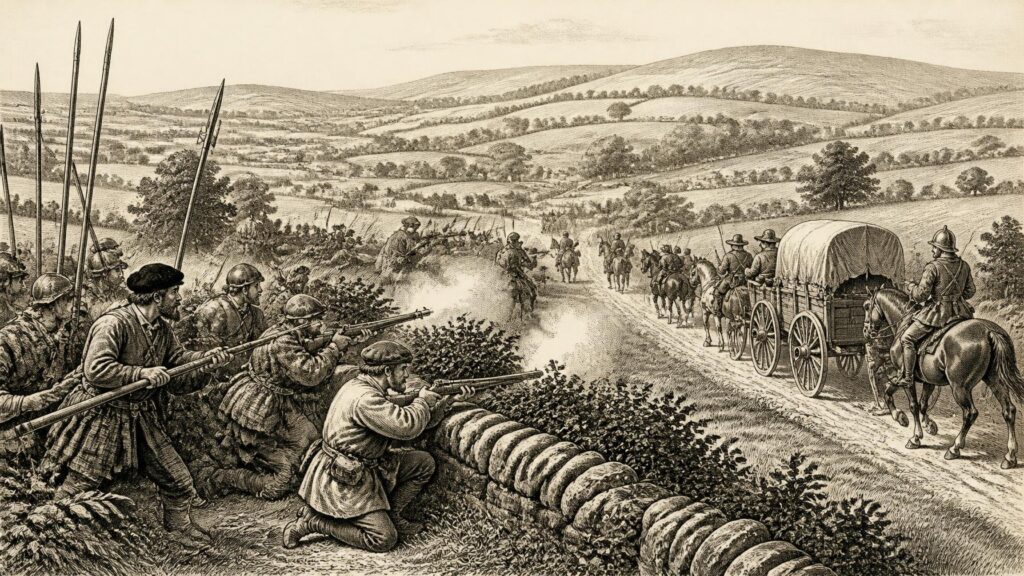
The best-known action came in late May, near Clontibret in County Monaghan. A relief force had delivered provisions to the Crown-held garrison at Monaghan and set out towards Newry. O’Neill’s men attacked it after it left the town. The encounter was not a neat, single-field battle with an agreed casualty list; it was a prolonged running action, remembered from sharply different viewpoints. The Annals of the Four Masters, compiled later from Irish materials, emphasised the defeated convoy, abandoned equipment and the long duration of fighting. English reports acknowledged serious losses but offered much lower figures than Irish accounts. The precise totals cannot responsibly be fixed.
What is clear is that Sir Henry Bagenal’s column survived only with difficulty and that O’Neill’s army had demonstrated an alarming capacity. Its troops used ground, fieldworks and sustained firearm fire to harry an organised force of trained infantry and cavalry. O’Neill had not discarded older Irish forms of warfare: mobile kern, horsemen, cattle-raiding and the strategic use of woods, bogs and narrow roads all remained important. But Clontibret also displayed a force adapted to the gunpowder age, with pikemen and shot operating in disciplined formations. The result was an important Irish success rather than the annihilation sometimes claimed in later retellings.
For inhabitants of Monaghan and the borderlands, the distinction between battle and campaign mattered little. Roads became military corridors, crops and livestock were requisitioned or seized, and religious houses and castles could be used as garrisons. Monaghan’s Franciscan monastery was occupied by Crown soldiers and depended on supplies from Dublin. The conversion of such sites into military positions shows how war entered places normally associated with worship, hospitality and local exchange.
Ulster’s Wider Alliance
The Four Masters summarised the transformation starkly: Ulster rose in alliance against the English during this year. That should not be read as complete unanimity, but it captures the new scale of the crisis. O’Neill’s position was strengthened by the co-operation of O’Donnell, Hugh Maguire of Fermanagh and allies in Monaghan and elsewhere. The death in 1595 of Turlough Luineach O’Neill, O’Neill’s ageing kinsman and former rival, further removed an alternative focus of authority in Tyrone. Hugh O’Neill’s power was now more direct, though still dependent on negotiation, fosterage, hostages, service and reward.
The government attempted a major advance from Newry towards Armagh and the Blackwater. According to the Irish annalistic account, Crown forces encountered the fortified camp and battle array of O’Neill and O’Donnell, then withdrew to Armagh rather than push into Tyrone. Whatever the embellishments of a victorious tradition, the broader outcome is secure: the Crown had failed in 1595 to impose a decisive settlement in Ulster. Its military presence remained concentrated in exposed outposts, while O’Neill retained room to organise and recruit.
Diplomacy accompanied violence. O’Neill’s resistance drew strength partly from his ability to present himself in more than one political language: an earl defending his rights, an O’Neill protecting a lordship, and a Catholic leader opposing religious change and intrusive government. The religious dimension was real, but it should not obscure questions of land, jurisdiction, succession and the authority to appoint local officials. In this year the war’s coalition was taking shape before its later, more explicit international appeals to Spain became central.
O’Donnell’s Connacht Campaigns
While Tyrone confronted the government in Ulster, Hugh Roe O’Donnell carried the conflict west and south. His expeditions into Connacht in March and April 1595 crossed Breifne and struck into territories already unsettled by Crown intervention, competing claims and local feuds. The annals describe raids around Rathcroghan, the Boyle and Shannon crossings, and later attacks through Annaly and Cavan. Such accounts naturally celebrate the raiders’ success, but they also reveal the human substance of campaigning: cattle driven away, cabins and settlements burnt, hostages endangered, prisoners taken, and communities compelled to choose sides.
These were not merely destructive forays. Cattle and other movable wealth fed armies, rewarded followers and weakened opponents; hostages bound families and lordships to a new political order. In June, after George Bingham was killed, O’Donnell took Sligo and briefly extended his leverage along the north-western coast. Crown power in Connacht rested on towns, castles, loyal families and the provincial presidency of Sir Richard Bingham. O’Donnell’s campaigning exposed how thin that infrastructure could be outside defended centres.
Conflict also reached sacred places. A seaborne raid from Sligo into Tír Chonaill plundered religious goods at an abbey and on Tory Island, according to the Four Masters. Later fighting around Sligo involved siege works, gunfire and the dismantling of a castle. These episodes caution against treating religion as a dividing line that prevented attack on churches or monasteries. Ecclesiastical institutions held valuable objects, buildings, lands and supplies, and could be caught between armed interests regardless of confession.
By December O’Donnell was in Mayo, where he intervened in the disputed Mac William Íochtair lordship. He backed Theobald Burke, son of Walter Ciotach, and received hostages from rival interests. This was a conspicuous assertion that a northern war leader could reshape Connacht politics. The inauguration or nomination was not simply a revival of old Gaelic custom: it was a wartime act, protected by armed followers and directed towards the creation of dependable allies. A short truce proclaimed at the end of the year did not erase this new alignment.
Wicklow, Learning and Civilian Costs
War was not confined to the northern provinces. In January Russell campaigned against Feagh MacHugh O’Byrne at Ballinacor in Wicklow. Feagh and his household escaped into the mountain country, while the government left troops behind. Subsequent raids, burning and counter-raids demonstrated the familiar imbalance between official expeditions and a population able to disperse into difficult terrain. Later in the year Feagh submitted at Dublin and received a temporary safe-conduct, an indication that negotiation remained necessary even where the Crown claimed authority.
For ordinary people, 1595 meant insecurity rather than a tidy sequence of famous engagements. Soldiers needed food, fodder, carts, guides and intelligence. Families faced the loss of cattle, stored grain and shelter, while those suspected of aiding an enemy risked imprisonment or execution. The language of the annals can be triumphalist and the language of state papers defensive, but both record a landscape in which burning, plunder and forced movement were normal instruments of war.
Even so, learned and religious life did not vanish. The death of Maccon O’Clery, ollamh or learned historian to O’Donnell, was noted with unusual warmth in the annals. His commemoration is a reminder that hereditary learned families still preserved genealogies, poetry, law and historical memory amid upheaval. Their skills were politically valuable: lordship depended not only on armed men but on the ability to state ancestry, rights and reputation.
By the end of 1595, neither side had won Ireland. The Crown retained Dublin, major towns and many strategic garrisons; O’Neill and O’Donnell had not created a unified national government. Yet Clontibret had changed expectations. It showed that the Crown’s armies could be checked in the field, while the spread of O’Donnell’s influence showed that the conflict could not be contained within Fermanagh or Tyrone. The year closed with war becoming broader, more organised and more destructive—a turning point whose consequences would shape the rest of the decade.
Primary Sources
- Annals of the Four Masters: Annal M1595
- Annals of the Four Masters
- Beatha Aodha Ruaidh Uí Dhomhnaill (The Life of Hugh Roe O'Donnell)
- Strategy and Tactics in Irish Warfare, 1593–1601
- Political Discourse and the Nine Years’ War in Late Elizabethan Ireland, c.1593–1603
- Gaelic Lordship and Tudor Conquest: Tír Eoghain, 1541–1603
- Death in the Lakelands: Tyrone’s Proxy War, 1593–4
- Tyrone’s Complicity: No Smoking Gun?
- The Dead, Sick and Wounded of the Nine Years War (1594–1603)
- Feagh McHugh O’Byrne
- An Inauguration of a MacWilliam Íochtair at Rausakeera, Co. Mayo, During the Nine Years War
- An Tulach Tinóil
- 1595 Rausakeera Inauguration a One-off?
- Contesting the Sovereignty of Early Modern Ireland
- Gráinne Mhaol, Pirate Queen of Connacht: Behind the Legend
- 400th Anniversary of the Battle of Clontibret
- Historical Tradition: Battle of Clontibret 1595
- Monaghan County Development Plan 2021–2027: Volume 3, County Monaghan Heritage
- The Nine Years War and the Irish Military Revolution
- Flight of the Earls Booklet