

Dundalk’s Winter Cessation1597 CE
In 1597, Ireland’s war exposed the Tudor administration’s logistical and military weakness while Hugh O’Neill’s confederacy extended its influence. A gunpowder explosion in Dublin killed 126 people, damaged the capital’s supply system, and highlighted insecure wartime labour and logistics. The Crown killed Fiach MacHugh O’Byrne in Glenmalure, weakening but not pacifying Leinster. Hugh Roe O’Donnell raided Connacht, reaching Athenry and Galway. Lord Burgh’s Ulster offensive failed to unite royal forces, although Blackwater Fort was re-established; his death worsened the crisis. Irish victories near Carrickfergus and Daingean compelled talks outside Dundalk. O’Neill accepted a two-month cessation, gaining recognition without surrendering authority.
Dateline
In 1597, Ireland’s war was not decided by one great battle. Instead, a succession of shocks exposed the weaknesses of Tudor government and the reach of the confederacy led by Hugh O’Neill, earl of Tyrone, and Hugh Roe O’Donnell. A disastrous explosion tore through Dublin; the Crown eliminated its most durable Leinster enemy, Fiach MacHugh O’Byrne; Red Hugh carried war and plunder deep into Connacht; and a renewed royal offensive stalled in Ulster. By Christmas, the government was bargaining with O’Neill outside Dundalk because it lacked the strength to impose terms. The resulting cessation was a pause born of necessity, not a settlement.
Disaster on Dublin’s Quays
On 11 March, a consignment of gunpowder exploded beside the Liffey at the Crane near Wood Quay and Winetavern Street. The precise cause was never established. Contemporary investigation suggested a dangerous mixture of poor handling, insecure packing, dry conditions and the accumulation of barrels at a busy unloading point; later suspicions of deliberate sabotage were not substantiated. What is firm is the scale of the calamity. About 140 barrels blew up, the crane and cranehouse were destroyed, and a final count of 126 dead was reached. Seventy-six were Dublin citizens, including men, women and children, while fifty were described as strangers.
The explosion brought war’s material demands into the centre of civic life. The powder was part of the military supply system sustaining the Crown’s Irish forces, yet it had been landed in a dense mercantile quarter. Between twenty and forty houses were flattened, and the shock damaged buildings well beyond the waterfront. The city authorities calculated losses at more than £14,000 sterling. Testimony gathered after the blast also offers an unusually close view of labour on the quays: casual porters, many with Gaelic names, complained of being coerced or underpaid when compelled to move barrels and other military stores. Thus a catastrophe often remembered for its spectacular violence also revealed the dependence of the Dublin administration upon poorly protected workers and improvised logistics.
Dublin remained the governmental, commercial and military hub of English power in Ireland. Its harbour connected the city to England, while its castle and storehouses supplied garrisons and field armies. The March disaster did not halt that role, but it made the capital’s vulnerability painfully visible. It also intensified official anxiety about the loyalty of merchants and civic figures at a moment when the northern war was drawing support from beyond Ulster.
Glenmalure’s Fallen Chief
The Crown achieved a major success in Leinster in May. Fiach MacHugh O’Byrne, lord of Críoch Raghnaill in the Wicklow mountains and the most formidable Gaelic leader in Leinster, had resisted successive governments for decades. His difficult country around Glenmalure gave shelter to fighting men, livestock and families, while raids from the uplands threatened the approaches to Dublin, the Pale and the south-eastern roads. His alliance with O’Neill had made this local power strategically important during the Nine Years’ War.
On 8 May, after intelligence from within Fiach’s circle, forces sent by Lord Deputy Sir William Russell entered Glenmalure from different directions before dawn. Fiach was found in a cave and killed. Accounts differ slightly on the date of the final operation, but the death itself belongs securely to early May. His body and severed head were taken to Dublin; the head was subsequently sent to England, where the display intended as a trophy drew royal disapproval. The episode illustrates both the harshness of the campaign and the symbolic language of Tudor conquest: the death of a resistant lord was made into a public assertion of state authority.
Fiach’s killing did not make Wicklow instantly governable. His family and followers remained, and the terrain that had frustrated English columns did not change. Yet his removal deprived O’Neill of an experienced ally able to distract Crown resources close to Dublin. It also showed that the administration could still achieve a targeted success when it combined local knowledge, informers and mobile troops. The contrast with later events in Ulster was stark.
Connacht Under Pressure
While Leinster was being fought over, O’Donnell demonstrated how far the conflict could travel. The Annals of the Four Masters, compiled later from Irish annalistic materials, place him in east Connacht at the beginning of 1597. At the end of January he moved through Tirerrill, Corran, Machaire Chonnacht, Clann Conway and Hy Many. His forces reached Athenry, forced entry, broke into storehouses and strong dwellings, and carried away goods including metalware, clothing and other valuables. They then ravaged territory towards Galway, burning settlements and reaching the gates of the walled port.
The annalists’ language of vast spoil reflects the purpose of such campaigning. Raiding was not merely destruction: cattle, goods, hostages and provisions were the movable resources of war, and the recognition or replacement of local leaders could bind districts into a wider alliance. But the immediate human cost fell upon cultivators, townspeople and smaller landholders. Fields, corn, houses and herds were exposed to both raiders and counter-raiders. For Galway and Athenry, centres of trade connected to the Atlantic world, the incursions showed that stone walls and civic privileges did not insulate them from a war in which roads, rivers, food and livestock mattered as much as formal fortresses.
O’Donnell’s advance also tested the Crown’s fragile network in Connacht. Donal O’Connor Sligo, aligned with the government, fought O’Donnell’s forces in February and helped secure Sligo Castle in March. Sir Conyers Clifford, chief commissioner and then president of Connacht, was expected to restore authority in a province unsettled by the collapse of Sir Richard Bingham’s earlier regime. Clifford’s position, however, was constrained by shortages of trained men, money and provisions, as well as by rival loyalties among Gaelic and Old English lordships.
Burgh’s Offensive and the Blackwater
Elizabeth I appointed Thomas, Lord Burgh, as lord deputy in March; he landed in Dublin in May and was sworn in on 22 May. Burgh sought to recover the initiative after prolonged, inconclusive negotiation. His plan was ambitious: an army marching north from Dublin would combine with Clifford’s Connacht force and press into the rebel heartlands. On 5 July Burgh set out from Dublin with about 3,500 men, many locally recruited and inexperienced. The logistical problem was immediate. An army moving through Ulster needed food, transport and secure communications, but the country ahead was hostile and the Crown’s forts were themselves expensive mouths to feed.
The hoped-for junction failed. Burgh’s column did not push through to Lifford, while Clifford’s force, moving towards Ballyshannon, became dangerously isolated after instructions to withdraw were intercepted. Clifford fought his way back into Connacht with losses. The failure did not mean that Burgh achieved nothing. In early October he relieved and re-established the fort on the Blackwater, in the heart of O’Neill’s country. That post was strategically vital because it projected royal power towards Armagh and Tyrone; it was also acutely exposed. A fort could claim territory only if men, powder, food, fuel and forage could be brought to it.
Burgh fell ill during the subsequent northern march and died at Newry on 13 October, probably of typhus. His death deprived the Crown of an energetic commander just as the Blackwater garrison became increasingly difficult to sustain. The year’s campaigning had confirmed a problem that would define the conflict: English forces could seize or refit a strongpoint, but their supply lines offered targets to an enemy better able to concentrate locally and disperse quickly.
Defeats and Diplomacy
The Crown’s position worsened in November and December. On 4 November, James MacSorley MacDonnell defeated the English force led by John Chichester near Carrickfergus. Chichester was killed. The encounter was connected to a proposed parley, but the wider significance lay in the north-east: Carrickfergus, one of the few surviving English footholds in Ulster, had proved unable to dominate the MacDonnell country around it. O’Neill’s support for the MacDonnells further demonstrated the confederacy’s ability to link local grievances to the broader war.
On 5 December, Richard Tyrrell and Owny O’More won another Irish success near Daingean in Leinster. Tyrrell, a Gaelicised Old English captain from Westmeath, had become one of O’Neill’s most capable allies; O’More’s operations in Laois and adjacent districts exposed the weakness of the Crown’s inland settlements. These victories, together with the isolation of Blackwater Fort, made a fresh negotiation unavoidable.
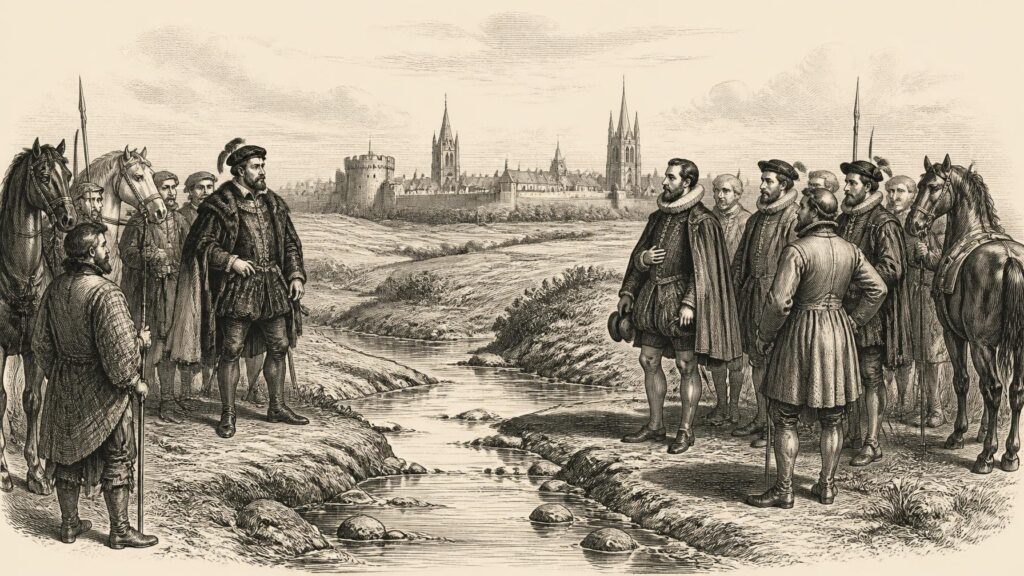
Thomas Butler, earl of Ormond, met O’Neill in open country outside Dundalk on 8 and 9 December. O’Neill’s choice to negotiate outdoors reflected fear of arrest and a refusal to submit to the visual and physical control of a town or castle. More formal discussions followed from 20 to 23 December, with Geoffrey Fenton and Thomas Jones, bishop of Meath, among the government representatives. Hugh Roe O’Donnell was expected but did not attend in person, enabling O’Neill to insist that he spoke for a wider confederacy while O’Donnell maintained a harder line.
O’Neill did sign a carefully qualified submission and accepted a two-month cessation. This was not a capitulation. He disputed the language put before him, argued that he and his allies had been provoked, and presented demands and grievances. Religious liberty was among the issues raised, and it was expressly rejected by Ormond’s side. The Crown’s immediate concern was more practical: food for the Blackwater garrison. O’Neill promised cattle and safe passage for supplies; some cattle arrived, though the soldiers found much of the stock unfit. The small garrison had only limited rations, making clear how little security the agreement provided.
The cessation therefore closed 1597 with diplomacy and hunger intertwined. O’Neill had won recognition as a negotiator for allied lords rather than merely a rebel seeking pardon. The Crown had gained breathing space and the possibility of provisioning a beleaguered fort, but not obedience. Across Ireland, the year had shown that war could demolish a Dublin street, empty Connacht storehouses, unsettle Atlantic towns, close roads through Leinster and force the representatives of Elizabeth I to treat with their most dangerous opponent in a field outside Dundalk.
Primary Sources
- Annals of the Four Masters
- The 1597 Ceasefire Documents
- O'Donnell, ‘Red’ Hugh (Ó Domhnaill, Aodh Ruadh)
- O'Byrne, Fiach MacHugh
- Burgh (Boroughs), Thomas
- Clifford, Sir Conyers
- Tyrrell, Richard
- O'Connor Sligo, Sir Donal (Domhnall)
- Bingham (Byngham), Sir Richard
- Norris (Norreys), Sir John
- Norris, Sir Thomas
- O'Neill, Sir Toirdhealbhach
- Dublin’s Great Explosion of 1597
- Feagh McHugh O’Byrne
- From a Spark to a Firebrand: Feagh Mac Hugh O’Byrne
- Beyond Reform: Martial Law & the Tudor Reconquest of Ireland
- One World: The Communities of the Southern Dublin Marches
- Context: Ceasefire of 1597
- Note on Explosion of Gunpowder at Dublin, 1597
- The Elizabethan Court Day by Day—1597
- Ireland in the 17th Century
- Part 7 of Annals of the Four Masters