O’Donnell’s Escape1592 CE
In 1592 Hugh Roe O’Donnell escaped Dublin Castle, where he had been held to restrain Ulster alliances, and returned to Tír Chonaill. Supported by his mother Iníon Dubh, Scottish connections and Hugh O’Neill, he became The O’Donnell, resisted garrisons and negotiated a fragile submission at Dundalk. His revival intensified conflicts within Ulster and exposed limits of crown authority. In Dublin, Elizabeth I chartered the College of the Holy and Undivided Trinity on the former All Hallows priory, to educate Protestant clergy and officials. Meanwhile, Catholic diplomacy with Spain heightened anxieties. These developments foreshadowed wider political, religious and military confrontation ahead.
Dateline
Two developments made 1592 a consequential year in Ireland, though they unfolded in sharply different settings. In the north-west, Hugh Roe O’Donnell escaped Dublin Castle, returned to Tír Chonaill and became the effective head of one of Ulster’s greatest lordships. In Dublin, Queen Elizabeth I granted the charter for the College of the Holy and Undivided Trinity near Dublin, later Trinity College. One event exposed the limits of crown coercion beyond the Pale; the other created an institution intended to strengthen the English Protestant state within it. Neither, by itself, settled Ireland’s future. Together, they reveal a kingdom in which authority, religion and learning were being remade amid mounting strain.
An Escape from Dublin Castle
Early in January, conventionally dated 6 January 1592, Hugh Roe O’Donnell escaped from imprisonment in Dublin Castle. He had been held since his seizure as a teenager in 1587, when government agents captured him aboard a ship at Rathmullan. His detention was calculated to prevent a dangerous alliance between the O’Donnells of Tír Chonaill and Hugh O’Neill, earl of Tyrone. In a political world where the person of a leading heir could bind a lordship to the crown, holding Hugh Roe in Dublin was meant to restrain a powerful northern family.
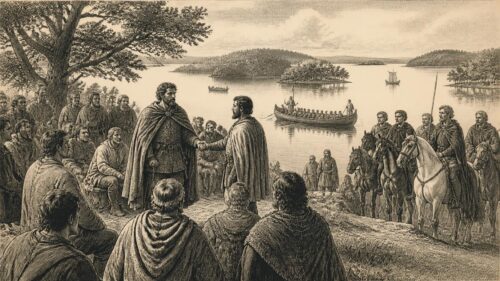
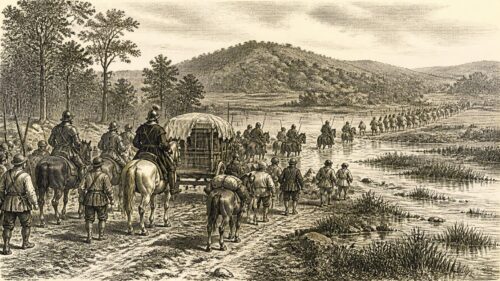
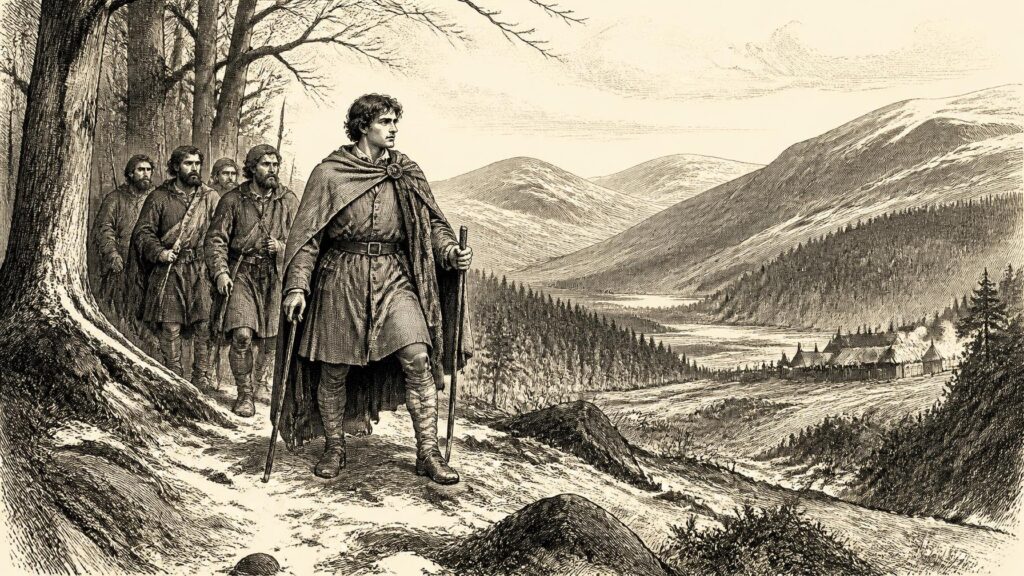
The escape was organised through a web of servants, bribery and regional allies rather than by a simple dash for freedom. Hugh Roe fled with Henry O’Neill and Art mac Shane O’Neill after their restraints were relaxed for a meal. Henry separated from the other fugitives; Hugh Roe and Art headed south towards the Wicklow fastness of Fiach MacHugh O’Byrne, an adversary whom the Dublin government had never subdued. The winter journey was punishing. Art died from exposure before help reached the party, while Hugh Roe survived and recovered in Glenmalure. Later Irish accounts give the episode a providential and heroic cast, but its political importance requires no embellishment: a hostage whose captivity had helped contain Ulster was now beyond the government’s reach.
Fiach MacHugh’s assistance also demonstrated how connections could run across apparent regional boundaries. Wicklow’s wooded mountains and narrow valleys were not merely a remote refuge; they linked a Leinster lord with northern political networks. Hugh O’Neill’s role in arranging the escape, as reported in biographical and state evidence, made the point even clearer. The earl still presented himself to the crown as a loyal nobleman, yet the liberation of his son-in-law served his own interests in Ulster. Public professions of service and private preparation for contingencies could coexist.
A Lordship Reconstituted
Hugh Roe’s return transformed politics in Tír Chonaill. His father, Aodh mac Maghnusa Ó Domhnaill, was old and infirm, while rival branches of the extended O’Donnell kindred had profited from the heir’s absence. Hugh Roe’s mother, Fionnghuala MacDonnell, known as Iníon Dubh, was central to restoring her son’s position. A daughter of the MacDonnell lord of the Scottish Isles, she commanded formidable family connections and access to Scottish fighting men. Her influence is an important reminder that Gaelic lordship was not directed by men alone: elite women could organise retainers, build kin alliances and determine succession in moments of crisis.
The Annals of the Four Masters, compiled later but drawing on Irish learned tradition, dates Hugh Roe’s inauguration as ‘The O’Donnell’ to 3 May. Modern biographical scholarship places the installation at the traditional inaugural site of Kilmacrenan in April. The discrepancy cautions against forcing a false precision upon the ceremony. What is secure is that, in the spring of 1592, his father yielded practical lordship and Hugh Roe was publicly recognised as head of Tír Chonaill. The act was both dynastic and constitutional in Gaelic terms: it conferred a name, an office and leadership of a people, not simply ownership of land.
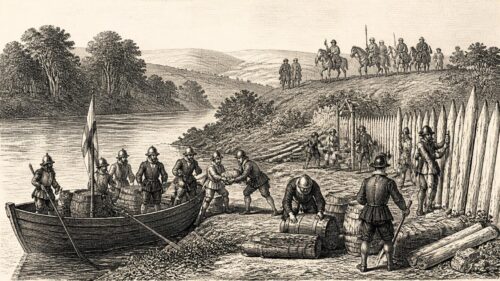
His authority was immediately tested. English captains and their soldiers had been operating in the lordship, while internal competitors remained active. The annals describe troops plundering the countryside, taking cattle and prisoners, and occupying or threatening key places including Donegal and Ballyshannon. Such reports should not be read as neutral military dispatches, but they illuminate the everyday stakes of high politics. Cattle were movable wealth, prisoners could be ransomed, and religious houses could become lodgings, stores or targets. For tenants, herdsmen, religious communities and small settlements, the contest for lordship brought requisitioning, displacement and insecurity.
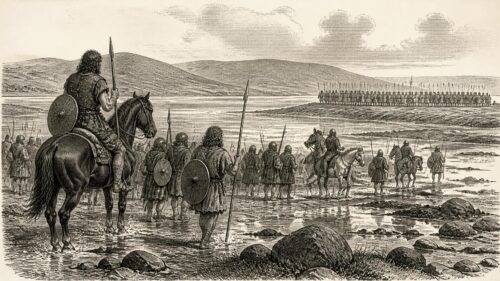
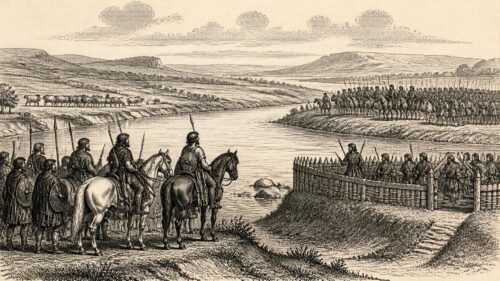
Hugh Roe rallied supporters and compelled the withdrawal of troops from Donegal, according to the annalistic narrative. He then struck into neighbouring territories of Tír Eoghain. The attacks were not yet the open, kingdom-wide conflict later called the Nine Years’ War; that war is generally dated from 1593. Yet the pattern was unmistakable. Raids, counter-raids, contested garrisons and the movement of armed followers were reshaping the balance of power before a formal breach with the crown occurred.
Dundalk and Conditional Peace
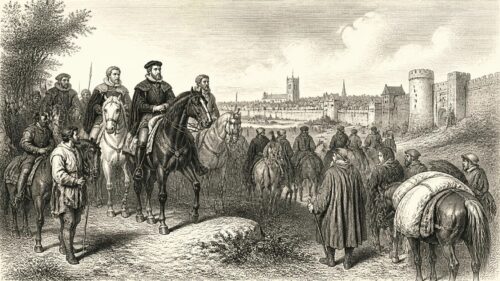
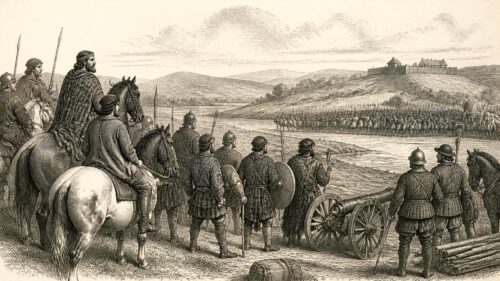
During the summer, Hugh O’Neill acted as intermediary between Hugh Roe and Sir William Fitzwilliam, the lord deputy. In July, Hugh Roe travelled under protection to Dundalk and made his submission to the government. The encounter is firmly connected to 1592 and shows that rebellion and obedience were not straightforward alternatives. O’Donnell sought official recognition while retaining the power gained at home; Fitzwilliam sought to stabilise a volatile lordship without committing the resources needed for full conquest.
The reported undertakings were revealing. Hugh Roe was to acknowledge Elizabeth’s authority, accept a sheriff in Tír Chonaill, pay rents promised by his father, treat rivals fairly, refrain from supporting opponents in Connacht and exclude Catholic clergy from his lordship. The terms combined finance, local administration, factional politics and religion. They show how the crown hoped to convert a Gaelic polity into one governed through sheriffs, rents and obedient officeholders. They also show why the arrangement was fragile. A settlement dependent on a young lord’s promises, an ageing deputy’s judgement and an earl of Tyrone’s mediation could not resolve the underlying dispute over who governed Ulster.
Irish annals also describe O’Donnell’s campaigns against Turlough Luineach O’Neill, the older holder of the O’Neill title, and forces associated with him. Houses outside Strabane’s defences were reportedly burned after the opposing side refused battle. The details come from a partisan narrative and should be treated as such, but the wider conclusion is sound: Hugh Roe’s recovery strengthened Hugh O’Neill against his internal rival. The two related leaders did not thereby create a single Irish command, but their interests increasingly converged.
All Hallows Becomes a College
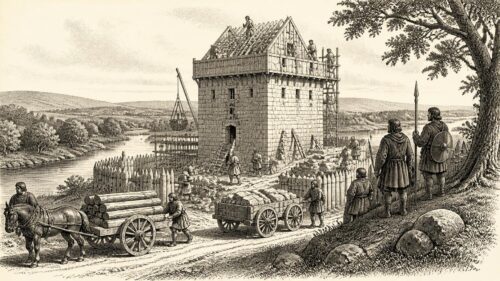
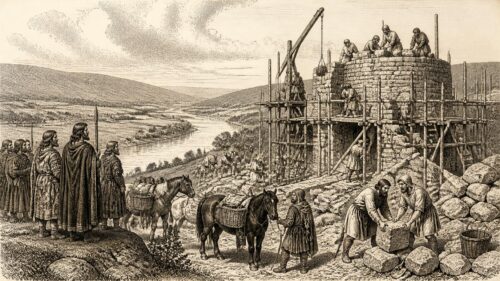
While authority was being contested in Ulster, a very different assertion of state purpose occurred in Dublin. On 3 March 1592 Elizabeth I granted a royal charter establishing the College of the Holy and Undivided Trinity near Dublin, described as the mother of a university. Dublin Corporation provided the site: the former Augustinian priory of All Hallows, east of the small walled city. The location and the grant bound civic government, church leadership and royal authority together in a conspicuous project of institutional building.
The initiative had been promoted by Archbishop Adam Loftus and other members of Dublin’s Protestant elite, including Henry Ussher and Luke Challoner. It was not a neutral scheme for learning in the modern sense. Its founders hoped to supply educated clergy and civil servants and to consolidate the Protestant Reformation in a kingdom where the established Church of Ireland had limited support among the majority of the population. In this respect, the college was part of the Tudor state’s wider ambition to make government more durable through trained personnel, English legal culture and a reformed church.
The new foundation should not be imagined as an instant university town. It began without a large endowment or a great body of students, and its early buildings occupied only a small portion of the spacious former monastic site. Yet the charter mattered because it created a corporate body with a provost, fellows and scholars, able to hold property, teach and develop a library. Dublin, increasingly functioning as the administrative capital of the kingdom, now possessed a college intended to stand alongside the educational institutions of England and Scotland.
Religion, Spain and an Unfinished Crisis
Religion connected these two apparently separate stories. Trinity’s founders regarded education as a means to secure Protestant ministry and public service. In Ulster, meanwhile, Catholic networks were becoming more politically active. Edmund Magauran, the Catholic archbishop of Armagh, was in Spain during much of 1592. In September he obtained an audience with Philip II and carried a promise of Spanish assistance to Irish leaders. He sailed from Bilbao in October and reached Drogheda in December after a hazardous voyage.
Magauran’s arrival did not cause a Spanish landing or an Irish general rising in 1592. Those are later developments and should not be projected backwards. It did, however, bring overseas diplomacy directly into the year’s political calculations. The prospect of Spanish help gave a wider European dimension to the fears of Dublin Castle and to the hopes of Catholic clerics and northern lords. By year’s end, Ireland was not yet at war across the kingdom, but the elements of a larger confrontation were in place: disputed lordships, insecure government expansion, confessional division, private alliances and the possibility of foreign intervention.
Thus 1592 was a year of restoration and foundation. Hugh Roe O’Donnell’s escape and installation restored a Gaelic power that the crown had tried to contain. Trinity’s charter founded an enduring Protestant and civic institution on the edge of Dublin. Each development had consequences far beyond its immediate setting. One helped make Ulster more difficult to govern; the other equipped the colonial state with an intellectual and clerical centre. Ireland entered the following year with neither question resolved.

Primary Sources
- Annals of the Four Masters
- Annals of the Four Masters, Annal 1592
- Beatha Aodha Ruaidh Uí Dhomhnaill
- Beatha Aodha Ruaidh Uí Dhomhnaill: English Translation
- O'Donnell, ‘Red’ Hugh (Ó Domhnaill, Aodh Ruadh)
- O'Neill, Hugh
- O'Byrne, Fiach MacHugh
- Fitzwilliam, Sir William
- O'Neill, Turlough Luineach
- Maguire, Hugh
- O'Neill, Sir Toirdhealbhach
- MacDonnell (Nic Dhomhnaill), Fiona (Fionnghuala) (‘Iníon Dubh’)
- Magauran, Edmund
- Loftus, Adam
- Ussher, Henry
- Challoner, Luke
- History – About Trinity
- Early Days: 1592–1640
- Calendar of the State Papers Relating to Ireland, 1588–1592, Volume 4
- State Papers Ireland 1509–1782: Government Papers on Irish Affairs