

Yellow Ford’s Broken Column1598 CE
In 1598, the Battle of the Yellow Ford transformed the Nine Years’ War into a crisis for English government in Ireland. On 14 August, a crown army suffered devastating defeat near the River Blackwater in County Armagh. Confederates associated with Hugh O’Neill and Hugh Roe O’Donnell gained confidence, while royal forward positions became harder to maintain. Revolt widened beyond Ulster into Leinster and Munster. The outcome emerged from a year combining warfare, negotiation and political manoeuvre, rather than inevitable rebel victory. Yellow Ford’s significance lay in its consequences: weakened royal strategy, strengthened resistance and an expanding challenge to crown authority.
Dateline
A Crisis at the Blackwater
In 1598 the Nine Years’ War ceased to look like a difficult northern rebellion and became a crisis for English government across Ireland. The year’s decisive episode was the Battle of the Yellow Ford, fought on 14 August beside the River Blackwater in County Armagh. Its importance lay not merely in the destruction inflicted on a crown field army, but in what followed: the abandonment of forward positions in Ulster, renewed confidence among the confederates led by Hugh O’Neill, earl of Tyrone, and Hugh Roe O’Donnell of Tír Chonaill, and a rapid widening of revolt into Leinster and Munster.
It is important not to read the outcome backwards. At the beginning of the year, war, negotiation and private manoeuvre existed side by side. Government commissioners had been treating with O’Neill and O’Donnell, while both leaders used talks to protect their position and gain time. By the spring the commissioners concluded that the negotiations were going nowhere. The expiry of the truce in June brought the immediate military issue into sharp focus: the crown’s Blackwater fort, known in contemporary Irish accounts as the New Fort, was under pressure and short of supplies.
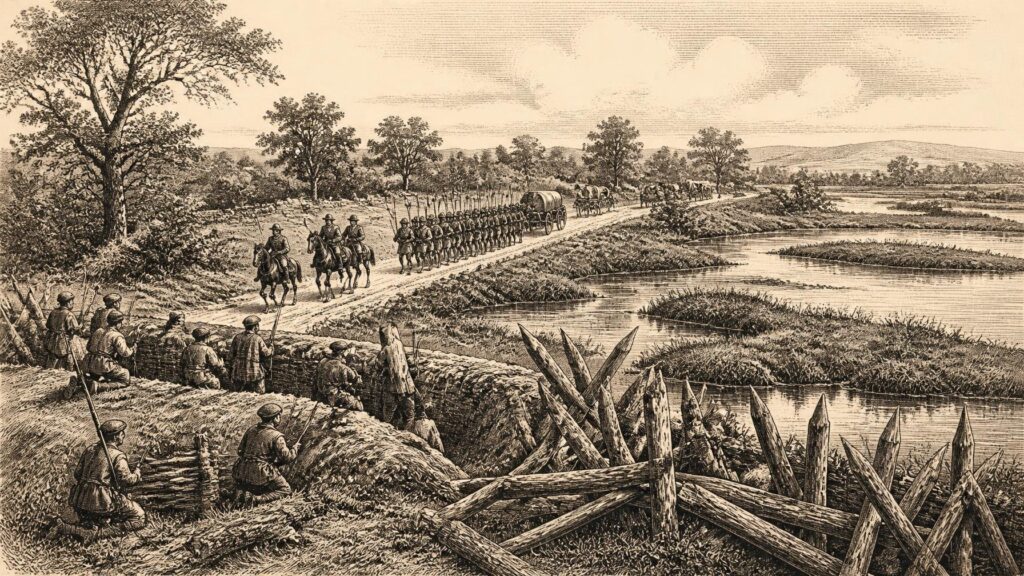
The fort mattered because it projected crown power into the heart of Tyrone’s country. It also exposed the limits of that power. Everything needed by its garrison—food, drink, ammunition, pay and reinforcements—had to be carried along vulnerable roads from the settled and garrisoned zones to the south and east. A government letter of 2 August reported that O’Neill had obstructed the route between Armagh and the Blackwater with felled and interwoven timber, deep holes, trenches and other fortifications. This was a war in which the control of tracks, river crossings and provisions could matter as much as possession of a castle.
The March from Armagh
Sir Henry Bagenal, marshal of the Irish army and a powerful figure on the Ulster frontier, received command of the relief expedition. His personal enmity with O’Neill had long been acute, but the campaign was larger than their feud: it was an effort to maintain the crown’s military corridor into Ulster. Accounts differ on the precise numbers, as they do for losses, but the force was substantial—roughly 3,500 foot and 300 horse in the government’s own pre-battle estimate, with artillery, ammunition and a supply train. It reached Armagh and, on the morning of 14 August, marched towards the fort.
The Irish confederate army was not simply an improvised gathering. O’Neill’s force included men trained and armed in ways shaped by contemporary European warfare, while O’Donnell brought troops from the north-west and Connacht allies. The army exploited ground it had prepared. Irish narrative sources describe commanders placing troops behind a sequence of ditches and trenches; crown accounts likewise acknowledged the obstacles. The tactical aim was to slow and divide an enemy whose column had to move along a constricted route while protecting artillery and baggage.
The fighting was hard and confused rather than a single charge at a ford. Bagenal’s advance guard crossed early obstacles, but continued fire and attacks on the flanks and rear disrupted contact between the companies. Bagenal was killed. During the action an explosion in the crown ammunition train deepened the disorder. The Annals of the Four Masters, written later from a strongly Irish perspective, gives a vivid account of the blast and rout; it should not be treated as neutral reportage, but its central outline is corroborated by other evidence. Modern estimates generally suggest that losses may have approached half of Bagenal’s field force, though a secure exact total cannot be recovered.
The human reality behind such figures was brutal. Soldiers were killed in combat and during the retreat; wounded men, camp followers and servants were especially exposed. Before leaving Armagh, the army had left behind victuals, baggage and non-combatants. The battle therefore threatened not only the fighting column but the larger temporary community that travelled with an early modern army. For inhabitants around Armagh and the Blackwater, fields, roads and settlements became a military landscape: a source of food, labour, intelligence and shelter, but also a place liable to requisition, destruction and flight.
Victory, Withdrawal and Negotiation
Those crown troops who escaped fell back to Armagh. Two days after the battle, on 16 August, the lords justices and Irish council wrote directly to O’Neill. Their letter recognised that many of the soldiers had retired into the town and urged him to permit their departure without further harm. Its language was a striking indication of weakness: Dublin could threaten Elizabeth I’s displeasure, but it also had to ask the victorious commander for restraint.
The immediate result was the evacuation of the Blackwater fort and of Armagh’s forward garrison. O’Neill did not, however, march on Dublin or instantly overthrow the administration. His army had incurred losses of its own, and its strengths in field warfare did not automatically translate into the capacity to take major walled towns. Yet the political effect was immense. The crown had lost experienced officers, weapons and prestige, while O’Neill had shown that a large Tudor expedition could be checked and broken in Ulster.
Yellow Ford also changed the language through which contemporaries understood the conflict. O’Neill’s alliance drew upon lordship, defence of local rights, opposition to intrusive government and an increasingly prominent appeal to Catholic religion. These motives did not make every participant politically identical. Gaelic lords, Old English landowners, townspeople, soldiers and plantation settlers faced different pressures and had different interests. Still, victory made the confederacy appear a plausible national alternative to the crown’s advancing system of sheriffs, garrisons, provincial presidencies and land settlements.
Munster’s Sudden Upheaval
The most dramatic consequence came in the south. In the autumn, O’Neill’s allies Owny O’More and Richard Tyrrell moved towards Munster, where grievances over land, official power and the earlier destruction of the Desmond lordship had left deep reserves of discontent. In early October Piers Lacy of County Limerick entered open rebellion; a contemporary manuscript history says that others followed in quick succession. On 10 October James FitzThomas Fitzgerald joined the main rebel army and was proclaimed earl of Desmond—the figure later derisively called the Súgán, or ‘straw’, earl by his enemies.
The rising overturned much of the Munster plantation established on former Desmond lands after the 1580s wars. English undertakers had received estates on condition that they settle and improve them, but the plantation was uneven, thinly defended and dependent on the security supplied by crown forces. Thomas Butler, earl of Ormond, reported to Elizabeth on 12 October that, apart from three or four, the undertakers had abandoned their castles and houses before rebels came into view, leaving munitions, livestock and goods behind. His hostile wording served his own political purposes, but it captures the speed with which settlement could collapse once protection disappeared.
The collapse brought real violence, dispossession and fear. Settler families fled towards defended towns, especially Cork; homes and farm buildings were burned or seized, and local communities were pulled into decisions about loyalty, protection and survival. Later English accounts often presented every episode through atrocity narratives, and historians warn against accepting their rhetoric uncritically. That caution does not mean that the upheaval was bloodless. Rather, the surviving evidence requires a distinction between securely documented flight and seizure, and wider claims whose numbers and circumstances are difficult to verify.
For Munster’s Irish inhabitants, 1598 did not simply mean an attack on ‘English’ settlers from outside. Some participants sought restoration of older lordly claims; others reacted to plantation tenure, military exactions or local rivalries. Many remained cautious, and rivalries soon weakened rebel unity. The year nevertheless exposed the fragility of a settlement project that had attempted to reorder ownership, agriculture and allegiance in a region still marked by the Desmond wars.
Spain, Religion and an Uncertain Future
Ireland’s crisis belonged to the wider Anglo-Spanish war. O’Neill and O’Donnell had already sought Spanish assistance, presenting their cause in Catholic as well as political terms. Philip II of Spain died on 13 September 1598, but correspondence did not cease: a surviving copy records Philip III writing to O’Neill and O’Donnell on 31 October. Such exchanges encouraged hopes of intervention, though no Spanish army arrived in Ireland during 1598. For the confederates, Spanish backing remained a possibility rather than a dependable resource; for Elizabeth’s government, it made an Irish military reverse part of a far larger strategic danger.
By the end of the year, Ireland was more unstable than it had been in January. Crown authority endured in Dublin, in major walled towns and in important garrisons, but the assumptions behind its advance had been shaken. The Blackwater campaign demonstrated how force could fail when supply, terrain and local political support worked against it. The Munster rising demonstrated how quickly military defeat in Ulster could unsettle property and allegiance hundreds of miles away. Yellow Ford was thus not merely the year’s great battle. It was the moment at which a northern war became an island-wide emergency.
Primary Sources
- Annals of the Four Masters: Annal M1598
- Beatha Aodha Ruaidh Uí Dhomhnaill, Part 8
- The Lords Justices and the Irish Council to Hugh O'Neill, earl of Tyrone, 16 August 1598
- A Calendar of Manuscript Material relating to Ireland, 1580–1602
- Portions of a Manuscript History Relating to Ireland
- Portions of a Manuscript History Relating to Ireland: Piers Lacy and the Munster Revolt
- Earl of Ormond to Elizabeth I, 12 October 1598
- Hugh O'Neill
- O'Donnell, ‘Red’ Hugh (Ó Domhnaill, Aodh Ruadh)
- Fitzgerald, James fitz Thomas
- Tyrrell, Richard
- Political Discourse and the Nine Years’ War in Late Elizabethan Ireland, c.1593–1603
- Memories of Violence and New English Identities in Early Modern Ireland
- State Papers Ireland 1509–1782: Government Papers on Irish Affairs
- The Discovery and Recovery of Ireland with the Author's Apology
- Dialogue of Silvynne and Peregrynne
- Letter Book of Florence Mac Carthy Reagh, Tanist of Carbery, Mac Carthy Mór
- Copy of a Letter, in Latin, from Philip III of Spain to O'Neill and O'Donnell, 31 October 1598
- Calendar of Letters and State Papers Relating to English Affairs Preserved Principally in the Archives of Simancas, Volume 4
- Pacata Hibernia: Or, A History of the Wars in Ireland During the Reign of Queen Elizabeth
- A Calendar of Manuscript Material Relating to Ireland, 1580–1602: TEI Header