

Chichester’s July Proclamation1605 CE
In 1605, Sir Arthur Chichester became lord deputy, seeking to convert victory in the Nine Years’ War into durable royal control through law, land reform, revenue and Protestant conformity. March’s proclamation declared Irish people direct subjects of James I, challenging Gaelic lordship and encouraging fixed rents and tenures. Hamilton’s November grant in County Down foreshadowed Scottish settlement, without constituting the later Ulster Plantation. July’s proclamation expelled Catholic clergy and demanded Church of Ireland attendance, while mandates targeted Dublin Catholics. Administrative changes strengthened Protestant authority. Continental Catholic education and military service across Europe also underscored an uneasy post-war settlement in Ireland.
Dateline
In 1605, Ireland was not at war in the manner it had been only two years earlier, but peace was neither simple nor settled. The Nine Years’ War had ended with the treaty at Mellifont in 1603, bringing the great Ulster lords, including Hugh O’Neill, earl of Tyrone, into formal submission to King James I. Yet the end of campaigning did not resolve the central question that faced the new Stuart regime: how could a crown that had conquered the island make its authority routine in communities accustomed to powerful local lordships, Gaelic legal custom and overwhelmingly Catholic religious life?
The year’s most important development was a change of administration. On 3 February, Sir Arthur Chichester became lord deputy of Ireland. A veteran soldier of the Ulster war and a substantial landowner around Carrickfergus, Chichester arrived with a markedly more interventionist view of government than the conciliatory mood which had accompanied the 1603 settlement. His task was not simply to prevent renewed rebellion. It was to convert military victory into a durable system of royal law, revenue, landholding and religious conformity.
A Deputy for the Peace
Chichester governed from Dublin Castle on behalf of James I, who was king of England, Scotland and Ireland. The multiple kingdoms remained legally distinct, but the union of the English and Scottish crowns in 1603 gave Irish policy a new British dimension. Scottish courtiers, soldiers, merchants and prospective tenants now had readier access to royal favour and Irish opportunities. Ireland’s political future would increasingly be shaped by that connection, especially in Ulster.
The deputy inherited a country still carrying the physical and social consequences of war. Garrisons, forts and military officials remained important across Ireland, particularly in the north. Roads and districts which the crown had only recently entered by force still required supplies, policing and negotiation. Chichester’s early government therefore combined a desire to reduce extraordinary wartime practices with an insistence that royal authority could reach further than before. Commissions for martial law were reviewed and many were withdrawn, but the administration retained coercive resources and did not abandon the military framework through which conquest had been completed.
That balance mattered to ordinary people. The ending of open warfare could mean safer movement to markets, a diminished risk of raiding and the prospect of cultivating land without an army nearby. But it also meant new officials, courts, rents and demands. For many inhabitants, especially in recently conquered areas, the peace brought not a return to an earlier order but a transition into a more intrusive one.
Subjects of the Crown
A proclamation of 11 March expressed the regime’s ambition in unusually direct terms. It declared the people of Ireland to be immediate subjects of the crown rather than subjects of any local lord or chief. The wording was politically consequential. It challenged the assumption that authority in a Gaelic lordship was mediated principally through the lord’s lordship, kinship and client networks. In the crown’s ideal, every inhabitant stood in a direct relationship to the king and could claim the king’s law.
This was not an overnight abolition of Gaelic society, nor did a proclamation instantly settle disputed rights to land. Local power remained real, and magnates continued to command respect, service and armed followings. But the policy gave royal officials a principle with which to intervene between lord and tenant. In Ulster during 1605, Chichester sought to encourage leading men to grant their tenants more secure estates through freeholds, copyholds or leases, while substituting fixed rents for older, variable exactions. To crown servants, this promised settled agriculture, clearer titles and more dependable revenue. To lords, it threatened to narrow customary authority; to tenants, it could offer security but also placed their holdings within unfamiliar English legal forms.
The language of reform was therefore not neutral. Officials described traditional charges as oppressive or disorderly, while Gaelic elites could see the same programme as a deliberate weakening of their position. The politics of land and the politics of sovereignty were inseparable. A tenant’s written lease, a sheriff’s warrant or a circuit judge’s arrival could alter the local balance of power as surely as a fort had done during the war.
Ulster Before Plantation
It is important not to project the later, organised Ulster Plantation backwards into 1605. The great Crown plantation of six Ulster counties followed the Flight of the Earls in 1607 and the subsequent forfeitures; it had not yet begun. Hugh O’Neill and Rory O’Donnell, earl of Tyrconnell, still held their titles and considerable landed influence. Their adjustment to the post-war settlement was uneasy, but neither man had fled Ireland, and the province had not yet been confiscated wholesale.
Nevertheless, 1605 contained a significant precursor in east Ulster. In November, James Hamilton received a royal grant of Upper Clandeboye and the Great Ardes in County Down. The grant arose from the complicated division of the Conn O’Neill estate, in which Hamilton, Sir Hugh Montgomery and Conn O’Neill each had interests. It gave Hamilton a large territorial base beside Belfast Lough and Strangford Lough and made plain the opportunities opened by royal patronage.
The grant itself was a change in ownership and authority, not yet a completed demographic transformation. The substantial arrival of Lowland Scottish tenants on the Hamilton and Montgomery estates belongs to 1606. Yet in 1605 the legal foundation was being laid for settlement, estate management and the redirection of rents towards new proprietors. County Down thus offered an early model of a process that would become much more extensive after 1607: political insecurity and royal law could be used to remake landholding, settlement and the relationship between local communities and the crown.
No Toleration
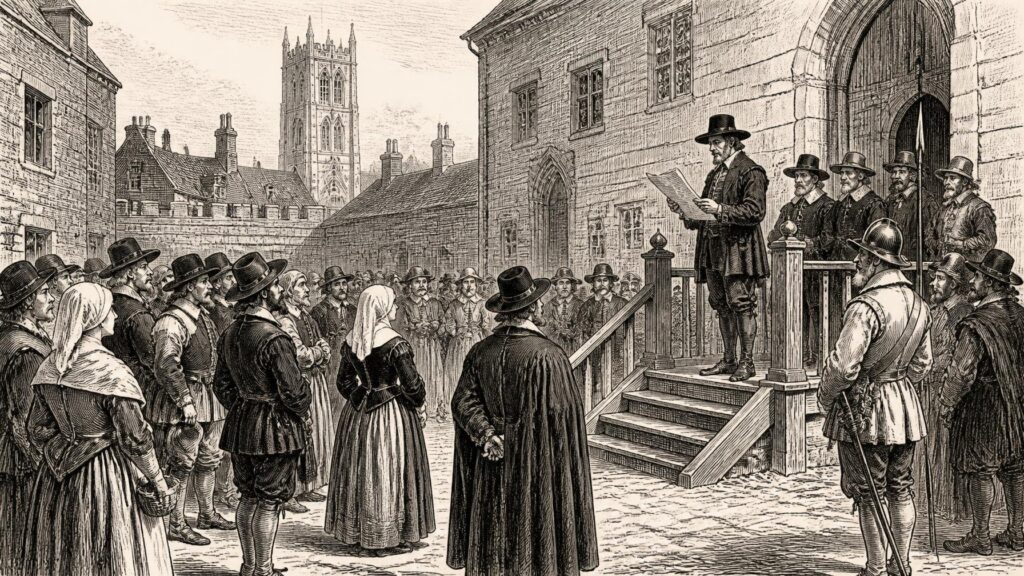
The sharpest immediate conflict of 1605 concerned religion. Many Catholics had hoped that James’s accession might produce a relaxation after Elizabethan warfare. Those hopes were decisively checked by a royal proclamation issued on 4 July. It ordered Jesuits, seminary priests and other clergy ordained by authority derived from Rome to leave Ireland by 10 December. It also directed lay people to attend services of the established Church of Ireland under the penalties provided by law.
The proclamation did not make Ireland Protestant. The great majority of the population remained Catholic, and the state did not possess enough reliable clergy, churches, money or local cooperation to transform practice quickly. In many parishes, the established church was poorly provided, while Catholic worship depended upon networks of priests, households, patrons and communities. The measure should therefore be understood chiefly as a declaration of official intent: James’s government would not recognise a general religious toleration in Ireland, and Chichester’s administration would try to make conformity politically meaningful.
Its effects were felt most immediately in towns and among the wealthier Catholic elite who could be identified, summoned and fined. During the latter part of 1605, Chichester began the policy later known as the ‘mandates’: instructions directed at prominent Dublin Catholics requiring attendance at the established church. Sixteen leading Catholics were selected. The initiative had apparently been delayed by plague in Dublin, a reminder that disease still shaped the timing and capacity of government as well as household life. The policy was coercive, but its very selectivity exposed the limits of the administration. It could pressure named aldermen, merchants and gentlemen more easily than it could regulate belief across the country.
Dublin’s Changing Establishment
Religious policy and high office converged in Dublin during the same year. Adam Loftus, archbishop of Dublin and lord chancellor of Ireland, died at St Sepulchre’s on 5 April. Loftus had been a central figure in the Tudor reformation and in the construction of a Protestant governing elite around the capital. His death removed a man whose ecclesiastical office, legal authority, family alliances and connection with Trinity College Dublin had made him exceptionally influential.
Thomas Jones succeeded him as lord chancellor and archbishop of Dublin in November. Jones was already a committed advocate of a more assertive Protestant policy, and Chichester regarded him as a trusted ally. The concentration of the chancellorship and Dublin archbishopric in Jones’s hands was more than a personnel change. It symbolised a government in which the established church, law and executive power reinforced one another. In a kingdom where confessional allegiance was also bound up with inheritance, urban office and political trust, that alignment carried obvious consequences for Catholics of the Pale and the towns.
Irish Connections Abroad
Developments beyond Ireland also mattered. In Paris, John Lee, a priest from a Waterford mercantile family, moved the residence for Irish students to a house in the rue de Sèvres in 1605 with the assistance of Jean de l’Escalopier. This was an important stage in the formation of the Irish College in Paris. It did not answer the proclamation at home, but it illustrates how Irish Catholic education and clerical formation were becoming ever more dependent on continental networks.
Military links likewise endured. In the Spanish Netherlands, Henry O’Neill, a son of the earl of Tyrone who had been sent abroad during the war, became colonel of an Irish regiment in Spanish service late in 1605. This was not an Irish uprising and should not be treated as one. It was, however, a reminder that former Irish combatants and their families remained connected to European conflict, Catholic patronage and Spanish power. For officials in Dublin and London, those connections made religious enforcement and the management of Ulster appear matters of international security as well as domestic order.
An Uneasy Settlement
By the end of 1605, no single dramatic rupture had occurred in Ireland. Instead, the year established patterns. Chichester’s deputyship gave the post-war regime a forceful administrator. The March proclamation asserted a direct bond between king and subject. The July proclamation rejected religious toleration. The Down grant anticipated a new relationship between Scottish settlement, royal title and Ulster land. Dublin’s offices passed into hands more closely identified with Chichester’s programme, while Irish Catholic learning and Irish military service continued across the Channel.
These were connected developments, but they should not be mistaken for an inevitable script. The future plantation of Ulster, the Flight of the Earls and later conflicts were still ahead. What can securely be said of 1605 is that the crown was testing how far a peace won by arms could be consolidated by proclamations, property law, office-holding and religious pressure. For Ireland’s people, that experiment made the post-war settlement feel less like an ending than the beginning of a new and uncertain political order.
Primary Sources
- Calendar of the State Papers, Relating to Ireland, of the Reign of James I, 1603–1606
- State Papers Ireland 1509–1782: government papers on Irish affairs
- Chichester, Arthur
- O’Neill, Hugh
- Jones, Thomas
- Loftus, Adam
- The Irish College in Paris: John Lee
- Lord Deputy Chichester and the English Government’s ‘Mandates Policy’ in Ireland, 1605–1607
- Henry O’Neill and the Formation of the Irish Regiment in the Netherlands, 1605
- Provincial Government and Administration in Jacobean Munster
- The Commonwealth of Ireland, Part I
- A Discovery of the True Causes Why Ireland Was Never Entirely Subdued
- By the Lord Deputie and Councell
- The Hamilton Manuscripts: Containing Some Account of the Settlement of the Territories of the Upper Clandeboye, Great Ardes, and Dufferin
- The Plantation of Ulster: Story of the Irish Map
- East Ulster 1606
- Statute Law Revision Act 2015, Schedule 2
- Two Seventeenth-Century Franciscans from Thomond
- Calendar of the State Papers, Relating to Ireland, of the Reign of James I: Google Books record
- Observations Made by Sir John Davies, Attorney of Ireland
- Sir Arthur Chichester, Lord Deputy of Ireland, 1605–1616
- Irish Colleges on the Continent