

Derry’s First Jacobean Charter1604 CE
In 1604, after the Nine Years’ War, the crown sought to convert military victory in Ireland into durable administration. James I’s 11 July charter for Derry envisaged a fortified commercial town on the Foyle, combining garrison, trade, law and settlement, though it preceded the later Ulster Plantation. Recovery remained painful amid famine, displacement and contested land rights; Brian Óg O’Rourke’s death symbolised defeated resistance. Knighthoods, patents and territorial grants rewarded cooperative elites while reshaping Gaelic lordship and provoking rivalries. Anglo-Spanish peace reduced prospects of intervention. Arthur Chichester’s appointment and John Davies’s policies foreshadowed stronger crown government, surveys and planned settlement.
Dateline
In 1604, Ireland was emerging from the devastation of the Nine Years’ War, not into a settled peace but into a testing period of reconstruction, negotiation and official redesign. The conflict had ended only in 1603, after years in which armies had moved across much of the island, crops and livestock had been destroyed, and famine had accompanied military campaigning. James VI of Scotland, now also James I of England and king of Ireland, inherited a kingdom whose formal submission to the crown was more complete than ever before. Yet the means by which that authority would work in local communities, especially in Ulster, remained uncertain.
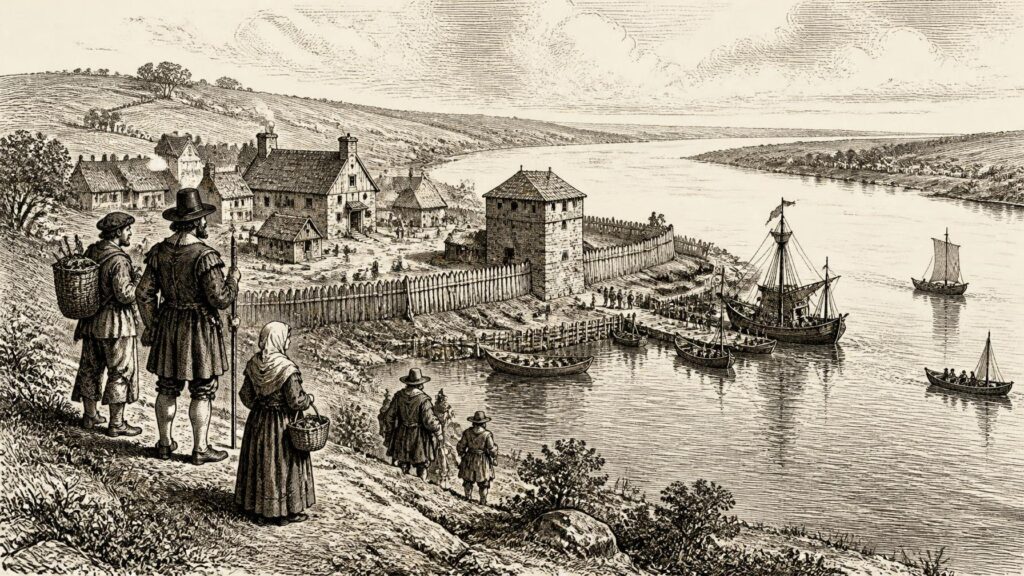
The year’s most significant firmly dated Irish development came on 11 July, when James granted Derry its first Jacobean charter. The document made unusually explicit the crown’s intentions for the place. Derry, it said, was naturally suited to become both a “town of war” and a “town of merchandise”: a fortified strategic base and a commercial settlement. That double purpose captured the character of government policy in post-war Ireland. Security, settlement, law, trade and the reshaping of landholding were not separate projects. They were parts of a single attempt to secure a newly conquered region.
A Charter for Derry
Derry was an old ecclesiastical site on the River Foyle, but the settlement addressed in 1604 had been transformed by recent war. Sir Henry Docwra’s expedition had established itself there in 1600, building and maintaining a crown foothold in north-west Ulster at immense human and financial cost. The position provided a route into Tír Chonaill and Tyrone, controlled access to Lough Foyle, and threatened the communications of Hugh O’Neill and the O’Donnell lordship during the final phase of the war.
The charter of 11 July recognised Docwra’s work in recovering, repairing and repopulating a place described as ruined and wasted during the rebellion. It envisaged walls, entrenchments, inhabitants, liberties and legal incorporation. Its language should not be mistaken for a description of a fully built urban reality. It was a programme as much as a recognition of what existed: the crown wanted a defensible, governed and marketable town at a key northern river crossing and harbour. Soldiers, officials, craftsmen, traders and their households were therefore central to the future imagined for Derry.
It is important not to read the later Plantation of Ulster backwards into 1604. The new charter did not itself create the later City of Londonderry or complete the large-scale London-backed plantation associated with the 1610s. Those later developments followed further political crises, including the flight of leading Ulster earls in 1607 and the rising led by Cahir O’Doherty in 1608. But the charter was an important early marker. It identified Derry as a site where military occupation could be converted into an urban institution, commercial opportunity and a durable instrument of crown authority.
For local people, such plans carried mixed implications. A fortified market town might offer employment, protection and access to trade. It also meant garrisons, officials, new legal jurisdictions and pressure upon older patterns of landholding and authority. The words “war” and “merchandise” belonged together because commerce could help sustain a garrison, while military power could protect a settlement intended to attract newcomers and investment.
Aftermath of a Long War
The charter needs to be understood against the immediate aftermath of the Nine Years’ War. The war had not merely decided a contest between commanders. In Ulster and elsewhere, civilians had endured the destruction of food supplies, displacement, disease and hunger. The crown now faced the practical burden of maintaining forts, paying troops, restoring communications and converting wartime control into everyday administration. Peace did not instantly repair fields, households or local economies.
The death on 28 January of Brian Óg O’Rourke at the Franciscan friary of Ross Errilly in County Galway was a sombre sign of that unfinished aftermath. O’Rourke, a lord of West Breifne and a prominent commander in the Irish confederacy during the war, had been driven from his lordship after 1603. He died of fever while in hiding and reportedly awaiting passage to Spain. His death did not end the O’Rourke family’s importance in Breifne, but it removed one of the last major figures who had remained in the field against the crown. It also illustrates how a defeated lord might be reduced from commanding men and territory to dependence upon religious shelter and overseas escape.
Such individual stories caution against treating 1604 as a clean dividing line between “war” and “peace”. Formal submission and royal pardons could coexist with dispossession, family rivalries and fear of litigation. Land titles were increasingly examined through crown law, while Gaelic and old English elites sought grants that would make their estates secure under the new regime. A patent might offer protection, but it could also redefine a lord’s rights, impose rents, exclude dependants or separate a lesser landholder from a traditional overlord.
Rewards, Patents and Divided Loyalties
Government policy in 1604 did not rest on wholesale replacement of Irish elites. It also depended on rewarding men prepared to serve the crown, often by recognising them as knights, landowners or office-holders. On 17 April at Reban in County Kildare, the lord deputy, Sir George Carew, knighted Toirdhealbhach O’Neill of the Fews, Donnchadh O’Connor Sligo and Tadhg O’Rourke. These honours were political statements. Each recipient came from a family whose position had been shaped by the war, internal succession disputes and negotiations with royal officials.
Knighthood did not erase older loyalties. Toirdhealbhach O’Neill had served the crown at critical moments, but remained connected by kinship and local interest to the wider world of Ulster lordship. Donnchadh O’Connor Sligo, recently pardoned after a turbulent career, was trying to defend a diminished estate against competing claims. Tadhg O’Rourke had gained Breifne with crown assistance while his half-brother Brian Óg was driven into exile. Royal favour could therefore intensify local conflict as readily as it ended it. It encouraged allies to identify their interests with English law and royal grants, but it made other relatives and dependants vulnerable.
In Tír Chonaill, Ruaidhrí O’Donnell, recently created earl of Tyrconnell, received in April a grant of most of his ancestral territory. Yet the settlement expressly preserved Sir Cahir O’Doherty’s lordship in Inishowen. This was a consequential limitation. O’Donnell had to accept a political landscape in which crown patents could define, fragment and rank rights formerly contested or settled by Gaelic lordship. O’Doherty, who had received his own grant in 1603 and held office within Derry’s civic framework, was at this stage regarded as a useful royal ally. The tensions within this arrangement would become clearer only later; in 1604, accommodation rather than revolt was the operative policy.
Elsewhere in Ulster, alliance-making continued through marriage as well as patent and office. Sir Randal MacDonnell of north-east Ulster married Ellis O’Neill, daughter of Hugh O’Neill, in 1604. The marriage showed that the old networks of kinship survived the war and could cross divisions hardened by military service. MacDonnell had cultivated royal favour, while Hugh O’Neill remained the pre-eminent Gaelic magnate in Tyrone despite his submission. Neither crown officials nor Irish lords could assume that political allegiance, family connection and religious identity would neatly coincide.
Peace Beyond Ireland
Ireland’s position was also affected by diplomacy beyond its shores. The Treaty of London, concluded between the English and Spanish crowns in August 1604, ended the long Anglo-Spanish war. Ireland had been one of that wider conflict’s theatres: Spanish expeditions and hopes of Spanish support had mattered greatly to the Irish confederacy, especially at Kinsale in 1601. The peace therefore removed the immediate prospect of a new Spanish intervention on behalf of Irish opponents of the crown.
Its importance should be measured carefully. The treaty did not end Irish Catholic links with continental Europe, nor did it stop Irish soldiers, clerics and exiles from travelling abroad. In December, for example, the Dominican Edmund O’Hallaghan secured financial support at the Spanish court for religious purposes connected with Ireland. Catholic devotional life and clerical organisation continued despite the established Church of Ireland and official suspicion of Catholic institutions. But Anglo-Spanish peace made open military assistance for a renewed Irish war far less likely, strengthening the crown’s confidence that its northern settlement could proceed without an immediate foreign challenge.
From Garrison to Government
By October, Arthur Chichester had been appointed lord deputy of Ireland, though he would assume office the following year. His appointment signalled continuity with the hard military methods used to defeat the northern rebellion, but also a turn towards civil administration, surveys, courts and planned settlement. The solicitor general, Sir John Davies, already argued that the crown should weaken the powers of great lords and establish more direct relations between the king and individual freeholders. These ideas were not yet a completed blueprint in 1604, but they were becoming increasingly influential.
Derry’s charter, the grants and honours bestowed on Irish elites, the settlement of disputed territories, and the Anglo-Spanish peace all belong to this moment of transition. The year was not one of a single dramatic battle or parliamentary act. Rather, it exposed the practical work of conquest after the fighting: deciding who could hold land, which towns would be strengthened, how allegiance would be rewarded, and whether military dominance could be made permanent through law, commerce and settlement.
For many inhabitants, recovery from war remained the immediate reality. For the crown, however, 1604 offered an opening to turn victory into a new political order. Derry’s first Jacobean charter was among the clearest statements of that ambition: a planned town on the Foyle, intended to be prosperous enough to sustain itself and strong enough to command a transformed Ulster.
Primary Sources
- Irish Patent Rolls of James I: Facsimile of the Irish Record Commission’s Calendar Prepared Prior to 1830
- Derry Corporation Minute Books: Historical Background
- History of the Role of the Mayor
- Docwra’s Derry: A Narration of Events in North-West Ulster 1600–1604
- Annals of the Kingdom of Ireland by the Four Masters
- The Annals of Ulster
- State Papers Ireland, 1509–1782: Government Papers on Irish Affairs
- Docwra (Dowkra, Dockwra, Dockwraye, Dockquerye), Sir Henry
- O’Doherty (Ó Dochartaigh), Cahir
- O’Donnell (Ó Domhnall), Ruaidhrí
- O’Rourke (Ó Ruairc), Brian Óg
- O’Neill, Sir Toirdhealbhach
- O’Connor Sligo, Sir Donal (Domhnall)
- MacDonnell, Sir Randal mac Sorley
- Chichester, Arthur
- Davies, Sir John
- Blount, Charles Brooke
- O’Hallaghan, Edmund (Simon of the Holy Spirit)
- Bodley, Sir Josias
- Virtual Record Treasury of Ireland: Patent Roll, 6 James I, Part 2
- Irish Texts at CELT
- Londonderry 400: Plantation of the Walled City