Membership is completely free, giving members unlimited access to all available resources, services, features, and benefits without any restrictions or fees.
Welcome back. Sign in to continue enjoying unlimited access to all available resources, services, features, and member benefits at no cost.
A firmly dated early event came in Waterford. On 23 January, the city’s charter was revoked after its citizens had repeatedly chosen recusants as civic officers. A recusant was a person who refused the religious conformity required by the established Church of Ireland, most often because he remained a Roman Catholic. Waterford was not merely a local corporation: it was one of Ireland’s principal ports, with a long tradition of municipal privilege, merchant government and overseas commerce. To remove its charter was therefore to challenge a corporate community that possessed both wealth and a strong civic identity.
James I was king in 1617, and Ireland was governed in his name by Sir Oliver St John, lord deputy since the previous year. The island had emerged from the Nine Years’ War without a fresh general rebellion, but peace did not mean continuity. Dublin Castle’s authority depended increasingly on sheriffdoms, courts, land surveys, patents, military garrisons and individual interventions in local disputes. A letter of 10 April illustrates this administrative reach. The English privy council asked St John to investigate claims made by Florence MacCarthy concerning mortgaged and occupied lands in Munster. MacCarthy’s petition referred to losses suffered during ‘the troubles’ and to his own restraint in England. It is a small, specific record, but an instructive one: landholding, debt, wartime dispossession and access to royal officials could all be entangled in one lawsuit.
The clearest Irish event of the year occurred far from Ireland. On 20 July 1616 Hugh O’Neill, second earl of Tyrone and the most formidable Irish lord of the previous generation, died in Rome. The date is firmly recorded in the Annals of the Four Masters. For contemporaries in the Irish Catholic world, his death marked the end of a life that had moved between accommodation with the crown, regional lordship, open rebellion and exile. For the Dublin administration, it removed a figure whose name still carried immense political weight, even though he had been absent from Ireland since the Flight of the Earls in 1607.
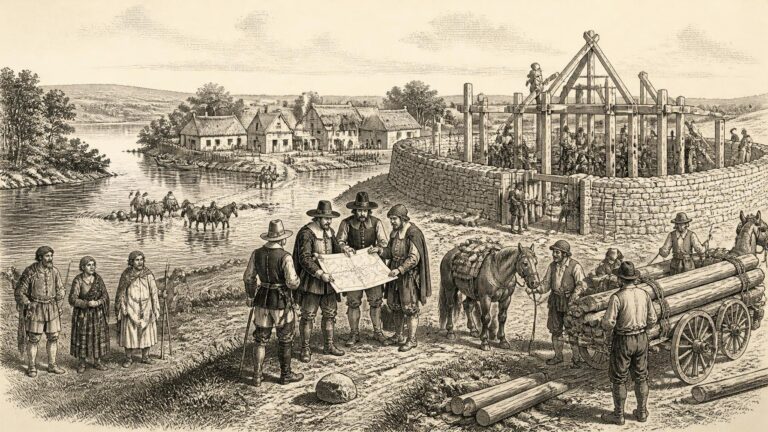
In 1615, Ireland was governed in the name of King James I by Sir Arthur Chichester, lord deputy since 1605. The great wars of the previous reign had ended, but peace had not made the kingdom settled. Nowhere was this clearer than Ulster. The flight of the earls in 1607, the defeat of Sir Cahir O’Doherty in 1608, and the ensuing confiscations had opened immense territories to the crown. The Plantation of Ulster was changing ownership, settlement and authority across six escheated counties. English and Scottish undertakers received estates on conditions: they were to build, bring in British Protestant tenants and form defensible villages. Native Irish communities, meanwhile, faced removal from some lands, insecure tenures on others, and the daily presence of new landlords, courts, garrisons and boroughs.
On 2 April, James I rebuked the Irish Catholic representatives who had travelled to England to complain about the conduct of the Irish parliament elected in 1613. Their grievances were substantial. The Crown had created many new boroughs, including plantation and small corporate towns, which returned members likely to support the government. Catholic opponents argued that this distorted representation; they also protested against the enforcement of the oath of supremacy and the exclusion of Catholics from municipal office. Their objections joined constitutional argument to the practical anxieties of established landowners and urban elites.
One firmly dated development belongs to the opening months. Between 2 February and 25 April, Sir Josias Bodley carried out a royal survey of the Plantation of Ulster. This was not simply a map-maker’s exercise. The Crown had confiscated extensive lands after the Flight of the Earls and subsequent upheavals, then divided much of the six ‘escheated’ counties among English and Scottish undertakers, military servitors, churches and selected Irish proprietors. Grantees had been expected to bring in British tenants, erect defensible houses and bawns, establish villages and keep armed settlers available for defence.
George Carew, Lord Carew of Clopton, was commissioned in June to investigate Irish government and, especially, the progress of the Ulster Plantation. He arrived in Dublin on 11 July. The surviving state-paper calendar dates the commissioners’ formal Ulster circuit from 29 July; Carew and his colleagues travelled north by way of Newry, Carrickfergus and Dunluce, reached Derry on 14 August, and then moved through Donegal, Fermanagh, Tyrone and Armagh. They were back in Dublin early in September, although Carew’s wider Irish business continued into October.
The formal Plantation centred on six counties where extensive lands had escheated to the Crown: Armagh, Cavan, Coleraine, Donegal, Fermanagh and Tyrone. This was not the whole of Ulster. Antrim and Down, for example, had already attracted substantial private settlement, particularly from Scotland. But the six escheated counties became the arena for a much more systematic Crown programme, designed in Dublin and London and justified as a means of security, revenue, Protestant reform and ‘civil’ order.