

Powell’s Dublin Prayer Book1551 CE
Dateline
In 1551, Ireland’s political map still consisted less of a single governed realm than of overlapping jurisdictions, alliances and rival claims. Edward VI was king, and the Dublin administration claimed authority over the whole island, but its regular reach remained strongest in Dublin, the Pale and a scattering of garrisons. Beyond them, Gaelic lordships and great aristocratic territories retained armed followings, local law, hereditary expectations and diplomatic connections across the Irish Sea. The year brought this uneven kingdom into sharp focus: an English prayer book was printed in Dublin for the first time, a new lord deputy took office, and government intervention in Ulster helped ignite a dangerous O’Neill family war.
Prayer, Print and Dublin
Religious policy gave 1551 its most enduring cultural landmark. On 1 March, Sir Anthony St Leger, then lord deputy, addressed a convocation of clergy in Dublin about the introduction of Edward VI’s reformed service, based on the 1549 Book of Common Prayer. The initiative was political as well as devotional. The Tudor crown’s claim to ecclesiastical supremacy in Ireland required bishops and clergy to acknowledge royal direction; a shared English-language liturgy was intended to make that direction visible in parish worship.
Its practical reach, however, should not be exaggerated. English was familiar in Dublin, the Pale and some towns, but was not the everyday language of most people across the island. Nor did the crown possess an effective machinery for enforcing changed worship in every diocese. Many clergy and lay communities remained attached to the inherited Latin rites, local saints’ cults and sacramental practices. The controversy therefore concerned not simply doctrine but authority: who could prescribe the form of worship, in what language, and through which institutions?
George Dowdall, archbishop of Armagh, embodied that resistance. He had accepted royal supremacy under Henry VIII, yet his churchmanship remained conservative and he opposed the advance of Protestant reform in his province. By July 1551 he had left Ireland rather than serve where the Mass was abolished. His departure did not mean that the old religion had disappeared from Armagh or Ulster. Rather, it showed the narrowness of governmental control and the fracture within a hierarchy which the crown hoped to use as an instrument of reform.
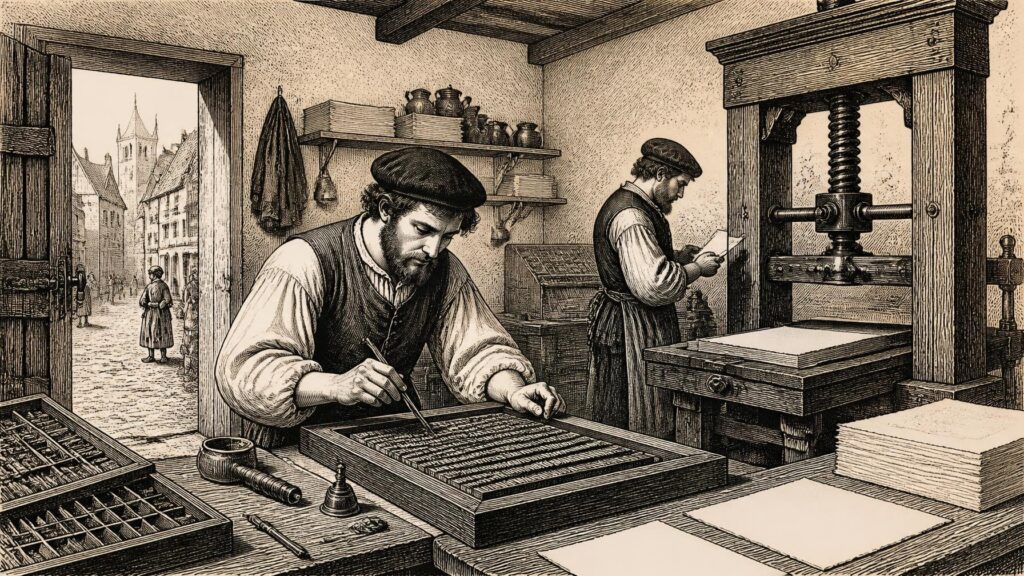
In Dublin, by contrast, reform acquired a remarkable material form. Humphrey Powell, a London printer assisted by a grant from the English privy council, arrived in the city in the spring and established a press in a chamber at the old city gate on Winetavern Street. By the summer he had printed The Boke of the Common Praier, the first book produced in Ireland by movable type. One of the surviving copies records a prayer for Sir James Croft, the incoming deputy, helping to place the edition after Croft’s assumption of office.
This was a modest volume, not an instant printing revolution. It was printed in English and aimed principally at the English-speaking church and governing world around Dublin. Yet its significance was substantial. Books could now be made under official supervision within Ireland rather than imported across the sea. The press joined royal government, religious reform and the urban economy in a single undertaking: compositors, paper, type, binding, patrons and purchasers all had to be assembled in a city where the crown’s authority was most concentrated. The first recorded use of the reformed service in Christ Church Cathedral that Easter relied on the same official programme, whether the particular books used were locally printed or brought from England.
St Leger Recalled, Croft Installed
The change in government was firmly dated. St Leger was replaced on 29 April, and Sir James Croft was sworn in as lord deputy on 23 May. St Leger’s removal followed mounting criticism of his administration, his handling of finance and his comparatively conciliatory approach to powerful Irish lords. He had long favoured negotiation, pardons and grants of land held from the crown—what historians call surrender and regrant—rather than attempting conquest everywhere by force alone.
Croft inherited that legacy but arrived with more explicitly military instructions. Before becoming deputy, he had been sent to consider the defence of Munster ports against a possible French attack. French–Scottish hostility to England made Ireland’s western and northern coasts appear vulnerable, while reports of Irish contacts with continental powers heightened official anxiety. Government policy thus linked domestic disorder, coastal defence and international rivalry. Ireland was not a remote afterthought: London feared that its opponents might use Irish discontent to open a second front.
Yet Croft could not simply impose policy. His administration depended upon the co-operation of Dublin councillors, Old English landowners, Irish bishops, local captains and selected Gaelic rulers. Courts and assemblies offered places to distribute pardons, hear complaints, demand service and make grants. They were also theatres of unequal power, in which attendance might mean recognition, pressure or temporary expediency rather than lasting submission.
Ulster’s Escalating Crisis
The most consequential crisis developed around Conn Bacach O’Neill, earl of Tyrone. Conn’s acceptance of an English earldom in the 1540s had brought a crown-recognised succession scheme into a lordship accustomed to Gaelic rules of dynastic competition. His son Matthew, known in Irish sources as Feardorcha and in English as the baron of Dungannon, was recognised as heir to the earldom. Shane O’Neill, Conn’s legitimate son, rejected that arrangement. The disagreement was not a private quarrel: it concerned land, tribute, military followings and the leadership of one of Ireland’s greatest lordships.
During 1551, Conn was arrested at a great court in Dublin after accusations advanced by Dungannon. The Annals of the Four Masters connect the arrest directly to complaints by his son, while other evidence confirms that Dungannon secured official backing at a moment when he declared himself the king’s man. The arrest was a grave miscalculation. Instead of stabilising Tyrone through the crown’s designated successor, it intensified resistance. Shane emerged as the defender of his detained father’s cause, drew support from discontented O’Neill interests and opened warfare against rivals within Ulster.
Croft’s government also confronted the MacDonnell Scots in north-east Ulster. Migration and military employment from the western Scottish islands had long connected the Hebrides, the Glens of Antrim and the north coast. To Dublin officials, the expanding MacDonnell presence looked particularly dangerous amid fears of Scottish and French intervention. In early autumn Croft led a hosting into Ulster, while a seaborne force attacked Rathlin Island, called Reachrainn in the annals.
The result was humiliating. The Four Masters report that the attackers were defeated and that a surviving lieutenant was captured; modern biographical evidence confirms the collapse of the expedition and the taking of prisoners by James and Colla MacDonnell. Those captives became bargaining counters. Sorley Boy MacDonnell, held in Dublin Castle since 1550, was released in exchange, with further ransom reported by the annals. Rathlin demonstrated the limits of a government that could send ships and soldiers to the coast but could not rely on local intelligence, secure sea power or compel durable obedience.
A second English expedition into Ulster later in the year also failed, according to the annalistic account, which says that English troops and their Irish allies suffered heavy losses against a prepared Ulster and Scottish force. The precise scale of casualties is difficult to verify, but the political outcome is clear enough: Croft’s opening campaign did not settle the north. By November, royal instructions still considered how to deal with Conn, sought Shane’s capture if possible, and proposed strengthening Dungannon’s authority during his father’s absence. Such orders reveal a government trying to manage a conflict which its own intervention had helped sharpen.
Patents, Prisoners and the Midlands
Elsewhere, the crown continued to alternate coercion with legal incorporation. A court at Athlone granted Mac Coghlan a pardon and a patent for his territory; the annals add that Delvin Eathra became tributary to the king. Such a patent did not erase local lordship. It translated it, at least on paper, into a tenure acknowledged by the crown, in return for loyalty and defined obligations. The episode belonged to the same broader strategy that had made Irish chiefs peers and royal tenants in the previous decade.
The policy looked far less reassuring in Offaly. Brian O’Connor Faly, once a pivotal lord of Uí Failghe, remained a prisoner in England. He escaped custody during 1551 and travelled northwards, but was recaptured and returned to confinement. His continued imprisonment was a stark sign that negotiation had given way to dispossession in the central plain. Plans were already being discussed for leasing, dividing and more tightly governing Leix and Offaly. They should not be confused with a completed plantation in 1551, but they foreshadowed the more systematic colonial schemes that would follow.
Deaths and a Thomond Succession
Two deaths marked the year’s changing political and ecclesiastical landscape. Edmund Butler, archbishop of Cashel and a son of Piers Butler, died on 5 March and was buried at Cashel Cathedral. His career had linked the church hierarchy to the interests of the Butler lordship in Munster. His death occurred just as the Edwardian government was attempting to press a more visibly Protestant settlement, though Cashel’s religious life could not be transformed merely by a vacancy at the top.
On 7 November, Murrough O’Brien, first earl of Thomond, died. He had been a central figure in the Tudor remaking of lordship: formerly head of the O’Brien polity in Thomond, he had accepted an English earldom under Henry VIII. The title’s special settlement separated the earldom from the barony of Inchiquin, and Murrough’s nephew Donough succeeded as earl. The Four Masters simultaneously described Donough as inaugurated according to Irish custom. That pairing is revealing. English patent and Gaelic inauguration were not interchangeable, but both were politically meaningful in Thomond. In 1551, as in much of Ireland, authority rested not on one uncontested constitutional language but on the active negotiation of several.
By year’s end, the first Dublin-printed prayer book and the failures of Croft’s Ulster expeditions offered contrasting images of Tudor Ireland. One showed the crown creating a durable cultural instrument in its capital. The other showed how quickly royal intervention could founder beyond its secure base. Ireland was being drawn more closely into Tudor institutions, print and Reformation policy, but 1551 also made plain that the process would be contested region by region, lordship by lordship and parish by parish.
Primary Sources
- Annals of the Four Masters, Annal M1551
- St Leger, Sir Anthony
- Croft(s), Sir James
- Dowdall, George
- Powell, Humphrey
- The First Printed Book in Irish
- Printing of Ireland's First Book to Be Commemorated
- MacDonnell, Colla
- MacDonnell, Sorley Boy
- O'Neill, Shane (Seaán)
- O'Neill (Ó Néill), Matthew (Feardorcha)
- O'Connor Faly (Ó Conchobhair Failghe), Brian
- O'Brien (Ó Briain), Murchadh
- Butler, Edmund
- Paris, George
- MacGillapatrick, Brian
- Calendar of State Papers, Ireland: Tudor Period, 1547–1553
- State Papers Ireland 1509–1782: Government Papers on Irish Affairs
- Calendar of the State Papers Relating to Ireland
- O'Brien, Murrough, First Earl of Thomond (d. 1551), Chieftain and Rebel
- Leabharlann Náisiúnta na hÉireann: Inchiquin Papers
- ‘What Is Rare Is Wonderful’: Protestant Print and the Atlantic Fringe
- State Papers Online