

Gerald FitzGerald’s Return1554 CE
In 1554 Queen Mary restored Gerald FitzGerald, surviving Kildare heir, as earl of Kildare and baron of Offaly, symbolising Geraldine rehabilitation while retaining tighter Tudor supervision. His return accompanied military cooperation with Lord Delvin against Clandeboye amid O’Neill dynastic conflict. Elsewhere, O’Brien campaigns, Burke alliances and a MacSweeney battle demonstrated persistent local warfare, raiding and divided kindreds. Marian religious restoration deprived Edward Staples of Meath, advanced William Walsh, and promoted Catholic discipline under George Dowdall. Dublin’s legal administration continued through new judicial appointments. Deaths of Gaelic lords and poet Tadhg Ó Cobhthaigh underscored Gaelic power, cultural memory and learned traditions.
Dateline
In 1554, Irish politics acquired a powerful symbol of restoration: Gerald FitzGerald, the surviving heir of the Kildare Geraldines, recovered the title of earl of Kildare. The grant, made by Queen Mary on 13 May, did not simply reward one aristocrat. It brought back into public life the younger half-brother of Thomas ‘Silken Thomas’ FitzGerald, whose rebellion of 1534 had ended in execution, attainder and the destruction of the old Kildare ascendancy. Yet the year was not a return to the Ireland of the early sixteenth century. Authority was fragmented, religious policy was changing direction again, and warfare continued to be conducted through local rivalries, raids, castles and shifting alliances.
A Title Restored
Gerald had spent much of his youth outside Ireland, first as a fugitive after the collapse of his family and later in continental Europe. He had already received a partial restoration of estates under Edward VI. Mary’s decision in May 1554 gave him the earldom of Kildare and the barony of Offaly, restoring a rank that had carried extraordinary political weight in late medieval and early Tudor Ireland. The act was more than sentimental. The Kildare house had long supplied royal deputies, commanded wide affinities in Leinster and the Pale, and possessed relationships reaching far beyond the English-speaking lordship around Dublin.
The restoration nevertheless had limits. It did not erase the legal and political consequences of the 1530s at a stroke, nor did it make Gerald master of the position his forebears had held. Tudor government was now less willing to entrust Ireland to a single magnate. The crown’s councillors in Dublin, its officers, garrisons and legal institutions mattered more than they had in the age of Gerald’s grandfather, the ‘Great Earl’. The recovered title was therefore both a concession to inherited influence and an attempt to harness it within a more closely supervised royal order.
Gerald’s rehabilitation was also part of Mary’s wider politics. Her reign favoured the repair of relationships unsettled under Henry VIII and Edward VI, whether dynastic, religious or diplomatic. In July she married Philip of Habsburg at Winchester. Ireland remained a separate kingdom joined to the English crown, but the marriage altered royal style and the European setting in which Irish government operated. For people in Ireland, its immediate practical effect was likely smaller than the concerns of their own lordships, rents, livestock, harvests and local security; nevertheless, royal favour shown to the Kildare heir demonstrated that court decisions in England could transform Irish political prospects.
War on Several Fronts
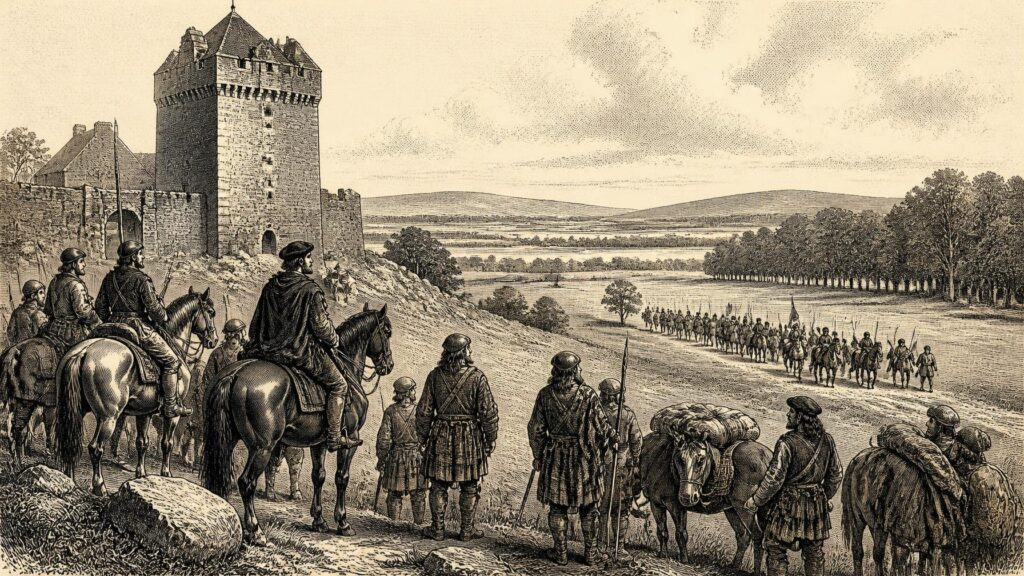
The sources for 1554 do not present one national campaign. Instead, they show a country of overlapping contests. Gerald FitzGerald and Richard Nugent, Baron Delvin, campaigned against Phelim Rua O’Neill of Clandeboye. The episode joined a newly restored Geraldine earl to a leading lord of the Pale in military action connected with Ulster. It also illustrates a basic fact of Tudor Ireland: the government’s reach depended heavily upon aristocratic partnerships, while those partnerships rested on their own local interests, kinships and armed followings.
In the north, the O’Neill world was already marked by a dynastic crisis. Conn Bacach O’Neill, earl of Tyrone in the crown’s terminology, faced deep divisions within his family. His son Shane, known in Irish as Seaán Donnghaileach, had emerged as an increasingly formidable figure, drawing support through alliances in Clandeboye and with Scottish MacDonnell forces. That broader struggle cannot be reduced to the Kildare-Delvin expedition, whose date and operations are not securely detailed. But it explains why fighting involving Clandeboye mattered: eastern Ulster was a contested zone where Gaelic dynasties, Scottish mercenaries, Newry interests and the Dublin administration all watched one another closely.
Further south and west, the Annals of the Four Masters record Donnell O’Brien, lord of Thomond, marching against Dún Michil, held by Conor Groibhleach O’Brien. Thomas Butler, tenth earl of Ormond, arrived with forces to drive Donnell away. The annal then records an O’Brien hosting into Clanricarde, where substantial plunder was taken before Donnell proceeded to Dún Lathraigh in County Galway. There, branches of the Burkes came to him and accepted fosterage and wages. These notices convey a political landscape in which a castle, a lordly household and the command of paid followers were inseparable. Control of a strongpoint could determine access to territory; a raid could acquire animals and goods while displaying a lord’s capacity to reward service.
Such warfare pressed hardest on communities with the least voice in the records. A “great depredation” was not an abstraction: it could mean lost cattle, disrupted cultivation, frightened households and the movement of dependants seeking protection behind a lord’s authority. Yet the annals’ language also warns against imagining uniform devastation. Raiding was a recognised, if brutal, political instrument. The ability to feed retainers, accept fosterage and distribute wages helped sustain lordship as much as the taking of castles did.
One firmly dated conflict occurred on 1 November, the feast of Samhain. At Ceann Salach, in the district called Cloch Chinnfhaelaidh in Tír Chonaill, rival branches of the MacSweeneys fought a battle. Owen Óg MacSweeney, his brother Turlough Carragh, and Niall son of Maolmhuire stood on one side; the sons of Donough MacSweeney—Hugh Buidhe, Edmund, Conor and Donnell—on the other. The surviving annal gives the participants and the day, but not a full explanation of the quarrel or reliable casualty figures. It is best understood as another reminder that political violence in 1554 was not confined to crown-versus-Irish narratives. Great kindreds could be divided within themselves, and their disputes shaped life in regions far from Dublin.
A Catholic Restoration in Practice
The most clearly documented governmental change of the year concerned religion. Mary’s accession in 1553 had reversed the direction of official policy after Edward VI’s Protestant reforms. In Ireland, however, the change did not require the same scale of reconstruction as in England. Traditional religious practice had remained resilient, and the number of married clergy targeted by the Marian programme appears to have been limited. Even so, the crown’s actions in 1554 mattered because they removed prominent bishops associated with the earlier religious settlement and re-established an episcopal leadership sympathetic to Rome.
In April, George Dowdall, archbishop of Armagh, joined a royal commission empowered to deprive married bishops and clergy. On 29 June, Edward Staples, bishop of Meath, was formally deprived, his marriage making him unacceptable under the restored Catholic discipline. Staples had been a significant figure in the Henrician and Edwardian church, and his removal was therefore an unmistakable declaration that the terms of ecclesiastical office had changed.
William Walsh, a Meath-born cleric associated with the Cistercian tradition and with Cardinal Reginald Pole during exile, was selected to replace him. Walsh was provided to the see in October by Pole as papal legate, while royal letters patent followed in November. The sequence shows the dual character of the Marian restoration: authority was being repaired through both papal and royal channels. Dowdall also held a provincial synod at Drogheda during 1554, directed towards reviving Catholic observance and disciplining clergy who had married. Its exact date and full proceedings are uncertain, but its purpose is clear enough.
For parishioners, changes in bishops did not automatically remake the texture of worship overnight. Parish churches, pilgrimage, customary devotions and the practical constraints of local clergy had their own histories. Nor did the revival of Catholic authority restore dissolved monasteries or recover all former church property. But 1554 made visible a renewed official preference for the old sacramental order. In Meath and Armagh especially, the deposition and appointment of bishops gave that preference institutional form.
Law, Learning and Memory
Government in Dublin also continued to depend on lawyers and courts. John Bathe became chief justice of the Irish common pleas after the death of Sir Thomas Luttrell, while Barnaby Skurlock was appointed attorney-general, an office now described with that title rather than the earlier “king’s attorney”. Such appointments did not mean that common-law administration reached evenly across the island. They do, however, reveal the persistence of a professional legal world around Dublin, one serving the crown, the Pale and landholders able to bring disputes into royal institutions.
The deaths recorded for the year point to another kind of continuity. Cahir mac Art Kavanagh, a leading figure of the MacMurrough Kavanaghs, died. The annalist praised him as a capable warrior who might have become lord of Leinster but for “the invasion of the English”, a retrospective judgement that preserved a Gaelic political memory even while Kavanagh lords dealt with the Tudor crown and its titles. In the midlands, Cormac MacCoghlan, heir to the lordship of Delvin Eathra, died at Clonlonan; local succession remained a matter of consequence in a region crossed by competing Gaelic, Old English and crown interests.
Most revealing culturally was the death of Tadhg son of Aodh Ó Cobhthaigh, described as chief precentor of Ireland and Scotland in poetry. The phrasing signals the continuing prestige and interlinked world of learned Gaelic culture across the North Channel. Poets were not merely entertainers. They preserved genealogy, praised patrons, transmitted political memory and taught the demanding conventions of classical Irish verse. In a year marked by restored earldoms, episcopal commissions and armed hostings, the notice of Ó Cobhthaigh’s death is a useful corrective: Ireland’s intellectual life was still sustained by hereditary learned families and institutions whose geography was Gaelic rather than simply English or Irish.
Thus 1554 was a year of recovery, but not of settlement. The restoration of the Kildare earldom offered the crown an experienced dynastic partner in Leinster. Marian religious policy displaced reforming bishops and strengthened Catholic office-holders. Yet from Thomond and Clanricarde to Tír Chonaill and Clandeboye, armed lordships retained the means to make, resist and reshape power. The year’s records reveal an Ireland in which royal policy, aristocratic restoration, church discipline and Gaelic political culture all endured together, often uneasily.
Primary Sources
- Annals of the Four Masters
- Fitzgerald, Gerald
- Dowdall, George
- Staples (Staple, Stapull, Stakboll), Edward
- Walsh, William
- O’Neill, Shane (Seaán)
- Croft(s), Sir James
- Reform Government and the Feudal Magnates
- Collaborator and Survivor? Gerald the Eleventh Earl of Kildare and Tudor Rule in Ireland
- The Reformation in Ireland: Interpretations Old and New
- Tudor Re-Conquest in County Kildare
- ‘Ireland’s Greatest Family’: The Fitzgeralds, Earls of Kildare
- Crown of Ireland Act 1542
- Mary I: First Crowned Queen of England
- Calendar of the State Papers Relating to Ireland, 1509–1573
- State Papers Ireland 1509–1782: Government Papers on Irish Affairs
- Calendar of the Carew Manuscripts: 1515–1574
- New Calendar of State Papers, Ireland 1509–1585
- ‘And So Began the Irish Nation’: Nationality, National Consciousness and Nationalism in Premodern Ireland
- The Irish Law Officers
- George Dowdall
- William Walsh (1512?–1577)
- Calendar of State Papers Relating to Ireland
- Crown of Ireland Act 1542: Irish Statute Book Table of Effects