

Inis Saimer and Base Coin1546 CE
In 1546, Henry VIII’s Irish government faced factional conflict and uneven authority. Sir Anthony St Leger defeated the Earl of Ormond in disputes over regional power, though Ormond’s death soon exposed continued dependence on magnates. A fort at Daingean extended crown influence into the midlands, provoking annalistic accounts of destruction. In Ulster, Donnell O’Donnell’s murder at Inis Saimer violated guarantees of protection and reflected enduring Gaelic politics. Debased copper coinage affected exchange, while episcopal appointments asserted royal control over the Church. The imprisonment of poet-teacher Teige O’Coffey highlighted pressures on bardic learning. These events reveal a kingdom undergoing contested transformation.
Dateline
In 1546, Ireland was not transformed by one decisive battle or parliament, but several sharply documented events exposed the tensions of mid-Tudor rule. The crown had styled Henry VIII king of Ireland since the legislation of 1541, yet authority still depended on bargains with great lords, the labour of garrisons, and the willingness—or coercion—of communities far beyond Dublin. This was Henry’s last full calendar year as king. It was also a year in which a feud at the top of government, a killing in the O’Donnell country, a new fort in the midlands and a debased coinage showed how unevenly power was being extended.
The evidence must be handled with care. Official correspondence and later calendars illuminate the dispute between the lord deputy, Sir Anthony St Leger, and James Butler, ninth earl of Ormond. The Annals of the Four Masters, compiled in the seventeenth century from earlier material, preserve a cluster of reports assigned to 1546: the murder of Donnell O’Donnell, imprisonment of a poet-teacher, the introduction of copper coin and building work at Daingean. They are invaluable, but their emphatic language records a Gaelic learned perspective rather than an all-Ireland statistical survey. Together, however, these sources give 1546 an unusually textured character.
A Feud Before the King
The largest political story was the struggle between St Leger and Ormond. St Leger’s policy had sought to enlarge the king’s authority by negotiation as well as force: Gaelic and Anglo-Irish lords were encouraged to accept royal titles, English legal forms and individual hereditary estates in return for submission. Ormond, lord treasurer and the leading Butler magnate, had initially worked with this programme. By 1545–46, however, their relationship had broken down. The issue was not simply personal hostility. It concerned who would govern southern Leinster and Munster: a royal deputy and council centred on Dublin, or a powerful local lordship with its own tenants, clients, castles and armed following.
Early in 1546 the Irish privy council feared that faction might produce disorder even in Dublin. Its members urged that the quarrel be settled in England. St Leger demonstrated his support at a gathering in Dublin on St Patrick’s Day, when nobles, councillors and a number of Gaelic leaders joined in a favourable address to Henry. His allies presented him as the rare governor able to bring men to Dublin by persuasion. His opponents gave a darker account. Sir John Alen, lord chancellor, maintained that the king’s obedience scarcely extended beyond the Pale and attacked St Leger’s management, partiality and use of revenue. Walter Cowley, connected to Ormond’s interest, was drawn into the affair and imprisoned in the Tower after submitting accusations against the deputy.
Both principal antagonists went to England to answer before the king and privy council. The result favoured St Leger. Alen’s campaign was judged malicious; he was removed from control of the great seal, which was temporarily entrusted to Sir Thomas Cusack, and Sir Richard Reade was later appointed chancellor. Ormond was required to accept a settlement that limited aspects of his political reach. In September, Henry’s judgement also provided that a quorum of Irish privy councillors should attend the deputy, an attempt to make government less dependent on one man’s household and more visibly collegiate. It was a practical constitutional adjustment, though no guarantee against future faction.
The settlement did not bring a durable partnership. On 17 October Ormond attended a feast in London. He became gravely ill and died eleven days later, on 28 October 1546. Contemporary circumstances encouraged suspicions of poisoning, particularly because he had been St Leger’s principal opponent, but no inquest established murder; modern scholarship therefore treats food poisoning as the secure conclusion while acknowledging the suspicions. His death mattered profoundly in Ireland. His heir, Thomas Butler, was about fifteen and already at the English court. The immense Butler lordship in Kilkenny and Tipperary did not disappear, but it lost its adult head at a critical moment. St Leger returned to office in November, while the crown confronted the awkward fact that effective regional order still required cooperation with Ormond’s widow, brothers and servants.
Fortifying the Midlands
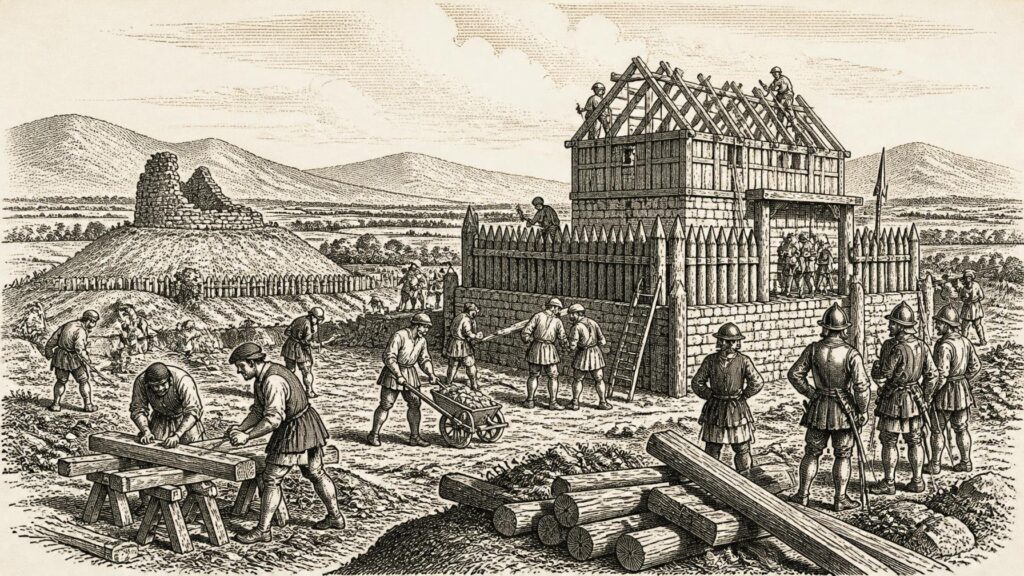
The political argument over lordship was matched by physical intervention in the midlands. In 1546, while Sir William Brabazon acted as lord justice, a new English fort was established at Daingean in Uí Fhailí, in what is now County Offaly. Later known as Fort Governor, it occupied the site of an earlier O’Connor Faly stronghold. The location was strategic: it lay on a contested frontier between the crown’s more settled jurisdictions and powerful Gaelic territories. A fort meant soldiers, stores, roads, supply demands and a defended base from which officials could project royal claims. It also foreshadowed the more systematic plantation and shiring schemes that would follow in the next decade.
The annalists remembered the construction bitterly. They wrote that the English erected the castle of Daingean, demolished the church of Cill O’Duirthi for building material and ruined the castle of Cruachan. Archaeological and historical work on Daingean supports the central point that Brabazon’s fort dates to 1546 and was strengthened in 1547. The report of reused church fabric should not be inflated into a general account of all religious life in the district, but it gives a stark local image of conquest: sacred masonry becoming military infrastructure. Such building works made the crown’s presence materially visible to people whose political language may have been very different from that of Dublin or Westminster.
The same annalistic sequence records another harsh encounter between lordship and government. Brian Mac Giolla Phádraig had his own son Tadhg, described as a distinguished captain, sent to Dublin with written accusations; the Dublin authorities executed him at his father’s request. The episode is too compressed to reconstruct its legal process or family background. It nevertheless warns against imagining a simple opposition between “English” state and “Irish” society. Gaelic and Old English rulers could use the expanding institutions of the crown in their own dynastic conflicts, while the crown relied on such alliances to make its authority effective.
A Killing on the Erne
In north-west Ulster, the year’s clearest firmly dated event occurred on 20 April. Donnell, son of Aodh Dubh O’Donnell, was killed at Inis Saimer, near Ballyshannon, after being invited there by Eoghan O’Gallagher and his wife Honora. The Four Masters stress that he had come under guarantees of protection offered by named learned men, Godfrey Mac an Bhaird and Cú Choigcríche Ó Cléirigh. Their emphasis is revealing. In Gaelic political culture, the giving of surety and sanctuary carried serious moral weight; killing a guest under protection was represented as treachery rather than an ordinary casualty of feud.
Donnell was not presented merely as a private victim. The annalist says that, among his generation of the descendants of Conall Gulban, none had inspired greater expectation. His death therefore mattered within the O’Donnell political world, even if the surviving notice does not permit a precise account of the immediate succession consequences. A manuscript tradition associated with Cú Choigcríche Ó Cléirigh adds a human consequence: after Donnell’s killing, the learned man travelled to Thomond and composed for Manus O’Donnell. The movement of such a scholar shows that bardic learning, patronage and political security remained closely connected. Learned families were not detached observers; their homes, employment and writing could be reshaped by violence among their patrons.
Copper, Church and Learning
The most widely felt intervention reported for 1546 may have been monetary. The annals say that “new coin” of copper was introduced and that people were compelled to accept it as silver. The phrasing is polemical, but it accords with numismatic evidence for Henry VIII’s severely debased Irish coinage, including issues associated with Bristol in 1546. Debasement allowed the crown to stretch scarce silver and extract profit from minting, but it damaged confidence in money. Its effects would have varied. Cash mattered especially in towns, ports, rents, military wages and dealings with government; cattle, grain, credit and customary renders continued to matter greatly elsewhere. Even so, a base coin imposed through royal authority made distant fiscal policy tangible in Irish buying and selling.
Religious change in 1546 was similarly real but uneven. On 30 May Henry nominated Cornelius O’Dea to the bishopric of Killaloe; he was consecrated on 12 July. The appointment demonstrates the crown’s claim to control episcopal succession after the break with Rome. It should not, however, be mistaken for evidence that ordinary worship in Thomond was suddenly Protestant. Henry’s own church remained doctrinally conservative, and reform advanced very differently from diocese to diocese. The reported destruction of Cill O’Duirthi during the Daingean works belongs to the same changing landscape, but was above all an act of military appropriation.
The annals close their year with Teige O’Coffey, called preceptor of Ireland’s schools of poetry. English authorities imprisoned him in the king’s castle for eighteen weeks because of his attachment to the Irish; the account says that execution was intended, but that he escaped. Whether every detail can now be independently checked, the notice is important evidence of what the annalists believed was at stake. The bardic schools preserved language, genealogy, law, praise-poetry and political memory. In 1546 the crown was building forts, remaking offices and circulating its money; it was also encountering learned networks capable of sustaining a different account of authority.
Thus 1546 was a year of no settled outcome. Henry’s government secured a victory over Ormond in London, yet Ormond’s death exposed its dependence on the very magnate power it wished to restrain. Daingean marked an advance into the midlands, while Inis Saimer showed the continuing force of regional lordship and obligations of protection. Copper coin and episcopal appointment carried royal policy into markets and dioceses, but neither erased older economic practices or cultural institutions. The year’s surviving records reveal a kingdom being pressed into new forms, not one already mastered.
Primary Sources
- Annals of the Four Masters, Part 5: Annal M1546
- Rogha Dánta as LS G 167 i Leabharlann Choláiste na Tríonóide
- Calendar of State Papers, Ireland: Tudor Period, 1509–1547
- Calendar of the State Papers Relating to Ireland, 1509–1573
- State Papers Ireland 1509–1782: Government Papers on Irish Affairs
- St Leger, Sir Anthony
- Butler, James
- Butler, Thomas
- Alen, Sir John
- A ‘New Departure’ in Mid-Tudor Ireland?
- The Coinages for Ireland of Henry VIII
- County Offaly Urban Archaeological Survey: Daingean
- Excavations.ie Report 23310: Daingean, County Offaly
- Fasti Ecclesiae Hibernicae: The Succession of the Prelates and Members of the Cathedral Bodies in Ireland
- Ireland in the Reign of Henry VIII
- The Church Among Two Nations
- MacDonnell, James
- On the Fringe and in the Middle: The MacDonalds of Antrim and the Isles, 1266–1586
- The Ormond Lordship in County Kilkenny, 1515–1642: The Rise and Fall of Butler Feudal Power
- The Tánaiste and the Crown Prince Problem
- Irish Texts at CELT
- Irish Texts: University College Cork CELT Resource