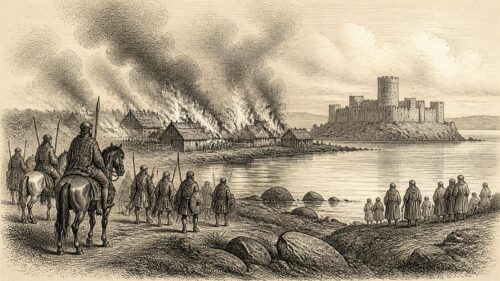
Derrinlaur Castle1574 CE
In 1574 Tudor authority faced pressures across Ireland. In Munster, Desmond’s restored influence, Geraldine Combination and his son’s seizure of Derrinlaur Castle challenged crown control; Fitzwilliam and Ormond captured the castle in August, and Desmond submitted at Cork on 2 September, though settlement remained fragile. In Ulster, Essex’s failing Clandeboye colony suffered plague, shortages and mutiny before his destructive campaigns and arrest of Sir Brian mac Phelim O’Neill, whose family and followers were killed or executed. Unpaid troops burdened Pale communities, while Catholic links endured through Edmund Tanner’s Roman appointment. The year revealed Tudor power’s coercive reach and governing limits.
Dateline
In 1574 Ireland was not at peace, though no single island-wide war defined the year. Instead, political authority was being tested in several regions at once: in Munster, where the Geraldine earldom of Desmond resisted closer crown control; in Ulster, where the earl of Essex’s private colonial venture was failing amid local alliances and violence; and in the Pale, where the government’s own unpaid soldiers burdened the communities meant to sustain them. The taking of Derrinlaur Castle in August and Gerald FitzGerald, fifteenth earl of Desmond’s submission at Cork on 2 September were the year’s clearest southern landmarks. Yet the settlement they produced was provisional, and events in Clandeboye showed how brutally the Tudor state could pursue its ambitions elsewhere.
A Lordship Under Pressure
Desmond’s position had been unsettled since his return from English custody in 1573. He was an Anglo-Irish earl whose authority in south-west Munster rested on inherited land, affinity, military service and the exercise of lordship over a mixed population. But the crown increasingly demanded that great lords operate within English administrative and legal limits. Desmond, by contrast, sought to retain forms of autonomous authority which his family had long exercised, including the use of Gaelic law and the command of armed followers.
The immediate background to 1574 was therefore not simply an ethnic contest between English and Irish. It was a struggle over jurisdiction, land, service and allegiance, involving Old English magnates, Gaelic lords, crown officers, townspeople and soldiers. Desmond’s old feud with Thomas Butler, tenth earl of Ormond, remained particularly dangerous. Ormond was a powerful Munster lord with close connections at Elizabeth I’s court; Desmond’s resurgence threatened both his regional rival and the crown’s effort to govern through dependable aristocratic allies.
The Annals of the Four Masters, compiled later from Irish learned tradition, record Desmond harrying his enemies in the spring of 1574 and defeating forces associated with MacCarthy Mór. The annal is useful evidence for the persistence of local warfare, but it does not make every movement of the earl precisely recoverable. What can be stated firmly is that the stand-off between Desmond and Lord Deputy Sir William Fitzwilliam continued through much of the year, while each side sought advantage through negotiation, displays of force and control of strategically placed castles.
The Geraldine Combination
On 18 July, leading Geraldines signed what later documents called the “Combination”, pledging unconditional support to Desmond. The act was politically potent because it made visible a network of family and lordship rather than merely the private defiance of one earl. Among those associated with the Geraldine interest were Desmond’s brother Sir John Fitzgerald, the lord of Lixnaw, and John fitz Edmund Fitzgerald of Cloyne. Their commitment warned Dublin that pressure on Desmond might draw in men whose local authority extended across Kerry, Limerick, Cork and adjoining districts.
The Combination should not be treated as proof that all Munster was united behind rebellion. Alliances were conditional, and many lords balanced loyalties to kin, neighbourhood and crown. Nor did Desmond openly launch the later rebellion of 1579 in this year. Rather, 1574 was a moment when his recovery of influence made the government fear that the limited settlement achieved after the first Desmond rebellion was collapsing.
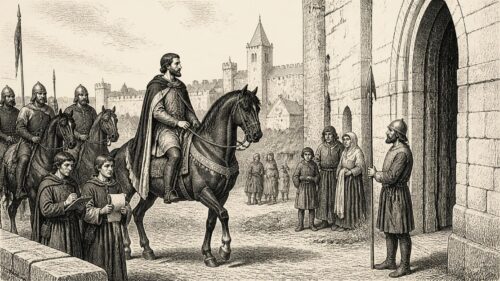
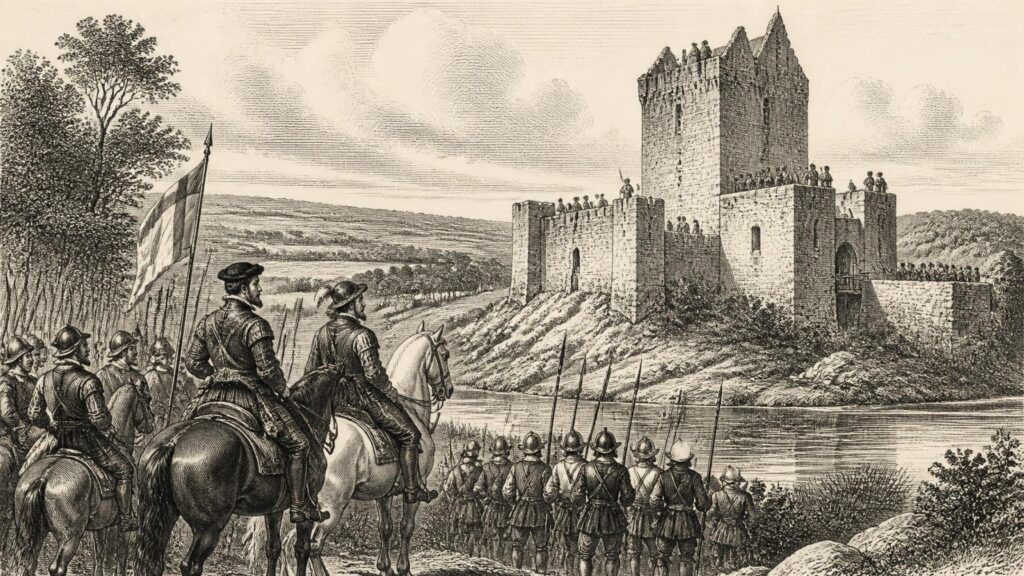
Derrinlaur Castle, or Doire an Láir, near the lower Suir country, became the immediate flashpoint. The Four Masters state that Desmond’s son John seized the “good and strong” castle and installed trusted guards. Its occupation mattered less as an isolated military exploit than as a challenge on the Munster frontier, in an area where Butler and Fitzgerald interests met. Fitzwilliam and Ormond responded when royal permission for decisive action finally arrived. Their expedition entered Munster late in the summer, and Derrinlaur was captured in August. Contemporary and later accounts agree that the garrison was killed; the exact circumstances and numbers are less securely established, and should not be invented.
Submission at Cork
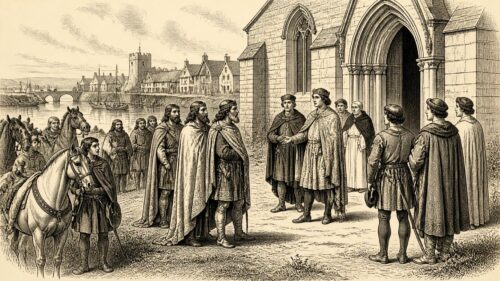
Military pressure brought Desmond back to negotiation. On 2 September he made a formal submission before Fitzwilliam at Cork. The deputy reported a “perfect conclusion” shortly afterwards, stressing the earl’s oath of allegiance and outward show of duty. Desmond also placed his estates in the hands of trustees, an arrangement intended to constrain his independent power and safeguard family interests. Such legal devices reveal the double character of Tudor policy: conquest was accompanied by attempts to translate unstable lordship into documents, trusteeships, recognisances and enforceable obligations.
The submission was a significant success for Fitzwilliam, whose authority had been weakened by criticism at court and by financial disorder in Dublin. It also had a wider political effect: disaffected lords elsewhere could see that the crown, when supplied and supported by Ormond, could bring a great Munster earl to terms. But submission was not reconciliation. Desmond and Sir John appear to have treated it partly as a respite, while James fitz Maurice Fitzgerald retained his commitment to seeking Catholic assistance abroad. The invasion that James fitz Maurice would lead in 1579 lay in the future, not in 1574; nevertheless, the distrust and political networks that made it possible were already present.
Essex in Clandeboye
While Munster was being forced into a fragile settlement, north-east Ulster endured a different and more destructive experiment. Walter Devereux, earl of Essex, had received a grant of Clandeboye and hoped to establish an English colony there through a mixture of private investment and royal military support. The region was held principally by the O’Neills of Lower Clandeboye under Sir Brian mac Phelim O’Neill, while Scottish MacDonnell settlers and fighting men were also an important force along the Antrim coast. The project assumed that land could be secured, settlers maintained and profit generated at modest cost. Events proved otherwise.
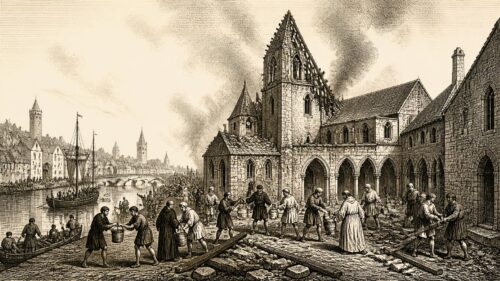
In spring 1574 plague struck Carrickfergus, Essex’s principal base. Pay, food and transport were inadequate; soldiers mutinied, deserted or fell ill. In March Essex had made a truce with Turlough Luineach O’Neill of Tyrone, and Sir Brian submitted again during the spring. These were tactical pauses, not durable settlements. Once Desmond had submitted, Essex was able to mount his long-planned northern campaign. In September he crossed towards Tyrone, raiding, taking cattle and burning crops, before reaching Lifford and supporting Aodh O’Donnell against Turlough’s allies. The expedition displayed military reach but did not permanently break Turlough’s power.
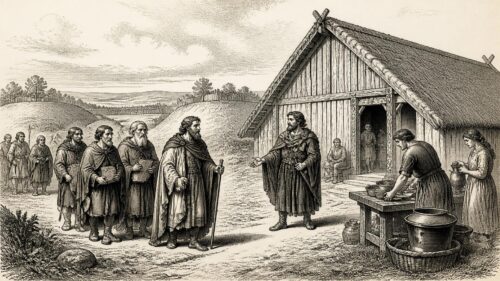
The year’s darkest episode followed in October. Essex met Sir Brian mac Phelim near Belfast, ostensibly to cooperate against the Scots. After several days of feasting, he had Sir Brian arrested and around 200 members of his party killed, including women and children according to the principal biographical account. Sir Brian, his wife and his brother were sent to Dublin and executed in November. Essex alleged that Sir Brian intended betrayal, but the evidence for that justification is unconvincing. The killing destroyed an established lord and shattered the political order of Lower Clandeboye; succession conflict followed. It also demonstrated that negotiations conducted under crown auspices could end in coercion rather than agreement.
The Cost of Government
The campaigns in Munster and Ulster depended on an administration already short of money. Fitzwilliam had entered 1574 claiming serious personal debt after years of trying to finance government and war. His troops were insufficiently supplied, and soldiers took food and livestock from inhabitants of the Pale. By the later months of the year this had provoked organised resistance and civil disobedience among communities which, in theory, lay closest to the crown’s authority. For farmers, tenants and householders, military government was experienced not only in proclamations and castles but in demands for provisions, horses, lodging and animals.
Dublin Castle’s surviving household accounts provide a contrasting glimpse of elite life. Fitzwilliam’s establishment consumed imported Gascon wine, fortified wine, sugar and spices in 1574, evidence of commercial connections reaching far beyond Ireland. That luxury did not mean the government was financially secure. Rather, it highlights the sharp divide between the ceremonial household of the queen’s deputy and the precarious fiscal system which struggled to feed his soldiers.
Religion Across the Sea
Religion remained inseparable from politics, though its practical expression varied greatly from place to place. On 5 November Edmund Tanner was appointed Roman Catholic bishop of Cork and Cloyne and consecrated at Rome. Tanner had been associated with the Jesuits and had studied on the Continent. His appointment did not create a functioning diocesan administration overnight, and he did not set out for Ireland until the following year. It did, however, show that Irish Catholic ecclesiastical life remained connected to Rome and to the wider Counter-Reformation world at precisely the moment when Munster’s political loyalties were under scrutiny.
Thus 1574 ended without a final settlement. At Cork, Desmond had bowed to the crown; at Derrinlaur, royal force had made that submission credible; in Clandeboye, Essex had turned a colonial venture into a devastating breach of trust. The year exposed both the reach and the limits of Tudor power. It could take castles, compel oaths and destroy local leaders. It could not cheaply govern the territories it claimed, erase rival systems of lordship, or make coerced obedience into lasting peace.

Primary Sources
- Fitzgerald, James fitz Maurice
- Fitzgerald, Sir John fitz James
- Fitzgerald, John fitz Edmund
- Fitzwilliam, Sir William
- Devereux, Walter
- O'Neill (Ó Néill), Sir Brian
- Annals of the Four Masters, Part 8: English Translation
- Annals of the Four Masters, Part 8: Irish Text
- Calendar of the State Papers Relating to Ireland, 1574–1585
- Texts Beginning with the Letter C: Celtic Digital Initiative Text Archive
- Letter from the Lords of the Council to the Lord Deputy, 30 March 1574
- Food and Power in Sixteenth-Century Ireland: Studying Household Accounts from Dublin Castle
- Essex’s ‘Enterprise’ and Plantation in Early Modern Ireland
- The Project Gutenberg eBook of Ireland Under the Tudors, Vol. II
- Edmund Tanner
- Bishop Edmund Tanner
- Cotton MS Galba C V
- Add MS 5754
- An Account of Complaints Made Against the Maintenance of the Army in Ireland by Way of Cess
- The Place-Names of the Decies
- Gerald FitzGerald, 15th Earl of Desmond
- Walter Devereux, 1st Earl of Essex
- Ireland Under the Tudors; With a Succinct Account of the Earlier History