

Carrigogunnell’s Broken Bridge1536 CE
In 1536, Tudor authority in Ireland expanded after the Kildare revolt through Leonard Grey’s appointment as lord deputy, the Dublin parliament and military campaigning. Parliament asserted Henry VIII’s royal supremacy over the Irish church, attainted Kildare interests and initiated changes to religious property, though enforcement remained limited and monastic dissolution was incomplete. Grey captured Carrigogunnell Castle and destroyed its bridge, exploiting regional rivalries. Elsewhere, Connacht experienced succession disputes, raids, artillery warfare, sanctuary violations and the burning of Dromahair monastery. Plague, smallpox and illness compounded instability, while deaths of lords and poet Tomás Ó hUiginn marked cultural loss. Local lordship remained.
Dateline
In 1536, Ireland was not one political unit obedient to a single government, but a patchwork of lordships, town jurisdictions, ecclesiastical territories and shifting alliances. Dublin Castle claimed authority in the name of Henry VIII, yet its effective reach was uneven and depended upon negotiation, military force and local collaborators. The year brought a marked assertion of Tudor power: Leonard Grey became lord deputy, a parliament opened in Dublin to advance the Henrician religious settlement, and Grey’s army struck south-west towards the Shannon. At the same time, Irish annals record plague, smallpox, local warfare, contested successions, the burning of a friary and the death of a celebrated poet. The contrast is essential. Crown policy was becoming more ambitious, but everyday political life remained intensely regional.
A New Deputy After Kildare
The immediate backdrop was the collapse of the Kildare ascendancy. The revolt of Thomas FitzGerald, ‘Silken Thomas’, had been crushed in the preceding year, but its consequences were unresolved. Thomas himself was held in the Tower of London during 1536; his execution came only on 3 February 1537 and should not be placed in this year. His young half-brother Gerald, heir to the Kildare connection, remained beyond the government’s grasp. The destruction of the leading Geraldine house created both an opportunity and a danger: Dublin Castle could attempt a more direct style of rule, yet many lordships had long been tied to Kildare through kinship, service and mutual interest.
Sir William Skeffington, the lord deputy who had led the final phase of the campaign against Silken Thomas, died at the end of 1535. On 1 January 1536 the Irish council chose Lord Leonard Grey as lord justice, and Henry VIII appointed him lord deputy on 23 February. Grey was not an outsider without Irish connections. He was brother-in-law to the late ninth earl of Kildare and uncle to the fugitive Gerald FitzGerald. That relationship made his appointment politically charged. It offered a possible route to conciliation with Geraldine sympathisers, but also gave his Butler and anti-Geraldine critics reason to suspect him of indulgence.
Grey’s instructions combined economy, security and political reconstruction. He was expected to reduce military expenditure, preserve the king’s authority where it was already established, and draw Gaelic and Anglo-Irish lords into agreements to keep the peace. Such agreements were not evidence that an entire country had been conquered. They were practical bargains, dependent on hostages, personal promises, local advantage and the evident capacity of the deputy’s army to punish refusal. In 1536, Grey began a pattern that would define his deputyship: negotiated submissions backed by artillery and rapid campaigning.
Dublin’s Reformation Parliament
On 1 May, a parliament began sitting in Dublin. It continued, with interruptions and meetings beyond Dublin, until December 1537, so its legislation must be handled with care: some measures belong firmly to 1536, while others emerged later in the parliament’s life. The opening programme nonetheless made 1536 a turning point. It brought the king’s claims over the Irish church into statute and widened the legal consequences of loyalty and disloyalty after the Kildare rebellion.
The most consequential measure was the assertion that Henry VIII and his heirs were the supreme head on earth of the Church of Ireland, styled Hibernica ecclesia. This was a transfer of jurisdiction from papal to royal authority, not an instant conversion of Irish society to Protestant doctrine. Henry himself still upheld much traditional Catholic teaching, and the religious changes of this early stage were principally institutional: who held ultimate authority, who could visit and discipline clergy, and where ecclesiastical revenues and legal appeals should lead. The claim was deliberately all-Ireland in language, even though the government’s means of enforcing it were far more substantial in the Pale and the towns than in many Gaelic lordships.
Parliament also served the political settlement after rebellion. An act of attainder treated the late earl of Kildare’s alleged treason as reaching back to 8 July 1528, with grave consequences for the family’s status and property. Such legislation did more than punish one dynasty. It recast older patterns of aristocratic power, military following and diplomacy as matters for royal law. In a society where lords commonly maintained armed affinities and made alliances across cultural boundaries, the crown was pressing a sharper distinction between faithful subject and traitor.
The parliamentary statutes began the legal process through which religious houses might be brought under the crown’s control. Yet 1536 should not be presented as the year in which Irish monastic life suddenly vanished. The dissolution in Ireland unfolded unevenly over subsequent years, and a royal survey of monastic property followed in 1540. Friaries, abbeys and religious communities remained visible institutions in the landscape and in local devotion. The year’s change was therefore constitutional and administrative before it became fully material: the ground rules governing church authority and religious property had been altered in Dublin, but their implementation was incomplete and contested.
Grey at Carrigogunnell
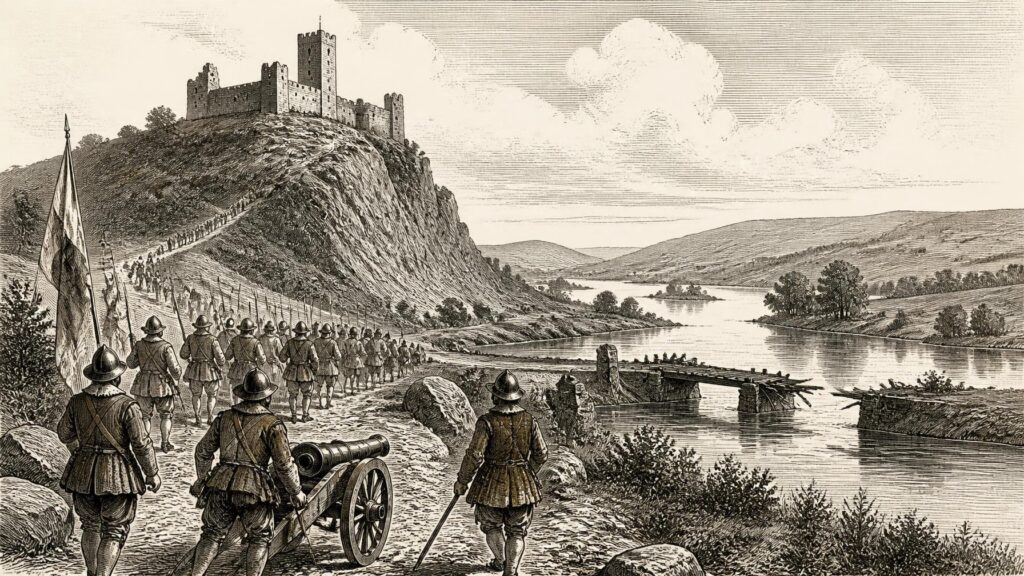
Grey’s most striking military action came in August, when he marched south towards the Shannon. The Annals of Connacht and the Annals of the Four Masters agree that the English justiciar took Carrigogunnell Castle and destroyed the bridge associated with Murchadh O’Brien. The castle stood on a steep rock west of Limerick and was described by Grey’s government as strategically important. Its seizure, and the breaking of the bridge, were demonstrative acts as well as tactical ones: they damaged strongpoints and routes linked with O’Brien and Desmond influence near a major river crossing.
The campaign showed the kind of power the Tudor government could bring to bear when it concentrated men and guns. Artillery enabled a deputy to threaten castles that had long anchored local lordship. But the expedition did not erase the political complexity of Thomond and Munster. The Annals of Connacht cautiously add that Donnchadh, son of an O’Brien, may have assisted Grey’s undertaking. Whether or not that report can be verified beyond the annal, it captures an important reality: crown advances often depended on divisions within Irish ruling families. Grey was not simply confronting a united ‘Irish’ opposition; he was exploiting, and becoming entangled in, competing claims and rivalries.
The Four Masters also assign to 1536 an attack upon Brian Ó Conchobhair Fáilghe, in which castles were demolished and men killed, allegedly through the manoeuvring of his brother Cathal Ruadh. The detail again underlines the politics of intervention. A deputy’s army could tip a succession dispute or internal feud decisively, but local informants, allies and enemies shaped where that army went. Crown warfare imposed terrible costs on communities around contested strongholds, including the loss of shelter, stores, livestock and the security which a castle’s presence could provide.
Connacht’s Wars and Sanctuaries
Beyond the deputy’s march, the annals show a western Ireland governed by its own urgent conflicts. In Lower Connacht, Tadhg Óg Ó Conchobhair adopted the title Ó Conchobhair, replacing the customary style Mac Domhnaill Meic Muircheartaigh used by the lord of his line. The change was a claim to enhanced precedence, a reminder that titles were political instruments rather than decorative survivals. His subsequent raid into Clann Goisdealbh produced a hostage, a promised ransom and the surrender of a valuable coat of mail. Warfare could centre on cattle and captives, but also on armour, honour and the public recognition of lordship.
A larger contest set Ó Domhnaill against the nobles of Lower Connacht. The annalist describes an expedition leaving Ballyshannon, camping between the Duff and Drowes rivers after a meal, and posting sentries against a possible night attack. In the dawn confusion, Niall Ó Baoighill was killed by men on his own side who mistook his party for enemies. At the tidal crossing of Fearsad Ranna in Liagáin, the two armies watched one another until Ó Domhnaill positioned cannon covering the ford. The opposing Ó Conchobhair force withdrew rather than risk the crossing; a subsequent skirmish still brought deaths by gunshot and javelin. This unusually detailed account preserves the texture of campaigning: food, watch duty, tides, misidentification, cavalry, traditional missiles and firearms in the same conflict.
Religion remained woven into this world rather than separate from it. When raiders approached in Lower Connacht, cattle were driven into the sanctuary of Termon of Erris. Bishop Barrett reportedly brought them out to the army, and they were not restored in honour of the saint. The episode indicates both the practical value of church sanctuary and the authority that clerical figures could wield in war. Elsewhere, Dromahair’s monastery was burned at night after its inhabitants had gone to sleep. This was not a consequence of the Tudor dissolution programme, but a local act of destruction recorded by the annalist. It is a warning against explaining every sixteenth-century assault on a religious house through the Reformation alone.
Illness, Death and Learning
The Annals of Connacht call 1536 an unhealthy and pestilential year, naming widespread plague, smallpox, flux and ‘lectual sickness’. The terms cannot supply modern diagnoses or a reliable death toll, but the notice is strong evidence that contemporaries experienced an exceptional burden of disease. In a society already exposed to raiding and disrupted food supplies, sickness would have affected households, labour, travel and the ability of lords to maintain followers. The annals’ record of notable deaths includes Feradach Mag Fhlannchaidh of Dartry, said to have died of smallpox.
Death also altered political and cultural life. Cormac Óg Mac Carthaigh, lord of Muskerry, died and was buried at Kilcrea; the annalist mourned him in unusually elevated terms. In Clanricarde, the death of MacWilliam John son of Richard triggered a struggle in which rival MacWilliams were proclaimed. Such successions were rarely private family matters: they could reorganise alliances, invite raids and expose communities to renewed demands for food, cattle and military service.
Finally, the death of Tomás Ó hUiginn was recorded as that of a teacher of the men of Ireland in poetry. The phrase signals the prestige of learned culture within Gaelic society. Poets did not merely compose entertainment; trained hereditary scholars preserved genealogies, praise, satire, political memory and linguistic accomplishment. While Dublin’s parliament announced a new royal supremacy, the death notice for Ó hUiginn reveals another enduring authority: the cultural standing of the learned families whose work gave rank and reputation meaning across lordships.
Thus 1536 was a year of forceful royal initiative but not simple transformation. Grey’s guns broke a castle and bridge on the Shannon; parliament advanced a new constitutional relationship between crown and church; and the Kildare crisis deepened the language of treason. Yet in Connacht and beyond, succession, sanctuary, cattle-raiding, disease, poetry and local war continued to shape life. The Tudor state had become more assertive, but the Ireland it sought to govern remained plural, armed and politically resilient.
Primary Sources
- Annála Connacht: Annal 1536
- Annals of the Four Masters, Volume 5: Annal M1536
- Annals of the Four Masters, Volume 5: M1536 in Irish
- Grey (Gray), Lord Leonard
- Treason and dissimulation in the Henrician Reformation: Leonard Grey and the polarisation of politics in the Irish Pale, 1534–40
- Statute Rolls of the Irish Parliament: Richard III to Henry VIII
- Irish Supremacy Act
- Poynings' Law
- Dissolution of the Monasteries, 1536–1540
- Letters and Papers of Henry VIII
- State Papers Published Under the Authority of His Majesty's Commission: King Henry the Eighth, Part III, Volume 2
- Calendar of the State Papers Relating to Ireland, 1509–1573, Volume 1
- State Papers: King Henry the Eighth, Part III, Volume 2
- National Library of Ireland Sources Catalogue: Leonard Grey Manuscripts
- Creevelea Franciscan Friary
- The Constitutional and Parliamentary History of Ireland till the Union
- Ireland under the Tudors, Volume I
- The Beginnings of Modern Ireland
- The History of Ireland from the Reformation to the Union
- Statute Law Revision Act 2009