

Sligo’s Captive Manuscripts1470 CE
In 1470, Ireland remained politically fragmented, with the English lordship largely confined to the Pale while Gaelic and Gaelicised dynasties contested power through warfare, alliances, tribute and inauguration. Enrí Ó Néill campaigned in Clandeboye and faced internal rivalry; plague struck Fermanagh amid Maguire succession disputes. Aodh Ruadh Ó Domhnaill captured Sligo Castle, gained Lower Connacht’s submission and recovered Leabhar na hUidre and other dynastic treasures, though his Breifne intervention failed. Thomas FitzGerald became chief governor as parliament addressed local Pale concerns. John Ó Conchobair Kerry founded the Franciscan house at Lislaughtin there, illustrating lordly patronage alongside conflict and cultural prestige.
Dateline
The surviving record for 1470 is uneven, but it is unusually revealing. Irish annals preserve hard, year-specific notices of campaigns, killings, a disease outbreak, a parliamentary programme and a new Franciscan house. Read together, they show an island with no single effective political centre. The English lordship remained institutionally present around Dublin and the eastern counties, while Gaelic and Gaelicised dynasties exercised power across most of Ireland through alliances, hostage-taking, tribute, cattle-raiding, castles and local inaugurations. The year’s most striking episode came at Sligo, where Aodh Ruadh Ó Domhnaill’s capture of a castle also brought the recovery of celebrated Irish manuscripts.
War in Ulster’s Borderlands
In the north, Enrí Ó Néill, lord of Tír Eoghain, conducted a large expedition into Clandeboye, the region around modern south Antrim and north Down. He came to assist Mac Uibhilín or MacQuillin, a lord established in the Route and the Glens. Their opponent was Conn Mac Néill Buidhe and the Clann Aodha Buidhe, a branch of the wider Ó Néill kindred. The Annals of Ulster describe a battle fought late in the day after MacQuillin and Ó Néill overtook a raiding party. Clandeboye was defeated; prominent prisoners were taken; and the castle of Sgath Dearg, on Sketrick Island in Strangford Lough, was seized and entrusted to MacQuillin.
This was more than a local squabble. A castle gave its holder a defended base, a place for stores and captives, and a means of supervising movement across water and countryside. The arrangement also demonstrates how overlordship worked in practice. Enrí did not necessarily annex Sgath Dearg for himself: he captured it, then placed it in the custody of an ally. Political authority rested on maintaining such networks, not simply on drawing fixed boundaries.
Yet Enrí’s own lordship was troubled from within. The annals record a widening war between him and the sons of Art Ó Néill. Ruaidhrí, Enrí’s son, was killed in a night attack at Tobran, apparently in the house of Ua Corra. Retaliation followed. At Áth Leathan, Enrí’s side defeated the sons of Art and their associates; Henry and Brian, sons of Art, were among those killed. Enrí and his sons then moved against the rival family’s castle at Oghmagh. The conflict did not end neatly: Eóghan Ó Domhnaill and the sons of Neachtan Ó Domhnaill aligned themselves with the sons of Art. These entries make plain that kinship did not make a dynasty politically united. Rival branches competed for land, dependants and the right to speak for the name Ó Néill.
Another northern campaign shows both the destructive and conciliatory sides of lordship. Enrí entered Trian Conghail with magnates from Ulster, including Ó Domhnaill, men of Fermanagh, the Ó Catháin following and MacQuillin. The force burned houses and crops, then received submissions from local rivals and made peace between them and MacQuillin. Such an expedition imposed heavy costs on farming households: stores, livestock, standing crops and dwellings could all be targets. But it was also political theatre, through which a leading lord converted military presence into homage and settlement.
Plague and Fermanagh’s Succession
Fermanagh endured a more intimate disaster. The Annals of Ulster record a “great plague”, termed Airaing, in the lordship, and say that Cormac Ó Flannagáin of Tuath Rátha and many others died. The sources do not permit a modern medical diagnosis, nor do they provide a death toll. They do, however, confirm a serious outbreak locally in 1470. Disease was not merely a private misfortune: it could weaken households, disrupt labour and unsettle the calculations of lordly politics.
Among those who died was Philip Mag Uidhir, a leading member of the Maguire ruling family and heir to the lordship of Fermanagh. Both major annalistic traditions dwell on his reputation for charity, humanity and prowess in battle, and the Ulster annalist states that he had been expected to become lord without opposition. That language should be read as an obituary ideal rather than a neutral biography, but it signals how consequential his death was. In a political world where succession depended on the support of a wide kin-group rather than automatic inheritance by an eldest son, the loss of a widely acceptable candidate could create dangerous openings.
Violence among Maguire relatives continued. John, son of Domhnall Ballach Maguire, was killed by Ruaidhrí, grandson of Philip Maguire, on 12 April according to the Annals of Ulster. Other branches raided Cathal Mac Maghnusa’s lands at Rinn Airigh. The record does not authorise a simple claim that plague caused these quarrels. Rather, 1470 placed disease, bereavement and pre-existing competition side by side in Fermanagh.
Sligo Castle and the Books
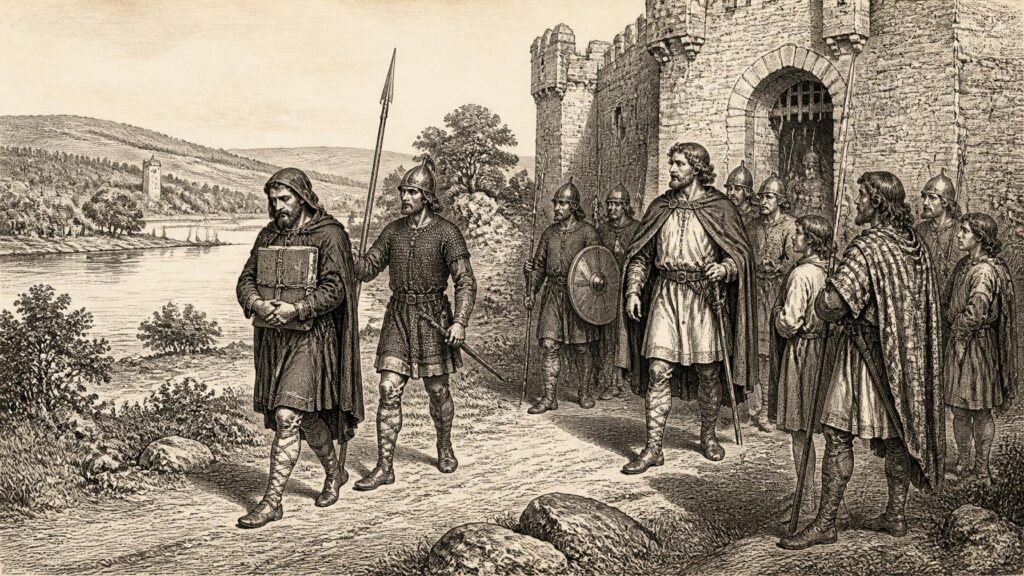
In Connacht, Aodh Ruadh Ó Domhnaill, ruler of Tír Chonaill, captured Sligo Castle from Domhnall, son of Eóghan Ó Conchobair, after what the Annals of the Four Masters call a long siege. The annal further says that Ó Domhnaill received gifts, submission and tribute from Lower Connacht. Such formulae should not be mistaken for permanent conquest: tribute and submission were often contingent outcomes of superior force, requiring renewal. Even so, the fall of this strategic stronghold at the mouth of the Garavogue was a substantial assertion of Ó Domhnaill power beyond Donegal.
The capture mattered for culture as well as territory. Ó Domhnaill recovered the Leabhar Gearr, now lost, and Leabhar na hUidre, the Book of the Dun Cow, along with ceremonial chairs associated with an earlier Ó Domhnaill lord. Leabhar na hUidre is the oldest surviving manuscript written wholly in Irish. Its recovery in 1470 was therefore not the accidental rescue of a book but the repossession of a valued dynastic and learned inheritance. A later note in the manuscript itself associates its recovery with Aodh Ruadh and the taking of Sligo.
The episode also warns against imagining late medieval warfare as hostile to learning. Manuscripts could travel as ransom, booty, heirlooms or objects of patronage. Their possession carried cultural prestige and could reinforce a ruler’s claim to continuity with celebrated ancestors, poets and learned families. At Sligo, military success, tribute and a manuscript recovery were recorded as parts of the same achievement.
Ó Domhnaill’s intervention extended eastwards into Breifne. He and an Ó Ruairc claimant marched towards Cruachán Uí Chupair, the inauguration hill of the West Breifne rulers, intending to inaugurate an Ó Ruairc. They were blocked at Bel-atha-Chonaill, modern Ballyconnell, by Ó Raghallaigh, English forces and the MacKiernans of Tullyhunco. Men and horses were killed or wounded, including the son of Aodh Ó Raghallaigh and the son of Bishop Ó Gallchobhair, and the expedition turned back. The failure is important. Inauguration was a public act that made lordship; preventing access to the site was a direct denial of political legitimacy.
The Pale’s Narrow Authority
In the English lordship, Thomas FitzGerald, seventh earl of Kildare, became chief governor in October 1470, serving as justiciar and deputy lieutenant. His return followed the upheavals of the Wars of the Roses in England and the fall of John Tiptoft, earl of Worcester, whose harsh government in Ireland had generated lasting hostility. The Four Masters report his execution by Warwick and Clarence in language coloured by sympathy for the earlier execution of the earl of Desmond. The annal is not an impartial account of English politics, but it captures how events across the Irish Sea could reshape authority in Ireland.
Legislation enrolled in the Irish parliament in 1470 gives a practical view of the Pale’s concerns. One measure required tenants of Saggart, on Dublin’s south-western edge, to abandon a truce with the Ó Tuathail of Wicklow. Another provided protection for the Dublin herring fishery; further acts dealt with local taxation, subsidies and private land interests. These were modest but revealing matters. Government was concerned not only with grand claims to lordship, but with a frontier settlement’s negotiated peace, a food and commercial resource at the capital, and the revenue needed to sustain local administration.
The acts do not show a government capable of directing all Ireland. Instead, they reveal a jurisdiction working intensely within a constrained zone, while leading Gaelic lords made war and peace elsewhere on their own terms. Kildare’s importance lay partly in his capacity to work across that fractured political landscape through alliances as well as office.
A Kerry Foundation
Amid warfare, a religious foundation began at Lios Laichtín, now Lislaughtin near Ballylongford in County Kerry. The Four Masters attribute the Franciscan monastery to John Ó Conchobair Kerry, who chose it as his burial place. The surviving friary is associated with the Observant Franciscan movement, which promoted a stricter interpretation of Franciscan poverty and discipline. Later papal licensing and building history should not be projected backwards too confidently, but the foundation itself belongs securely to 1470.
Its setting on the Shannon estuary is significant. A lord’s patronage of friars could provide prayers, burial, prestige and a durable institutional presence close to family territory and maritime routes. The new house therefore belongs with the year’s other evidence of lordship: castles held or taken, tribute demanded, claimants inaugurated or resisted, manuscripts recovered, and religious communities endowed. Ireland in 1470 was politically divided, but it was neither static nor isolated. Its regional powers were energetic, literate and deeply connected to the Irish Sea world.
Primary Sources
- Annals of the Four Masters, Annal M1470
- Annals of Ulster, Year U1470
- Annals of Ulster otherwise Annala Senait, Year U1470
- Annals of the Four Masters, Irish text
- O'Neill (Ó Néill), Enrí
- O'Donnell (Ó Domhnaill), Aodh Ruadh
- O'Rourke (Ó Ruairc), Donnchadh
- O'Reilly (Ó Raghallaigh), Eóghan
- FitzGerald, Thomas ‘fitz Maurice’
- Irish Statute Book: Public and Private Acts of 1470
- Lislaughtin Franciscan Abbey
- Lislaughtin Franciscan Friary
- Irish Script on Screen: MS 23 E 25 (Leabhar na hUidhre)
- Codices Hibernenses Eximii I: Lebor na hUidre
- The English Lordship of Ireland and the Irish Sea World: Re-assessing the Origins of the Kildare Ascendancy, c.1390–c.1513
- The English Lordship of Ireland and the Irish Sea World: re-assessing the Origins of the Kildare Ascendancy, c.1390–c.1513
- Gaelic Society and Economy
- Tudor Policy and the Kildare Ascendancy in the Lordship of Ireland, 1496–1534
- Irish Lords and English Rulers
- Gaelic Lordship and Tudor Conquest: Tír Eoghain, 1541–1603
- Geographical Loyalty? Counties, Palatinates, Boroughs and Ridings
- Ulster and the Isles in the Fifteenth Century
- Mendicant Orders and Vernacular Irish Learning in the Late Medieval Period
- Donegal Castle