

Claregalway’s Hostage March1469 CE
In 1469, Irish annals record struggles for lordship, wealth and security rather than a unified political order. Aodh Ruadh Ó Domhnaill secured hostages in Lower Connacht, allied with the newly installed Mac William Burke, and burned Claregalway and neighbouring territory during a campaign against Clanricarde, partly revenging 1467. Uí Maine faced disputed succession after Aodh Ó Cellaigh’s murder; Maguire kindreds fought destructive raids in Fermanagh; and the Whites expelled the Savages from Lecale. Death notices for a harpist, historian-hosteller and ecclesiastical coarb illuminate cultural institutions. Violence, alliance, kinship, hostages and resources shaped lordship, while ordinary people remained invisible in sources.
Dateline
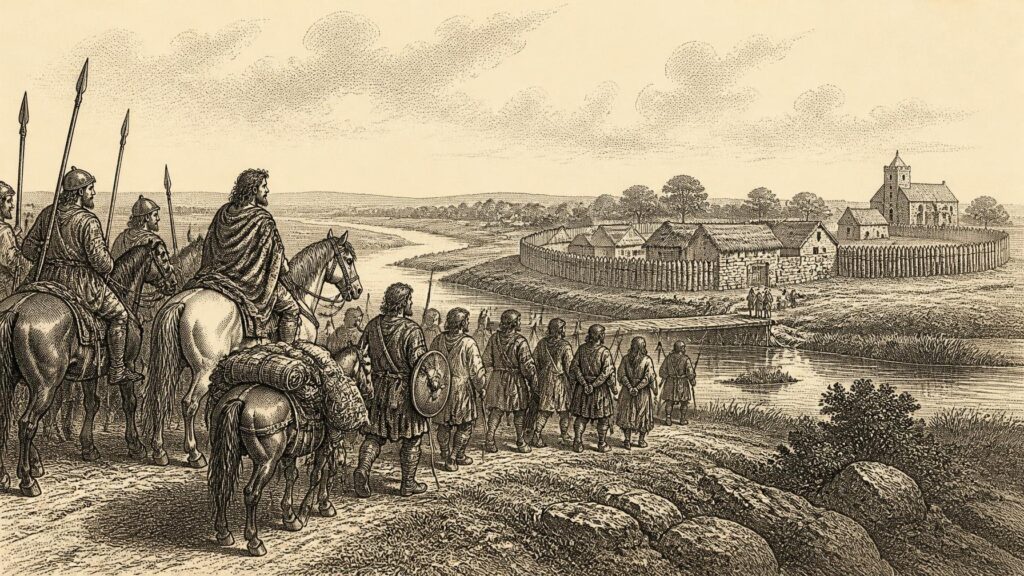
In 1469, the most consequential Irish campaign recorded by the surviving annals began far from Dublin, in the north-west, and ended amid fire in County Galway. Aodh Ruadh Ó Domhnaill of Tír Chonaill gathered a major hosting, took hostages in Lower Connacht, and marched south with the newly installed Mac William Burke against the rival Burke lordship of Clanricarde. The burning of Baile an Chláir, identified by the annals as Mac William’s town and generally understood as Claregalway, was not an isolated raid. It was a display of alliance, coercion and regional ambition in a landscape where power rested on kinship, military followings, cattle, hostages and the capacity to protect dependants.
What Can Be Dated Securely
The evidence for 1469 comes principally from the Irish annals: texts compiled in different places, often drawing on local information and written from the viewpoint of learned record-keepers. They are strongest on the acts and deaths of lords, clergy and professional men, while saying much less directly about tenants, women, traders and labourers. Several entries give firm dates. In Uí Maine, Aodh Ó Cellaigh was killed on the Monday before Shrove Tuesday. In Fermanagh, an attack in Lurg was placed on the eve of the Feast of the Holy Cross, 2 May, and another killing occurred at Achadh-inbhir on 24 August. Other major events, including Ó Domhnaill’s Connacht expedition, are securely assigned to the year but not to a day or month. This distinction matters: 1469 can be reconstructed as a year of violent political change, but not as a continuous calendar diary.
A Murdered King in Uí Maine
The year opened with a succession crisis in Uí Maine, the broad territory east of the Shannon associated with the Ó Cellaigh lordship. Annála Connacht records that Aodh, son of Uilliam Ó Cellaigh, described as king of Uí Maine and famed for generosity to petitioners, was treacherously killed by kinsmen: the sons of Breasal and Tadhg, son of Donnchadh. The wording preserves a political judgement as well as a bare fact. Treachery was not merely violence; it was violence that violated expected obligations between kindred.
The killing did not produce an uncontested replacement. Two men were proclaimed: Uilliam, son of Aodh son of Brian, and Tadhg Caech, son of Uilliam Ó Cellaigh. Such a dual proclamation reveals that lordship was not simple inheritance by eldest son. Leading branches of a ruling lineage, their clients and allied families could advance competing candidates. For inhabitants of the territory, the immediate consequences were likely to include demands for food, service, armed support and pledges of loyalty, although the annals do not describe these burdens in detail.
Ó Domhnaill’s Connacht Intervention
The political opening in Connacht formed the setting for Aodh Ruadh Ó Domhnaill’s intervention. The Annals of Ulster and Annals of Loch Cé agree that he led a great hosting into Lower Connacht, received its hostages, and brought its force with him against Richard, son of Edmund de Burgh, the Lower Mac William Burke. Hostages were central instruments of government rather than incidental prisoners: their delivery marked a submission intended to guarantee future conduct. In this instance, however, the Lower Mac William was not simply defeated. Richard, son of Thomas Burke, had resigned the lordship, according to Annála Connacht, and Richard, son of Edmund was made lord in his stead. The annalist’s sardonic comment that this was no ‘tone for an egg’ suggests a transfer regarded as unstable or contentious.
Ó Domhnaill and the Lower Mac William then turned towards the neighbouring Burke power of Clanricarde, known in Irish as Clann Ricaird. This alliance crossed the old distinction between a northern Gaelic dynasty and a family of Anglo-Norman descent long embedded in Irish lordship. The Burkes’ political vocabulary was thoroughly local: the annals call the leaders Mac William, report hostages, and place them within the same shifting field of military and dynastic relationships as Ó Domhnaill, Ó Cellaigh and Ó Briain.
The target was substantial. The force burned Machaire Riabhach and Baile an Chláir, the town of Mac William, where it encamped for a night. Annála Connacht adds that the attackers burnt the whole of Machaire Chlann Taidc on the following day, killing men and horses. Mac William of Clanricarde and an Ó Briain force came up with the raiders, but no pitched battle followed. Instead, Domhnall, son of Ó Conchobhair of Corcomroe, was killed, and Ó Domhnaill returned home with what the annals call triumph. The episode was connected to the aftermath of the victory of Cros-Maighe-Croinn in 1467, when Clanricarde had defeated an alliance including Richard Burke and Ó Cellaigh. Thus the 1469 march was both a fresh assertion of strength and a reckoning for an earlier humiliation, not a random eruption of destruction.
Conflict in Fermanagh
While Connacht was being drawn into Ó Domhnaill’s orbit, Fermanagh experienced a concentrated series of conflicts within the Mag Uidhir, or Maguire, kindred. The Annals of Ulster first record the sons of Philip Maguire and Edmund, son of Thomas Maguire junior, raiding the sons of Aodh Maguire in Mibolg. They carried off large preys, a word that commonly meant livestock and other movable wealth. Brian Maineach, son of Donnchadh son of Aodh Maguire, was killed.
A second raid followed in Lurg on 2 May. Eoghan, son of Aodh Maguire, Flaithbertach, Eoghan’s son, and Cormac Ó Manchain were slain. The rivalry continued into late summer: on 24 August, Domhnall Maguire and Gilla-Ísu Ó Flannagáin were killed by the sons of Aodh Maguire and the Muintir Manchain at the port of Achadh-inbhir. These notices make clear that the conflict involved more than two neat factions. Kin-groups, client lineages and local allies entered the struggle, while raids provided both a means of damaging opponents and a way of redistributing wealth.
Lecale Changes Hands
In eastern Ulster, 1469 also brought a sharp change in Lecale, the peninsula south-east of Downpatrick. Patrick Savage junior was captured by the Whites. With the support of Henry Ó Néill and Mac Uibhilín, or MacQuillan, Patrick White took the lordship of Leth Cathail, and the annalist says that surviving members of the Savage family were forcibly expelled. This was not a distant royal administrative alteration. It was a local seizure of lordship, made possible by a coalition of neighbouring powers. The terse record nevertheless shows the human scale of political loss: a leading family was displaced, its lands and dependants becoming the prize of new rulers.
The same annal records the death, in late summer, of Richard Ó Raighilligh junior, an ‘excellent prospective king’ of Bréifne. The phrase is revealing. He had not become lord, but his standing was sufficiently recognised for the annalist to register the lost possibility. Succession, everywhere in 1469, remained contingent on survival, backing and military capacity.
Church, Learning and Hospitality
Not all the year’s notable losses belonged to warriors. Ruaidhrí, son of Donnchadh son of Eoghan Ó Dálaigh, died; Annála Connacht calls him the most skilful harpist in Ireland. The notice is brief but important evidence for the high standing of trained musicians in late medieval Gaelic culture. Their art belonged to a wider professional world of poets, historians, lawyers and ecclesiastics supported by lordly and learned households.
The Annals of Ulster also mourn Tadhg Ó Cianáin as an eminent historian and keeper of a guest-house. Learning and hospitality appear together for good reason. A learned household was a place where travellers, clients, churchmen and scholars could be received, and where genealogies, legal memory and political reputation were cultivated. At the Termon of St Dabeoc, John the Tawny Mac Craith died as coarb, or hereditary ecclesiastical successor, and Diarmaid Mac Craith replaced him. The entry records continuity in a religious institution whose office, land and local influence were bound closely to kinship.
A Year of Uneven Reach
1469 does not support a story of a single Ireland moving under one government. English royal authority remained important in and around the lordship centred on Dublin, but the year’s annalistic record is dominated by regional polities acting on their own calculations. Ó Domhnaill could exact hostages in Connacht; Burke factions could alter the leadership of Lower Mac William; Maguires could conduct lethal internal raids; and a coalition in Lecale could expel a rival lordly family.
For ordinary people, the sources are frustratingly quiet. Yet the recorded burning of settlements, seizure of preys, death of horses, taking of hostages and expulsion of families expose the material foundations of power. Warfare struck at stores, animals, labour and security as much as at named leaders. At the same time, the obituaries of a harpist, historian-hosteller and ecclesiastical coarb show that political life depended on cultural and religious institutions as well as armed followings. Claregalway’s burning was therefore the year’s most dramatic image, but it belonged to a wider Irish pattern: lordship was made and unmade through force, alliance, memory and the control of people and resources.
Primary Sources
- The Annals of Ulster, Year U1469
- Annála Connacht, Annal 1469
- Annals of Loch Cé, Annal LC1469
- Annals of Loch Cé: Edition and Bibliographical Information
- The Annals of Ulster, Volume 3 English Translation
- TEI Header for The Annals of Ulster
- Annals of Ulster Otherwise Annala Senait, Annals of Senat
- Annála Connacht
- Annala Rioghachta Eireann: Annals of the Kingdom of Ireland by the Four Masters
- Annals of the Four Masters, Volume 4
- Annals of the Four Masters
- List of Published Texts at CELT
- Irish Texts at CELT
- Exploring the Irish Annals
- James IV, the O’Donnells of Tyrconnell and the Road to Flodden
- The Later Middle Ages
- Richard II and the Wider Gaelic World: A Reassessment
- Medieval Ireland C. 1170–1495: A Bibliography of Secondary Works
- Gluais: Irish Place-Name Glossary
- Gazetteer of Ireland / Gasaitéar na hÉireann