

Oghmagh’s Winter Siege1471 CE
In 1471, Ireland’s competing lordships pursued power through sieges, raids, hostages, alliances and negotiated submissions. Henry O’Neill captured Oghmagh after a winter-long siege, strengthening his son Conn’s position, while northern settlements accompanied continued conflict. In Fermanagh, Thomas Óg Maguire surrendered lordship to his son Edmund, illustrating dynastic succession, patronage and ecclesiastical connections. Connacht saw lineage violence, cattle-raiding and contested castles, while English and Gaelic forces contested frontier regions. Churchmen and learned families remained politically vulnerable yet valued. Annals also recorded unusual weather: damaging spring hail, followed by heat, drought, early crops and abundant nuts, linking security to land and harvest.
Dateline
In 1471, Irish political life was shaped less by a single national crisis than by a succession of local contests in which castles, cattle, hostages, kinship and negotiated submission mattered greatly. The surviving annals place several developments firmly within this calendar year. Taken together, they show a country of powerful but competing lordships, where authority was asserted through campaigns and alliances, yet also by the protection of churches, scholars and dependants.
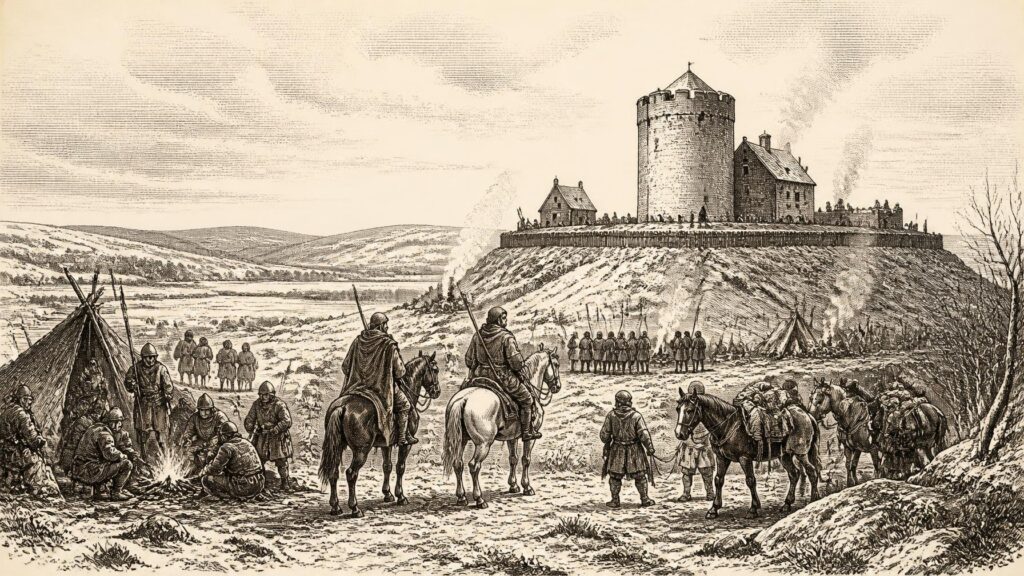
The year’s clearest northern episode was the capture of the castle of Oghmagh by Henry O’Neill, son of Eóghan. The annalist’s account is unusually full. Fighting had begun at the opening of winter between the descendants of O’Neill and the sons of Art O’Neill; the latter were defeated, with two of Art’s sons and many others killed. Henry’s party then closed in upon the castle. Inside was Síle, daughter of Niall Garbh O’Donnell and wife of Niall, son of Art O’Neill, while her husband and some of his kinsmen had gone to seek support from O’Donnell and the men of Tír Chonaill.
A Castle Under Siege
The siege was prolonged rather than a sudden storming. O’Neill remained before Oghmagh from the beginning of winter until the end of spring. That span is one of the few securely seasonal markers available for Irish warfare in 1471. It implies the difficult work of maintaining a force through cold months: feeding men and horses, controlling roads and fords, and preventing relief. Castles were not merely symbols of status. They served as defended residences, storehouses and centres from which a lord’s following could be protected or organised.
Eventually the sons of Art submitted and delivered the castle. Henry gave it to his son Conn, then returned home in what the annal calls triumph. The outcome was more than a family quarrel. It shifted a strategic strongpoint and publicly established Conn as a beneficiary of his father’s victory. Elsewhere in the north, O’Neill burned Tír Bresail but escaped an attempted interception by the sons of the king of Tír Chonaill and the sons of Art. Conn, son of Aodh Buidhe, also recovered all of Trian Conghail and received submissions from prominent neighbours. The annals further record a peace between O’Neill and O’Donnell, made on O’Neill’s terms, with the release for ransom of a son of O’Neill Buidhe. Conflict and agreement were therefore inseparable: campaigns generated leverage, while hostages, ransoms and submissions translated force into political advantage.
Fermanagh’s Ordered Succession
A quieter but highly revealing change occurred in Fermanagh. Thomas Óg Maguire, having held lordship for much of his life, relinquished it “for love of God”, according to the Annals of Ulster. The same entry praises his charity, humanity, leadership and his general protection of bardic companies and learned people. Its language is conventional praise, but it demonstrates what a successful Gaelic lord was expected to provide: military leadership and hospitality, certainly, but also patronage for the professional keepers of poetry, genealogy, law and history.
Thomas’s retirement was arranged within the ruling family rather than by automatic primogeniture. His son Edmund became lord of Fermanagh; another son, Donnchadh, remained tanaiste, or designated successor; and a third, Rosa, held the bishopric of Clogher. This distribution of secular and ecclesiastical influence illustrates the close overlap between lordship, kinship and church office. It should not be mistaken for a modern state succession: its durability depended upon the continued acceptance of relatives, allies and armed followers. The death of Aodh Maguire on 14 February, and the killing soon afterwards of rival Maguire kinsmen at the house of Mag Craith in the termon, or protected church land, show how vulnerable such arrangements could be. The annalist interpreted the subsequent killing of the attackers as divine punishment for profaning St Dabeoc’s sanctuary.
War, Cattle and Submission in Connacht
Connacht’s annals are crowded with killings within ruling lineages. Conchobhar O’Conchobhair of Corcomroe was killed by his nephews; several other O’Conchobhair kinsmen died in factional violence; and Domnall Mac Branáin was killed at Lissonuffy despite the guarantees and oaths of the kings and chiefs of Síol Muireadaigh. Such notices should not be read as evidence of constant indiscriminate disorder. Rather, they reveal a political world in which the control of a lordship was repeatedly contested among eligible male kin, and in which the breaking of sworn protection was considered especially grave.
Military action centred on resources as much as territory. O’Donnell and the sons of Eóghan O’Conchobhair raided the cattle of Cairbre and Clann Donnchadha north of Sligo. Mac William Burke entered Cairbre and took hostages. O’Donnell later led an army into north Connacht, burning and plundering part of Tír Fhiachrach belonging to the O’Dubhda family. Cattle-raiding could feed a force, impose humiliation, weaken a rival’s capacity to reward followers and compel a settlement. Hostages, meanwhile, were a material pledge that an agreement or submission would be honoured.
The year also brought an attack on Sligo castle. Mac William Burke marched into Lower Connacht to assist a claimant descended from Brian O’Conchobhair. While the sons of Eóghan O’Conchobhair were away with O’Donnell, Domnall, son of Eóghan, entered the castle. Mac William’s men broke the fortification of its door, but peace was made afterwards. The record does not allow us to invent terms for that peace or declare a permanent victor. It does, however, preserve the important fact that a breach in a castle’s defences did not necessarily end in conquest; negotiation could intervene even at the moment of apparent military success.
The Pale and Its Frontiers
In the midlands and north-east, the boundaries between the English lordship’s effective sphere and neighbouring Gaelic polities remained contested. The Annals of Ulster records a great war in Offaly between rival O’Conchobhair parties. Tadhg O’Conchobhair sought assistance from the “Foreigners” and brought a host of them into Offaly, where the country was said to have been devastated. In annalistic usage, this term commonly distinguished English or Anglo-Irish forces from Gaelic Irish, rather than describing visitors newly arrived from overseas.
Thomas FitzGerald, seventh earl of Kildare, and the men of Meath also raided Fermanagh. They made major forays against Mag Mathghamhna, whose followers retaliated with spoiling, burnings and killings. The episode is a useful corrective to any simple division of Ireland into separate English and Irish worlds. Political and military relationships crossed cultural frontiers, but those frontiers were real enough to organise alliances, raids and the language of the sources. Wider English affairs mattered too: Edward IV recovered the English throne in April 1471, and Kildare was reappointed deputy-lieutenant late in the year. Yet the immediate security of the Pale still rested chiefly on local magnates and their capacity to mobilise men.
Church, Learning and Vulnerability
Religious institutions were woven into this political landscape. Edmund, son of Bishop Pierce of Clogher, died on 14 April, Easter Sunday that year. At Armagh, the death of Archbishop John Bole in February was followed before year’s end by the appointment of the Franciscan John Foxal. A later seventeenth-century compilation, the Annals of the Four Masters, also attributes the foundation of a Franciscan friary at Galbally in the diocese of Emly to 1471; it adds that the house was destroyed in the following year. The foundation belongs securely to the year in that source, but the short notice cannot tell us how substantial the community had become before its destruction.
The annals also reveal churchmen exposed to worldly conflict. Diarmait, son of the erenagh of Elphin, was killed in a dispute over land, while Aodh O Mocháin, dean in a contested deanery, was put to death in the river at Killicknan. Conversely, the death of Cú Choicriche Ó Maolchonaire, prospective ollamh of Síol Muireadaigh, was marked with special regret. He died at Mac William Burke’s castle at Lough Mask and was buried at Rosserk under the protection of God and St Francis. His notice, together with the praise of Thomas Maguire’s patronage, is valuable evidence for the continuing place of hereditary learned families in late medieval Irish society.
Weather and the Year’s Harvest
Natural conditions received striking attention. The Ulster annalist simply called the summer hot. The Connacht annalist recorded an abundant nut crop, a very dry summer and autumn, and crops ripening unusually early. But these favourable general conditions followed destructive hailstorms around Beltaine, early May. Lightning and thunder accompanied hail that damaged blossom, beans and fruit in places across Ireland; one storm was reported to have flooded the floor of Boyle monastery’s great church. Later observers noted odd seasonal signs: nut trees flowering around the September feast of the Nativity of Mary, broody geese, and seed reportedly green within two days of sowing.
These observations cannot yield a modern national harvest statistic. They do show, however, that contemporaries measured political and household security against the condition of crops, orchards, livestock and buildings. In 1471, siege warfare and raiding took place alongside a year of damaging spring weather, heat and dryness, early produce and remembered abundance. The record is fragmentary, but its fragments preserve a vivid Ireland in which lordship was won at castle gates, maintained through kin and learning, and always constrained by the land’s uncertain seasons.
Primary Sources
- The Annals of Ulster, Year U1471
- Annála Connacht, Annal 1471
- Annals of the Four Masters, Annal M1471
- The Annals of Ulster: CELT Project Source Description
- Annals of Ulster Otherwise Annala Senait, Annals of Senat: Manuscript Sources and Editions
- Annála Connacht: CELT Project Source Description
- Annals of the Four Masters: CELT Project Source Description
- MS 23 P 6 (The Annals of the Four Masters)
- Plunkett (Plunket), Sir Alexander
- Irish Statute Book: Public General Acts, 1471–72 (11 & 12 Edw. 4)
- Statute Law Revision Act 2007
- The Struggle for Control of the Irish Mint, 1460-c. 1506
- Archdiocese of Armagh: Bishops and Archbishops
- Abbots, Bishops & Archbishops
- ‘Geographical Loyalty’? Counties, Palatinates, Boroughs and Ridings
- Collaborator and Survivor? Gerald the Eleventh Earl of Kildare and Tudor Rule in Ireland
- James IV, the O’Donnells of Tyrconnell and the Road to Flodden
- Bardic Poetry and the Analysis of Gaelic Mentalities
- William Buide O’Kelly and the Late Medieval Renaissance of the Uí Maine Lordship
- From Medieval Ireland to the Golden Age of Irish Science