Brian’s Cashel Fortifications995 CE
In 995 the Annals of Inisfallen record Brian son of Cennétig strengthening Cashel, Inis Locha Gair, Inis Locha Sainglenn and numerous other structures. This programme demonstrated Dál Cais control of Munster’s traditional royal centre while securing resources and refuges against raiding. Annalistic dating varies for connected events, including killings among Leinster, Osraige and Déisi rulers and Armagh’s destruction by lightning-fire. The year also saw ecclesiastical succession at Emly, the death of the scribe and coarb Colla, and deaths of rulers linked to Dublin and Alba. Together, these events reveal Brian’s rising, yet contested, authority amid political violence and institutional vulnerability.
Dateline
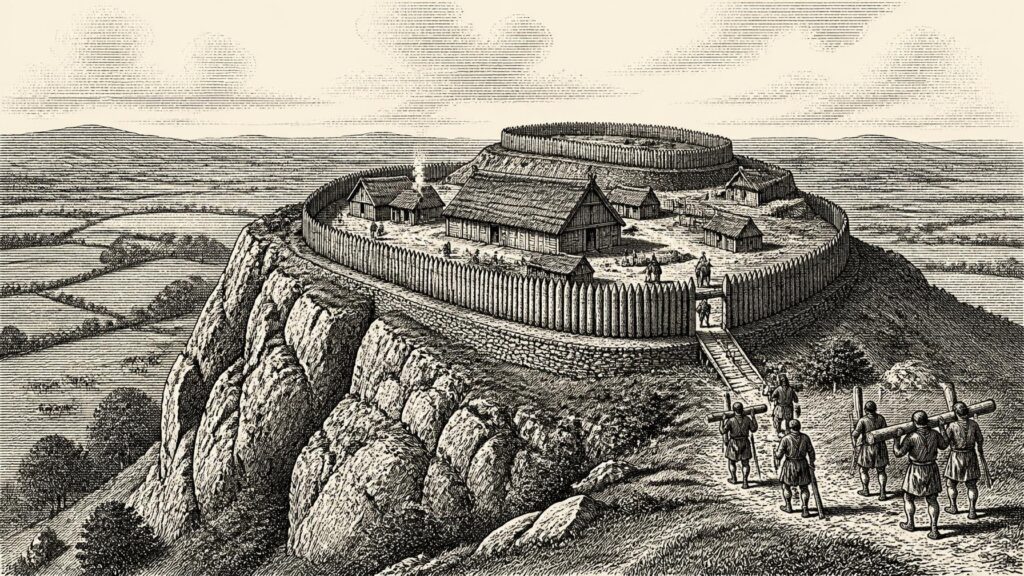
For 995, the clearest firmly dated Irish notice comes from the Annals of Inisfallen, a Munster-centred chronicle. It records an act of building by Brian, son of Cennétig: the strengthening or fortifying of Caisel, Inis Locha Gair and Inis Locha Sainglenn, together with “many structures besides”. The entry is brief, but it is unusually revealing. In a decade when Brian’s power was expanding beyond his Dál Cais homeland, work at royal and lake-side strongholds expressed security, wealth and authority as surely as a military expedition did.
A Year With Uneven Dates
Irish annals are indispensable for 995, but they must be read with care. They were copied and compiled over centuries, and their year-numbers do not always align neatly with a modern calendar. The Inisfallen entry is headed 995. A connected group of notices appears under 995 in the much later Annals of the Four Masters; the Annals of Ulster, however, place the same material under “995 alias 996”, while the Annals of Tigernach assigns several episodes to 996. This is not a reason to discard the reports. It is a reason to distinguish what can be tied securely to the annalistic year 995 from events that belong to its immediate chronological cluster but cannot honestly be pinned to one modern twelve-month period.
The fortification notice is therefore the centrepiece for the calendar year. It does not say that Brian built a new stone castle, and it would be wrong to picture the later cathedral, chapel or round tower that now dominate the Rock of Cashel. Those monuments post-date him. The Old Irish verb used by the annalist is commonly translated with a question mark as “fortifying”, and may encompass refurbishment, enclosure-making, defensive improvement or the provision of associated buildings. What matters is that the annalist regarded the work as substantial enough to record alongside royal deaths and ecclesiastical successions.
Cashel as a Statement of Power
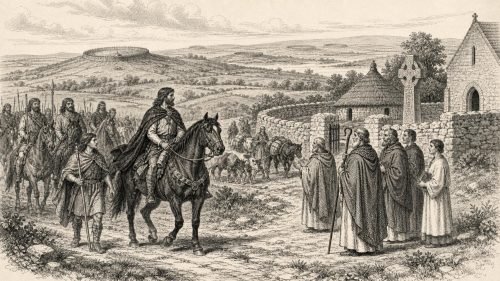
Cashel stood on a limestone outcrop above the fertile Golden Vale. It had long been associated with the kingship of Munster, above all the Eóganacht dynasty. By the later tenth century Brian’s Dál Cais had displaced the old ruling order at Cashel. Brian had succeeded to the Munster kingship in 978, but in 995 he was not yet undisputed ruler of Ireland: Máel Sechnaill mac Domnaill, king of Tara and leading ruler of the southern Uí Néill, remained his formidable rival in the midlands.
That context gives the building programme its political force. Cashel was not merely a residence. A royal hilltop, visible across a productive agricultural region, was an arena where a king received allies, stored resources, displayed armed followings and performed lordship. Improving its defences and buildings advertised that the Dál Cais occupation of this inherited Munster centre was durable. It also helped make authority practical. Labour, timber, food supplies, skilled craftwork and supervision had to be gathered and directed. A ruler capable of organising them demonstrated command over people as well as land.
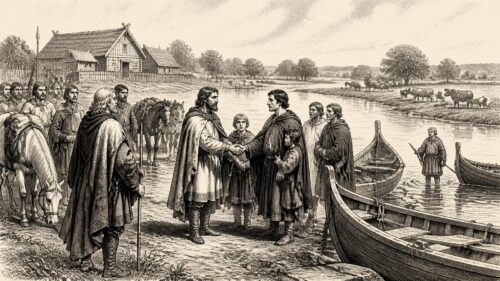
The two other named sites sharpen that message. Inis Locha Gair is generally associated with an island stronghold at Lough Gur in present-day County Limerick. Inis Locha Sainglenn was another lake-island site, though its exact modern identification is less secure. Lake settings offered natural protection, controlled access and a safe place for people, goods and animals in dangerous times. Their inclusion beside Cashel suggests a linked landscape of power rather than isolated construction projects: a prominent royal centre, defended refuges and other unnamed works within Brian’s Munster.
This was not construction for display alone. Raiding was a normal instrument of politics in early medieval Ireland, and cattle, food and captives could be taken in sudden attacks. Strongholds limited vulnerability, safeguarded stores and provided a place from which a lord and his household could organise resistance. Yet fortification also had a ceremonial dimension. A royal enclosure gave physical form to the claim that its ruler could protect dependants and command obedience.
Lives Behind the Works
The annals name kings and clerics, not the carpenters, food-producers, carriers and household workers whose effort underpinned their world. Archaeology supplies the wider setting. Much of the population lived on dispersed farmsteads, commonly enclosed by earthen banks and ditches or, in stony districts, by stone cashels. Within were round timber-and-wattle houses, hearths, animal shelters and stores. People cultivated grain, kept cattle and other livestock, spun and wove, worked leather and iron, ground corn and managed the seasonal demands of farming.
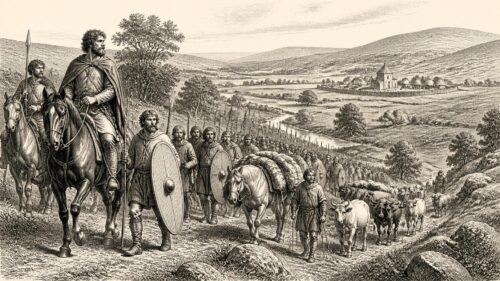
Such households could experience royal building as an obligation rather than a distant spectacle. Timber had to be cut and moved; food had to sustain work parties; animals and carts or pack transport had to be supplied. The sources do not tell us which communities contributed to Brian’s works in 995, so no particular levy can be reconstructed. Still, the scale implied by “many structures besides” makes clear that royal power rested on the productive capacity of the countryside. Cashel’s authority was built from everyday labour.
Churches, Writing and Succession
The Annals of Inisfallen also record the death of Colla son of Connacán, described as a scribe and coarb, or successor, of Senán. This was more than an obituary. A coarb held the institutional inheritance of a saint, combining religious standing with rights, lands and influence. The notice shows the importance of learned clerics in a society where writing, commemoration and authority were closely connected. The survival of the annal itself is part of that world: ecclesiastical communities preserved and reshaped the record of kings, churches and catastrophe.
Another Inisfallen entry states that Colum Ua Laigenáin took the abbacy of Imlech Ibuir, Emly. Monastic and ecclesiastical centres were not separate from politics. Their leaders controlled estates, received patronage, maintained churches and schools, and could lend legitimacy to rulers. Brian’s building activity at royal sites and the recording of an abbatial succession belong to the same broader landscape: power was exercised through both secular households and religious institutions.
The annal also notes the death of Ragnall, grandson of Ímar, called king of the foreigners. The phrase normally referred to rulers of the Scandinavian-Gaelic communities, especially those connected with Dublin and the Irish Sea. His death, together with the recorded killing of Cinaed son of Máel Coluim, high-king of Alba, reminds us that Ireland’s politics were never wholly confined to the island. Dynastic change in Dublin or across the North Channel affected alliances, shipping routes, mercenary connections and the calculations of Irish kings, even when no expedition is recorded for Brian in this particular year.
Violence on the Eastern Frontier
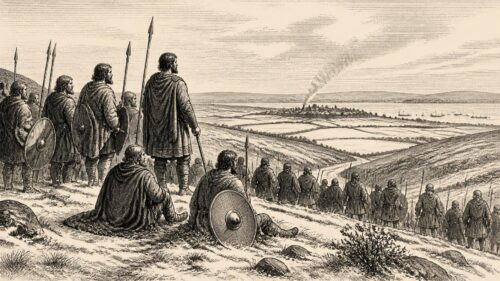
A darker sequence, securely connected to this annalistic horizon but uncertain in exact modern dating, concerned Leinster, Osraige and the Déisi. The Annals of the Four Masters place it in 995. They say that Diarmait son of Domnall, lord of Uí Cheinnselaig, was killed through treachery by Donndubán son of Ímar. Gilla Pátraic son of Donnchad, king of Osraige, was then killed by Donndubán and Domnall son of Faelán, king of the Déisi. Donndubán, in turn, was killed by Leinstermen within a week, in revenge for Diarmait; Domnall of the Déisi soon died as well.
The other annals corroborate important parts of the sequence but arrange it differently and do not always preserve its full explanation. The lesson is not merely that Ireland was violent. These were targeted killings of rulers in territories lying between Munster and Leinster, where control of routes, client peoples and political loyalties mattered greatly. The speed of retaliation described by the Four Masters suggests how personal kingship was: the death of one lord could rapidly unsettle neighbouring polities and invite revenge.
Armagh’s Destruction
The most vivid event associated with this chronological cluster was the burning of Armagh after a lightning strike. The Annals of Ulster, under 995 alias 996, state that lightning left no oratory, stone church, vestibule or wooden sanctuary unburnt. Inisfallen similarly places the blaze in its 996 entry. The Four Masters assign it to 995 and expand the destruction to houses, churches, bell-towers and the sacred wood. Whatever the precise calendar placement, the accounts agree that a major ecclesiastical settlement suffered a devastating fire.
Armagh was the principal church associated with Patrick and an important centre of learning, authority and pilgrimage. The wording shows a complex of buildings in stone and wood within an enclosed religious precinct, not a solitary church. Fire meant the loss of shelter, furnishings, books, stores and accumulated work as well as sacred structures. It also exposed a practical reality of tenth-century Ireland: even prestigious centres, protected by status and patronage, remained vulnerable to weather and flame.
Seen through the strongest evidence, 995 was a year of assertion rather than final triumph for Brian. At Cashel and the lake strongholds, he invested in the physical infrastructure of Munster power. Elsewhere, clerical succession continued, regional kings died violently and Armagh’s disaster demonstrated the fragility of even the greatest religious centre. These were not yet the events of Brian’s later dominance. They were the foundations, pressures and uncertainties from which that dominance would emerge.
Primary Sources
- Part 55 of Annals of Inisfallen
- Part 6 of Annals of Inisfallen
- Part 566 of The Annals of Ulster
- Part 16 of The Annals of Tigernach
- Part 10 of Annals of the Four Masters
- Annals of Inisfallen: Bibliography and Manuscript Information
- The Annals of Ulster
- The Annals of Tigernach
- Chronicon Scotorum
- Chronicon Scotorum: Bibliography and Manuscript Information
- Brian Bórama (Bóruma, Boru) | Dictionary of Irish Biography
- The Rock of Cashel
- The Rock of Cashel: The High King of Irish Monuments
- Making Provincial Kingship in Early Ireland: Cashel and the Creation of Munster
- Earthen Banks and Broken Walls: Archaeology and Monuments in the Irish Countryside
- Early Medieval Farmsteads
- Irish Field: Ringforts
- Cogadh Gaedhel re Gallaibh: The War of the Gaedhil with the Gaill
- Annals of Inisfallen to Go on Public Display in University College Cork
- Chronological Synchronisation of the Irish Annals