Swords, Silkbeard and Ímar994 CE
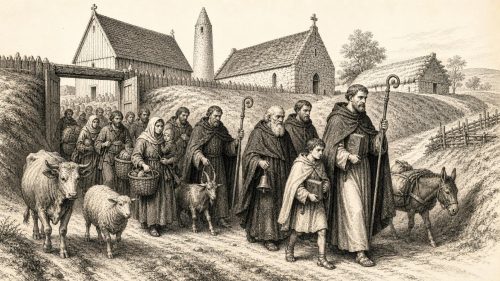
In 994, Ireland’s annals recorded political and ecclesiastical change. Sitriuc Silkbeard was expelled from Dublin during a brief Hiberno-Scandinavian dynastic takeover linked to Ímar of Waterford and his son Ragnall, whose rule soon collapsed. Máel Sechnaill, king of Tara, burned Swords, demonstrating his coercive influence near unstable Dublin. Elsewhere, regional rulers including Fogartach of Corcu Trí, Áed, heir of Ailech, and Conn of Uí Fhailgi were killed. The deaths of Armagh’s bishop Máel Muire and Scattery’s vice-abbot Fínnechta underline church institutions’ central public role. These scattered notices reveal local violence, competitive kingship, vulnerable ecclesiastical settlements, and interconnected Irish Sea politics.
Dateline
A Year Seen Through Fragments
The surviving record for 994 is brief, regional and unusually revealing. No annal offers a continuous narrative of Ireland that year; instead, separate notices register killings, a church burning, clerical deaths and a sudden reversal in Dublin. Taken together, they show an island divided among many competing lordships, in which authority rested not upon a single state but upon the ability of kings, dynasties and church communities to defend people, land, prestige and wealth.
The firmest contemporary-style framework comes from the Annals of Ulster, whose entry for 994 records the killing of regional rulers, the burning of Sord, or Swords, by Máel Sechnaill son of Domnall, the death of Máel Muire son of Scannlán, bishop of Armagh, and the expulsion of Sitriuc Silkbeard from Dublin. The Annals of Inisfallen, compiled from a Munster perspective, adds the death of Fínnechta Ua Ciarucáin, vice-abbot of Inis Cathaig, Scattery Island. These compact notices are not a complete account of the year. They are, however, valuable precisely because they preserve the concerns of institutions and political communities that had reason to remember them.
Dublin’s Brief Usurpation
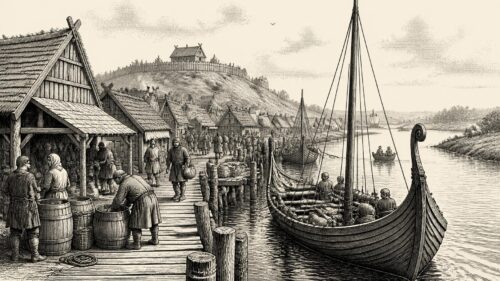
The year’s most consequential development was the disruption of power in Dublin. The annalist states plainly that Sitriuc son of Amlaíb, better known as Sitriuc Silkbeard, was expelled from Áth Cliath. Sitriuc belonged to the Hiberno-Scandinavian dynasty descended from Ímar, a family whose branches ruled or contested the seaports of the Irish Sea. Dublin was not an isolated Viking camp by 994: it was an established, densely occupied port settlement, sustained by craft production, maritime exchange and connections with Irish, British and Scandinavian worlds. Control of it therefore meant command of more than walls and quays. It meant access to ships, movable wealth, mercantile relationships and political leverage in Leinster and beyond.
Later and parallel annalistic traditions allow the episode to be connected with Ímar of Waterford, another member of the Uí Ímair kindred and Sitriuc’s rival. Modern biographical scholarship identifies Ímar as the man who briefly gained Dublin when Sitriuc was driven out, apparently installing his son Ragnall. The Annals of Ulster also place Ragnall’s killing by Murchad in the same annal-year. The exact order and timing of every move are not fully recoverable, and some later compilations differ by a year in their headings. The responsible conclusion is nevertheless clear: in 994 Dublin underwent a short, violent dynastic takeover, and the Waterford branch of the family was unable to hold its prize for long.
This was an Irish political crisis as much as a Scandinavian one. Sitriuc’s mother, Gormlaith, was of the Leinster ruling dynasty, while Ímar’s struggle with Dublin had implications for Waterford, Leinster and the ambitions of Máel Sechnaill, king of Tara. Labels such as “Irish” and “Viking” can conceal these entanglements. Leading families made alliances through kinship, fosterage, marriage, tribute and military need; the population of Dublin itself included people of mixed and changing cultural backgrounds. In 994, a quarrel within a Hiberno-Scandinavian dynasty could therefore alter the balance among Irish kings.
Máel Sechnaill’s Reach at Swords
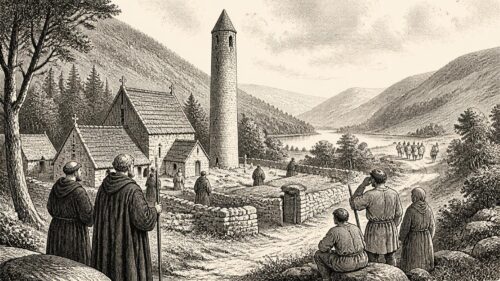
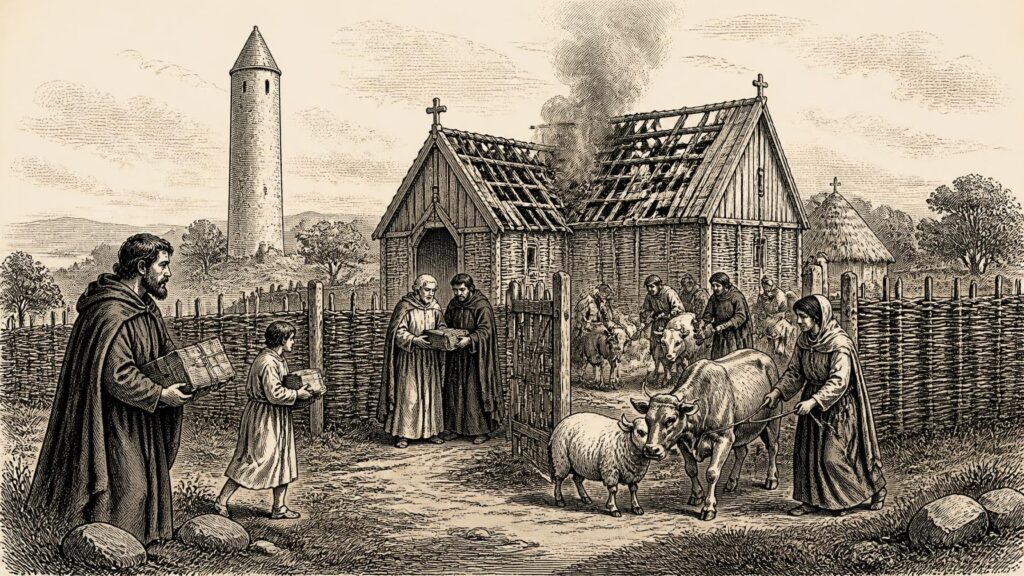
The burning of Sord by Máel Sechnaill was another sharply dated event. Swords lay north of Dublin, in a strategically important landscape between the city and the territories of Brega. The annal calls it “Sord of Colum Cille”, identifying the settlement through its Columban ecclesiastical association. That wording matters. Churches were not simply places of prayer outside politics. Major ecclesiastical communities possessed land, tenants, livestock, manuscripts, metalwork, food stores and legal standing; they were also places where rulers negotiated, displayed patronage and sought religious legitimacy.
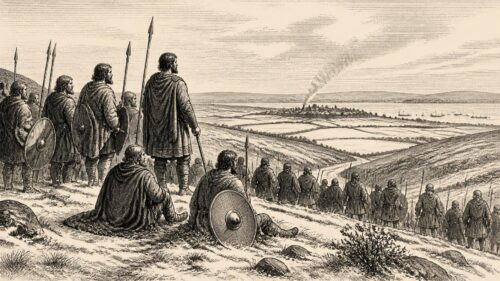
Nothing in the surviving entry explains why Máel Sechnaill burned Swords or specifies the scale of destruction. It would be unsafe to imagine a detailed siege, to assign casualties, or to suppose that every church building was destroyed. Yet the act demonstrates the coercive reach of the king of Tara within the eastern midlands at a moment when Dublin’s kingship was unstable. Burning a settlement associated with Colum Cille was an act with material and symbolic consequences: timber buildings, roofs, stores and household possessions were vulnerable to fire, while the attack also proclaimed that no local institution stood wholly beyond a dominant ruler’s power.
Máel Sechnaill’s position was formidable but not unchallenged. As king of Mide and king of Tara, he led the principal southern Uí Néill dynasty and claimed a pre-eminent place among Ireland’s kings. Brian son of Cennétig, ruler of Munster, was meanwhile building an increasingly powerful southern kingship. Their better-known accommodation belongs to 997, when annalistic sources record their division of spheres of authority. That settlement lay three years ahead. In 994, it should not be projected backwards as if Ireland were already divided into two settled halves. The political atmosphere was one of rivalry, rapid campaigning and shifting local loyalties.
Deaths in the Regional Kingdoms
The annals also record several killings that underline how fragmented political life remained. Fogartach son of Diarmait, king of Corcu Trí, was killed by the Gailenga of Corann. Corcu Trí belonged to the Connacht world, while Corann lay in the north-western interior. The notice does not preserve a cause, battlefield or settlement, and no responsible reconstruction can supply one. Its significance lies in its scale: a king of a comparatively small people could be killed in a conflict that never entered later national stories, even as such conflicts determined possession of cattle, land, dependants and status locally.
Áed, son of Dubgall son of Donnchad and heir-designate of Ailech, was also killed. Ailech was the great northern power-centre of Cenél nÉogain, one of the leading branches of the northern Uí Néill. The loss of an acknowledged heir did not necessarily cause an immediate constitutional crisis, since Irish succession was competitive and could involve several eligible members of a ruling kindred. It did, however, remove a man already marked for high status and illustrates the insecurity of dynastic politics even in the most prestigious royal houses.
Conn son of Congalach, king of Uí Fhailgi, was likewise killed. Uí Fhailgi occupied part of the central-eastern midlands, between the larger spheres of Mide and Leinster. These three deaths—recorded in Connacht, the northern Uí Néill sphere and the midlands—should not be forced into a single island-wide war. Rather, they reveal simultaneous local contests across Ireland. Royal power was personal and territorial. A death could rearrange a whole neighbourhood of clientships and rival claims without producing a change visible from every province.
Church Communities and Learned Office
Religious life appears in 994 not as a tranquil background to warfare but as an essential part of public order. Máel Muire son of Scannlán, bishop of Armagh, died during the year. Armagh’s authority was rooted in its association with Patrick and in its extensive ecclesiastical network. A bishop’s death mattered to clerics, tenants, pilgrims and patrons, but the annal does not identify his successor or describe the transition. It is best understood as a recorded change in one of Ireland’s foremost religious centres, not evidence for a wider reform or crisis.
In the south-west, Fínnechta Ua Ciarucáin, vice-abbot of Inis Cathaig, died. Scattery Island stood in the Shannon estuary, where maritime travel connected Munster, Connacht and the wider Irish Sea. The title vice-abbot indicates an organised community with recognised offices rather than a solitary religious retreat. The death notice is slight, but it reminds us that ecclesiastical settlements had administrators as well as saints and scholars. Their communities required food, buildings, boats, labour, livestock, hospitality and the management of inherited rights.
Other annalistic traditions, though their chronological placement must be treated carefully, preserve notices of learned churchmen around this moment, including a scribe of Clonmacnoise. Clonmacnoise, beside the Shannon, was a major religious and intellectual settlement with a substantial lay population and strong political connections. Such references help explain why scribes, abbots, bishops and church officers were named in historical records alongside kings. Literacy was embedded in institutions that also owned property, received patronage and mediated memory. The annals themselves are products of that learned environment.
What 994 Cannot Tell Us
For ordinary households, the sources are far less direct. They do not report a harvest, famine, epidemic, extraordinary weather or island-wide market conditions for 994. It would be misleading to manufacture a year of universal hardship or prosperity from silence. Most people continued to live in dispersed rural settlements, working land and tending cattle, sheep and pigs, while some lived in or near larger monastic and port communities. Their experience was shaped by seasonal labour, obligations to local lords and churches, and the risk that a nearby raid or succession dispute might bring demands for food, animals or service.
What can be said is that the events recorded in 994 made security and mobility important. Dublin’s contested kingship affected a maritime town tied to overseas trade. The burning at Swords exposed the vulnerability of ecclesiastical settlements in the eastern midlands. The killings of rulers in several regions show that political change could come suddenly and violently. Meanwhile, the recorded deaths at Armagh and Scattery demonstrate the continuing authority of church institutions in organising society and preserving its history.
Thus 994 was not a year dominated by one famous battle or a single royal proclamation. Its importance lies in the overlap of local violence, contested urban rule and ecclesiastical continuity. Sitriuc’s expulsion exposed Dublin’s susceptibility to dynastic intervention; Máel Sechnaill’s burning of Swords displayed the hard edge of midland kingship; and the notices from Armagh and Scattery show the enduring institutional world through which Irish society understood rank, memory and legitimate power.
Primary Sources
- The Annals of Ulster
- Annals of Inisfallen, Part 55
- Annals of the Four Masters
- Annals of the Four Masters, Part 10
- Annals of Tigernach
- Annals of Tigernach, Part 16
- Chronicon Scotorum
- Sitriuc Silkbeard (Sitric, Sigtryggr Ólafsson Silkiskeggi)
- Ímar (Ívaar)
- Brian Bórama (Bóruma, Boru)
- The Dublin Coinage c.995–1050
- The Vikings in Scotland and Ireland in the Ninth Century
- General Vikings in Ireland
- Exploring the Irish Annals
- Annals of Inisfallen to Go on Public Display in University College Cork
- Clonmacnoise Monastic Site
- Clonmacnoise Visitor Guide
- Scattery Island Monastic Site and Visitor Centre
- High Crosses
- TEI Header for The Annals of Tigernach