Bordered Networks
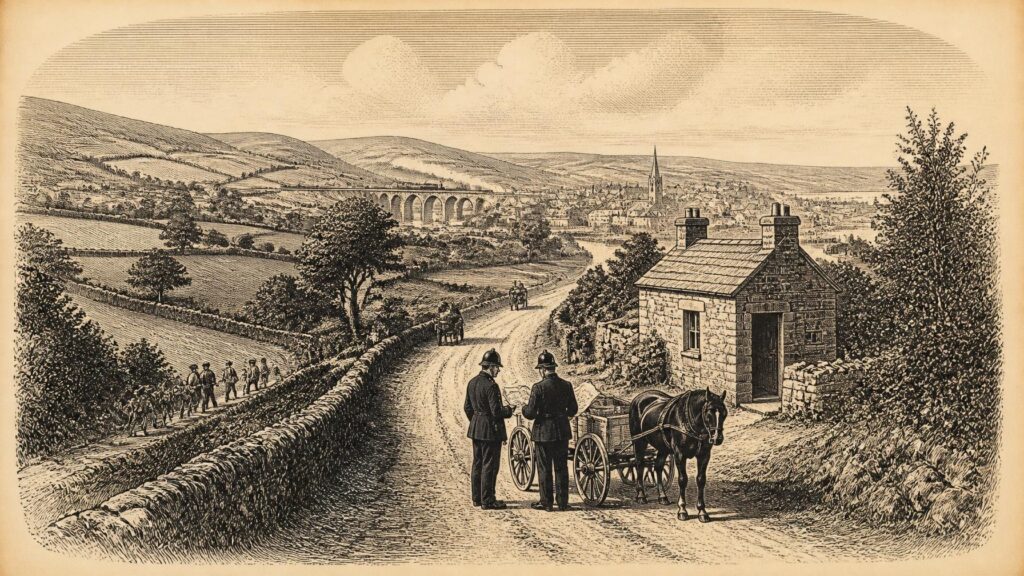
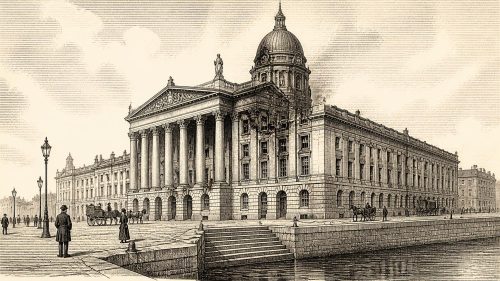
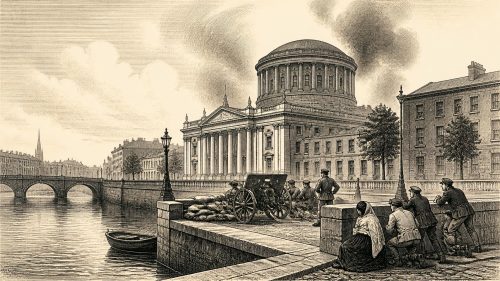
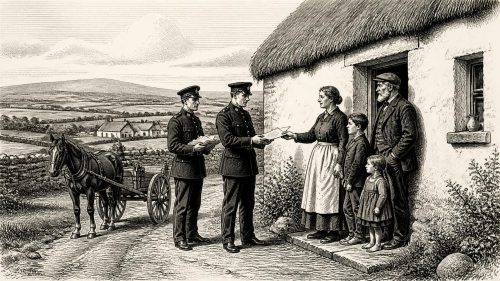
AI generated historical illustration, not a contemporary photograph.
At a Glance
Cross-border policing on the island of Ireland is a history of institutions learning to work across a line that was politically charged, legally consequential and, in ordinary life, often highly permeable. Organised crime did not create that problem, but it has made its persistence unusually clear. The history is neither a simple tale of two police services overcoming old enmities nor a story of criminals effortlessly exploiting an “open border”. It is, rather, the record of practical cooperation growing unevenly out of partition, conflict, legal difference, personal contact and constitutional change.
Historical Setting
The modern subject begins with partition. The border that emerged from the Government of Ireland Act 1920 and the establishment of the Irish Free State in 1922 separated six counties remaining within the United Kingdom from the rest of the island. It divided roads, railway lines, farms, families, commercial networks and local hinterlands. It also created two policing jurisdictions: the Royal Ulster Constabulary in Northern Ireland and, from 1922, An Garda Síochána in the Free State. Each service was embedded in a different constitutional order, criminal law and political culture. That institutional division was fundamental. A suspect, stolen vehicle, consignment or witness could cross a few miles and pass beyond the ordinary powers of the pursuing police officer.
It is tempting to describe the frontier as either rigid or invisible, but neither description is adequate across the whole period. Customs posts, revenue enforcement and state-security measures made it conspicuous at particular times and places. Yet the terrain contained hundreds of minor roads, lanes, fields and waterways; trade and kinship continued across it; and the Common Travel Area supported extensive everyday movement. The frontier therefore had a dual character. It was a hard boundary of sovereignty and criminal jurisdiction, but a soft boundary in many social and economic routines. This contradiction created opportunities for evasion, but it also made permanent, heavily intrusive policing difficult and politically sensitive.
“Cross-border policing” should not be read as a single activity. It can mean the exchange of intelligence, reciprocal requests for evidence, coordinated searches, liaison over missing people, shared emergency planning, parallel investigations, training, extradition or surrender arrangements, and cooperation among police, customs, tax and financial-investigation bodies. It does not ordinarily mean that a Garda officer has general powers in Northern Ireland, or that a PSNI officer can exercise constabulary powers in the Republic. That distinction matters because popular discussion often assumes a seamless all-island police power which the law has not created.
The history also requires a distinction between politically motivated violence and profit-driven organised crime. During the Troubles, security cooperation chiefly concerned paramilitary violence, weapons, fugitives and intelligence. Some paramilitary organisations engaged in extortion, smuggling, robbery and later other illicit businesses, but it would be historically misleading to treat every cross-border offence as paramilitary or to describe all organised crime as a continuation of the conflict. The overlap was real in some cases; the categories, motivations and evidential bases remained different.
Partitioned Policing
In the first decades after partition, police cooperation was limited by more than geography. The RUC was associated with the Northern Ireland state and the Gardaí with the new southern state; their relationships reflected wider diplomatic uncertainty and unresolved constitutional claims. Scholarly work on the subject describes the early decades as a “back-to-back” existence in which cross-border cooperation was neither systematically structured nor publicly prominent. Routine contact could occur where practical necessity demanded it, but there was no settled, visible architecture comparable to later agreements. The border was itself a sensitive emblem of legitimacy, so police contact could acquire political meanings beyond the immediate case.
Crime nevertheless crossed it. Smuggling is the clearest early example because a boundary separating tax and customs regimes creates price differences that can be monetised. Livestock, alcohol, tobacco and other goods could be moved unlawfully, while stolen property and suspects might be transferred from one jurisdiction to the other. Such activity should not be romanticised as harmless border folklore. Some evasion was opportunistic and local; other schemes relied upon repeat routes, transport, concealment, buyers and corrupt assistance. The historical record supports a continuum between small-scale evasion and more organised commercial offending rather than a clean dividing line.
Jurisdiction imposed practical limits. An officer who received intelligence about a crime committed on the other side might need to pass it on, request assistance, or wait for the other force to act. Evidence had to be obtained according to the receiving jurisdiction’s rules; witnesses might be reluctant; and prosecutions required proof capable of surviving scrutiny in a different court system. Cooperation thus depended not only on goodwill but on compatible procedures, secure communications and confidence that shared information would be used lawfully. These difficulties are familiar to modern investigators, but their roots lie in partition itself.
The border counties also demonstrate why local knowledge mattered. Policing depended on knowing which roads were usable, how communities moved, where commodities could be stored and which apparently ordinary commercial links were significant. Yet local familiarity had a reverse side: in tightly connected communities, information could travel quickly and police action could be anticipated. The later language of intelligence-led policing can obscure this older reality. Border policing had always been information-dependent; what changed over time was the scale, technological form and legal regulation of information exchange.
Security Priorities
The outbreak of the Troubles at the end of the 1960s transformed the significance of the frontier. It became a security landscape of checkpoints, military deployments, closed roads, surveillance and contested sovereignty. The RUC operated alongside the British Army in Northern Ireland, while the Gardaí worked with the Irish Defence Forces in the Republic. Terrorist organisations and security forces alike attached strategic importance to routes across the border. The resulting environment was far removed from ordinary policing: it involved emergency law, intelligence, armed patrols and profound public distrust.
Documented historical research shows that official concern about cross-border security was central to Anglo-Irish relations during the conflict. The issue was not merely whether individuals could cross; it was whether weapons, intelligence, explosives, money and safe accommodation could be moved or used across two jurisdictions with different laws and political constraints. British governments frequently pressed Dublin for stronger action against republican paramilitaries, while Irish governments had to balance security cooperation with constitutional sensitivities, civil liberties and public opinion. These were state-to-state issues as much as police-to-police ones.
In this period, cooperation existed, but the evidence does not sustain a picture of frictionless partnership. Academic accounts emphasise that much operational contact was informal and dependent upon professional relationships, particularly before the later formal agreements. Informality could be useful: officers who knew one another could exchange urgent information quickly and avoid bureaucratic delay. It could also be fragile, opaque and vulnerable to wider political tensions. When trust was low, intelligence sharing was constrained by fears over source protection, operational compromise and allegations of collusion or partiality.
The Troubles left a durable institutional legacy. Both services gained extensive experience of serious crime investigation, intelligence handling, border movement and multi-agency security work, but at considerable human and political cost. The history cautions against celebrating operational effectiveness while ignoring legitimacy. Policing in Northern Ireland was intensely contested, and cooperation with the Gardaí could itself be interpreted through nationalist or unionist assumptions. Any later system seeking public consent had to address not only criminal capacity but the inherited meanings of the police institutions involved.
Informal Contacts
Informal cooperation deserves attention because it was neither trivial nor a substitute for law. Before robust formal structures emerged, personal relationships could enable practical responses to cross-border offending. Officers could alert counterparts to a wanted person, a suspicious vehicle or a developing threat; detectives could compare information; senior officers could make contact during major incidents. This form of cooperation was especially valuable where a case moved faster than the formal machinery of mutual legal assistance. It reflected a basic fact of border policing: criminals do not arrange their activity around administrative timetables.
Yet informal practice raises difficult historical questions. It may be hard to reconstruct because its most important exchanges were oral, confidential or never retained in accessible records. It can also escape ordinary democratic oversight. Professor Dermot Walsh’s analysis of cooperation argues that productive professional ties developed strongly, while transparent regulatory and accountability arrangements lagged behind. That is an important interpretation rather than a claim that informal contact was inherently improper. The historical point is that effectiveness, legality and accountability are related but not identical objectives.
The Independent Commission on Policing for Northern Ireland, chaired by Chris Patten in 1999, reached a related conclusion. It found cross-border cooperation more ad hoc and more dependent on personal relationships than comparable international arrangements. Its recommendations included structured liaison, exchanges, joint planning and consideration of rapid arrangements after major incidents with a significant cross-border dimension. The commission did not imagine that constitutional difference would disappear; it proposed that better organisation could make it less obstructive.
This shift from personal acquaintance to institutional design was historically significant. Personal trust remains valuable, particularly in urgent investigations, but an enduring system cannot rely solely on the careers or goodwill of particular officers. It needs agreed channels, records, supervision, training and legal authority. The later history of cross-border cooperation is therefore best understood as an effort to preserve the speed of professional contact while placing it within more durable and accountable frameworks.
Political Change
The Anglo-Irish Agreement of 1985 and the wider peace process did not resolve every operational problem, but they altered the political environment in which cooperation could develop. The Belfast/Good Friday Agreement of 10 April 1998 then supplied a new constitutional and institutional settlement. Its policing provisions stressed a professional, effective, fair, impartial and accountable service operating within a cooperative criminal-justice system and human-rights norms. The Agreement did not create a single police force for the island; rather, it made constructive North–South cooperation a legitimate and expected element of a wider settlement.
The Patten process was crucial because police reform was not simply an administrative matter. The RUC’s replacement by the Police Service of Northern Ireland in 2001 formed part of an attempt to build a service capable of attracting support across communities. For cross-border work, legitimacy mattered operationally. A police partnership perceived as an extension of one state’s security apparatus would have limited credibility in many border communities. Conversely, cooperation grounded in accountable services and agreed institutions could be presented as public protection rather than a constitutional manoeuvre.
The peace process also changed the relationship between security and ordinary crime. Serious threats remained, including dissident republican violence, but the reduction in large-scale conflict allowed greater emphasis on drugs, fraud, trafficking, revenue crime and asset recovery. This did not mean that the border ceased to be politically charged. It meant that cooperation could increasingly be discussed in the language of community safety, victim protection and criminal justice rather than exclusively through counter-insurgency.
Interpretation is needed here. The growth of cooperation after 1998 was not caused by goodwill alone. It reflected political agreements, changing police institutions, European legal instruments, better communications and the practical pressure of criminal markets. But the peace settlement made those developments more sustainable. It created a setting in which officials could formalise arrangements without appearing to concede sovereignty or erase constitutional difference. That was one of its less dramatic but lasting consequences.
Legal Foundations
The most important formal bilateral step was the Agreement between the Government of Ireland and the Government of the United Kingdom on Police Co-operation, signed at Belfast on 29 April 2002 and brought into force on 20 December that year. The agreement supplied a framework for cooperation between the Gardaí and the PSNI, including information exchange, personnel exchanges, training, liaison and arrangements for operational support. Its significance lay not in abolishing the boundary but in acknowledging that two sovereign legal systems could establish predictable means of working together.
The agreement should not be overstated. It did not confer general policing powers across the frontier, create unrestricted hot pursuit, or remove the need to comply with domestic law. Where coercive action was required, the host jurisdiction’s authorities retained responsibility. That arrangement reflects a central principle of international policing: cooperation can be close without transferring sovereignty. It also explains why investigators may run coordinated but legally separate operations, execute searches through local officers, or pursue parallel cases in different courts.
Legal foundations extended beyond the 2002 agreement. Extradition and, later, European arrest-warrant arrangements; mutual legal assistance; joint investigation practices; customs and revenue powers; financial intelligence; and European police databases all affected the ability to pursue cross-border cases. Such instruments are less visible than patrol cars or checkpoints, yet they often determine whether a lead becomes admissible evidence, whether a suspect can be surrendered, or whether criminal assets can be restrained. Cross-border policing is consequently inseparable from cross-border criminal justice.
The legal architecture has remained layered. Bilateral arrangements operate alongside domestic statutes, UK–EU arrangements, Irish and British constitutional safeguards, data-protection rules and international conventions. This can appear cumbersome, but it is also a safeguard. The very fact that a case spans jurisdictions increases the risk of unlawful evidence gathering, duplication or unaccountable intelligence use. Rules and records can slow an investigation, but they are also what enable a prosecution to withstand challenge and distinguish lawful cooperation from informal state power.
Operational Practice
By the 2010s, cooperation had become more systematic. The Gardaí and PSNI issued joint cross-border policing strategies, including the 2016 Cross Border Policing Strategy. Its scope extended beyond organised crime to operations, investigations, intelligence, information sharing, training, human resources and emergency planning. This breadth matters. A durable response to crime cannot be built solely around occasional high-profile raids; it depends on routine liaison, compatible procedures, shared professional understanding and the ability to respond together to incidents affecting both jurisdictions.
Operational coordination normally involves several agencies. Police forces may work with HM Revenue and Customs, the Irish Revenue Commissioners, the National Crime Agency, Border Force, the Criminal Assets Bureau, immigration authorities and financial-intelligence units. Their roles differ. Police investigate offences and protect the public; revenue bodies focus on tax and excise; asset-recovery agencies follow money and property; immigration bodies address unlawful movement and exploitation. Organised crime frequently crosses these administrative categories, which is why a multi-agency approach became more prominent.
Such coordination is not the same as a combined command. Agencies retain their own legal mandates and evidential standards. A revenue seizure may generate intelligence for a police investigation; a policing operation may identify unexplained wealth for civil recovery; an immigration encounter may reveal trafficking indicators. The value of a task-force structure lies in allowing these strands to be connected without pretending that every agency does the same work. It can also prevent duplication and reduce the chance that one operation compromises another.
Modern cooperation is thus best seen as a network rather than a single institution. It contains strategic meetings, liaison officers, operational coordination, information systems, joint days of action and separate investigations that converge on the same people or commodities. This networked form is partly a response to the dispersed nature of criminal enterprise. Drugs, cash, counterfeit goods and victims may travel through different routes and intermediaries; no individual agency is likely to see the full picture alone.
Criminal Markets
Organised crime on the island has taken varied forms. Official assessments identify drugs, financial crime, excise fraud, human trafficking, organised immigration crime, theft and mobile criminality among the principal cross-jurisdictional concerns. These categories overlap. A group moving drugs may launder proceeds through cash-intensive businesses; a network transporting illicit tobacco may use the same logistics and concealment techniques for other commodities; burglary crews may move stolen goods across the border before disposal elsewhere. The point is not that one universal criminal organisation controls all activity, but that markets, routes and facilitators can overlap.
The Cross Border Organised Crime Assessment 2018 offers a valuable contemporary snapshot rather than a timeless statistical truth. It reported significant relationships between groups operating in Northern Ireland and those based in Ireland, and described mobile organised crime groups, drugs, smuggling and financial offending. Its figures and assessments should be read in their date-specific context: they record what agencies knew and prioritised in 2018, not a fixed measure of all crime or a definitive description of every border community.
Official threat assessments necessarily focus on detected or intelligence-known networks. They are strong evidence of institutional assessment and operational concern, but not a complete census of hidden crime. They can be affected by enforcement priorities, reporting rates, intelligence quality and the capacity to investigate. A rise in recorded cross-border activity may indicate a growing threat, improved detection, changed classifications, or several of these at once. Historical writing should therefore avoid treating seizure values or arrest totals as simple proof of the total scale of a market.
Nor should the language of organised crime turn border regions into suspect landscapes. Most cross-border movement is lawful and socially ordinary. The same road network that can assist a smuggler also allows commuters, patients, students, families and businesses to travel. Effective policing has to target patterns of offending without recreating a security regime that burdens ordinary life or symbolically hardens the frontier. That balance has been central to policy since the peace process.
Paramilitary Legacies
One of the most sensitive subjects is the relationship between paramilitarism and criminality. Northern Ireland’s official organised-crime material recognises that some organised groups may have paramilitary connections. The Fresh Start Agreement of November 2015 likewise linked efforts against cross-jurisdictional organised crime with commitments to tackle paramilitary activity and paramilitary-related crime. Those formulations are evidence that governments regarded the overlap as an operational concern. They are not evidence that all present-day cross-border crime is controlled by paramilitary organisations.
Historically, illegal fundraising and coercive control formed part of the repertoire of several paramilitary organisations. Smuggling, extortion, robbery and protection rackets could serve political, organisational or personal purposes. After the ceasefires, some criminal practices did not automatically disappear, and allegations of continuing influence became part of public debate. But the evidence is uneven, and labels are often contested. A careful account must distinguish court findings, official assessments, intelligence-based claims and community belief. They do not carry the same evidential weight.
There is also a risk in treating paramilitary association as an explanation for every difficult case. Contemporary organised crime can be entrepreneurial, transnational and detached from local political loyalties. Its actors may cooperate pragmatically across community and jurisdictional lines where profit demands it. This is one reason why the post-2015 task-force model focused on commodities and harms—drugs, trafficking, finance, excise and rural crime—as well as on labels of organisational identity.
The historical lesson is that criminal justice responses require both precision and restraint. Where there is evidence of paramilitary-linked criminality, it demands serious investigation. Where there is not, attaching the label can damage trust, distort analysis and obscure other causes of harm. Police cooperation gained after 1998 depends partly upon avoiding the broad, politically loaded assumptions that made earlier security policy so controversial.
Revenue Crime
Fuel fraud, illicit tobacco and alcohol have been especially important in accounts of cross-border organised crime because taxation produces exploitable price differences and because legitimate transport systems can be adapted for illicit use. Fuel laundering became a conspicuous example during the early twenty-first century. Criminals could exploit marked fuel, processing equipment, storage sites and distribution networks, while the environmental damage caused by waste disposal added a public-health dimension. The crime was not simply a loss to the exchequer; it could contaminate land and water and fund wider criminal activity.
Revenue crime illustrates why police cooperation alone is insufficient. Revenue agencies possess specialist knowledge of excise rules, supply chains and compliance records; police possess powers and expertise relevant to criminal investigation; environmental authorities may be needed where waste is involved; financial investigators may trace proceeds. Cooperation between HMRC and the Irish Revenue Commissioners has therefore been as important as Garda–PSNI liaison. The 2018 assessment and later Northern Ireland Assembly reporting identify excise fraud as a continuing priority for joint work.
Public memory sometimes presents fuel laundering as a problem solved once and for all through dramatic discoveries of plants and dumps. That is too neat. Enforcement can disrupt a method, raise its costs and change its profitability, but illicit markets adapt. Criminal groups may move to different products, routes, technologies or jurisdictions. Historical evaluation should ask not only whether a particular site was closed, but whether the underlying incentives, distribution channels and financial rewards were altered.
The same caution applies to seizure statistics. A large seizure may represent excellent intelligence and operational success; it may also reveal the volume capable of moving through the system. Neither conclusion follows automatically without wider evidence. The most supportable judgement is usually narrower: a seizure documents a particular intervention and, when placed alongside other evidence, can indicate the persistence and methods of a market.
Financial Networks
Following money is essential because organised crime is sustained by profit, not merely by the movement of contraband. Cash may cross the border physically, be deposited through businesses, converted into property or vehicles, mixed with legitimate income, or moved through accounts beyond either jurisdiction. Financial investigations are often slower than commodity seizures, but they can expose organisers, facilitators and beneficiaries who remain distant from a vehicle stop or a warehouse search. Asset restraint and recovery may therefore have a longer-term disruptive effect than a single interception.
Cross-border financial work is demanding. Investigators must identify beneficial ownership, obtain bank material lawfully, follow transactions across legal systems and prove the connection between assets and criminality. Criminal assets can be held in another person’s name or embedded in apparently legitimate enterprises. The work requires forensic accounting and close coordination between police, revenue authorities and asset-recovery bodies. It also requires procedural care: the more complex the case, the more vulnerable it may be to delay, disclosure disputes and legal challenge.
Fresh Start specifically called for enhanced specialist capacity, including forensic accounting, in tackling proceeds of crime. The Joint Agency Task Force later made financial crime one of its priority areas. This reflects a wider historical shift from concentrating on offenders at the point of arrest to treating finance as an operational target in its own right. That change is not unique to Ireland, but it is particularly relevant in a border setting where profits can be moved or disguised through more than one jurisdiction.
Claims about the precise financial scale of organised crime should be approached carefully. Estimates can be useful for planning, but they often rely on assumptions about hidden markets. Documentary evidence is strongest where it concerns specific court orders, seizures, audited tax losses or identified assets. Broader figures are better understood as informed estimates of risk and harm, not as exact accounts of an underground economy.
Human Exploitation
Human trafficking and organised immigration crime bring a different moral and investigative dimension. Unlike an illicit commodity, a trafficked person is not an object of enforcement but an individual who may be coerced, deceived, indebted or otherwise exploited. Victims may fear police, lack secure immigration status, be controlled by exploiters, or have experienced violence. Cross-border cooperation must therefore combine investigation with safeguarding, interpretation, accommodation, referral and support. A purely enforcement-led approach risks missing the harm at the centre of the offence.
The Common Travel Area and the absence of routine frontier controls can be exploited by people-smuggling networks, but it would be misleading to portray ordinary free movement as the cause of trafficking. Exploitation depends on recruiters, transporters, controllers, employers, document fraud, accommodation and profit. The task for authorities is to identify criminal abuse while preserving lawful travel and avoiding indiscriminate suspicion of migrants. Assembly evidence and government reporting have treated trafficking, including child trafficking, and organised immigration crime as joint priorities.
Cross-border referral is especially important where a potential victim has moved between Northern Ireland and the Republic. Information sharing may help identify patterns, locate relatives, establish routes and protect other victims. But personal data in these cases are exceptionally sensitive. The desire to share intelligence must be matched by safeguards against exposing victims to traffickers, family pressure or immigration consequences. The history of police cooperation therefore intersects with modern human-rights standards as much as with traditional detective work.
This field also demonstrates why headline arrest figures do not by themselves measure success. An arrest may be necessary, but a victim’s safety, willingness to engage and access to support matter too. Conversely, a low number of identified victims does not prove low prevalence; it may reveal barriers to disclosure. Historical accounts should give priority to documented institutional arrangements and known cases while making the limits of detection explicit.
European Frameworks
European cooperation added another layer to bilateral policing. United Kingdom and Irish participation in European criminal-justice measures gave investigators routes for exchanging information, pursuing fugitives and cooperating with agencies across the continent. Europol links, passenger data, criminal-record arrangements, DNA and fingerprint mechanisms, and the European Arrest Warrant formed part of the wider environment in which cross-border cases on the island operated. Their importance was not limited to the Irish border: a case involving Dublin, Belfast and a third country might depend on several linked systems.
The advantage of European frameworks was not that they replaced Garda–PSNI contact. Rather, they made that contact more useful when a case extended beyond the island. A stolen vehicle, cocaine shipment, fraud victim or trafficking network may have connections in Britain, continental Europe or elsewhere. The bilateral relationship supplied local knowledge and immediate communication; European systems could provide wider alerts, identity checks or formal cooperation. The two levels were complementary.
Parliamentary scrutiny after the Brexit referendum stressed this point. The House of Commons Northern Ireland Affairs Committee concluded that close Garda–PSNI relationships were central but that EU information systems had also supported cross-border cooperation. It noted the historical development from informal contacts toward more formal mechanisms after the Belfast/Good Friday Agreement. This is strong evidence against the idea that bilateral goodwill alone can compensate for every loss of shared legal or technical infrastructure.
European cooperation also reinforced procedural expectations around data protection, proportionality and judicial safeguards. These can appear remote from frontline policing, but they are integral to trust. Information shared across borders must be accurate, necessary and handled under clear rules. In a region where policing has a contested history, the legitimacy provided by such safeguards is not bureaucratic ornament; it is an operational resource.
Brexit Adjustments
Brexit altered the formal setting but did not remove the practical need for cooperation. The United Kingdom left the European Union on 31 January 2020, and the transition period ended on 31 December 2020. The border on the island remained uniquely sensitive because of the peace settlement, the Common Travel Area and the commitment to avoid a hard land border. For policing, the key question was how to preserve operational capacity, information exchange and judicial cooperation when some EU arrangements ceased or changed.
Academic and parliamentary analyses warned that the loss of particular EU tools could make cooperation less direct or less efficient, even where bilateral links remained strong. This did not mean that Gardaí and PSNI officers stopped working together. It meant that the legal routes, databases and procedures surrounding their work required adjustment. The distinction is important: continuity of professional commitment does not guarantee continuity of every technical capability.
Brexit also revived a familiar historical concern: how to manage crime without turning the border into a conspicuous security barrier. A physical enforcement response may seem attractive when discussing smuggling or immigration offences, but it carries practical limits and political costs. The post-Agreement approach has generally favoured intelligence-led, mobile and multi-agency activity rather than permanent frontier infrastructure. That choice reflects both the geography of the border and the political lesson that visible security architecture can itself become contentious.
It is too early for a final historical verdict on the post-Brexit settlement. The available evidence supports a more modest conclusion: bilateral cooperation, the 2002 agreement, joint strategies and task-force arrangements have provided resilience, while changes to European mechanisms created new pressures and dependencies. The capacity of the system will continue to depend on resources, legal clarity, data-sharing arrangements and the maintenance of trust across institutions.
Persistent Limits
Cross-border cooperation cannot eliminate the advantages that jurisdiction may offer offenders. Criminal groups can exploit different legal procedures, move quickly, use false identities, divide tasks between places and conceal assets through layered transactions. Rural terrain and dense road networks make comprehensive interception unrealistic. Meanwhile, investigators must comply with evidential standards and cannot simply pursue a suspect across the line as though it did not exist. The border remains a constraint, even where it is not visibly policed.
Hot pursuit is the clearest example. It has recurrent intuitive appeal: if an offender crosses a nearby boundary, why should police have to stop? Yet the question involves sovereignty, officer powers, firearms policy, accountability, communications, insurance, evidence and political consent. Northern Ireland Assembly discussion has acknowledged that joint hot-pursuit arrangements face legal, practical and political obstacles, despite the attractions of closer collaboration. The absence of a general power is therefore a deliberate feature of the constitutional order, not merely an administrative oversight.
Resource pressures are another limit. Joint structures can coordinate existing capability, but they cannot substitute indefinitely for investigators, analysts, translators, digital specialists, prosecutors and victim-support services. Organised crime adapts to technology, encrypted communications, online fraud and international logistics. A historical account should resist the assumption that an agreement or strategy automatically delivers capacity. Implementation depends on personnel, budgets, leadership and sustained political attention.
Finally, cooperation creates its own risks. Intelligence may be wrong, sources may be endangered, personal data may be mishandled, and operational enthusiasm may outrun legal authority. The answer is not to retreat into isolation. It is to ensure that oversight, audit, judicial process and independent accountability develop alongside operational cooperation. The history of policing in Ireland makes that balance especially necessary.
Public Accountability
Accountability has been a central issue because cross-border arrangements can appear distant from the communities affected by them. A joint operation may involve several agencies, multiple legal powers and intelligence that cannot be fully disclosed. That complexity can make it difficult for a complainant, journalist, legislator or court to identify who made a decision and under which authority. Formal agreements, published strategies and ministerial reporting do not solve every problem, but they make the institutional landscape more visible than reliance on informal contact alone.
The Joint Agency Task Force, created under the Fresh Start Agreement, embodies this attempt at structured oversight. Its design includes a Strategic Oversight Group to identify priorities and report through ministerial arrangements, and an Operations Coordination Group to coordinate joint activity. Its stated areas have included rural crime, drugs, financial crime, trafficking, excise fraud and organised immigration crime. This is a governance model as well as an enforcement model: it seeks to align agencies while retaining their separate statutory responsibilities.
There is nevertheless a difference between reporting activity and proving effectiveness. Annual reports can show arrests, seizures, operations and assets restrained. These are meaningful outputs, particularly when supported by case evidence. They do not automatically reveal whether a criminal market has contracted, whether victims are safer, whether offending has displaced elsewhere, or whether public confidence has improved. Good historical judgement therefore treats official reports as important primary evidence while recognising the institutional perspective from which they are written.
Community confidence is not a secondary concern. Members of the public provide information, serve as witnesses, report exploitation and accept—or resist—policing practices. In border areas shaped by surveillance and conflict, legitimacy may determine whether intelligence reaches investigators at all. The long-term achievement of post-Agreement cooperation is not merely that agencies can work together; it is that they can seek to do so within an increasingly explicit framework of law, human rights and public accountability.
Historical Judgement
The documented record supports several firm conclusions. Partition made cross-border crime and police cooperation structural features of life on the island. The Troubles turned the border into a central security problem and left deep institutional mistrust. The peace process, Patten reforms and the 2002 bilateral agreement moved cooperation from a heavily personal and often ad hoc basis toward more formal arrangements. Later strategies and the Joint Agency Task Force widened the focus from security to a broad range of organised criminal harms.
It also supports more qualified conclusions. Cooperation has plainly become more extensive and institutionalised, but it remains dependent on relationships, resources and legal mechanisms that can change. Official assessments demonstrate serious threats and real operational links between criminal groups, yet they cannot quantify all hidden activity. The involvement of paramilitary-linked actors is documented as a continuing concern, but it should not become a catch-all explanation for criminality. Brexit created genuine challenges, but not a complete rupture in cross-border policing.
Folklore frequently simplifies the subject. One version imagines the border as so porous that law is powerless; another imagines a permanently watched line whose criminal possibilities are closed by checkpoints. The historical evidence supports neither extreme. The boundary has repeatedly offered opportunities, but it has also generated cooperation, intelligence and joint enforcement. Its significance lies less in its physical length than in the legal and political meanings attached to it.
The enduring lesson is that cross-border policing works best when it accepts the reality of two jurisdictions while refusing to let criminals treat that reality as a shield. No single operation, treaty or database can achieve that alone. The necessary combination is patient: lawful information sharing, carefully coordinated investigations, financial scrutiny, protection for victims, practical professional trust and institutions capable of being questioned. That is the historical foundation on which the response to organised crime on the island of Ireland continues to rest.