Duiblitir at Cell Shléibe923 CE
In the annalistic year conventionally associated with 923, Scandinavian raiders from Carlingford Lough plundered Cell Shléibe, modern Killeavy, and killed Duiblitir, a priest of Armagh. Other plundering struck ecclesiastical districts in Louth, while obituaries of clergy and church officers reveal institutions linking learning, estates and regional authority. Political insecurity appeared in the treacherous killings of rulers and designated heirs in Conaille, Connacht and Leinster. The death of Lígach, queen of Brega, highlighted dynastic marriage and memory. Sources offer no full social or economic picture, but depict interconnected churches and kindreds vulnerable to maritime raiding and internal rivalry throughout the island.
Dateline
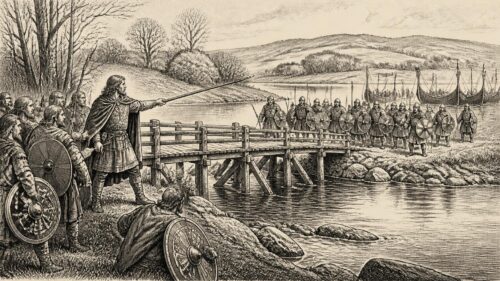
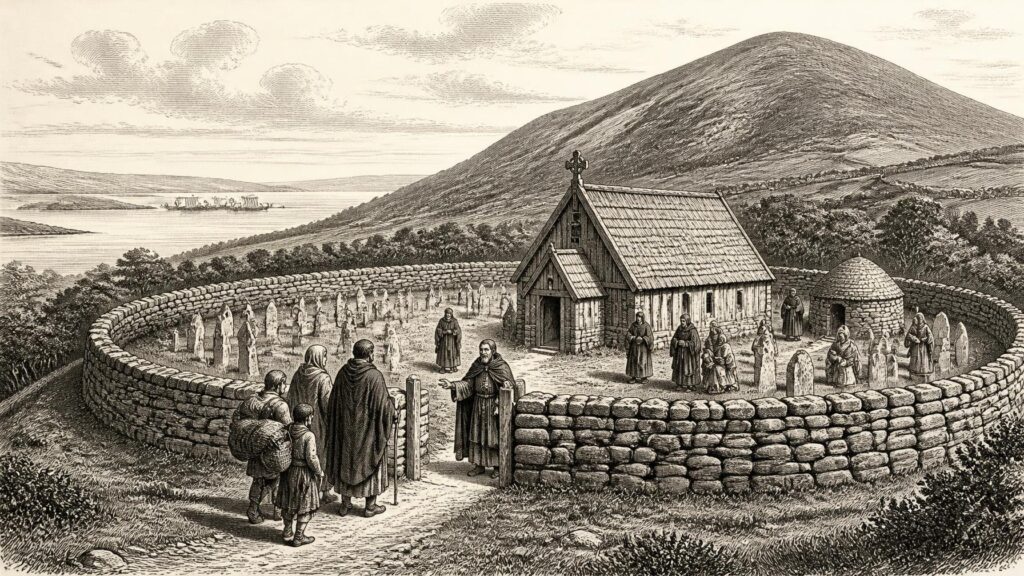
The record for 923 is concentrated in the north and east of Ireland, but its implications reach much further. It shows a country in which religious communities remained centres of learning, wealth and local authority; in which kingship depended on vulnerable family lines; and in which Scandinavian fleets could use sea-loughs and river approaches to strike deep into settled districts. The year’s clearest episode was the plundering of Cell Shléibe, now Killeavy in south Armagh, by raiders operating from Snám Aignech, the Carlingford Lough area. During the attack Duiblitir, a priest of Armagh, was killed.
There is an important chronological caution. The Annals of Ulster place this cluster of notices under U923, whose heading itself reads “AD 922 alias 923”. Irish annals were compiled through systems of year-numbering that do not always align neatly with the modern calendar. Events are therefore best described as belonging to the annalistic year conventionally associated with 923, rather than assigned invented dates or seasons. Other annal compilations preserve some overlapping material under different year headings. What follows gives priority to the contemporary-looking U923 sequence and distinguishes its specific notices from wider context.
A Raid from Carlingford Lough
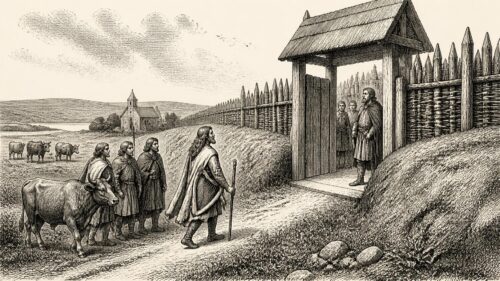
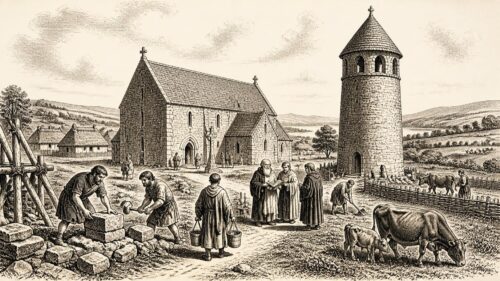
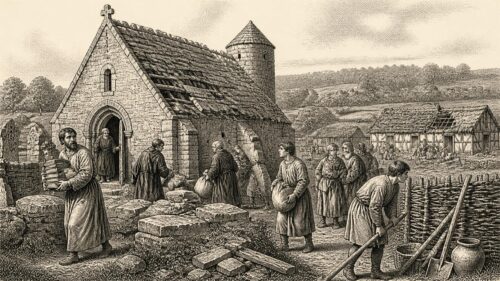
Cell Shléibe was not an isolated wilderness church. It stood beneath Slieve Gullion, near routes linking Armagh, the southern coast of Ulster and the Irish Sea. The annals call the attackers gentiles, “heathens”: their usual term for Scandinavian raiders. They had come from Snám Aignech, generally identified with Carlingford Lough, whose sheltered waters and access to the sea made it an effective maritime base. The record does not name their leader, number their ships, or say what goods they seized. Its precision lies instead in naming the ecclesiastical target and the man who died.
Duiblitir was a priest of Ard Macha, Armagh, not merely a local casualty. That affiliation matters. Armagh was the foremost Patrician church in Ireland, with a web of religious, political and economic connections extending well beyond its immediate territory. A priest travelling or resident at Cell Shléibe linked the smaller community to that wider network. His killing demonstrates both the human cost of raiding and the danger faced by clergy moving among dependent churches, estates and allied communities. It should not, however, be made into evidence that Armagh itself was attacked in 923: the annal states that Cell Shléibe was plundered and that Duiblitir was killed there.
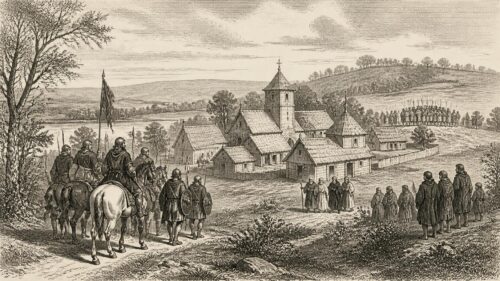
The episode also belongs to a recent and alarming regional history. In the preceding annalistic year, Gofraid grandson of Ímar had led men from Dublin into Armagh’s territory, sparing its principal religious precinct but ravaging widely around it. Raiding in 923 was thus not a sudden first encounter. It was part of sustained pressure on northern communities by maritime forces able to move between Dublin, the Irish Sea coast and the great inlets of Ulster. Nor were all such forces permanently external to Ireland: by this date Scandinavian political and commercial centres, above all Dublin, were embedded in Irish affairs.
Churches, Estates and Learning
Several notices in U923 reveal how extensive ecclesiastical institutions were. Fir Arda, Lann Léire and Fir Rois were plundered in the same month. The annals do not identify the raiders or explain whether these were stages of a single expedition, linked local attacks, or violence by Irish rivals. That restraint is necessary. Still, the geographical grouping is telling: Lann Léire, at modern Dunleer in County Louth, lay in a settled and strategically connected district between the Boyne and Carlingford Lough. The recurrence of its name in the annals indicates an institution of consequence, not simply a chapel.
The death of Cú Chongalt, priest of Lann Léire, gives a rare glimpse of the prestige expected from a learned churchman. He is praised as a paragon of Ireland in voice, appearance and learning. The language is stylised, but it is far from empty. A community capable of sustaining clergy, worship, literacy and public reputation required land, food renders, dependants and patrons. Churches were places of prayer, burial and teaching, but also employers, landlords, repositories of valuables and points at which secular power met sacred authority. Their attractiveness to raiders derived from that social role, not from a simplistic image of monasteries as detached treasure houses.
Elsewhere, Máel Pátraic, superior of Druim Cliab and Ard Sratha, died. These establishments, associated with Drumcliff in the north-west and Ardstraw in the Tyrone–Donegal borderlands, show that one leading ecclesiastic could hold authority across separated communities. Máel Calann, superior of Dísert Diarmata, also died. Such notices are terse obituaries, yet they preserve the institutional geography of tenth-century Ireland: religious houses connected distant districts, stored memory in their learned personnel and helped organise the resources on which local society depended.
Chronicon Scotorum adds deaths at Clonmacnoise, including Máeltuile, its lector, and Dédemus, its vice-abbot. These notices are not proof that they died on the same day or even necessarily in the same modern calendar year as the Ulster entries, but they reinforce the picture of an ecclesiastical world in which offices were specialised. A lector’s work was bound up with reading, teaching and liturgical learning. The notice that Flann of Fobhar held office for only a year and was reproached by all is unusually pointed. It hints at disagreement within a major church community, though the source does not tell us its cause.
Heirs in Danger
Alongside attacks on churches, the annals record a striking run of political killings. Spelán son of Congalach, king of Conaille, was treacherously killed. Conaille lay in the north-east, in the wider region of modern County Louth. The annalist’s word “treacherously” is a judgement, not a full explanation; no perpetrator, meeting or disputed succession is supplied. Yet the death removed a regional king at a time when coastal churches and territories nearby were exposed to violence.
Máel Cluiche son of Conchobor, described as heir-designate of Connacht, was likewise killed by treachery. In Leinster, Finn son of Máel Mórda, heir-designate of the province, was killed by his own kinsman. These were not routine deaths. An heir-designate was a recognised successor, but recognition did not guarantee survival. Irish kingship operated through royal kindreds in which several adult males might possess a credible claim. Competition could be managed by agreement, hostage-taking, marriage or military display; it could also end in assassination. The 923 notices reveal the personal insecurity beneath apparently stable titles.
The simultaneous loss of heirs in Connacht and Leinster should not be exaggerated into evidence for a single island-wide conspiracy or war. The sources make no such claim. Rather, they show a recurring political condition: authority was layered, regional and contested. Donnchad son of Flann, king of Tara in the annalistic terminology, stood at the summit of southern Uí Néill power, but he did not command a modern state. Provincial kings, local dynasties, churches and Scandinavian rulers all possessed armed followings and interests of their own. Political communication travelled through kinship, church connections, tribute, hostages and raids as much as through any central administration.
A Queen of Brega
The death of Lígach, daughter of Máel Sechnaill, queen of the king of Brega, is quieter but politically revealing. Chronicon Scotorum identifies her husband as Máel Mithig and names her sons, Congalach and Áed. Her position joined the family of the former high king Flann Sinna with the rulers of Brega, the rich and politically important plain north of Dublin. Queens in the annals often appear only at death, in genealogical notices or as figures of inter-dynastic marriage. Even so, Lígach’s entry preserves a fact central to tenth-century politics: royal women could embody alliances, transmit dynastic standing and stand at the centre of the kin networks from which future rulers emerged.
The obituary is complemented by a short verse in Chronicon Scotorum, calling Lígach a good woman in her time and naming her children. Such verses show that annals did more than tally violence. They carried praise, genealogy and literary remembrance. The death of Cú Chongalt, celebrated for learning, and the memorial verse for Lígach suggest that cultivated speech and commemoration retained public value amid warfare. Learning was not an ornament outside politics; it gave institutions and dynasties the language through which status, legitimacy and loss could be recorded.
What the Year Cannot Tell Us
The sources do not provide a harvest report, weather record, price list or detailed account of ordinary households for 923. It would therefore be wrong to invent famine, prosperity or a particular environmental crisis. Most people lived through mixed farming, cattle-keeping, food processing, craft work and obligations to local rulers and churches, but the annals name them only when violence reached their communities or when their leaders died. The plundering of Cell Shléibe and the Louth districts nonetheless affected more than elites: livestock, food stores, buildings, dependants and local security were all vulnerable when armed men arrived.
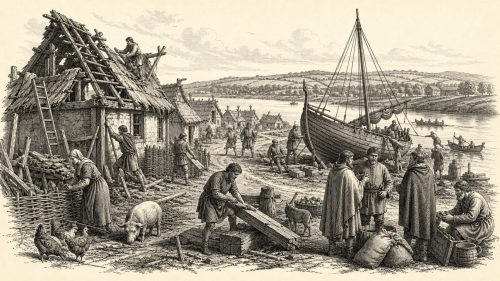
Nor should “Irish” and “Viking” be treated as fixed blocks. The annals’ religious language marks the raiders as outsiders to Christian society, but Scandinavian settlers and rulers had already established durable connections in Ireland. Dublin’s renewed Scandinavian kingdom, founded on ships, silver, trade and armed manpower, shaped the political horizon of 923. The raiders at Carlingford Lough were part of this maritime world, though the surviving notice does not prove they came from Dublin or acted on its orders.
In 923, then, the sharpest surviving image is of Cell Shléibe under attack and an Armagh priest killed there. Around it lie lesser but significant signals: plunder in Louth, the passing of learned churchmen, contested offices, the deaths of a queen and senior ecclesiastics, and the lethal vulnerability of royal heirs. Together they show an Ireland neither overwhelmed nor tranquil: a densely connected landscape where churches and dynasties endured, but where sea-borne raiding and internal rivalry could quickly expose the fragility of both.
Primary Sources
- The Annals of Ulster: Year U923
- The Annals of Ulster: Year U922
- The Annals of Ulster: Year U921
- The Annals of Ulster: Year U924
- Chronicon Scotorum: Annals CS920–CS924
- Chronicon Scotorum
- Annals of the Four Masters: Annal M923
- Annals of the Four Masters: Annals M913–M919
- CELT: List of Published Texts
- CELT Frequently Asked Questions
- The Vikings in Ulaid
- Viking
- Early Medieval Ireland: Archaeological Excavations, 1930–2009
- Transforming Rulership in Tenth-Century Ireland: Paradigms, Problems and Prospects
- The Vikings in Ninth-Century Ireland: Sources and Settlements
- Dunleer, County Louth Urban Archaeology Survey
- About Us: Dunleer Parish
- History of Dunleer Church
- Viking Age
- Viking Life in Dublin
- Viking Dublin
- History of Irish Shipping