Lough Erne’s Long Season924 CE
Dateline
In 924, Ireland’s waterways became theatres of prolonged violence. The most securely associated annalistic record, the Annals of Ulster entry conventionally cited as U924, describes a foreign naval force operating on Lough Erne, raiding its islands and the districts around the lake before withdrawing only in the following summer. Other entries place raiders in Strangford Lough, report a catastrophic wreck at the entrance to Dundrum Bay, and record an unsuccessful expedition sent from Dublin towards Limerick. Taken together, these notices show an island in which ships could bring danger far inland, but also one in which Viking leaders competed sharply with one another rather than acting as a single force.
The evidence needs careful handling. Medieval Irish annals were assembled and copied over generations, and their year-numbering is not perfectly aligned. The Annals of Ulster head this material “AD 923 alias 924”; Chronicon Scotorum places related notices under 924; and the later Annals of the Four Masters places several of them under 922. The events discussed here are therefore connected securely with the annalistic year conventionally treated as 924, but—with one exception—the sources do not supply a day or month. Later entries sometimes preserve a fuller story, but should not be allowed to create a false precision for the calendar year.
A Fleet on Lough Erne
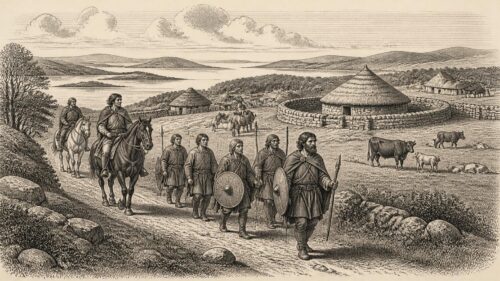
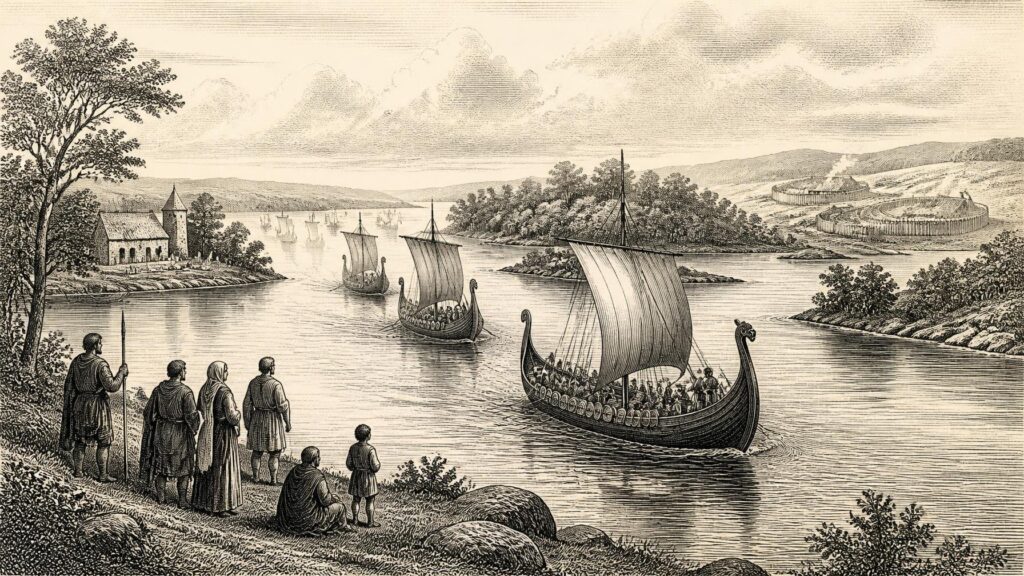
The longest episode was the occupation of Lough Erne by a naval force described simply as Gall, “foreigners”, the usual Irish annalistic term for Scandinavian or Hiberno-Scandinavian groups. Lough Erne’s two broad basins, joined by the River Erne, were dotted with islands and lay amid a densely settled region of churches, farms, minor lordships and lake-based routes. A fleet there could strike repeatedly, shift landing places quickly and threaten communities which possessed neither permanent walls nor a professional army.
The annalist’s wording is emphatic: the force ravaged the islands of the lake and “the surrounding peoples, to and fro”. That does not permit a reconstruction of every landing or casualty, but it strongly indicates sustained rather than incidental raiding. Islanders could lose livestock, stored food, boats, metal goods and captives; people on nearby shores faced the same threat whenever crews came ashore. The reference to a departure in the following summer also makes the episode unusually revealing. This was not merely a coastal foray timed to a single tide. The force remained through a winter, requiring food, shelter, repair materials and enough control—or intimidation—to sustain its crews.
Such an occupation was a harsh environmental fact as well as a military one. Winter travel and agricultural work continued around the lough, but normal movement by water could become perilous. Islands, often desirable sites for ecclesiastical settlements or defended residences, became exposed rather than secure. The annals do not name every church attacked in 924, and it would be wrong to invent a list. Yet the location of the raiding makes clear why monastic communities, local rulers and farming households alike had reason to fear a fleet that could choose its targets from week to week.
Strangford Lough and Dundrum Bay
Eastern Ulster suffered another blow. Foreigners entered Loch Cuan, the modern Strangford Lough, and Máel Dúin son of Áed, described as heir-designate of the province, was killed by them. The title marks him as a man expected to inherit major authority in Ulaid, not simply a casualty among unnamed fighting men. His death mattered politically: succession in early medieval Ireland depended on powerful dynastic kindreds, and the loss of an acknowledged heir could unsettle alliances and invite rivalry.
The same cluster of notices preserves a striking reversal. A “great new fleet” of foreigners foundered at Fertas Rudraige, generally identified with the sandbank and waters at Dundrum Bay in modern County Down. The Annals of Ulster says that 900 or more drowned; Chronicon Scotorum gives 1,200. Both figures may be conventional large numbers rather than a modern headcount, but both agree that the loss was enormous. The point is not only numerical. A fleet represented ships, crews, weapons, provisions, navigational expertise and the political prestige of those who commanded it. Its destruction at a dangerous coastal entrance could abruptly alter the balance of power.
These events caution against a simple picture of invaders who always controlled the sea. Ships gave mobile forces exceptional reach, but Irish Sea weather, tides, shoals and narrow inlets could be as decisive as battle. The tragedy at Rudraige followed violence at Loch Cuan in the annalistic narrative, although the sources do not explicitly prove that the drowned men were the very same raiders. That connection must remain possible, not asserted as fact.
Dublin’s Failed Southern Expedition
In the same annalistic year, Gothfrith—Gofraid grandson of Ímar—led an expedition from Áth Cliath, Viking Dublin, to Luimnech, Limerick. The result was costly: a very large part of his following was left dead “with Ailche’s son”. The terse formula does not name a battlefield or explain the sequence of fighting. Nor can the opponent securely be identified beyond the annalist’s designation. Nevertheless, the notice is among the clearest evidence that the principal Scandinavian powers in Ireland were rivals.
Dublin was already a major defended port and political centre on the east coast, ruled by members of the dynasty commonly called Uí Ímair, descendants or claimed descendants of Ímar. Limerick, at the Shannon estuary and river crossing, was emerging as another Scandinavian centre. Its position gave access not merely to the Atlantic but to the Shannon system and, through it, the Irish midlands. Gofraid’s advance towards Limerick therefore looks less like indiscriminate raiding than an attempt to project authority against a competitor. Its failure showed that Dublin’s king could not simply dictate terms across the island.
Related annalistic material, placed under 924 in Chronicon Scotorum and under 922 in the Four Masters, records Colla son of Báirid, called king or lord of Limerick, operating with foreigners on Lough Ree. Echthigern son of Flannchad, king of Bregmaine, was killed by them. Because these compilations demonstrably differ in chronology, the synchronism with the U924 material is stronger than the differing headings. The episode matters for 924 because it confirms the reach of the Limerick force into the central Shannon corridor. Lough Ree was no remote frontier: it was a waterborne route into territories where local kings, church settlements and agricultural communities could be attacked or coerced.
Irish Kingship Under Pressure
The year’s violence unfolded amid fragmentation in Irish politics. Donnchad son of Flann, king of Tara in the broad contemporary sense, remained the leading southern Uí Néill ruler, while Muirchertach son of Niall was building power in the north. Neither title meant command of a centrally administered kingdom. Authority was exercised through kinship, tribute, hostage-taking, alliances, client kings and the ability to lead successful forces. In 924, the death of an Ulster heir, the killing of a Bregmaine king and raids in several regions exposed precisely the local structures on which wider claims depended.
Chronicon Scotorum also places the killing of Cellach son of Cerball, heir-designate of Leinster, and the retaliatory killing of his opponent Donnchad son of Domnall among its notices for 924. The Four Masters preserves the same linked deaths under its shifted 922 heading. Even allowing for uncertain exact dating, the tradition illustrates the intimate character of political conflict: succession disputes and revenge killings within Irish dynasties continued alongside attacks by foreign fleets. The distinction between “Irish” and “Viking” warfare was therefore not the whole story of power.
Armagh’s Offices and Memory
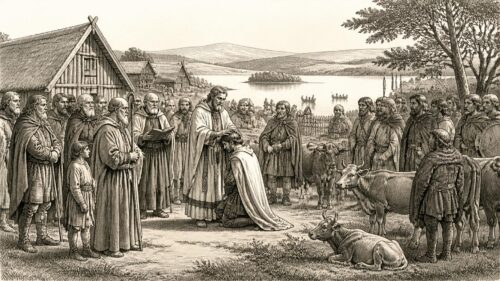
War was not the only business of the year. The Annals of Ulster records the death of Mochta, bishop of Uí Néill and priest of Armagh, and that of Máel Mórda son of Congal, superior of Daiminis, an island monastery in Strangford Lough. Most revealing is the death of Muiredach son of Domnall, tanist-abbot of Armagh. He was also chief steward of the southern Uí Néill, successor of Buite son of Brónach, and chief counsellor of all the men of Brega, laymen and clerics.
Muiredach died on 27 November, the one firmly dated personal event in the U924 entry. His accumulation of titles demonstrates that a major church office was neither isolated from secular society nor confined to prayer and learning. Armagh’s senior figures could be custodians of religious authority, managers of estates and revenues, advisers to lay elites, and intermediaries between rival political interests. The annalist’s deliberate inclusion of both clergy and laity in describing Muiredach’s counsel reveals an institutional world in which church and kingship were deeply interwoven.
For ordinary people, 924 was likely remembered less through the succession of office-holders than through the immediate consequences of fleets: disrupted travel, requisitioned food, burned or plundered property, bereavement and insecurity. Yet churches such as Armagh and Daiminis also offered continuity. They maintained communities, landholding and written memory. It is because those literate institutions preserved brief records that the long season of fear on Lough Erne, the calamity at Rudraige and Dublin’s southern defeat can still be connected to this particular year.
A Year of Competing Fleets
The central lesson of 924 is not that Ireland stood helpless before seaborne raiders. It is that water linked the island’s regions in unusually dangerous ways. Lough Erne could be occupied over winter; Strangford Lough could be entered by a hostile force; Dundrum Bay could destroy a fleet; the Shannon and Lough Ree could carry Limerick’s power into the midlands; and Dublin could send an army south only to suffer a serious reverse. Political authority remained dispersed, and religious institutions remained essential centres of influence and record-keeping. In that unsettled landscape, ships were instruments of raiding, settlement, rivalry and survival—and, as 924 showed with brutal clarity, they could also become traps.
Primary Sources
- The Annals of Ulster
- The Annals of Ulster: Year U924
- Chronicon Scotorum
- Chronicon Scotorum: Annal CS924
- Annals of the Four Masters
- Annals of the Four Masters: Part 2
- Annals of Inisfallen
- The Annals of Tigernach
- Fragmentary Annals of Ireland
- Vikings in Irish Chronicles, 794–902: Introduction
- Vikings in Early Medieval Ireland: Church-Raiding, Politics and Kingship
- Vikings in Ireland and Scotland
- The Vikings in Ninth-Century Ireland: Sources and Settlements
- Early Medieval Ireland: Archaeological Excavations, 1930–2009
- Early Medieval Archaeology Project Report 2.1
- Viking
- The Vikings in Ireland
- The Vikings
- Fertas Rudraige and Loch Rudraige: Place and Tribal Names
- Kings Island Flood Relief Scheme: Environmental Impact Assessment Report, Appendix 9.2