Vanished Giants
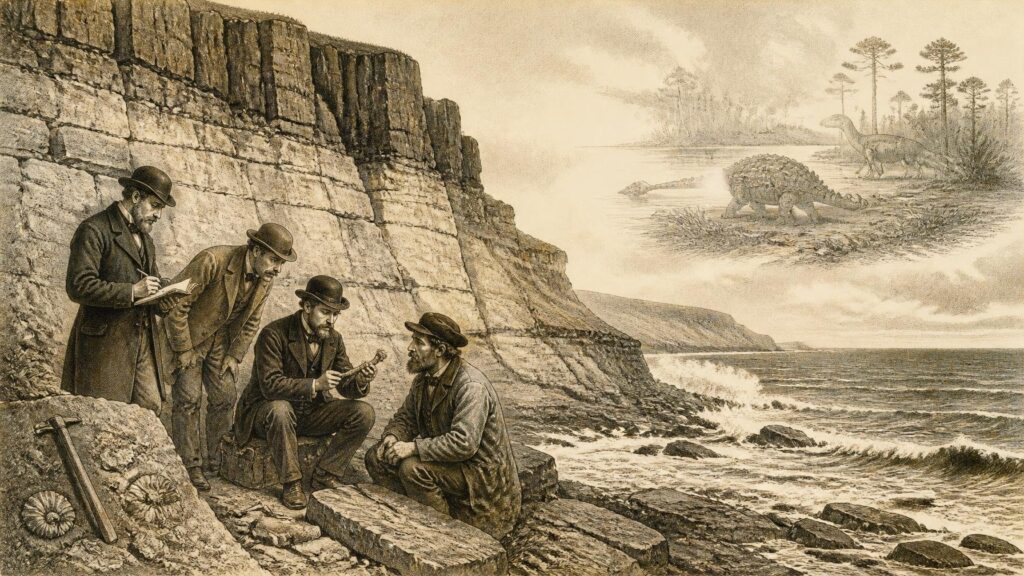
AI generated historical illustration, not a contemporary photograph.
At a Glance
Yes, dinosaurs almost certainly lived in the region that later became Ireland, and two confirmed dinosaur bones from County Antrim provide the island’s direct fossil evidence. Yet the fuller answer is necessarily cautious. Ireland has yielded no dinosaur skeleton, no certain dinosaur trackway and no rich dinosaur-bearing formation comparable with those of southern England. Its record is thin not because dinosaurs avoided the land, but because the rocks most likely to preserve them are largely absent, buried, eroded or marine in origin.
Direct Answer
The question “were there ever dinosaurs in Ireland?” seems at first to demand a simple yes or no. For much of modern scientific history, the most scrupulous answer would have been qualified: dinosaurs probably inhabited or passed through the land area represented by Ireland during the Mesozoic Era, but no demonstrable Irish dinosaur remains had been identified. That position changed in 2020, when a peer-reviewed study formally described two fossil bones from County Antrim as dinosaurian. They remain the only confirmed dinosaur bones known from the island of Ireland.
The conclusion matters, but it should not be inflated. The bones do not uncover a hidden Irish equivalent of the great dinosaur deposits of the Isle of Wight, Dorset or the American West. They are fragmentary hind-limb remains from two animals, recovered from Lower Jurassic marine rocks on the Antrim coast. One is part of a femur from a plant-eating armoured dinosaur and has been cautiously compared with Scelidosaurus. The other is part of a tibia from a meat-eating theropod, perhaps comparable in general kind with early Jurassic predators such as Sarcosaurus, but not securely assignable to a named genus.
That distinction between confirmation and certainty is central. The fossils establish that dinosaur remains entered the sedimentary environment now preserved in County Antrim. They do not allow palaeontologists to map a local herd, define a complete fauna, or say exactly where either animal died. The most plausible interpretation is that the bodies, or parts of them, were carried from land into the sea and then buried. The evidence is direct enough to answer the headline question affirmatively, but too limited to support a detailed portrait of dinosaurs roaming a recognisable Irish countryside.
There is also a question of language. Dinosaurs did not inhabit “Ireland” as a political, cultural or even geographical island. The island has been shaped by later movements of the Earth’s crust, changing sea levels, erosion, volcanic activity and repeated glaciations. When the Antrim dinosaurs lived, there was no Irish nation, no Atlantic island and no familiar coastline. It is nevertheless reasonable historical shorthand to say that dinosaurs existed in the territory from which the present island was eventually formed, provided that the difference between ancient landscape and modern map is kept in view.
Deep Time
Dinosaurs belonged to the Mesozoic Era, the long interval conventionally divided into the Triassic, Jurassic and Cretaceous periods. The first dinosaurs appeared during the Triassic, diversified through the Jurassic and Cretaceous, and disappeared in the mass extinction at the end of the Cretaceous, apart from the bird lineage. During that immense span, the crustal blocks that would contribute to Ireland travelled, collided, subsided, rose and changed latitude. The landscape was never static; nor were its climates, rivers, coastlines or seas.
Modern Ireland’s rocks preserve a much longer Earth history than the age of dinosaurs. Some of the oldest rocks on the island pre-date dinosaurs by hundreds of millions of years. Other prominent rocks, including much of the basalt landscape of northeast Ireland, are younger than the non-avian dinosaurs. This creates a deceptively simple problem. A fossil can only be recovered from rock of a suitable age, deposited in a suitable environment, preserved through later geological disturbance, exposed where someone can find it, and recognised correctly after discovery. The absence of a fossil from a district is therefore never a straightforward census of ancient life.
Geological Survey Ireland’s outline of the country’s history shows why Ireland is famous for many ancient environments without being a major dinosaur locality. Devonian rocks record rivers, lakes and early land vertebrate traces. Carboniferous limestones preserve abundant marine invertebrates from tropical seas. Later episodes left their own evidence in patches, basins, volcanic rocks and sediments. But the land record of the Mesozoic is incomplete. Long intervals are represented only sparsely onshore, while much relevant sediment lies offshore or beneath younger cover.
This does not mean that Ireland was bare land throughout dinosaur time, nor that every missing stratum proves erosion. Some rocks may never have accumulated in a particular place; some were deposited and later removed; others lie concealed. The surviving geological archive is a selection made by natural processes over extraordinary spans of time. Ireland’s dinosaurs are rare in collections because the archive is rare, not because palaeontologists have simply neglected an obvious treasure-house.
Moving Lands
At the beginning of dinosaur history, the pieces of crust now associated with Ireland formed part of a world very unlike the familiar North Atlantic setting. They were connected to broader continental arrangements and lay at different latitudes from those they occupy today. Over time, tectonic change reorganised seas and landmasses. The opening of ocean basins and the movement of plates eventually produced the Atlantic world, but that outcome lay far in the future of the earliest dinosaurs.
This changing setting is important because dinosaur fossils are inseparable from environments. A terrestrial animal is most readily preserved where sediment rapidly covers a body or a track: floodplains, river margins, lakeshores, deltas and sometimes coastal flats. A sea can preserve land-derived remains too, but usually only after transport. Marine sediment therefore offers evidence of nearby land animals in exceptional circumstances, while giving a far fuller picture of creatures that actually inhabited the sea.
Across much of the Mesozoic, parts of the area now occupied by Ireland were submerged, marginal or influenced by changing shorelines. The surviving Mesozoic rocks are consequently often marine limestones, mudstones and chalks rather than extensive continental deposits. This is not an absolute barrier to finding dinosaurs: carcasses can drift, rivers can carry bones seaward, and coastal animals can enter marine settings. It does, however, make complete skeletons and dense bone beds much less likely than in a well-preserved terrestrial basin.
The island’s later geological history compounded the difficulty. Uplift and erosion removed large quantities of rock. In northeast Ireland, later volcanic activity laid down basalt over parts of the older sequence. Those basalts protected some underlying rocks from total removal, but they also conceal them. Thus the same processes that created some of Ireland’s most dramatic scenery both preserved and obscured fragments of its Jurassic past.
Missing Rocks
The most decisive fact is that only a very small proportion of Ireland’s exposed bedrock belongs to the Mesozoic. The Natural History Museum in London has summarised the point starkly: most Irish rocks are older than dinosaurs, while much of the limited Mesozoic record is found in the northeast and is partly covered by younger rocks. Geological Survey Ireland likewise stresses that the island does not possess a complete Triassic, Jurassic and Cretaceous sequence. The phrase “missing rocks” is therefore more useful than the misleading idea of “missing dinosaurs”.
Northeast Ireland contains the most significant onshore Mesozoic succession. The Larne–Lough Neagh region and the Foyle–Rathlin region include Triassic, Jurassic and Cretaceous strata, although much is concealed. Around the edges of the Antrim basalt plateau, coastal erosion and quarrying have revealed slivers of older sedimentary rock. These exposures have supplied fossils of marine animals and, ultimately, the two dinosaur bones. Yet even here the sequence has major breaks. A large interval between preserved Jurassic and Cretaceous strata is not represented in the local onshore record.
Elsewhere on the island, Mesozoic deposits occur only in small, discontinuous or largely hidden remnants. Researchers have identified limited Triassic material in the Kingscourt area and possible remnants in the southeast, alongside small Jurassic occurrences near Cork and Carrick-on-Suir, deposits beneath Dublin Bay, and a minute Cretaceous chalk occurrence in County Kerry. Such occurrences are scientifically valuable, but none amounts to an extensive terrestrial dinosaur landscape available at the surface for systematic collecting.
It is tempting to suppose that all the missing rock must once have existed and later vanished. Some certainly may have been eroded. Yet the geological record is not merely a damaged library from which every absent volume has been torn. Deposition itself was uneven. Where a land surface stood exposed, sediment may not have accumulated; where sea covered an area, terrestrial fossils were less likely to be preserved; where sediment did form, later burial or removal determined whether it survived. A responsible answer must leave room for each of these processes.
Antrim Evidence
The confirmed Irish dinosaur material comes from Islandmagee, on the east coast of County Antrim. It was collected from Lower Jurassic rocks traditionally grouped within the Lias, a name long used for early Jurassic marine strata in Britain and Ireland. The specimens entered the Ulster Museum’s collections through Roger Byrne, a schoolteacher and dedicated fossil collector. Their scientific value emerged gradually rather than through a spectacular excavation announced at the moment of discovery.
This history is a useful reminder that museum collections are not passive storehouses. A specimen may be collected before the analytical tools, comparative material or research question needed to understand it are available. Fossils can be revisited, scanned, compared and reinterpreted. In this case, high-resolution digital modelling, anatomical comparison and examination of internal bone structure helped determine that two fragments were genuine dinosaur bones and did not come from a single animal.
The first specimen is the upper portion of a left femur. Its robust form and internal features indicate a basal thyreophoran ornithischian: an early member of the broad evolutionary branch that includes later armoured dinosaurs. The authors used a cautious comparison, cf. Scelidosaurus, rather than asserting that it is unquestionably the same species or even a securely identified member of that genus. In palaeontology, such caution is not indecision. A fragment lacks the many diagnostic features preserved in a complete skull or skeleton, and naming beyond the evidence would weaken rather than strengthen the result.
The second fossil is part of a left tibia from a theropod, the dinosaur group that includes the ancestors of birds and many famous predatory forms. It is slenderer than the plant-eater’s bone, with characteristics consistent with an active bipedal predator. The published study considered relationships among early theropods but did not provide a definitive genus-level identity. Popular accounts sometimes call it a Megalosaurus; that label is too certain. The formal research described an indeterminate neotheropod, possibly related in general terms to an early averostran-line animal or a megalosauroid.
Two other objects once suspected of dinosaurian origin were reassessed and rejected. One was interpreted as a fragment associated with a large marine reptile, perhaps an ichthyosaur or pliosaur; another proved to be a piece of much younger basalt. This correction is as significant as the confirmation. Science does not merely accumulate dramatic claims. It tests old identifications, separates plausible from demonstrable evidence, and records negative results when they narrow the truth.
Careful Names
Names such as Scelidosaurus, Megalosaurus and Sarcosaurus make an engaging answer sound more complete than the fossils permit. They should be handled as comparisons, not as a prehistoric roll-call for Ireland. The plant-eater resembles the kind of early armoured dinosaur known from broadly comparable early Jurassic deposits elsewhere in Britain. The theropod belongs to a predatory lineage, but its fragmentary condition prevents secure assignment to a particular famous species.
The distinction is especially important because older scientific and popular literature often used broad genus names more freely than modern systematic practice. Megalosaurus, for example, has a long place in the history of dinosaur science, but it should not become a convenient label for every early Jurassic predatory fragment. The Irish tibia demonstrates a theropod; it does not provide the anatomical evidence needed to establish a named Irish species of Megalosaurus.
Nor should the term “Ireland’s dinosaurs” suggest an endemic fauna. There is no basis for claiming that the two animals evolved uniquely on this island or that their populations were isolated in any modern sense. During the Early Jurassic, the relevant land areas and coastlines belonged to connected regional environments. Similarity with fossils from Britain is unsurprising, but the Irish material remains too sparse to measure regional difference with confidence.
The responsible formulation is therefore plain. County Antrim has produced one fragmentary bone from an early armoured plant-eater, tentatively comparable with Scelidosaurus, and one fragmentary bone from an unidentified early theropod. Those remains prove dinosaurs in Ireland’s fossil record. They do not justify more exact taxonomic or ecological claims.
Sea Burials
Why were dinosaur bones found in marine rock? The answer begins with the difference between where an animal lived and where its remains became fossilised. The Antrim Jurassic sediments were laid down in a marine environment. Dinosaurs were primarily terrestrial animals, although some may have frequented coasts and were capable of entering water. A dinosaur that died near a river mouth, shore or tidal inlet could have been transported into the sea. Detached bones could travel even more readily than an intact body.
National Museums NI has described the likely sequence carefully: the animals may have been swept to sea, alive or dead, then sunk to the seabed, where burial and mineral replacement allowed parts of their skeletons to survive. This is an interpretation, not an observed event. The fossils themselves cannot reveal whether the animals drowned, whether carcasses drifted, how far transport occurred, or whether scavengers disturbed them. But marine deposition explains why two terrestrial dinosaurs appear among a fossil record dominated by sea life.
The plant-eater’s possible relationship with Scelidosaurus invites further thought. Fossils of that dinosaur have been recovered from marine deposits elsewhere, leading some researchers to wonder whether it occupied coastal settings more readily than traditionally imagined. That is a reasonable hypothesis, but it remains a hypothesis. A dinosaur preserved in marine sediment is not automatically a marine dinosaur, and a tendency to occur in coastal deposits does not prove a seaweed-eating way of life or a specialised marine ecology.
What can be said with confidence is that the Antrim fossils belong to a nearshore world in which land and sea met. Their existence indicates terrestrial animals somewhere within reach of the depositional basin. It also demonstrates how strongly preservation filters the past. The sea floor recorded two transported leg bones while leaving no equivalent local census of the terrestrial communities beyond its shore.
Marine Worlds
The scarcity of dinosaur bones should not be mistaken for a scarcity of Mesozoic fossils in Ireland altogether. The surviving Jurassic and Cretaceous rocks of northeast Ireland preserve marine life much more readily. Ammonites, brachiopods, bivalves and other invertebrates are part of the record, as are marine reptiles in some deposits. These animals belonged to the ecosystems actually represented by the sediments, and their remains had a much better prospect of burial where they lived.
Marine reptiles are often mistakenly grouped with dinosaurs in popular language. Ichthyosaurs, plesiosaurs and pliosaurs were reptiles that lived in the sea, but they were not dinosaurs in the strict evolutionary sense. This matters in Ireland because a striking marine reptile bone may appear more “dinosaur-like” to a visitor than the small, fragmentary Antrim bones. Scientific classification distinguishes appearance from relationship: large extinct reptile does not automatically mean dinosaur.
The contrast also explains why early identifications can change. A weathered fossil fragment from a Jurassic coastal exposure may be incomplete and altered by mineralisation. Careful comparison, microscopy and imaging are needed to decide whether it is dinosaurian bone, marine reptile bone, fish bone, wood, mineralised rock or even a later volcanic fragment. The reclassification of two alleged Irish dinosaur specimens demonstrates this difficulty directly.
In historical terms, Ireland’s Mesozoic story is therefore more faithfully told as a story of shorelines and seas than as a lost dinosaur kingdom. Dinosaurs appear at the margins of that account. Their rarity is precisely what gives the Antrim bones their importance: they provide an unexpected terrestrial signal within a predominantly marine archive.
Older Footprints
Ireland does possess a celebrated set of ancient vertebrate traces that are sometimes wrongly advertised as dinosaur footprints. They are the Valentia Island tetrapod trackways in County Kerry. The error is understandable: both dinosaurs and the track-makers of Valentia had four limbs or descended from four-limbed vertebrates, and both left impressions in sediment. But the Valentia traces are vastly older than dinosaurs. They belong to the Devonian, long before the first dinosaurs evolved.
The Valentia trackways are important for a different reason. They record early tetrapods, animals close to the great evolutionary transition in which vertebrates established themselves on land. The scientific paper announcing a new trackway in the 1990s described more than 150 footprints and showed how their arrangement could reveal stride and movement after allowing for later deformation of the rock. Such evidence is fragile and interpretative, but it offers a rare glimpse of behaviour in deep time.
These tracks should be understood as a prelude rather than a dinosaur chapter. They reveal that rocks in Ireland can preserve footprints and that the island’s palaeontological heritage reaches far beyond bones. Yet they cannot answer whether dinosaurs lived here. Calling them dinosaur tracks obscures both the immense time separating Devonian tetrapods from dinosaurs and the special significance of the Valentia site in its own right.
The confusion nevertheless teaches a useful lesson about fossils. A footprint is a trace fossil, evidence left by an animal rather than preserved body tissue. It can reveal direction, pace, foot shape and the character of a sediment surface, but usually cannot identify an animal with the same certainty as a complete skeleton. In the Irish case, one should separate three categories: the confirmed Antrim dinosaur bones; the older Valentia tetrapod trackways; and the many rocks, hollows and weathered surfaces that merely resemble footprints to an untrained eye.
Fossil Chances
Fossilisation is exceptional. Most animals die, decay, are eaten or are scattered without leaving a permanent record. Even when a bone is rapidly buried, it must survive compaction, chemical alteration, tectonic disturbance and erosion. It must then be exposed at the surface without being destroyed, noticed by a collector, recovered with a usable record of its location, and studied by someone able to identify it. Every stage removes possibilities.
For dinosaurs in Ireland, several filters operated at once. The correct-age rocks are uncommon. The surviving deposits are often marine. Much Mesozoic material is buried beneath basalt or younger sediments. Coastal exposures are periodically revealed and damaged by weather and waves. Glaciation reshaped much of the modern landscape, stripping and redistributing surface material. Finally, a fragment must be recognised amid a wider assemblage of marine fossils and ordinary stones.
This chain of contingencies means that the current total of two confirmed bones is not a final verdict on all dinosaurs that ever inhabited the region. Further discoveries are possible, particularly where suitable rocks are exposed or collections are reassessed. But possibility is not prediction. There is no evidence that Ireland conceals enormous undiscovered dinosaur graveyards, and the same geological limits that made the first finds unusual remain in force.
Scientific humility requires two statements at once: absence of abundant fossils is not proof of absence of dinosaurs, and reasonable expectation that dinosaurs were present is not a substitute for fossils. The Antrim specimens bridge the gap between inference and direct evidence, but only narrowly. They allow certainty about two bones, not certainty about every question a modern visitor might ask.
Collecting History
The route by which the Antrim fossils became known is also part of Irish scientific history. They were found by Roger Byrne, an amateur collector whose material entered the Ulster Museum. Much palaeontological knowledge has depended on local observers, quarry workers, coastal walkers, teachers and collectors who noticed objects that professional researchers could not encounter alone. Their work is most valuable when specimens retain reliable information about where they were found and are deposited in a public collection where they can be tested.
That final point matters. A fossil in a private drawer may be exciting, but its value for history is reduced if its locality, geological layer and chain of custody are uncertain. Museum curation makes it possible to compare material across decades, return to it with new methods, and correct errors openly. The Ulster Museum’s geological collections, developed from much older natural-history traditions, provide precisely this public framework. The bones were available for re-examination because they had been preserved rather than dispersed.
The story also cautions against the romantic idea of the lone discoverer settling a scientific question at the cliff face. Discovery begins a process; it does not end one. The identification of the Antrim bones required curatorial knowledge, comparative anatomy, digital modelling and publication in a peer-reviewed journal. It also required the willingness to report that other suspected dinosaur fragments were not dinosaurs. That combination of enthusiasm and restraint is the real historical achievement.
Visitors who encounter fossils on Irish beaches or in rock exposures should therefore resist the urge to break material from protected sites or to make confident identifications online. Careful photographs, precise location information and contact with a museum, geological survey or university are usually more useful than casual collection. Fossils are non-renewable records. Their scientific context can be lost in a moment.
Popular Images
Dinosaurs occupy an unusual place in public imagination. A child’s picture of a dinosaur often depicts a huge skeleton, a dense forest and a dramatic predator. Ireland’s actual evidence offers none of these conveniences. It is two incomplete leg bones from a marine setting, supported by a complicated account of strata, erosion and uncertainty. Yet this apparent disappointment is exactly what makes the subject historically revealing. It shows how landscapes determine what can be remembered.
Imported dinosaur skeletons, casts and illustrations have long helped museums in Ireland explain global natural history. Such displays are valuable, but they should not be confused with local fossils. A mounted Diplodocus or a cast of a famous English dinosaur can illuminate evolution and anatomy while saying nothing direct about Ireland’s own record. The same distinction applies to souvenir-shop imagery and media headlines that convert cautious comparisons into definitive identifications.
The best public account does not diminish wonder; it relocates it. Instead of imagining Ireland as a place that somehow missed the dinosaur age, one can see it as a place whose rocks have survived selective destruction. A single bone from an ancient shoreline becomes evidence not only of an animal but also of changing seas, later lava flows, museum labour and the hazards of interpreting fragments.
Such an account has a further advantage. It treats the island’s other fossils fairly. Devonian tracks, Carboniferous corals and crinoids, Jurassic ammonites, Cretaceous sea-floor deposits, Ice Age mammals and archaeological bone assemblages each tell different stories. Ireland need not compete with dinosaur-rich regions to possess a deep and distinctive palaeontological heritage.
Folklore Limits
There is no dependable Irish oral tradition preserving a memory of dinosaurs. Dinosaurs vanished tens of millions of years before humans existed, and folklore cannot be used as evidence that people encountered them. Legends of giants, dragons, monstrous animals, miraculous stones or saintly deeds belong to cultural history, not palaeontological observation. They may be worth studying on their own terms, but they do not identify extinct species.
A familiar joke links the old legend that Saint Patrick expelled snakes from Ireland with the country’s lack of dinosaur fossils. It is a joke, not an explanation. The scientific reason for the sparse dinosaur record lies in the distribution, age and depositional setting of the rocks. No historical saint, legend or national myth can account for strata laid down and removed over geological time.
Folklore can nevertheless influence how fossils are seen. Unusual stones invite stories; large fossil bones have often been interpreted as giants’ remains in many parts of the world; footprints and natural hollows can attract attribution to heroes or saints. Such responses reveal how communities make meaning from remarkable landscapes. They should be recorded as interpretation, but never quietly converted into proof of prehistoric animals.
The distinction is especially useful in public history. Documentary evidence for Ireland’s dinosaurs consists of museum specimens, geological provenance, anatomical study and published analysis. Interpretation concerns the likely route by which the bones entered marine sediment and the kinds of animals to which they were related. Folklore concerns later human stories about striking natural forms. Each category has value, but each answers a different question.
Landscape Change
It is difficult to picture the places where Ireland’s dinosaurs lived because the modern island is the product of much later change. The Early Jurassic Antrim fossils came from a world of nearby land and sea, not from the green, temperate coast familiar today. The rocks record marine conditions, while the dinosaurs point beyond the preserved seabed towards terrestrial habitats that have largely disappeared from the local archive.
Later volcanic activity transformed northeast Ireland. Basalt lavas associated with the opening North Atlantic covered wide areas and formed the plateau landscape for which Antrim is now known. These events occurred long after the dinosaur-bearing sediments had formed. Their hard lava sheets helped shield some older layers from erosion, but they also complicated access to them. In this sense, the landscape that conceals dinosaur history is itself a monument to a later chapter of deep time.
Still later, ice sheets altered the surface again. They scoured bedrock, moved sediment and helped create the landforms through which modern people encounter geological exposures. The cliffs and shore platforms where fossils can be found are not neutral windows opened onto the past. They are changing interfaces shaped by present weather as well as ancient processes. What a collector sees in one season may be buried, collapsed or washed away in another.
Consequently, the question is not whether dinosaurs once walked through a modern Irish landscape. They did not walk beneath Antrim’s basalt cliffs, past medieval ruins or along county roads. The more accurate question is whether dinosaur-bearing life existed on lands and coasts that contributed to the geological history of Ireland. The Antrim bones make the answer yes, while the condition of the rocks explains why the answer remains so spare.
Future Finds
Could more dinosaurs be found in Ireland? Certainly; scientific collections and coastal exposures can always yield surprises. Reassessment of museum material may be particularly productive because fossils collected decades ago can be tested with imaging, histology and broader comparative datasets. The discovery of the Antrim bones themselves shows the value of revisiting material that had not previously received a definitive identification.
But expectation must be proportionate. The known geological limitations mean that additional finds will probably remain uncommon, fragmentary and concentrated in the few areas where appropriate Mesozoic rocks are accessible. A new bone, tooth or trace would be important precisely because it would add to a very small record. It should not be assumed that every unusual object from an Irish shore is a dinosaur fossil, or that the next discovery will necessarily transform the national picture.
Offshore geology may also hold information unavailable on land. Sedimentary basins beneath surrounding seas preserve Mesozoic successions that have no broad surface equivalent in Ireland. Boreholes and geophysical surveys contribute to understanding these buried landscapes, although they do not offer the same collecting opportunities as a cliff or quarry. They remind us that the onshore fossil record is only part of the regional geological story.
The most promising future is therefore not sensational but cumulative: better mapping, careful conservation, museum access, re-examination of old specimens and precise reporting of new ones. Every securely identified fossil can refine an account built from very limited evidence. In a country where so much of dinosaur time is absent from the exposed rocks, even a small fragment can be historically large.
Measured Conclusion
Dinosaurs were present in the deep past of Ireland, but the evidence is exceptionally limited. Two bones from County Antrim, formally described in 2020, are the island’s only confirmed dinosaur body fossils. One came from an early armoured plant-eater tentatively compared with Scelidosaurus; the other from an unidentified predatory theropod. Both were preserved in marine Jurassic sediments, probably after transport from land or a coastal environment.
The scarcity of discoveries has a geological explanation. Ireland retains little exposed rock from the dinosaur age; much of what survives is marine, concealed or interrupted by long gaps; and later erosion, volcanism and glaciation have further filtered the record. The celebrated tetrapod trackways of Valentia Island are not dinosaur tracks, but far older evidence of vertebrate life’s early movement onto land. Marine reptiles from Irish rocks were not dinosaurs either, though they shared the wider Mesozoic world.
The honest answer is thus more interesting than either extreme. It is wrong to say that Ireland had no dinosaurs. It is equally wrong to portray the island as a lost dinosaur province supported by rich local evidence. Ireland has two confirmed dinosaur bones, a remarkable geological setting and many unanswered questions. Its vanished giants survive not as a parade of complete skeletons, but as rare traces rescued from a deeply incomplete archive.