Cormac’s Fall at Belach Mugna908 CE
On 13 September 908, Munster’s king-bishop Cormac mac Cuilennáin was defeated and killed at Belach Mugna, or Mag Ailbe, by forces led by Flann Sinna of Tara, Cerball of Leinster and Cathal of Connacht. The battle ended Munster’s expansion, killing allied rulers and ecclesiastical leaders, including Cellach of Osraige, and strengthened Flann’s influence without unifying Ireland. Cormac’s reputation as scholar, scribe, bishop and anchorite illustrates overlapping royal and clerical authority. Annals record northern aggression, church deaths and uncertain reports, revealing rivalry, institutional Christianity and Irish Sea connections. Sources caution against treating later narratives, casualty totals or Viking involvement as certain.
Dateline
A September Battle
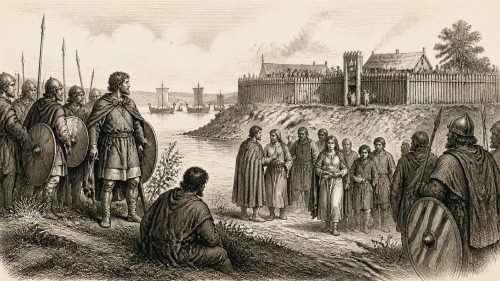
The defining Irish event of 908 was the battle of Belach Mugna, also called Mag Ailbe in the annals: a defeat which ended the career of Cormac mac Cuilennáin, king of Cashel and one of early medieval Ireland’s most remarkable clerical rulers. The Annals of Ulster date the fighting unusually precisely to Tuesday, 13 September, the feast of Dágán of Inber Dáile. Its entry names the opposing blocs rather than a single national army. Munster’s host faced the Laigin of Leinster and Leth Cuinn, the northern half of Ireland in the political language of the period. Flann Sinna, king of Tara, Cerball mac Muirecáin, king of Leinster, and Cathal mac Conchobair, king of Connacht, were recorded as victors.
Belach Mugna was therefore not a simple contest between an Irish ‘high king’ and a regional challenger. Ireland remained a patchwork of kingdoms, churches, client peoples and ambitious dynasties. Authority depended upon alliances, hostage-taking, tribute, military display and control of prestigious ecclesiastical centres as much as upon any abstract constitutional rank. Cormac’s death mattered because he was king of Cashel, leader of a Munster coalition and a churchman whose learning gave his kingship an exceptional aura. The battle revealed how quickly an expansive provincial alliance could be checked when Leinster, Connacht and the southern Uí Néill acted together.
The Road from Munster
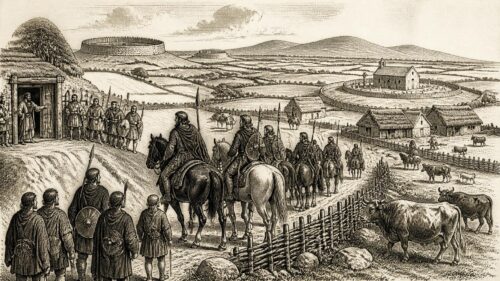
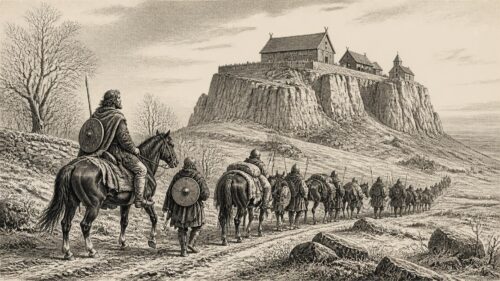
The immediate background lies in the campaigns of the preceding year, which must not be mistaken for events of 908 itself. The Annals of Inisfallen record that in 907 Cormac and Flaithbertach mac Inmainén led Munster forces northwards, taking hostages from Uí Néill interests and then obtaining their demands from Connacht. The same source stresses the scale and rapidity of the movement: Cormac’s forces were in the east at Christmas and in the west by 1 January. Such notices show a mobile political world connected by roads, river crossings, coastal routes and the resources needed to sustain a royal host. They also help explain why Flann and his allies treated Munster’s advance as a serious challenge.
By 908 Cormac’s eastern ambitions brought him into collision with Leinster. Cerball of Leinster was Flann Sinna’s crucial partner, while Cathal of Connacht joined the victorious side. Cellach mac Cerbaill, king of Osraige, fought with Cormac. Osraige’s position was particularly consequential: its rulers stood between Munster and Leinster and could alter the strategic balance of the south-east. The battle thus grew from competition across interconnected borderlands, not from a clash at an isolated frontier.
A later, eleventh-century narrative in the Fragmentary Annals of Ireland greatly enlarges the story. It presents Cormac and Flaithbertach gathering a Munster army to demand Leinster’s hostages, relates peace proposals, and frames ominous incidents in the camp as warnings against proceeding. It is valuable evidence for how later writers interpreted the catastrophe, but it is not a contemporary campaign diary. Its dramatic details should not be treated as independently verified fact. The concise annals are firmer ground: a battle occurred in 908, the alliance led by Flann, Cerball and Cathal won, and Cormac and leading Munster allies were killed.
A King, Bishop and Scholar
Cormac’s obituaries and later reputation make his death distinctive. Chronicon Scotorum calls him king of Cashel, an excellent scribe, bishop, anchorite and the wisest of the Irish. The Annals of Ulster identifies him principally as king of Cashel, while later annalistic compilations similarly mourn a ruler who combined royal and religious roles. Such descriptions were not merely compliments. They point to a society in which senior churchmen could be drawn from ruling families, lead communities with substantial land and dependants, and participate directly in high politics.
His learned reputation also illuminates the culture of the period. Cormac is traditionally associated with Sanas Cormaic, or Cormac’s Glossary, an important early Irish work concerned with words, learning and inherited custom. The surviving forms of the glossary are preserved in much later manuscripts, and modern scholarship rightly treats personal authorship with caution. It cannot simply be claimed that the text, as now known, was written by Cormac in 908. Yet the association is itself significant, while the contemporary annalistic praise for him as a scribe and sage confirms that scholarly accomplishment formed part of his public identity.
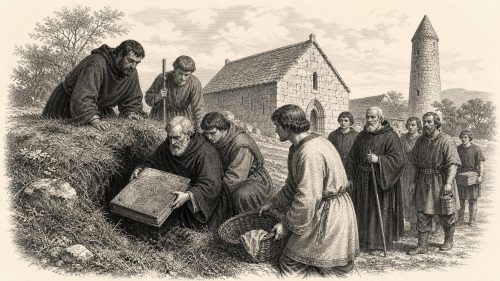
For a king to be remembered as an anchorite as well as a commander may seem contradictory to modern readers. In early medieval Ireland, however, religious vocation, literacy, aristocratic lineage and political leadership could overlap. Monasteries and churches were places of worship, education, craft production, hospitality, landholding and political negotiation. Their heads did not stand outside secular rivalries. Cormac’s life and death demonstrate that ecclesiastical prestige could strengthen a ruler’s claims, but could not protect him from the risks of campaigning.
Losses at Mag Ailbe
The battle’s human cost was concentrated among Munster and allied elites. The Annals of Ulster names Fogartach mac Suibne, king of Ciarraige; Cellach mac Cerbaill of Osraige; Ailill mac Eógain, superior of the Trian of Corcach; and Colmán, superior of Cenn Étig, among those who died with Cormac. Chronicon Scotorum adds Máel Mórda of Ráith Linne, Máel Gorm of Ciarraige Luachra, and Colmán’s kingship of Corcu Duibne. These variations are reminders that annals preserve selective memorial lists, shaped by regional knowledge and later transmission, rather than complete casualty rolls.
Chronicon Scotorum gives the striking total of 6,000 dead. That figure conveys the battle’s remembered scale, but it cannot securely be read as a modern numerical count; medieval annalists often used rounded or rhetorical totals. What is beyond doubt is the political significance of the named dead. Kings, provincial lords and ecclesiastical superiors were not replaceable simply as battlefield manpower. Their loss disrupted kin groups, client networks and the institutions whose leadership they held.
The consequence was immediate in broad political terms. Cormac’s fall ended the particular Munster offensive that had so alarmed Flann Sinna’s coalition. It also removed Cellach of Osraige, allowing the balance within that kingdom to change. Flann’s later restoration of Cellach’s brother Diarmait to Osraige belongs to the aftermath rather than to the securely dated events of the battle day, but it indicates how victory could be converted into influence. Belach Mugna strengthened Flann’s position at the centre of Irish politics without creating a unified Irish state.
Other Notices of the Year
908 was not solely a year of southern war. The Annals of Ulster and Chronicon Scotorum record an expedition by Cenél nÉogain, led by Domnall son of Áed and Niall son of Áed, which burned Tlachtga. The annals do not provide a precise day or explain the full political purpose. Tlachtga, near modern Athboy in County Meath, was an important ceremonial landscape in the midlands, and its burning was consequently a meaningful act of aggression. The entry warns against imagining Flann’s victory as bringing calm across the island: northern Uí Néill leaders were also demonstrating force within the wider sphere of Tara.
Church communities feature repeatedly in the year’s notices. Máel Mártain, superior of Lugbad, died; Diarmait, superior of Daire Calgaig, died ‘in peace’; and an anchorite named Cormac, superior of Druim Mór, also died. These brief obits preserve little about ordinary routines, but their very frequency shows the institutional density of Irish Christianity. Communities associated with places such as Louth and Derry were not peripheral to public life: their leaders were important enough for annalists to record, and their churches supplied literate settings in which such records were maintained.
The later Annals of the Four Masters, whose chronological arrangement for this period must be handled carefully, places a violent episode at Druim Inesclainn in its entry for 908. It says that Muiredach, abbot of the community, and Gairbhith, tanist of Conaille Muirthemne, were killed in the refectory by Congalach son of Gairbhith; Congalach was then killed by the Conaille nine months later. The same compilation reports an overseas defeat of an Ulster fleet by ‘foreigners’ in England. These notices are relevant to the year’s remembered history, but, unlike the battle dated by Ulster, they lack corroborating contemporary precision. They should be read as evidence of local lordship, monastic vulnerability and Irish Sea connections, not as grounds for a detailed reconstruction.
Aftermath and Limits
There is no reliable annalistic evidence for a major Viking assault in Ireland in 908 itself. That silence should not be turned into a claim that Scandinavian activity, trade or settlement had vanished. Dublin’s Scandinavian rulers had been expelled in 902, while Irish Sea travel remained important, as the report of fighting involving an Ulster fleet in England suggests. But Belach Mugna was principally an Irish dynastic conflict, and it would distort the year to force Vikings into its central narrative.
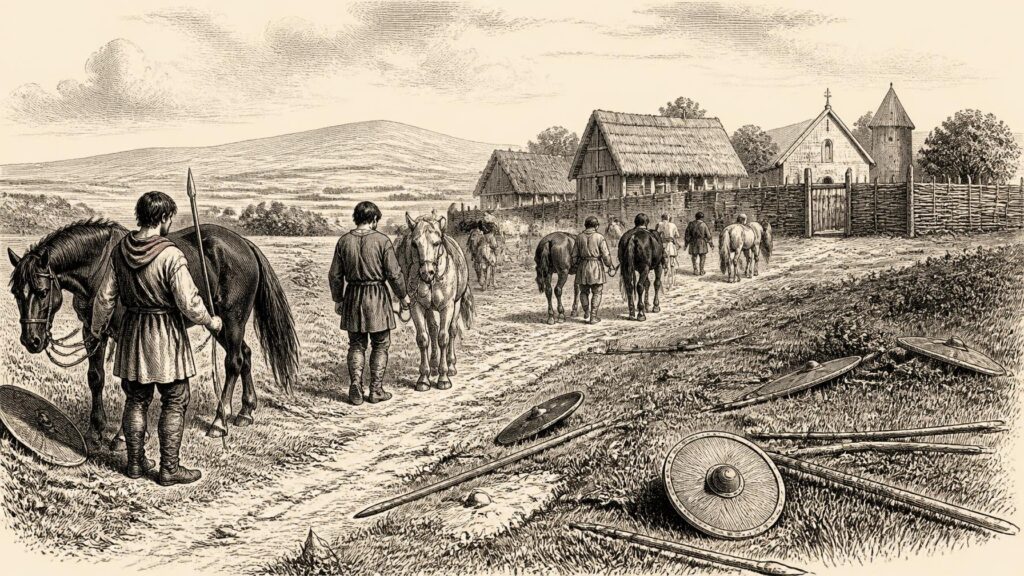
Nor do the surviving sources permit a confident account of harvests, prices, climate, trade volumes, women’s work or the daily experience of non-elite households in 908. What they do reveal is a society in which ordinary people bore the practical burdens of royal mobilisation: supplying food, animals, transport and labour; living with the destruction caused by burnings; and sustaining churches that were both spiritual communities and political assets. The death of Cormac at Belach Mugna became memorable not because it ended conflict, but because it exposed the fragility of a ruler who embodied kingship, clerical authority and learning. On 13 September 908, a coalition battle in the Leinster–Munster borderlands decisively altered the political horizon of Ireland.
Primary Sources
- The Annals of Ulster: U908
- Chronicon Scotorum: CS908
- Annals of Inisfallen: AI908
- Annals of the Four Masters: M908
- Fragmentary Annals of Ireland: FA423
- The Annals in Cotton MS. Titus A. XXV: Cott908
- Cormac
- Flann Sinna
- Cerball
- Muiredach
- Annals of Inisfallen
- Chronicon Scotorum
- CELT Project: Annals of the Four Masters
- CELT Project: The Annals in Cotton MS. Titus A. XXV
- CELT Project: Chronicon Scotorum
- Cath Bealaigh Mughna, 908 A.D.
- The Practice of Irish Kingship
- The Leinster Tribute Feud
- Texts: Early Irish Glossaries Database
- About the Project: Early Irish Glossaries Database
- Sanas Cormaic: National Library of Ireland Catalogue Record
- Three Irish Glossaries: Cormac's Glossary, Codex A
- The Vikings in Ninth-Century Ireland: Sources and Settlements
- Vikings in Ireland and Scotland