

The Last Hosting1039 CE
In 1039, Ireland remained divided among competing provincial and regional rulers after the collapse of broadly accepted high kingship. Donnchad mac Gilla Pátraic, overking of Leinster and Osraige, led a destructive hosting through Meath to Knowth and Drogheda before dying during or soon after it. His death weakened Osraige’s wider authority and aided conditions for Diarmait mac Máel na mBó’s later ascent. Annals also record killings, blinding and contested lordships across Leinster, the midlands, Ulster and Connacht. Church leaders died, Clonard’s bell tower reportedly collapsed, and a solar eclipse was observed. Rural production, monasteries and Hiberno-Norse trading towns sustained society.
Dateline
Ireland in 1039 had no single ruler whose authority was accepted throughout the island. The death of Máel Sechnaill mac Domnaill in 1022 had ended the last broadly recognised high-kingship, while the political order created by Brian Bóruma had fractured after his death at Clontarf. Power rested instead with provincial and regional kings competing through alliances, hostage-taking, raids and carefully advertised claims to precedence. The year’s most important development was the final campaign and death of Donnchad mac Gilla Pátraic, king of Osraige and overking of Leinster. His disappearance removed an unusually successful ruler and reopened the struggle for control of Leinster and Ireland’s south-eastern approaches.
Reading a Fragmented Record
The surviving annals provide several firmly dated notices for 1039, but they do not offer a continuous narrative. Their terse entries concentrate on rulers, senior churchmen, violent deaths and exceptional occurrences. The Annals of Ulster, Annals of Tigernach, Chronicon Scotorum, Annals of Inisfallen and later Annals of the Four Masters overlap without always agreeing. Some events appear in only one compilation, and descriptions of the same death can differ. Political interpretation must therefore remain cautious. Ordinary farming, craftwork and trade continued throughout the year, but their rhythms are reconstructed from archaeology and wider eleventh-century evidence rather than from entries explicitly dated to 1039.
Donnchad’s Northern Campaign
Donnchad mac Gilla Pátraic belonged to the ruling dynasty of Osraige, a strategically placed kingdom extending across much of modern County Kilkenny and adjoining districts. Osraige lay between Munster and Leinster and controlled routes linking the south-east with the central plain. Donnchad had exploited that position with exceptional skill. After years of warfare involving the Dál gCais rulers of Munster and rival Leinster dynasties, he secured recognition as overking of Leinster. Regnal traditions assign him several years in that provincial kingship, making him the only king of Osraige known to have achieved it.
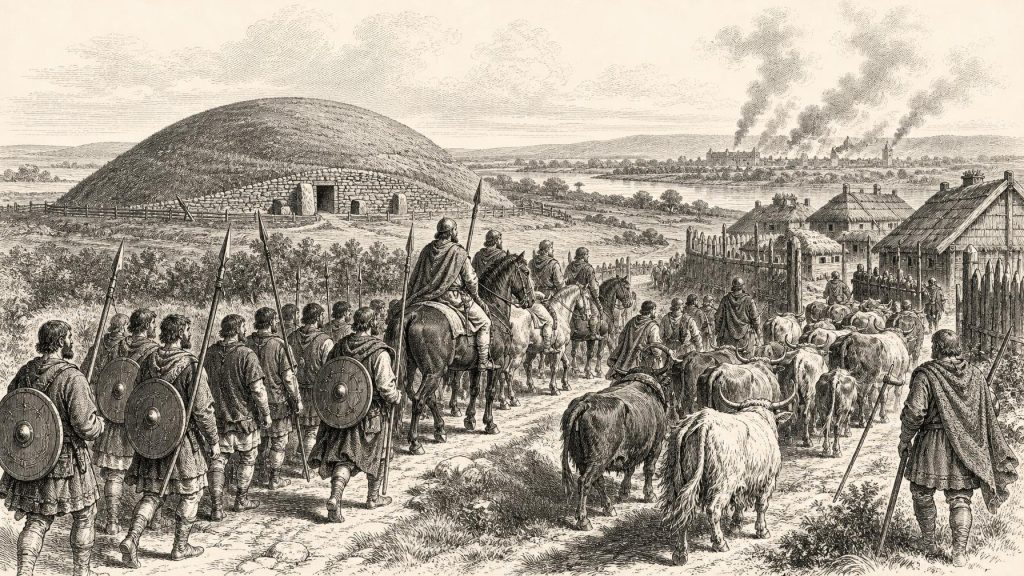
In 1039 he led the Osraige and Leinstermen northwards into Meath. The annals state that his forces burned as far as Cnogba, now Knowth, and Drochat Átha, Drogheda. The wording suggests a substantial destructive expedition through the Boyne region rather than a single battle. Such a hosting could damage rivals, gather livestock and captives, enforce claims to tribute and demonstrate that the attacking king could move an army well beyond his own heartland. Knowth was not merely a prehistoric ceremonial mound: it stood within the politically important kingdom of Brega and remained associated with settlement and royal power. Drogheda marked a valuable crossing and communications point on the Boyne.
Donnchad died in the same year. The sources agree on his importance but differ over the circumstances. The Annals of Tigernach call him overking of Leinster and Osraige and a “champion of Ireland”, adding that he met death with a prey, language connecting his end with raiding. Chronicon Scotorum simply records that he died, while the Four Masters say that he succumbed after a long illness. A modern biographical assessment concludes that he died during the hosting. It is safest to say that his final recorded act was the expedition into Meath and that his death followed during or shortly after it; no exact day is preserved.
His removal altered the balance of power. His son Gilla Pátraic succeeded within Osraige, but Donnchad’s wider Leinster supremacy was less easily inherited. Leinster contained several powerful dynasties, including the Uí Dúnlainge branches of the north and the Uí Chennselaig of the south-east. Diarmait mac Máel na mBó of the Uí Chennselaig was already emerging as a formidable regional ruler and would eventually dominate Leinster, Dublin and much of southern Ireland. That later achievement should not be projected fully into 1039, but Donnchad’s death clearly removed one of the principal barriers to Diarmait’s rise.
Violence Across the Kingdoms
Other entries reveal conflict on a smaller but widespread scale. Domnall son of Donnchad, ruler of the Uí Fháeláin, was killed by Domnall Ua Fergail, king of the Fortuatha of Leinster. The Uí Fháeláin were one of the leading north-Leinster dynasties, so the killing formed part of the intense competition beneath the level of the provincial kingship. Murchad Ruad, son of Máel Sechnaill, was blinded by Conchobar Ua Máel Sechnaill. Blinding was a political punishment: bodily perfection was associated with legitimate kingship, and mutilation could remove a rival without creating the religious and reputational consequences of killing him.
In the north and midlands, Muiredach son of Flaithbertach Ua Néill was killed by the Uí Labhradha, while the ruler of Fernmag, or Farney in modern County Monaghan, was reportedly killed by his own people. Mac Ruisse, king of Cenél Fiachach, was slain by the king of Fir Chell. Aed Ua Flannacáin, associated with Lurg and Uí Fhiachrach, also died violently. These notices should not be combined into an imagined island-wide war. They represent separate struggles over succession, local supremacy and obligations between kings and subordinate peoples.
Connacht’s eastern frontier was similarly unstable. Donnchad Derg, son of Art Ua Ruairc, was killed by Aed Ua Conchobair. Tigernach describes Donnchad as ruler of the whole of eastern Connacht and says that he was killed in place of his father, perhaps indicating that he became the selected target in a confrontation involving Art Ua Ruairc. The event belonged to the developing rivalry among the Uí Ruairc of Bréifne, the Uí Conchobair and other Connacht interests. It also illustrates how close royal kin were active military and political figures rather than protected heirs waiting peacefully for succession.
Churches and Learned Communities
The ecclesiastical record for 1039 is substantial. Mac Nia, bishop and successor of Buite at Monasterboice, died after what the Annals of Ulster described as many days. His community stood in the same Boyne–Louth region reached by Donnchad’s campaign, although no source says that the two events were connected. Monasterboice was both a religious centre and a place of scholarship. Flann Mainistrech, one of the foremost historians and poets of eleventh-century Ireland, served there as lector. His career demonstrates that monasteries preserved genealogies, synchronisms, dynastic traditions and learned verse as well as providing worship and pastoral care.
Célechair Ua Cuilennáin, successor of Tighearnach, also died, as did Muiredach son of Flannagán, a deputy superior at Armagh. The Annals of Inisfallen additionally record the death of Máel Finniae, bishop of Emly. Titles such as bishop, successor, lector and airchinnech reflected overlapping religious, educational and administrative responsibilities. Major churches possessed estates, received dues, maintained dependent communities and cultivated relationships with kings. Senior offices might be influenced by prominent local kindreds, linking ecclesiastical succession to regional politics.
The Four Masters alone report that the cloicteach, or bell tower, of Clonard fell in 1039. No cause is given, and no trace of the structure survives. It may have been brought down by structural failure, wind or another natural event, but choosing among these possibilities would be speculation. Round towers served primarily as prominent ecclesiastical bell towers and landmarks, with storage or refuge among their possible secondary functions. The fall was noteworthy because Clonard remained one of the great historic churches and centres of learning in the Irish midlands.
An Eclipse Over Ireland
The Annals of Inisfallen note an eclipse of the sun during the year. Modern astronomical catalogues identify an annular solar eclipse on 22 August 1039, visible in partial form across a broad surrounding region. The annalist supplied no day, hour or interpretation, so it cannot be proved where the observation was made. Its preservation nevertheless reflects the attention paid within learned communities to unusual celestial events. Irish clerics studied computus—the calculation of calendars and Easter—and annalistic notices of eclipses formed part of a long observational tradition.
Work, Wealth and Movement
For most inhabitants, life in 1039 was rural. Families occupied farmsteads enclosed by earthen banks, lived in timber or wattle buildings and worked managed landscapes of pasture, meadow and arable ground. Cattle remained central to wealth, tribute and status, while sheep, pigs and crops including barley and oats were also important. Dairy produce formed a major part of the diet. Archaeological evidence records spinning, weaving, leatherworking, carpentry, ironworking and the production of wooden vessels and agricultural tools. The annals’ frequent references to “prey” and captured cattle therefore describe attacks on the productive foundation of households, not merely symbolic trophies.
Ireland’s coastal towns presented a different environment. Dublin, Waterford, Limerick, Cork and Wexford connected inland producers with Irish Sea and wider European commerce. Dublin had struck silver pennies since the reign of Sitriuc Silkbeard, while silver by weight, imported coins and other valuables remained in circulation. Merchants and craftspeople handled hides, livestock products, timber, textiles, metalwork and imported goods. Irish and Scandinavian traditions had become deeply interwoven, producing the Hiberno-Norse material culture visible in jewellery, dress fittings, ships, houses and ecclesiastical metalwork. No major urban event can be assigned securely to 1039, but the towns were enduring political and economic forces with which rulers such as Donnchad mac Gilla Pátraic had to reckon.
A Year of Transition
The events of 1039 did not create a new island-wide settlement. Donnchad mac Briain remained king of Munster, the Uí Néill retained major northern interests, Connacht and Bréifne were contested, and Dublin followed its own Hiberno-Norse succession. Yet Donnchad mac Gilla Pátraic’s death was a genuine turning point. His career had shown that Osraige could project power into Leinster and Meath, but his broader authority proved personal and difficult to transmit. The raid through the Boyne country, the killings of regional kings, the blinding of a dynastic rival, the deaths of church leaders and the fall of Clonard’s tower together reveal a society that was politically violent but institutionally rich. Kingship, farming, monasteries, learned culture and maritime trade all remained closely connected as a new generation of rulers prepared to compete for supremacy.
Primary Sources
- The Annals of Ulster
- The Annals of Tigernach
- Annals of Inisfallen
- Annals of the Four Masters, Part 14
- Chronicon Scotorum
- Donnchad (d. 1039)
- Donnchad (d. 1064)
- Flann Mainistrech
- Catalog of Solar Eclipses: 1001 to 1100
- An Evaluation of Astronomical Observations in the Irish Annals
- An Evaluation of Astronomical Observations in the Irish Annals (PDF)
- The Political History of Connacht in the Eleventh and Twelfth Centuries
- Viking Ireland: Afterthoughts
- Viking
- Early Medieval
- 950–1450: Vikings, Normans and Medieval Mints
- Guide to the National Museum of Ireland
- Early Medieval Ireland: Archaeological Excavations, 1930–2009
- The Economy of Early Medieval Ireland
- Animals and the Economy of Medieval Ireland
- The Irish Round Tower: Origins and Architecture Explored
- Geophysical Investigation of the Site of the Former Monastic Settlement, Clonard, County Meath, Ireland
- Making Provincial Kingship in Early Medieval Ireland: Cashel and the Creation of Munster
- Kingship, Lordship, and Resistance: A Study of Power in Eleventh- and Twelfth-Century Ireland
- Exploring the Irish Annals