Ships Across Sliabh Fuait963 CE
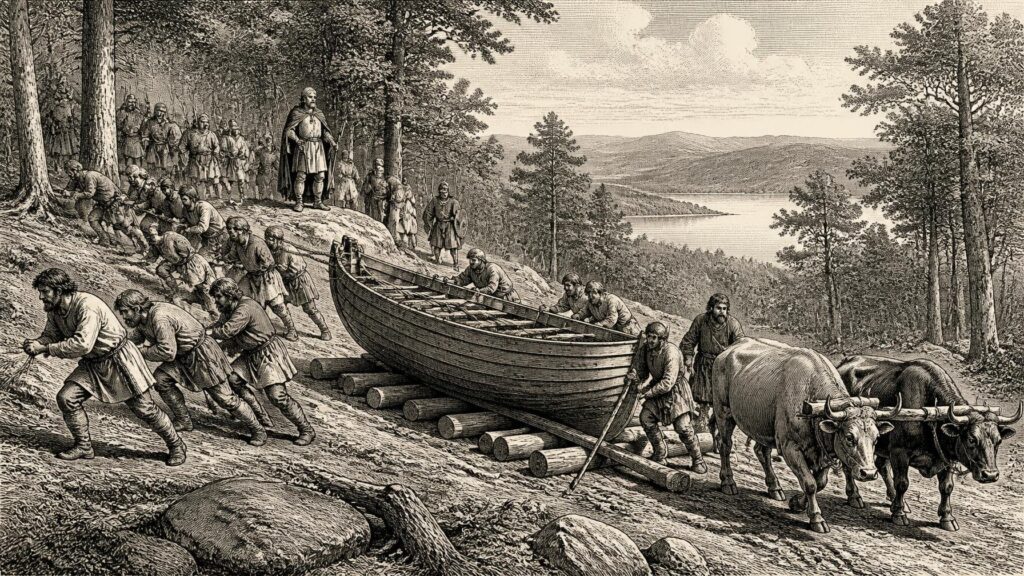
In 963, Ireland’s annals record local crises rather than a single national event. Domnall ua Néill, king of Tara, remarkably hauled ships across Sliabh Fuait, demonstrating logistical strength and political ambition. In Airgialla, Éicnech and his son were murdered by Murchad, who was himself swiftly killed, exposing dynastic instability. Donnchadh of Caisel died, Congal of Ciarraige Luachra was slain, and Tuadmumu suffered disaster on the Shannon. Ecclesiastical change included Máel Muire’s birth within Armagh’s succession and Cáenchomrac’s death at Clones. Gothfrith son of Amlaíb died. Despite uncertain annalistic chronology, these events reveal plural lordships linked by kinship, churches and waterways.
Dateline
In the annalists’ record, 963 was not a year of one island-wide battle or a single change of ruler. It was instead a year in which the workings of power appear in sharp, local episodes: a remarkable movement of ships across a northern upland route; a murderous succession crisis in Airgialla; the death of a king at Cashel; violence on the Shannon; and changes within major ecclesiastical communities. Taken together, these notices show an Ireland of many competing lordships, connected by rivers, roads, churches and kinship, rather than a country ruled through a single uniform administration.
Dating a Difficult Year
The evidence needs careful handling. The Annals of Ulster place their entries under “AD 962 alias 963”, an indication of the chronological complications built into medieval annal-keeping. The Annals of Inisfallen, by contrast, explicitly head their sequence as 963. The events discussed here can responsibly be connected with the calendar year 963, but the surviving annals were compiled and copied over centuries, and their year-numbering does not always coincide perfectly. Their concise notices are invaluable, yet they rarely give the wider causes, dates within the year, or full consequences of the events they preserve.
A further warning concerns the Annals of the Four Masters, compiled in the seventeenth century from earlier material. Under 963 they record a great famine and a Connacht expedition by Domnall ua Néill. Those grave claims cannot be treated as securely dated to 963 merely because they appear under that heading: other sources place related developments differently, and the Four Masters’ chronology in this period can be displaced. The famine notice is therefore important evidence for later annalistic memory, but not firm grounds for describing everyday life in 963 itself as a year of island-wide starvation.
Domnall’s Unprecedented Portage
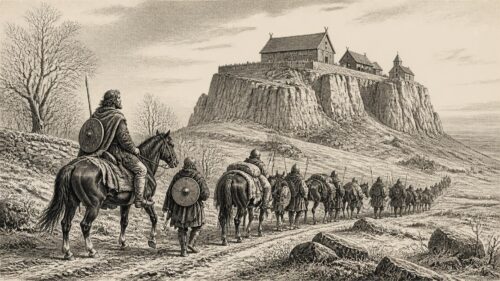
The most striking entry belongs to Domnall ua Néill, the powerful ruler of Cenél nÉogain and king of Tara. The Annals of Ulster report that he brought ships “from the Daball across Sliab Fuait to Loch Aininne”, adding that such a feat had not been done since ancient times and citing the Book of Dub dá Leithe. Even in the annal’s compressed form, this was meant to be remembered as extraordinary.
The notice does not explain why the ships were moved, how many there were, or whether the operation preceded a campaign. It would be unsafe to invent a battle or a destination. Yet the act itself is revealing. Ships were strategic resources: they moved men, food, tribute, plunder and messages more efficiently than roads could, especially along Ireland’s lakes, rivers and coasts. Hauling vessels overland across Sliabh Fuait required labour, planning and command over people and draft animals. The feat publicised Domnall’s capacity to mobilise resources in the north and to turn waterways into instruments of political reach.
That capacity mattered because Domnall’s kingship was real but not bureaucratic in a modern sense. He had achieved the kingship of Tara in the later 950s and sought recognition from rival regional dynasties. Such supremacy depended on personal alliances, hostages, tribute, military expeditions and displays of exceptional capability. The portage was not proof that he governed every part of Ireland directly. Rather, it illustrates the practical and symbolic means by which an ambitious overking could make authority visible across a fragmented political landscape.
Bloodshed in Airgialla
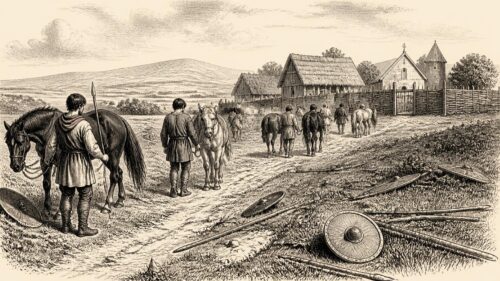
In the same annal, Éicnech son of Dálach, king of Airgialla, and his son Dub Dara were killed by Éicnech’s brother Murchad. Murchad was then killed “promptly” in the same month. The speed with which the killer himself died is one of the entry’s most telling details. It suggests not an orderly transfer of office but a violent rupture within the ruling kindred, followed by swift retaliation or counter-action.
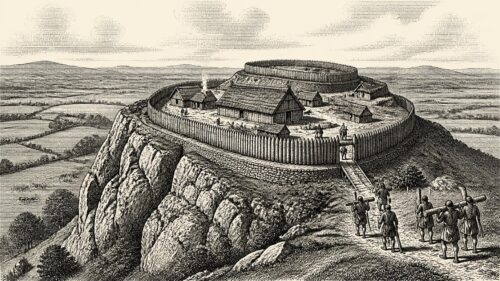
Airgialla was a politically important grouping of dynasties in the north and centre-east, situated between the ambitions of the Northern Uí Néill, the Ulaid and the kingdoms of the midlands. Its kingship was not an impersonal crown passed automatically from father to eldest son. Eligibility for rule rested within a wider royal kin-group, and rivalry between close relatives was an enduring feature of early medieval politics. Éicnech’s killing alongside his son was therefore both a family tragedy and a threat to the continuity of lordship. The annal provides no legitimate successor and no stated motive; its silence is a reminder that modern explanations must not be substituted for lost evidence.
Nevertheless, the episode shows why alliances between rulers could be fragile. A king such as Domnall ua Néill could seek the submission or support of neighbouring peoples, but internal conflict among those peoples might quickly alter the value of any agreement. Kingship was sustained by followers and landholding families as much as by inherited prestige. The murder of a ruler could unsettle obligations of military service, tribute and protection at a moment’s notice.
Cashel and the Shannon
Southern Ireland also saw significant losses and violence. The Annals of Inisfallen record the death of Donnchadh son of Cellachán, king of Caisel; the Annals of Ulster independently notes the death of “Cellachán’s son, king of Caisel”. The agreement of these annals makes the death a secure event of 963, although neither gives the manner of death, a precise day, nor an immediate successor. Cashel represented the authority of the Eóganachta in Munster, but it should not be imagined as exercising uncontested control across the province. Munster contained powerful regional groupings and was entering a period in which older political balances would be increasingly challenged.
The Inisfallen record also notes the killing of Congal son of Cormac, king of Ciarraige Luachra, a kingdom in the south-west. This was a reminder that the fate of small and middle-ranking kings mattered alongside that of Cashel. Such lordships controlled local territories, agricultural dues, client relationships and routes through their districts. Their rulers could be drawn into the contests of greater kings, but they possessed interests and rivalries of their own.
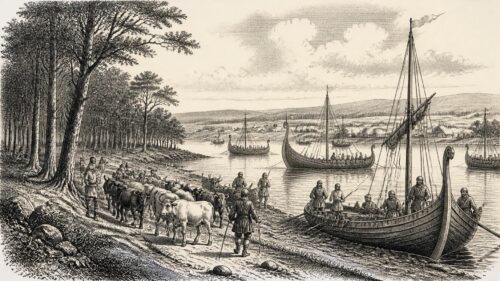
Another Inisfallen entry describes a slaughter of the Tuadmumu, the people of north Munster, on the Sinann or Shannon. Their vessels were abandoned and people drowned. The notice is vivid but frustratingly spare: it does not identify their opponents, the precise crossing-point, or the political objective. It does show, however, that the Shannon was more than a boundary on a map. It was a major avenue of movement and a dangerous military environment. Waterborne transport could give speed and carrying capacity, but a defeated force trapped at a river or deprived of boats faced disaster.
Churches, Succession and Learning
Ecclesiastical institutions form another thread in the year’s record. The Annals of Ulster report the birth of Máel Muire son of Eochaid, identified as successor of Patrick. This does not mean that a new successor took office in 963: the annal records a birth, not an appointment. Its importance lies in the language used. The succession of Patrick, centred on Armagh, carried exceptional ecclesiastical prestige, and the entry identifies a child already within a lineage connected to that office.
The same source records the death of Cáenchomrac, successor of Tigernach. Tigernach’s principal church was Clones, an important ecclesiastical centre in the borderlands of modern Monaghan and Fermanagh. A “successor” or comarba was not simply a parish priest. Such offices could bring spiritual authority, landed resources, dependants, legal privileges and influence among secular rulers. A change in leadership at a church could consequently have political as well as religious significance.
These brief entries also point to the habits of learning that made the annals possible. Monastic and ecclesiastical communities maintained Latin Christian culture while recording Irish dynasties, local places and inherited claims. The reference to the Book of Dub dá Leithe in the story of Domnall’s ships shows that annalists could draw upon earlier written authority to authenticate a claim about the past. Their world was not exclusively oral, even though much political memory, genealogical knowledge and legal custom was also transmitted through speech and performance.
Norse-Gaelic Ireland
The death of Gothfrith son of Amlaíb appears among the Ulster notices. The annal does not supply a title or place, so it is unwise to assign him a particular kingship with certainty. His Norse name and patronym place him, however, within the interconnected Norse-Gaelic world whose dynasties, ships and trading settlements linked Dublin, the Irish Sea, northern Britain and the islands. By the tenth century, Scandinavian-descended rulers and settlers in Ireland were not simply outside invaders: they were participants in Irish political struggles, while retaining maritime connections beyond the island.
That wider maritime world helps explain the significance of vessels in this year’s entries. Domnall’s portage over Sliabh Fuait and the drowning of Tuadmumu men after abandoning their boats belong to different political settings, yet both reveal a society in which control of water transport could shape power. Trade, raiding, diplomacy and warfare all depended on waterways. Ireland’s first towns, particularly Dublin, also channelled imported goods and people into an economy still overwhelmingly based on agriculture, livestock and local lordship.
A Year of Connected Local Crises
For most people, 963 would have been experienced not through the high politics of Tara or Cashel but through the demands of farming, cattle-keeping, food storage, seasonal movement and obligations to local rulers and churches. The annals seldom record this ordinary labour unless crisis made it visible. Yet their notices disclose the structures surrounding it: kings competed for resources; churches possessed enduring institutional weight; boats and waterways connected regions; and kinship could deliver both protection and lethal rivalry.
Thus 963 stands out less for a single decisive turning point than for a set of tightly observed incidents. Domnall ua Néill’s ships crossing Sliabh Fuait proclaimed unusual royal capacity. The deaths in Airgialla exposed the volatility of dynastic succession. The loss of Donnchadh of Caisel and violence on the Shannon marked instability in Munster. Ecclesiastical successions continued alongside secular conflict. In the annals’ economy of words, these episodes preserve a vivid picture of an Ireland whose regions were interdependent, but whose political order remained profoundly plural.
Primary Sources
- The Annals of Ulster, Year U963
- The Annals of Inisfallen, Annals AI960–AI969
- Annals of the Four Masters, Annal 963
- CELT Project: Annals of Ulster
- CELT Project: Annals of Inisfallen
- CELT Project: Annals of the Four Masters
- Ua Néill, Domnall
- The Cambridge History of Ireland
- Changing Human-Cattle Relationships in Ireland: A 6000-Year Isotopic Perspective
- The Irish Sea and the Atlantic Trade in the Viking Age
- Vikings in Early Medieval Ireland
- Early Viking Church Raiders and the Emergence of Political Purpose
- Ireland to 1170 (with Andrew Woods)
- Irish Society c. 700: I. Communities
- On Wet-Nursing, Fosterage and the Age at Which Fosterage Began in Medieval Ireland
- A Concise History of Ireland: Early Medieval Ireland c. 430–1169
- Chronicon Scotorum, Annals CS940–CS941
- The Annals of Ulster, Year U938
- The Annals of Ulster, Year U999
- CELT Project: Fragmentary Annals of Ireland
- Royal Irish Academy: Abbreviations List
- Digital Atlas of Cork/Corcaigh: General Abbreviations