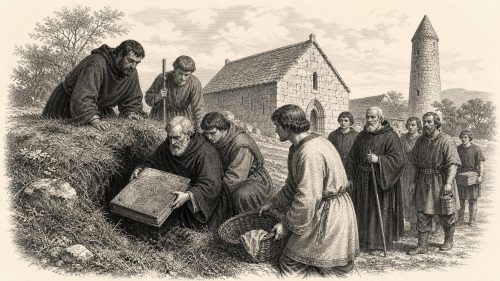
The Synod at Inis Aingin899 CE
In 899, Chronicon Scotorum recorded a rainy year and bread shortage, alongside political and ecclesiastical disruption in central Ireland. Connacht raiders entered western Mide, profaned Inis Aingin on Lough Ree during a synod attended by Cairbre Crom, bishop of Clonmacnoise, and Ciarán’s shrine, and killed one unnamed man. The men of western Mide defeated the raiders at Áth Luain the same day, leaving unspecified casualties. The annals also note Argadán, abbot of Corcach’s death. These events reveal food insecurity, strategic waterways, regional warfare and church authority as interwoven features of early medieval Irish society. Scholars date these events to 899.
Dateline
The Irish annals give 899 a strikingly local centre of gravity: an island meeting on Lough Ree, a raid from Connacht, and a defeat at Áth Luain. The fullest contemporary-style notice survives in Chronicon Scotorum. It records a rainy year and a shortage of bread, the death of Argadán, abbot of Corcach, a Connacht raid into western Mide, the profanation of Inis Aingin while a synod was assembled there, and the subsequent defeat of the raiders by the men of western Mide. The entries are brief, but together they reveal a country in which food supply, political violence, waterways and ecclesiastical authority were tightly interwoven.
Dating needs care. Chronicon Scotorum places these events under 899. The much later Annals of the Four Masters preserves a closely related account under 894, but its chronology for this period is displaced; modern scholarship treats that notice as referring to 899. The annals do not provide a day or month for the raid or battle, only their sequence and the emphatic statement that the defeat at Áth Luain came on the same day as the outrage at Inis Aingin. That is the firm chronological framework. Beyond it, interpretation must remain measured.
Rain and a shortage of bread
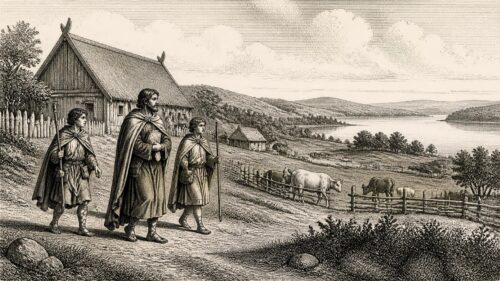
The annalist’s first secular observations are unusually revealing: pluuialis annus, a rainy year, followed by defectio panis, a shortage of bread. This is not a modern weather report. It neither quantifies rainfall nor says that every Irish district suffered equally, and it does not explicitly state that wet weather caused the shortage. Yet their juxtaposition makes clear that conditions affecting the food supply mattered enough to deserve record beside kings, churchmen and warfare.
For most households, bread meant grain grown, harvested, dried, stored, ground and baked through a chain of labour vulnerable to weather. A wet season could impede cultivation and harvest, spoil stored grain, make roads and tracks difficult, and complicate the movement of food between estates and settlements. It would be unsafe to turn the annal’s terse phrase into a claim of nationwide famine. There is no death toll, no report of starvation, and no named harvest failure. Nonetheless, a recorded shortage of bread signals real pressure on provisioning. In a society whose wealth also rested heavily on cattle, grain scarcity could heighten the importance of access to stores, rents and food-rendering obligations.
This background sharpens the significance of the year’s raid. Raiding in early medieval Ireland could seek cattle, portable wealth, captives, political submission or revenge; the source does not specify what the Connacht force intended to take in western Mide. It is therefore wrong to present the expedition simply as a food raid. But a shortage of bread was an unwelcome setting for any armed incursion, since a host consumed supplies while moving and exposed communities along its route to further demands.
Connacht Enters Western Mide
The Connachta crossed into iartur Mide, western Mide. This was not a march into an empty borderland. Mide lay at the political heart of Ireland, associated with the southern Uí Néill and with the wider claims of Flann Sinna, king of Tara. Connacht, to the west, was itself a mosaic of competing dynasties and lordships. The annal calls the raiders collectively “the Connachta”, without naming a king, commander or particular branch. That wording supplies evidence for an expedition from the province, but not for a single ruler’s complete control of it.
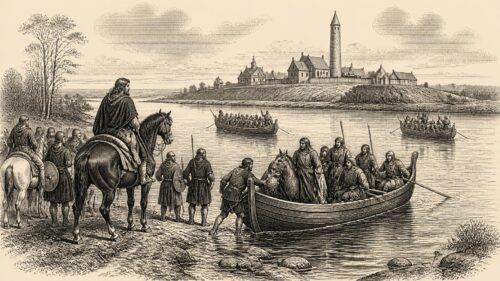
The geography mattered. The Shannon and its great lakes were major avenues through the central plain, connecting Connacht, Mide and the powerful ecclesiastical centre of Clonmacnoise. Áth Luain, the ford of Luan, stood at a strategic crossing of the Shannon. Whoever could assemble and fight successfully there could obstruct movement between Connacht and Mide. The notice that the western men of Mide defeated the Connachta at Áth Luain on the same day as the disturbance at Inis Aingin suggests a rapid, local response rather than a long campaign recorded over months.
The outcome is plain, even if the scale is not. The Connacht force was defeated and “left a number behind dead”. Medieval annalists often used such formulae without giving figures, and none should be invented. Nor does the entry identify every combatant on the Mide side. Still, the result was more than a skirmish in the margins: it halted a provincial raid at one of the Shannon’s crucial crossings and announced that western Mide could defend itself.
A Church Meeting on an Island
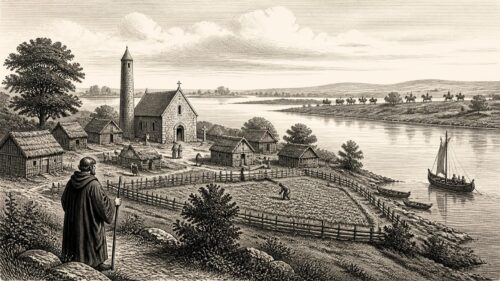
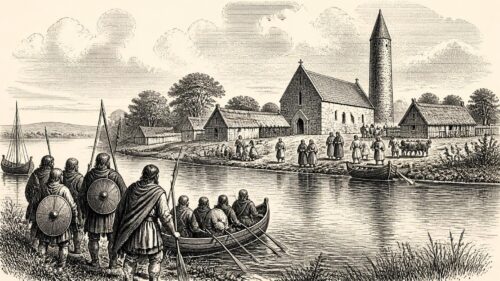
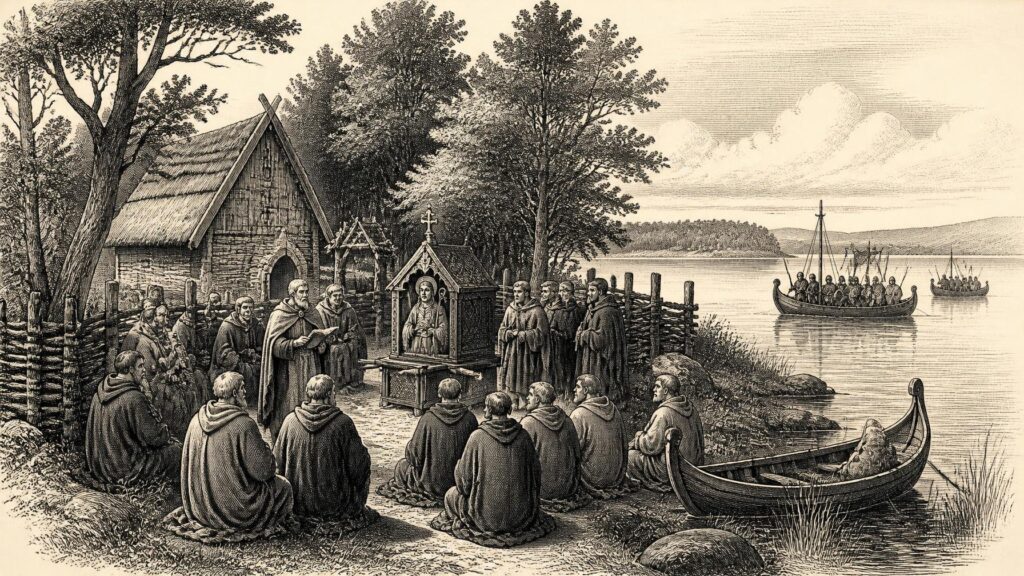
Before, during or alongside the fighting, Inis Aingin was profaned. The island is generally identified with Hare Island in Lough Ree, though medieval place-names can carry uncertainties and the annal does not describe its buildings. What it does describe is exceptional. The shrine of Ciarán was present, as was an assembly or synod of elders around Cairbre Crom, bishop of Clonmacnoise. The language points to a deliberately convened ecclesiastical gathering, not simply a resident monastic community surprised in daily routine.
The shrine was an object of devotion and an assertion of institutional identity. Ciarán of Clonmacnoise, the sixth-century founder saint, remained central to the authority and memory of the great Shannon monastery. Carrying or displaying a saint’s shrine at a gathering could make the saint’s presence tangible, lend solemnity to proceedings and connect a meeting on an island with Clonmacnoise’s spiritual claims. The annal offers no inventory of its materials and no description of damage. “Profanation” is the key judgement: sacred space, people or objects had been violated in circumstances that the writer regarded as a grave offence.
One man was killed at Inis Aingin. His name, rank and precise role are unknown. He may have belonged to the synod, the ecclesiastical household, the raiders or the surrounding population; the text does not say. The death should not be enlarged into a massacre. Its importance lies in its setting: bloodshed took place where a shrine and an assembly of senior churchmen were gathered. The episode demonstrates that sanctuary was a claim with moral and political force, but not an automatic shield against armed men.
Cairbre Crom’s presence makes the notice especially valuable. He is styled bishop of Clonmacnoise, not king, abbot or saint. Later tradition surrounded him with devotional stories, but the safely usable fact for 899 is narrower and stronger: he was a bishop associated with Clonmacnoise and was among the senior clergy at the Inis Aingin synod. The record does not preserve the meeting’s agenda. It may have concerned church discipline, property, jurisdiction, peace-making or matters now wholly lost; no conclusion can responsibly be chosen from that list. Its occurrence nevertheless shows that church leaders could gather across regional boundaries in a formal setting even amid acute political insecurity.
Clonmacnoise and the Central Waterways
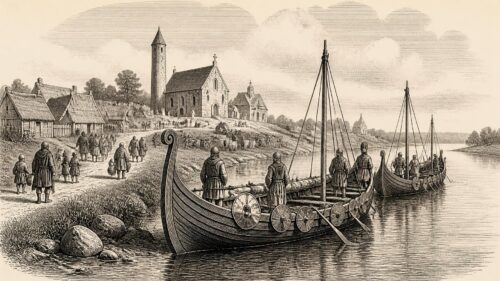
Inis Aingin’s connection with Clonmacnoise illuminates the reach of an Irish church settlement that was much more than a secluded place of prayer. Clonmacnoise stood on the Shannon, near major routes through the island. Its clergy, dependants, estates, churches, books, relics and patrons were bound into the political world around them. A synod attended by its bishop and marked by Ciarán’s shrine shows ecclesiastical organisation operating through travel, networks and public ritual.
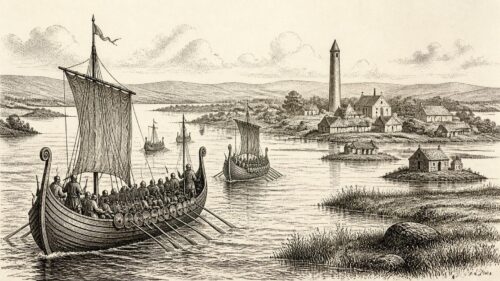
Water was central to that world. Lough Ree and the Shannon permitted movement by boat, while fords such as Áth Luain concentrated travellers, armies and trade. The same geography that allowed an island assembly to convene also made the region vulnerable to raiding parties and military interception. This was a landscape of linked waterways, rather than a simple division between religious islands and secular mainland. The attack and the battle reveal how quickly sacred, political and economic space could overlap.
The annalist does not name Viking raiders or a Scandinavian settlement in connection with these events. That silence is important. Viking activity and settlement had transformed parts of Ireland during the ninth century, especially along coasts and rivers, but the conflict recorded in 899 was explicitly between Connacht raiders and the men of western Mide. It should not be recast as a Viking episode merely because it occurred in the Viking Age. Native Irish warfare, rivalry and church politics had their own momentum.
Corcach and the Quiet Work of Succession
Amid the alarming notices, Chronicon Scotorum tersely records that Argadán, abbot of Corcach, “rested”: he died. Corcach, later Cork, was already an ecclesiastical settlement, and the death of an abbot mattered because abbots could exercise authority over communities, lands, tenants, learning and religious observance. The annal does not name Argadán’s successor, explain his tenure or connect his death to the rain, shortage or western conflict. Its inclusion is nonetheless a reminder that institutional continuity depended on successions that were significant enough to enter the historical record.
This small notice also corrects an overly martial image of 899. Much of life continued through the routines behind the annals: farming, food preparation, travel by river, obligations to secular and ecclesiastical lords, worship, teaching and care for religious communities. The surviving sources privilege disruptions and leading figures, not ordinary voices. The rainy weather and bread shortage are rare glimpses of the conditions beneath politics; Argadán’s death is a glimpse of the personnel through whom a church community endured.
A Year of Exposure
899 was not a year defined by one island-wide battle or a change in the high kingship. Its surviving record is more concentrated and, for that reason, unusually vivid. Rain and a shortage of bread exposed the fragility of food provision. Connacht’s raid exposed the contested character of the Shannon corridor. The profanation of Inis Aingin exposed the vulnerability of sacred gatherings, even when protected by a saint’s shrine and attended by senior clergy. The defeat at Áth Luain exposed the limits of the raiders’ venture.
The synod remains the year’s most evocative image: clerics gathered beside Lough Ree around Cairbre Crom and Ciarán’s shrine, while regional violence intruded upon their meeting. We cannot recover their deliberations or the identity of the slain man. But the annal preserves enough to show that, in 899, Irish religion was neither remote from society nor merely a victim of it. It was organised, mobile, publicly authoritative and deeply entangled with the routes, rivalries and risks of early medieval Ireland.
Primary Sources
- Chronicon Scotorum: Annal CS899
- Chronicon Scotorum: English Translation and Bibliography
- The Annals of the Four Masters: Annal M899
- Annals of the Four Masters
- The Annals of Ulster: Year U900, AD 899 alias 900
- The Annals of Ulster
- Annals of Inisfallen: Annal AI899
- Annals of Inisfallen: Annal AI900
- Annals of Inisfallen
- Annals of Inisfallen: CELT Document Record
- Vikings in Irish Chronicles, 794–902: Introduction
- Vikings in Irish Chronicles, 794–902: Data
- The Vikings in Ninth-Century Ireland: Sources and Settlements
- The Vikings in Ninth-Century Ireland: Sources and Settlements, Full Text
- Vikings in Ireland and Scotland
- Councils and Synods of the Gaelic Early and Central Middle Ages
- The Multivocality of the Cross of the Scriptures: Claiming Victory, Kingship, and Territory in Early Medieval Ireland
- Book of Leinster, Formerly Lebar na Núachongbála: Part 32
- Exploring the Irish Annals
- CELT: List of Published Texts