Blacair’s Last Battle948 CE
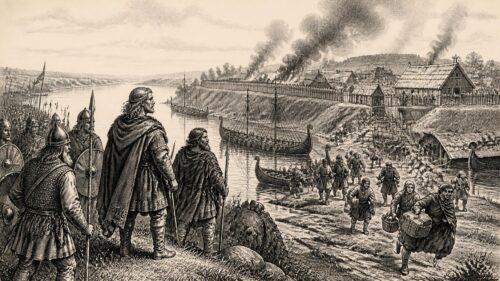
In 948, Congalach mac Máel Mithig, king of Brega and claimant to Tara, defeated and killed Blacair, ruler of Dublin’s Scandinavian dynasty. Annals differ over casualties and date, but agree that Blacair’s following suffered a defeat, perhaps through stratagem. The encounter reflected shifting alliances, dynastic rivalry and competition between Dublin’s prosperous port and neighbouring Irish kingdoms, rather than a simple ethnic conflict. Dublin survived under new rulers, while Congalach remained challenged by rivals. Conflict also affected churches: Colmán of Sláine died in captivity, and Clonmacnoise mourned Ainmire. Notices of Máel Sechnaill’s birth and Gormlaith’s death preserve dynastic and religious memory.
Dateline
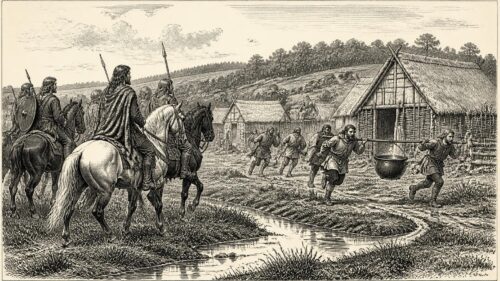
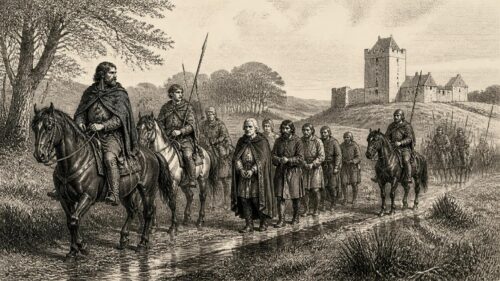
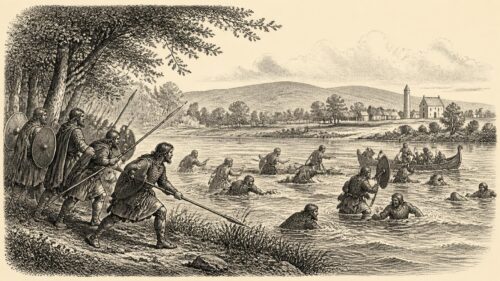
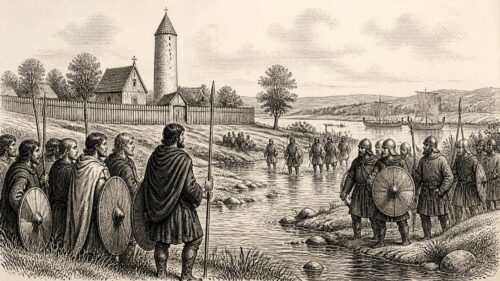
In 948, a sharp reversal in the struggle for Dublin ended the life of Blacair, a leading ruler of the town’s Scandinavian dynasty. The Annals of Ulster record that Congalach mac Máel Mithig killed Blacair, described as ‘king of the foreigners’, and that 1,600 of Blacair’s people were killed or taken captive. Chronicon Scotorum also records Blacair’s death at Congalach’s hands, though it gives the lower figure of a thousand and says that he was killed ‘by cunning’. The entries do not supply a day, a battlefield or a full narrative. The event should therefore be understood as a campaign or encounter in the Dublin–Brega political world, rather than imagined as a securely located set-piece battle.
A Dangerous Dublin Frontier
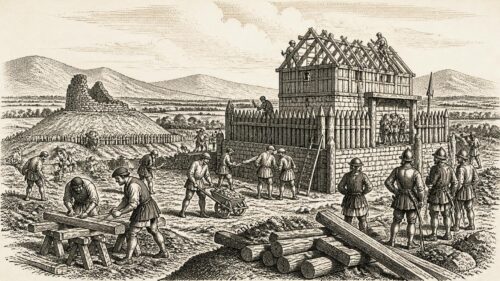
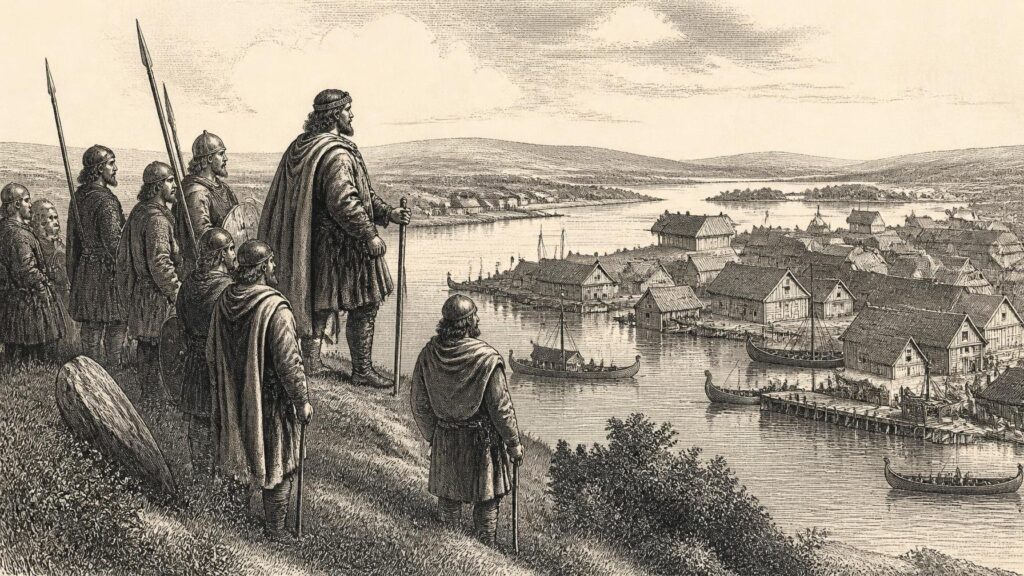
The death nevertheless belongs securely to the conventional year 948. It was an important moment in a long contest between the rulers of Dublin and the kings of the Irish midlands. Dublin was not merely a raiding base. By the tenth century it was a substantial port settlement, tied by sea routes to the Irish Sea, Britain and the wider Scandinavian world. Archaeology reveals a town of timber-built houses, craft production, commerce, weights and scales, silver, imported goods and people of varied cultural backgrounds. Yet the same town’s wealth, ships and armed following made it a formidable neighbouring power for rulers in Brega, Mide and Leinster.
Its political language should not obscure this complexity. Irish annalists often called the Dublin rulers Gaill, ‘foreigners’, but the town’s inhabitants and allies cannot be reduced to a single ethnic bloc. Nor was the contest simply one between ‘Irish’ and ‘Vikings’. Irish kings made alliances with Dublin leaders when it suited them; rival members of the Scandinavian dynasty competed among themselves; and the seizure of cattle, captives, tribute and ecclesiastical wealth connected warfare to the economies of both town and countryside. In 948, the men following Blacair lost heavily, but Dublin itself did not disappear.
Congalach’s Calculated Victory
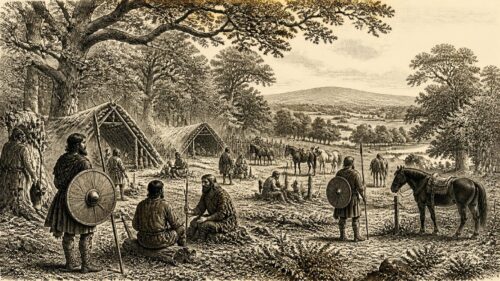
Congalach Cnogba was king of Brega and a member of Síl nÁedo Sláine, a southern branch of the Uí Néill. After the deaths of the powerful kings Muirchertach mac Néill in 943 and Donnchad Donn in 944, he had advanced a claim to the kingship of Tara, the premier overkingship in Ireland. This was not the rule of a unified kingdom in the modern sense. Authority depended on kinship, military followings, tribute, hostages and the acknowledgement of regional kings. Still, victory over a Dublin ruler could greatly strengthen a claimant whose heartland lay close to the lower Boyne and the approaches to the settlement.
Congalach had already shown that he could both fight and negotiate with Dublin. In 944 he and allies from Leinster plundered Áth Cliath, taking valuables and booty. The following years produced shifting alignments: Dublin forces could support Congalach against other challengers, while members of the Dublin ruling family could pursue their own authority. Blacair’s position in 948 seems to have been particularly exposed. Modern biographical scholarship judges that he had taken control in Dublin in defiance of Amlaíb Cuarán, another member of the Uí Ímair dynasty. Congalach’s intervention therefore served more than one purpose: it checked a dangerous neighbour while potentially restoring a more workable balance within Dublin itself.
The annals do not explain what the phrase ‘by cunning’ meant. It may preserve a claim that Blacair was caught through stratagem; it does not licence a detailed story of ambush, betrayal or secret negotiations. Likewise, the casualty figures are not modern battlefield returns. Their difference—1,600 killed or captured in the Annals of Ulster, a thousand with Blacair in Chronicon Scotorum—is a reminder that annalistic numbers communicated the scale of a disaster as much as they counted individuals. What both texts firmly convey is the destruction or capture of a large part of Blacair’s following and the death of its leader.
Aftermath Without Conquest
The immediate political result was not an Irish occupation of Dublin. Blacair’s death removed one ruler, but the port remained an autonomous and resilient centre whose rulers continued to matter in Irish politics. Gofraid mac Sitriuc emerged as Dublin’s ruler, while Amlaíb Cuarán remained a major figure in the dynasty’s wider Irish Sea connections. The survival of Dublin after 948 is crucial. Congalach had won an important advantage, not permanently settled the question of power on the east coast.
Nor had Congalach eliminated his principal Irish rival. Ruaidrí ua Canannáin of Cenél Conaill also sought the kingship of Tara and had defeated Congalach and Dublin forces near Sláine in the preceding year. The rivalry was still active after Blacair’s fall. That wider contest explains why a victory over Dublin should not be read as a straightforward triumph of one people over another. It was part of an unstable system in which dynastic legitimacy and military capacity were continually tested. Congalach’s position looked stronger in 948, but it still required allies and could still be challenged.
Sláine and the Cost to Churches
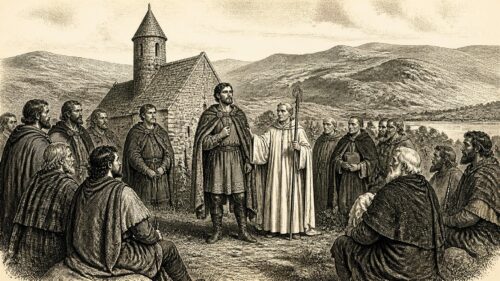
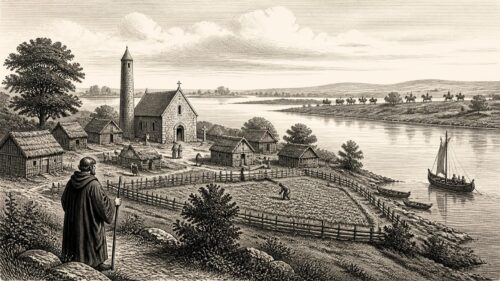
The year’s annals also preserve a more intimate consequence of conflict. Colmán mac Máel Pátraic, superior of Sláine, was taken prisoner by ‘the foreigners’ and died in their hands. Sláine, beside the Boyne in Brega, was a major ecclesiastical centre and lay within the contested zone between Dublin and Congalach’s power-base. The notice does not say when during the year Colmán was seized, whether his captors belonged to Blacair’s party, or whether his death occurred in the same operation as the king’s defeat. It does, however, show that a political contest involved religious communities as well as royal warbands.
Such a record should not turn monasteries into passive victims alone. Great churches were centres of landholding, learning, skilled labour, hospitality and political connection. Their leaders could be bishops, abbots, stewards and members of influential kindreds; their possessions included books, relics, metalwork, livestock and food-rents. Capturing an ecclesiastical superior could bring ransom, leverage or intimidation, while attacking a church could strike at the resources and prestige of a rival ruler. Colmán’s death demonstrates the human vulnerability beneath the annals’ compressed political language.
Another obituary marks the passing of Ainmire ua hAdlai, ‘successor of Ciarán son of the wright’, the saintly founder associated with Clonmacnoise. The phrase identifies him through office and spiritual succession rather than through a modern job title. Chronicon Scotorum calls an Ainmire of Uí Meic Uais of Mide superior of Clonmacnoise; the Annals of Ulster preserves the Ciarán succession. Taken together, these notices point to the continued standing of Clonmacnoise, a major midland church on the Shannon whose authority extended through memory, patronage and learning as well as territory.
Learning, Memory and Succession
The annals also place in 948 the birth of Máel Sechnaill mac Domnaill, although the notice appears parenthetically in the Annals of Ulster. He would become one of the most consequential kings of the later tenth and early eleventh centuries. For this year, however, the entry is only a birth notice, not a prophecy. Its value lies in showing how later political importance could shape what annalists and copyists chose to preserve. The child’s future was unknown to those living through Blacair’s defeat; the record survives because later generations knew what he became.
Gormlaith, daughter of Flann Sinna and widow of Niall Glúndub, is also recorded as having died after penance. Her obituary belongs to the world of dynastic memory: she was linked by marriage and descent to the great Uí Néill networks that framed Congalach’s career. Annalists did not record women only as relatives, but their surviving notices often locate them through kingship, marriage, religious devotion and death. Gormlaith’s commemoration reveals the importance attributed to penitence at the end of life, while also preserving the connections between competing royal lines.
The Limits of the Record
There is a need for care in assigning events to this calendar year. Tenth-century Irish annals can differ by a year in their chronological headings, and later compilations sometimes gather material under dates that do not align neatly with earlier texts. The Annals of Inisfallen, for example, places Blacair’s death under its entry for 947, whereas the Annals of Ulster and Chronicon Scotorum support the conventional date of 948. Rather than treating this as a reason to discard the event, historians compare the records, their chronological systems and their political contexts.
For Ireland, 948 is consequently best remembered not for an invented, cinematic battle scene but for a documented change in the balance around Dublin. Blacair’s death dealt a severe blow to one armed following; Congalach won prestige in the struggle for Tara; Sláine’s superior died a captive; and the monastic world of Clonmacnoise marked the death of a successor of Ciarán. Warfare, urban commerce, kingship and ecclesiastical authority were tightly interwoven. The surviving notices are brief, but together they reveal an island where control of a river port, a church community or a royal alliance could alter the prospects of far larger regions.
Primary Sources
- Annals of Ulster
- Chronicon Scotorum
- Chronicon Scotorum, Annal CS948
- Annals of Inisfallen
- Annals of Inisfallen, Annals AI940–AI949
- Annals of the Four Masters
- Annals of the Four Masters, Irish Text
- Blacair (Blakkr) | Dictionary of Irish Biography
- Congalach Cnogba | Dictionary of Irish Biography
- Ua Canannáin, Ruaidrí | Dictionary of Irish Biography
- Donnchad Donn | Dictionary of Irish Biography
- Flann Sinna | Dictionary of Irish Biography
- Viking | National Museum of Ireland
- Dublin City Urban Archaeology Survey: Preliminary Report
- Early Medieval Ireland: Archaeological Excavations, 1930–2009
- The Vikings in Ninth-Century Ireland: Sources and Settlements
- Vikings in Early Medieval Ireland: Church-Raiding, Politics and Kingship
- The Annals of Ulster: CELT Project Record
- Annals of Inisfallen: Bibliographical Record
- Chronicon Scotorum: Bibliographical Record
- CELT: List of Published Texts