Aidíth’s Treacherous End898 CE
In 898, annalistic records portray Ireland as a landscape of vulnerable regional kingships and influential churches. Aidíth son of Laigne, king of Ulaid, was killed by his associates, probably amid intensified rivalry after military defeat, although motives and successor remain unknown. Cairpre, superior of Lann Léire at Dunleer, died, marking transition within a powerful ecclesiastical community. A reported shower of blood at Ard Cianachta was recorded as an extraordinary, possibly portentous phenomenon. In Corcu Bascinn, west Clare, King Flann son of Cathrannach died and his brother Lennán succeeded, illustrating dynastic continuity. Divergent annalistic chronologies require caution in dating these events.
Dateline
In 898, Ireland’s political life was shaped less by a single island-wide campaign than by sudden changes in leadership. The annals preserve a small but revealing group of notices: the killing of Aidíth son of Laigne, king of Ulaid; the death of a senior churchman at Lann Léire; a strange reported “shower of blood” in Ard Cianachta; and, in the south-west, the succession of Lennán after the death of his brother Flann, king of Corcu Bascinn. None is assigned a day or season. Together, however, they show how power rested on vulnerable personal alliances, ecclesiastical communities remained major public institutions, and regional kingships continued to determine ordinary political security.
The dating needs care. The Annals of Ulster place these northern events under their entry U898, explicitly labelled “AD 897 alias 898”; this reflects the complicated chronological systems of the medieval Irish annals rather than an exact modern date. The Annals of Inisfallen, using a different record tradition, place the deaths and succession in Corcu Bascinn under AI898. The later Annals of the Four Masters attach Aidíth’s death to 897. It is therefore responsible to connect all these developments with 898 while avoiding claims about an exact day, month or sequence between them.
A King Killed by His Associates
The year’s most consequential recorded event was the treacherous killing of Aidíth son of Laigne. The Annals of Ulster call him king of Ulaid and state simply that he was killed “by his associates”. The word is important. This was not presented as a death against an external invader or in a formally named battle, but as betrayal or factional violence from within his own political world. The record neither names the killers nor identifies a successor. That silence is typical of annalistic notices, but it leaves the essential point stark: a ruler of Ulaid had been removed by people close enough to be described as his own associates.
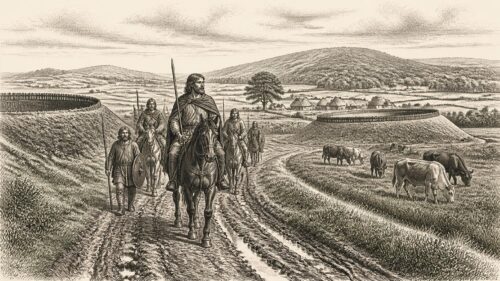
Ulaid was not a unitary state in the modern sense. It was an over-kingship in the north-east, where rival dynasties, especially Dál Fiatach and Dál nAraidi interests, competed for precedence. Aidíth’s career had been forged in precisely this violent environment. In the annals for the preceding years he appears as an active and dangerous leader: he killed Muiredach son of Eochucán, one of two kings of Ulaid, and was associated with a victory over Scandinavian forces alongside the Conaille Muirthemne. But his fortunes had then declined. In the annal immediately before U898, Máel Finnia of Brega routed the Ulaid and Dál nAraidi at Rath Cró; prominent regional rulers were killed, while Aidíth escaped wounded. The death recorded in 898 came after that setback, and may reasonably be understood as part of an acute struggle for authority following military failure. It would be unsafe, however, to claim that the unidentified associates acted because of Rath Cró: the sources do not say so.
For communities under Ulaid’s rule, such a killing mattered beyond the royal household. Kingship involved the protection and extraction of tribute, the mobilisation of armed followers, the settlement or aggravation of local quarrels, and relationships with churches. A disputed succession could alter demands for food-rents, cattle and military service, while creating opportunities for neighbouring rulers. Ireland in 898 remained a patchwork of such regional powers. Flann Sinna, king of Tara, held an acknowledged position above many provincial kings, yet his authority depended on negotiation, hostages, alliances and demonstrations of force rather than on a central administration able to prevent killings such as Aidíth’s.
Ard Cianachta’s Ominous Report
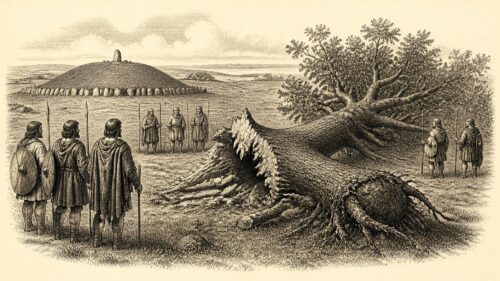
The same annal records that a “shower of blood” fell in Ard Cianachta, the territory between the Boyne and the Dee in what is now north County Louth. Medieval annalists occasionally registered unusual celestial or weather phenomena, especially when they could be read as signs in a Christian moral universe. The notice does not explain what observers saw, how widely it was seen, or whether it caused damage. It should not be treated as proof that literal blood fell from the sky. It may preserve a striking atmospheric event, material discolouration in rain, or a report framed as a portent. What can be said firmly is that people considered it memorable enough to enter into a historical record alongside royal deaths and ecclesiastical obits.
The location gave the report political resonance. Ard Cianachta had already suffered in the immediately preceding annalistic sequence: Cumuscach son of Muiredach, described as king of its people, had been killed by the Ulaid. The combination of recent violence and an ominous sign should not be turned into a causal story, but it helps explain why the notice may have carried weight. In early medieval Ireland, landscape, lordship and religious interpretation were closely entwined. An unsettling occurrence over a small kingdom could be understood by contemporaries not merely as weather, but as a warning about the condition of the people and their rulers.
Lann Léire and Public Religion
Cairpre son of Suibne, superior of Lann Léire, also died in the U898 entry. Lann Léire is generally identified with the early ecclesiastical site at Dunleer in County Louth. The annal’s use of “superior” shows that this was more than a place of worship. A major church community was an institution with land, tenants, livestock, learning, burial rights and political connections. Its head could exercise influence over dependants and negotiate with kings. Cairpre’s death therefore represented an institutional transition, even though the annal does not name the person who followed him.
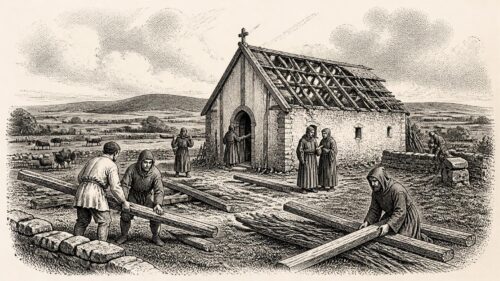
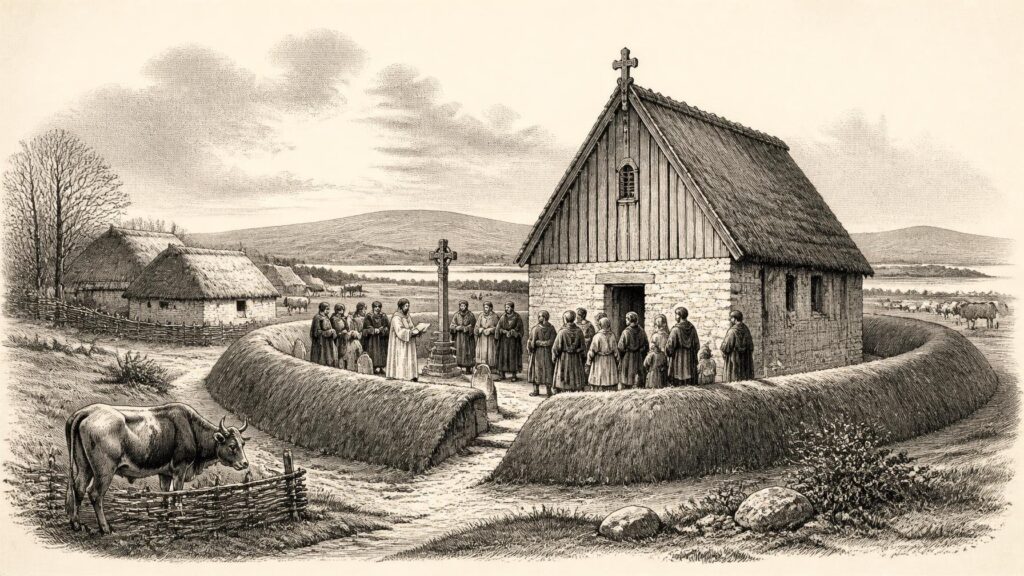
Irish monasteries and churches were not sealed-off settlements occupied only by ascetics. Their enclosed precincts contained churches and graves, but also workshops, storehouses, dwellings and agricultural spaces. They supported worship, hospitality, schooling, manuscript production and craft activity, while cattle and land sustained their economic life. The sparse record for 898 does not allow us to reconstruct Cairpre’s household or Lann Léire’s buildings in detail. Yet the decision to record his death beside that of a king indicates the standing expected of an ecclesiastical superior. Religious office was part of the fabric of secular politics, not an alternative to it.
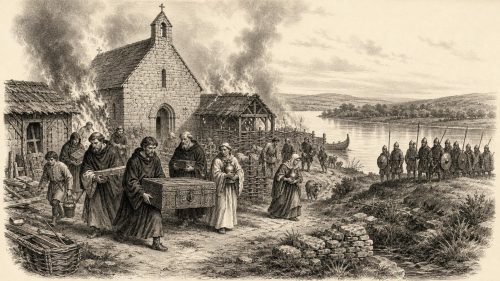
This was especially apparent in the north after years of conflict. Armagh, the pre-eminent Patrician church, had been plundered by Scandinavian raiders from Dublin only a few years earlier, when the annals report 710 captives taken away. That disaster belongs to 895, not to 898, and no comparable raid is recorded for this year. Its recent memory nevertheless forms essential context for the value of church protection, patronage and authority in the region. The absence of an annalistic Viking attack in 898 should not be mistaken for permanent safety; it means only that the surviving records do not assign one to this year.
A West Clare Succession
The Annals of Inisfallen direct attention far from Ulaid, to Corcu Bascinn in the west of present-day County Clare. They record the death of Flann son of Cathrannach, its king, and the accession of his brother Lennán. This is the clearest succession notice securely placed in the southern annals for 898. It demonstrates that the year was not defined solely by northern disorder: local kingships continued to change hands across Ireland, often within established ruling families. The prompt accession of Lennán suggests an available dynastic claimant, though it cannot prove that the transition was peaceful or uncontested.
Corcu Bascinn occupied an Atlantic-facing region shaped by pasture, river crossings, coastal communications and links across the Shannon estuary. Its ruler did not command the resources of a king of Tara or Cashel, but local kingship was still consequential. It governed access to land and cattle, led armed clients, and connected communities to larger Munster politics. The annal supplies no battle, raid or tribute demand for Flann’s final year. Its concentration on death and succession is itself revealing: continuity of a kin-group’s leadership was a matter worth preserving in the historical memory of a Munster-centred ecclesiastical chronicle.
What 898 Reveals
898 was a year of exposed authority. Aidíth’s killing shows that even a king of Ulaid could be undone by insiders after years of conflict. Cairpre’s obit confirms the public importance of an ecclesiastical leader in Louth. The report from Ard Cianachta records a phenomenon interpreted as extraordinary, whether natural or portentous. In Corcu Bascinn, the death of Flann and succession of Lennán show a different pattern: not recorded collapse, but dynastic replacement. The surviving evidence is brief, regional and sometimes chronologically difficult. It does not support a sweeping tale of national crisis. It does support a more faithful picture of Ireland: a landscape of local polities and powerful churches, linked by warfare, kinship, belief and annalistic memory.
Primary Sources
- The Annals of Ulster, U898
- The Annals of Ulster, U897
- The Annals of Ulster, U896
- The Annals of Ulster, U895
- The Annals of Ulster
- Chronicon Scotorum, CS898
- Chronicon Scotorum, Irish Text, CS898
- Chronicon Scotorum
- Annals of Inisfallen, AI890–AI899
- Annals of Inisfallen, Irish Text, I894–I900
- Annals of the Four Masters, M889–M899
- Annals of the Four Masters, Irish Text, M893–M894
- The Annals of Tigernach
- Fragmentary Annals of Ireland
- Vikings in Irish Chronicles, 794–902: Data
- Exploring the Irish Annals
- Early Genealogies of West Clare
- Early Medieval Dwellings and Settlements in Ireland, AD 400–1100: Vol. 2 Gazetteer of Site Descriptions
- Getting to Know Dublin
- Discover the Walled Towns of Ireland