Cellach Between Kildare and Iona865 CE
In 865 Irish annals recorded a solar eclipse on 1 January, confirmed by modern astronomy, and a lunar eclipse later that month, providing an unusually secure chronological anchor. Obituaries reveal ecclesiastical networks linking Kildare, Iona, Tallaght and Pictland: Cellach, abbot of Kildare and Iona, died among the Picts. Political instability appeared in the killing of Tadc, king of Uí Chennselaig, by his brothers and supporters, and the death of Tigernach of Loch Gabhair. Áed Findliath’s wider authority remained limited. Norse Dublin shaped the background, but Clondalkin’s burning is securely dated to 867, illustrating annalistic chronological problems within a fragmented polity.
Dateline
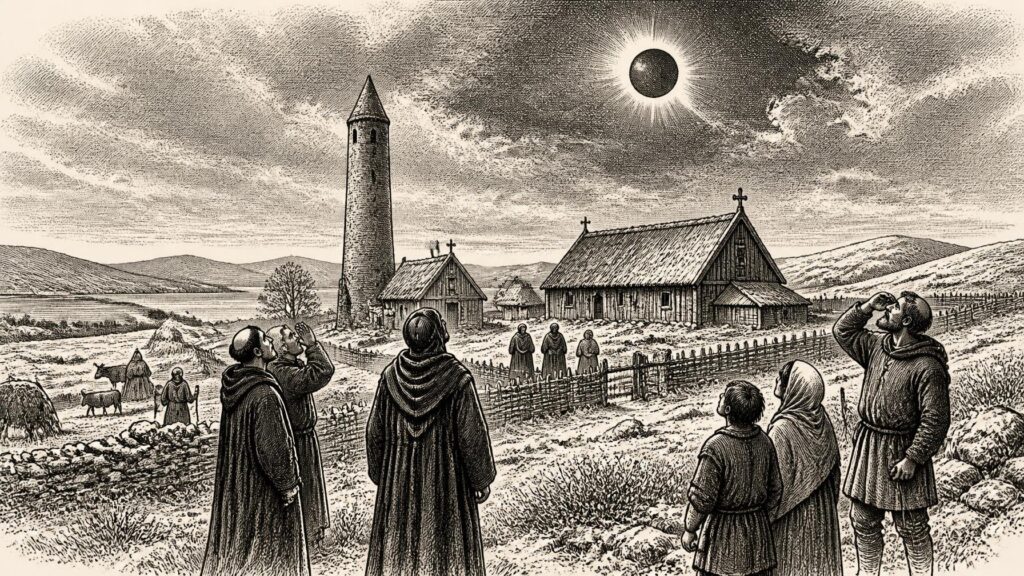
The opening day of 865 brought an event which, unlike much early medieval Irish history, can be checked against the motions of the heavens. The Irish annals record a solar eclipse on the Kalends of January – 1 January – and add that a lunar eclipse occurred in the same month. Modern astronomical calculation confirms the solar eclipse of 1 January 865, while the lunar eclipse followed later that month. The annalists did not describe crowds, weather or reactions, so none should be invented. Yet a deep darkening of the winter daylight was an experience shared across much of Ireland and the neighbouring islands, and it was memorable enough to enter several independent Irish chronicles.
A Year Fixed by the Sky
The eclipse is especially valuable because medieval annals do not always align perfectly with modern calendar years. They were compiled over long periods, copied repeatedly, and sometimes preserve differing chronological schemes. Here, however, the Annals of Ulster, Chronicon Scotorum, the Fragmentary Annals and the Annals of Inisfallen all place the solar eclipse at the opening of 865. The Annals of Ulster alone also explicitly mention the lunar eclipse in the same month. The agreement gives this otherwise sparse year a secure anchor.
For people in ninth-century Ireland, the event was not merely a spectacle of nature. Christian writers understood extraordinary phenomena within a providential universe, while ecclesiastical communities had practical reasons to observe calendrical time closely: feasts, fasts, Easter reckoning and the rhythm of worship all depended on it. Monasteries maintained books, trained scribes and preserved records. The notice of the eclipse therefore reveals both a striking natural occurrence and the intellectual infrastructure that enabled it to be remembered. It does not prove a particular interpretation in any individual church or household; it does show that learned observers considered it worthy of permanent record.
Cellach’s Far-Flung Offices
The death of Cellach son of Ailill, reported in 865, gives a more human measure of Ireland’s religious and political connections. The Annals of Ulster call him abbot of Cill Dara, modern Kildare, and of Í, Iona, and say that he died in the land of the Picts. The same basic notice occurs in Chronicon Scotorum and the Fragmentary Annals. A single man thus held, or was recognised as holding, authority in two of the most prestigious Columban and Brigidine centres of the Irish Sea world, and died across the channel in Pictland.
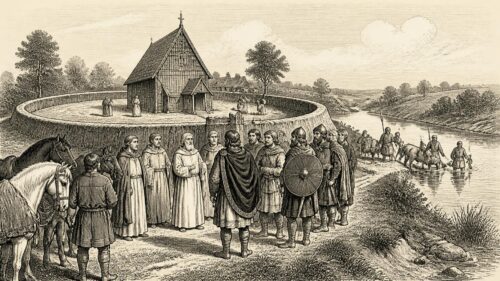
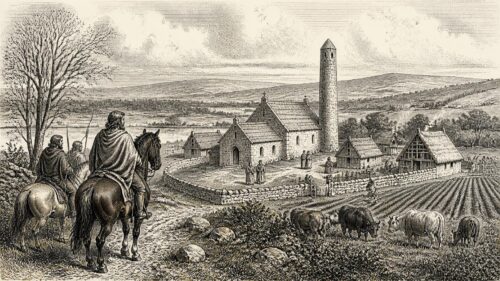
This was not evidence of a centralised Irish church in the modern sense. Ecclesiastical authority was organised through communities, churches, client networks, hereditary interests and relationships with kings. An abbacy could carry spiritual standing, control of land and revenues, and political influence. Kildare was associated with St Brigit and lay in Leinster; Iona, founded in the Columban tradition, remained a major religious centre with deep Irish links despite its position in the Hebrides. Cellach’s dual title points to an ecclesiastical geography in which sea crossings were routes of communication rather than edges of the world.
His death in Pictland matters for the same reason. The annals offer no explanation for why he was there, and it would be unsafe to manufacture one. He may have been travelling on institutional business, maintaining connections, or undertaking some other duty. What can responsibly be said is that his obituary records an Irish churchman operating in a world that included Ireland, Iona and Pictish territories. In 865, religious institutions were neither isolated from politics nor confined by the boundaries later imposed by nation-states.
Other obituaries reinforce this picture of dense clerical networks. Conmáel, described in the Annals of Ulster as an equonimus of Tallaght, died in the same year. The word suggests an officer responsible for institutional management rather than simply a private holy man. Tallaght, south-west of Dublin, was an important ecclesiastical settlement. The annals also record the death of Tuathal son of Artgussu, chief bishop of Fortriu and abbot of Dún Caillen, in Pictland. Together, Cellach and Tuathal demonstrate the close, continuing traffic of religious personnel and authority around the Irish Sea.
A later annalistic compilation, the Annals of the Four Masters, preserves a wider obituary list under 865: bishops, abbots, scribes, anchorites and a tanist abbot. Some of these notices are assigned differently in earlier chronicles, so they cannot all be treated as equally secure calendar-year evidence. Even so, the collection’s emphasis is revealing. Learning, writing, ascetic reputation and administrative office were recognised public distinctions. The death of a scribe or anchorite could be annal-worthy because churches were centres of literacy, memory, hospitality, production and local lordship as well as worship.
Violence in Leinster
The clearest political killing firmly placed in 865 was that of Tadc son of Diarmait, king of Uí Chennselaig. The Annals of Ulster state that he was treacherously killed by his brothers and his people; Chronicon Scotorum likewise attributes the killing to his brothers. The Annals of Inisfallen gives a shorter notice of his death as king of Laigin, Leinster. These varying formulations should not be forced into a detailed narrative of conspiracy. They agree on the essential fact: a leading Leinster ruler was killed by men from within his own political community.
Uí Chennselaig was a major Leinster dynasty, based broadly in the south-east. Kingship in this period was not governed by automatic primogeniture. Several members of a royal kindred could be eligible, and the position of a ruler rested upon kinship, military backing, client relationships and the ability to secure recognition. The killing of Tadc was consequently more than a family crime. It exposed the instability that could accompany succession and the capacity of local political coalitions to remove a king. The annal’s phrase “his people” is stark: royal power depended on supporters who could also become participants in a ruler’s downfall.
The death of Tigernach son of Focartach, king of Loch Gabhair and half-king of Brega, brought another change in the central-eastern political landscape. Loch Gabhair, associated with Lagore in modern County Meath, lay within Brega, a region of exceptional strategic importance between the Boyne and Liffey. The title “half-king of Brega” is a useful warning against imagining each Irish province as a single, stable kingdom. Authority could be shared, disputed or divided between branches of a dynasty. A death at this level altered the calculations of neighbouring rulers, including the king at Tara.
The Annals of the Four Masters calls 865 the fifth year of Áed Findliath’s rule. Áed, of the northern Uí Néill and king of Ailech, had become king of Tara after the death of Máel Sechnaill in 862. His claim to overarching authority did not erase the independence of Leinster, Brega, Munster, Connacht or Ulster dynasties. Rather, it supplied a framework within which a powerful ruler sought tribute, hostages, alliances and recognition. The killings and deaths recorded in 865 show why that framework remained fragile: local succession and regional rivalries continually changed the balance of power.
Dublin’s Hinterland and a Dating Problem
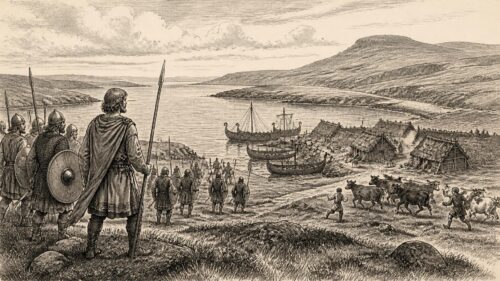
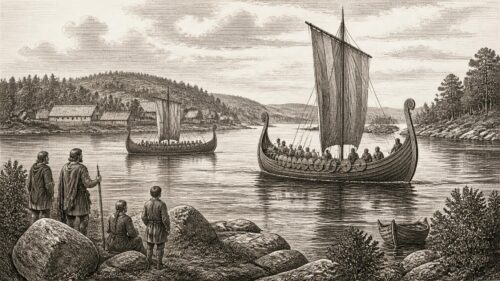
Viking activity was an inescapable condition of Irish politics in the 860s, but the surviving evidence requires restraint about 865 itself. Dublin was already a Norse centre, and its rulers and fleets had formed alliances with Irish kings as well as raided Irish territories. The year before, according to the annals, Áed Findliath had campaigned against Scandinavian bases in the north. That is essential context for 865, not an event to be silently transferred into it.
One apparent exception illustrates the problem. The Annals of the Four Masters place the burning of Dún Amlaíb at Clondalkin, and a victory over the foreigners of Áth Cliath, under 865. However, the earlier Annals of Ulster place the destruction of Amlaíb’s fort at Clondalkin in 867. Modern study of Viking settlement treats the Clondalkin episode accordingly. It would therefore be misleading to present the burning as a securely dated event of 865 simply because a later compilation assigns it there. The discrepancy is historically important in its own right: annals are indispensable witnesses, but their chronological headings must be compared rather than accepted mechanically.
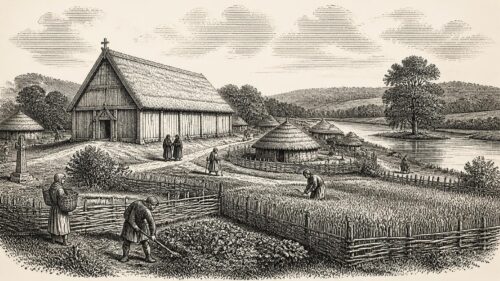
Clondalkin nevertheless helps explain the landscape in which people lived. It was an established monastic settlement west of Dublin, and its later association with a fort named for Amlaíb suggests how Norse power could reach beyond the coastal town into ecclesiastical and agricultural hinterlands. Such places were not passive victims standing outside history. Monasteries held land, people and resources; local dynasties fought around them; and Scandinavian leaders could raid, bargain, settle or seek control over strategic routes. In 865, the eclipse, the churchmen’s obituaries and the killings in Leinster and Brega all belong to this connected but politically fragmented Irish world.
What 865 Reveals
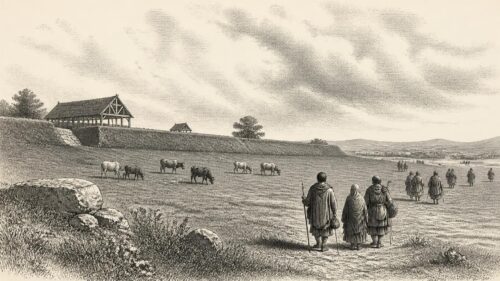
No surviving source permits a complete portrait of every harvest, voyage, household or market in 865. The annals are selective, and their silence is not proof that ordinary life stopped between recorded deaths and conflicts. Farmers continued to tend livestock and crops; craftworkers, clerics, sailors and dependants carried on within settlements structured by lordship and church lands. What the evidence does permit is a carefully bounded view. Ireland began the year under an extraordinary darkened sky. Its ecclesiastical leaders moved across the Irish Sea and linked Kildare, Iona, Tallaght and Pictland. Its regional kingships remained vulnerable to internal violence and succession. And the growing Norse presence around Dublin formed part of the background against which Irish institutions and rulers made decisions.
That is enough to make 865 more than a thin list of annal entries. It was a year in which the practical work of monasteries, the uncertainties of dynastic rule and the wider maritime world met beneath an eclipse that medieval observers took care not to forget.
Primary Sources
- The Annals of Ulster, Year U865 (English translation)
- The Annals of Ulster, Year U865 (Irish and Latin text)
- Chronicon Scotorum
- Chronicon Scotorum, Year CS865
- Annals of Inisfallen
- Annals of Inisfallen (Irish text)
- Annals of the Four Masters
- Annals of the Four Masters, Annal M865
- Annals of the Four Masters, Annal M865 (Irish text)
- Fragmentary Annals of Ireland
- Fragmentary Annals of Ireland, Annals FA331–FA337
- Fragmentary Annals of Ireland, Irish text
- Annals of Tigernach
- Áed Findliath, Dictionary of Irish Biography
- Í > IOUA > IONA, Iona’s Namescape, University of Glasgow
- An Interesting Absence: St Brigit, Iona’s Namescape, University of Glasgow
- The Vikings in Ninth-Century Ireland: Sources and Settlements
- Besselian Elements: Total Solar Eclipse of 865 January 01, NASA GSFC
- An Evaluation of Astronomical Observations in the Irish Annals
- Clondalkin Round Tower, Heritage Ireland
- The Vikings in Scotland and Ireland in the Ninth Century, Donnchadh Ó Corráin
- Viking Ireland Afterthoughts, Donnchadh Ó Corráin
- Annals of Inisfallen to Go on Public Display in University College Cork, Bodleian Libraries