

Neutrality Contested
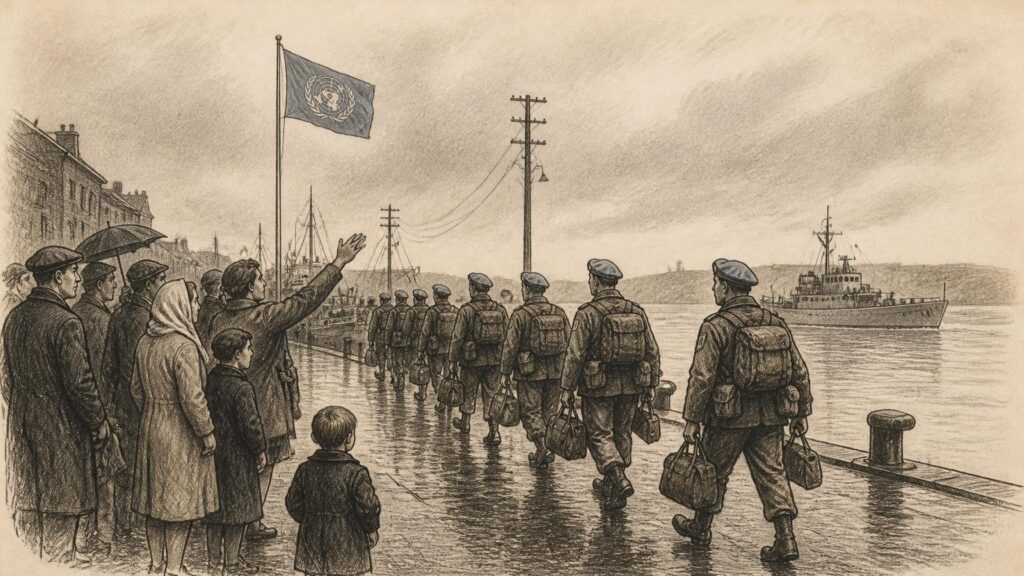
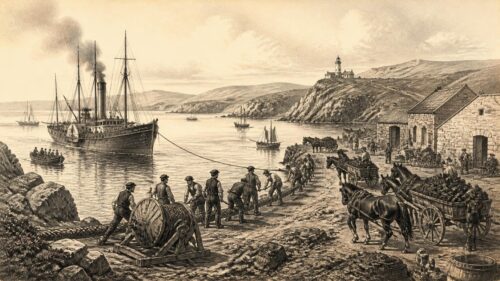
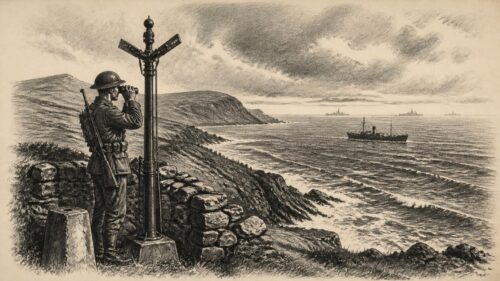
AI generated historical illustration, not a contemporary photograph.
At a Glance
Catherine Connolly’s prominence in the argument over neutrality belongs to a much older Irish story: the effort of a small, formerly colonised state to preserve independent judgement while participating actively in international affairs. Her interventions did not create that argument, nor can they settle it. They have, however, brought its historical tensions into unusually sharp focus: sovereignty and interdependence, peacekeeping and military preparedness, United Nations authority and democratic discretion, moral witness and practical security.
Present Debate
In modern Irish public life, neutrality is often spoken of as though it were a single inherited rule, clear in meaning and uninterrupted in application. The historical record is less tidy. Ireland has maintained a policy of military neutrality rather than a permanent neutrality recognised in international law. It is not constitutionally prescribed in the manner sometimes assumed in public discussion. Nor has it meant political indifference, withdrawal from international institutions, or refusal to criticise aggression. Successive governments have instead defined it principally through non-membership of military alliances and non-participation in common or mutual defence arrangements.
Catherine Connolly has become one of the most recognisable advocates of the more expansive public meaning of neutrality. Before becoming President, she was an Independent TD for Galway West and had repeatedly opposed measures that she believed might weaken Ireland’s independent voice or ease its movement towards military alignment. Her position has treated neutrality not merely as restraint upon military participation but as a positive tradition of peace-making, bridge-building, disarmament, international law and diplomatic independence. That language has won considerable support, but has also drawn sustained criticism from those who believe that it understates new threats and blurs the distinction between neutrality, pacifism and national defence.
The debate matters because it is not confined to rhetoric. It concerns the conditions under which Irish Defence Forces personnel may serve abroad, the State’s relationship with the European Union and NATO’s Partnership for Peace, protection of critical infrastructure, maritime surveillance, cyber security, and the authority of the United Nations Security Council. Connolly’s interventions are therefore best understood not as an isolated controversy around one political figure, but as a chapter in the long history of Irish foreign policy.
State Formation
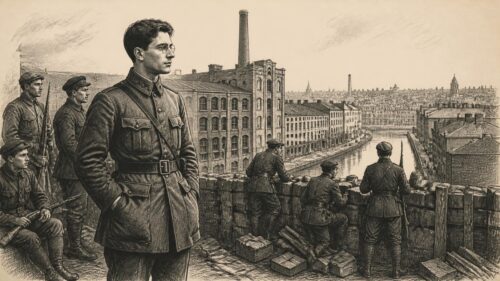
The roots of Irish neutrality lie in the difficult birth of the independent Irish state. The Irish Free State entered the international system after revolution, partition and civil war. Its political leaders had strong reasons to guard the State’s formal independence and to resist any assumption that Ireland’s external policy should follow Britain’s. That desire was not, in itself, a settled neutrality doctrine. The Free State was a member of the British Commonwealth and remained tied to Britain by geography, trade, constitutional inheritance and security realities.
Yet participation in the League of Nations gave Irish representatives an arena in which to assert separate statehood. Irish diplomacy in the interwar years frequently emphasised sovereign equality, arbitration, disarmament and international law. These principles were not uniquely Irish, and the State’s capacity to shape great-power affairs was necessarily limited. Nevertheless, they established a political vocabulary that later advocates of neutrality would inherit: Ireland as a small state whose security and moral standing depended upon rules rather than power.
The later policy also emerged from a particularly Irish understanding of vulnerability. Britain regarded the island’s western approaches as strategically important. Irish governments, meanwhile, feared that military dependence upon Britain would compromise the independence won at such cost. This was not an abstract philosophical disagreement. It was shaped by the continuing partition of the island, the legacy of the Treaty settlement, the unresolved status of ports, and memories of recent internal conflict. Neutrality, when it emerged as a practical policy, would be bound to the assertion that Irish sovereignty had to be visibly real.
Port Return
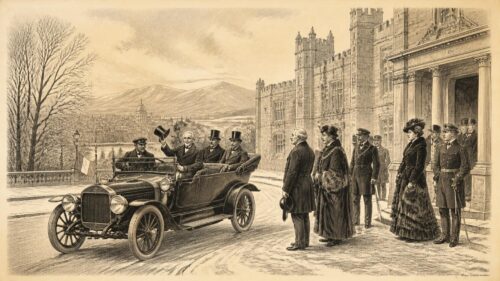
The Anglo-Irish agreements of 1938 were a crucial practical precondition for neutrality during the coming world war. Britain returned the so-called Treaty Ports at Berehaven, Cobh and Lough Swilly to Irish control. Their return did not remove Ireland’s strategic exposure, but it ended a highly visible remnant of British military control within the State. In historical interpretation, the importance of the ports is difficult to overstate: had Britain retained bases on Irish territory, an Irish policy of strict non-belligerence would have been much harder to maintain.
The return was therefore later remembered as proof of the value of determined constitutional and diplomatic statecraft. That retrospective memory has sometimes simplified the context. The agreements emerged from negotiation between two governments with their own interests, at a moment when Britain faced worsening European danger. Still, the result equipped Éamon de Valera’s government with a degree of freedom of action that had previously been absent.
For later generations, the port settlement became part of neutrality’s founding narrative. It suggested that independence required control over territory, defence facilities and foreign commitments. That lesson remains audible in modern arguments, including Connolly’s. When she and other advocates warn against arrangements that might limit Irish discretion, they draw—sometimes implicitly—upon a tradition in which sovereignty is understood not just as a legal condition, but as a practical ability to decline the demands of stronger states.
Wartime Choice
When war began in Europe in September 1939, Ireland adopted neutrality. The policy was maintained throughout the period known in the State as the Emergency. Documents on Irish Foreign Policy show that de Valera and his officials saw participation in a great-power war as a danger to Irish independence. They also feared that open alignment with Britain could sharpen internal divisions and potentially revive violence in a country still marked by civil war and partition.
Neutrality did not mean safety. Ireland faced the possibility of invasion, bombardment, blockade and severe economic strain. German aircraft bombed Irish territory on several occasions; the North Strand bombing in Dublin in May 1941 caused grave loss of life. The State mobilised and expanded its forces, imposed censorship and emergency controls, and prepared for contingencies that could not be openly discussed in detail. In the most literal sense, wartime neutrality was armed, anxious and improvised.
Neither was Irish conduct equivalent to equal distance from all belligerents. The archival record demonstrates substantial practical co-operation with the Allies, particularly in intelligence and security matters, while the government worked to preserve the formal appearance and legal position of neutrality. Allied airmen were generally assisted or returned in ways that reflected the wider political reality, while German personnel were treated differently. Such actions complicate any simple portrayal of the Emergency as either perfect impartiality or covert belligerence. It was a policy of survival, sovereignty and calculation under exceptionally dangerous conditions.
Wartime Memory
Public memory of the Emergency has supplied much of the emotional force of later neutrality debates. One popular version presents Ireland as a principled small nation that kept clear of imperial war. Another depicts neutrality as morally compromised because it did not join the struggle against Nazi Germany. Both contain elements that can be connected to real events, but neither adequately describes the whole historical situation.
Documented evidence shows that the Irish government did not sympathise politically with Nazism as a governing programme, while also maintaining diplomatic conventions and a formal neutrality that have remained controversial. It shows, too, that a state with limited military capacity could not easily dismiss the prospect of invasion or British pressure. The wartime record requires moral judgement, but it also requires attention to the constraints facing a recently independent state on Britain’s western flank.
Folklore and family memory have sometimes made the Emergency appear more unified than it was. There were disputes within Ireland about the policy, and individuals from Ireland served in British and Allied forces in large numbers. The idea that neutrality represented an uncomplicated national consensus is therefore misleading. Yet the experience left a durable political inheritance: many citizens concluded that avoiding formal belligerence had preserved the State, while critics concluded that independence should never be confused with detachment from crimes beyond Ireland’s shores. The same fault line remains visible in contemporary argument.
United Nations
Ireland joined the United Nations in 1955. Membership offered a different way of reconciling independence with international responsibility. Rather than binding the State to a military alliance, it situated Ireland within an institution built on collective security, international law and sovereign equality. For a country whose diplomats had long stressed the rights of smaller states, the United Nations had considerable ideological as well as practical appeal.
Irish participation in peacekeeping soon became central to the public character of neutrality. The Congo crisis of 1960 was a defining early commitment. Ireland sent troops to the United Nations Operation in the Congo, known as ONUC, one of the first large and exceptionally demanding peacekeeping operations. Irish service brought grave losses as well as public pride. The siege at Jadotville in 1961 later became one of the most widely recalled episodes, though its place in popular culture has sometimes overshadowed the broader complexity of the mission.
Peacekeeping did not prove that Ireland had somehow escaped the realities of force. It showed the opposite. Irish personnel served in situations where consent was contested, local authority fractured and international mandates were tested by violence. The Congo mission was a landmark in the history of United Nations peacekeeping precisely because its responsibilities exceeded the limited observer roles associated with earlier operations. Ireland’s experience there helped establish a tradition of overseas service that advocates across the neutrality debate still invoke, even where they disagree sharply on what that tradition now requires.
Peacekeeping Record
From the 1960s onward, Irish military service abroad became one of the most tangible expressions of the State’s international identity. Deployments under United Nations authority, notably in Cyprus and Lebanon, created a powerful public association between Irish soldiers, impartial service and humanitarian protection. The association was strengthened by the sacrifices made by members of the Defence Forces and by the extensive personal connections formed between military communities and places of deployment.
This legacy is important to Connolly’s understanding of neutrality. Her language consistently presents military neutrality as compatible with active internationalism. In that formulation, Ireland’s value is not that it stands apart from the world, but that it can work through the United Nations, defend international humanitarian law, contribute to conflict prevention and speak independently. The historical basis for that claim is substantial: Ireland has repeatedly participated in peace support operations and has developed a respected record in multilateral diplomacy.
There is, however, an interpretative step between acknowledging that record and claiming that neutrality automatically makes Ireland a uniquely trusted mediator. Trust is conferred by other parties, not simply declared by a state. Peacekeeping missions are also shaped by mandates, resources, host-state consent and the conduct of international actors far beyond Ireland’s control. The tradition remains real and significant, but it is neither magical nor uncomplicated. Its authority depends upon continued competence, resources and adherence to law.
Constitutional Limits
Ireland’s Constitution expresses commitments relevant to peace but does not establish a comprehensive constitutional code of neutrality. Article 29 affirms devotion to peace, friendly co-operation, international justice and the peaceful settlement of disputes. It also contains provisions developed through European treaty referendums that constrain participation in a common European defence. Article 28 provides that war shall not be declared and the State shall not participate in war without the assent of Dáil Éireann.
These provisions are politically important, but they do not make every question of security policy constitutionally self-answering. The Government’s own published explanation of international security policy has been explicit that Ireland’s traditional policy of military neutrality is not set out in, or required by, Bunreacht na hÉireann. This does not mean the policy is insignificant. It means that its precise shape has been formed by legislation, referendum guarantees, diplomatic practice, government decisions and public expectation rather than by a single constitutional clause.
This distinction is central to the dispute surrounding Connolly. Her supporters commonly regard neutrality as a defining democratic inheritance that should not be diluted without a direct popular mandate. Her critics reply that policy may develop through the institutions provided by the Constitution, subject to Dáil accountability and law. The disagreement is not merely technical. It turns upon rival ideas of constitutional culture: whether a longstanding public consensus can create obligations beyond black-letter legal text, and whether elected governments can adapt security policy without treating every change as abandonment.
European Integration
Ireland joined the European Communities in 1973, and European integration gradually became the setting in which neutrality was most intensely debated. Membership brought economic opportunities and political influence, but it also raised questions about whether the development of European foreign and security co-operation might constrain Irish military independence. These questions became particularly prominent around the Single European Act, the Maastricht Treaty, the Amsterdam Treaty, Nice and Lisbon.
Each treaty debate encouraged opponents and supporters to define neutrality more carefully. Governments generally argued that Ireland was not joining a military alliance and retained control over decisions involving its forces. Critics often warned that institutional language, military co-operation and shared commitments could create a gradual path towards a European army or alliance obligations. The argument was rarely resolved by a single legal formula because the dispute was partly about future direction and political culture rather than immediate text alone.
The Lisbon Treaty produced legally binding assurances addressing Ireland’s traditional policy of military neutrality. The relevant protocol stated that the treaty did not affect or prejudice that policy. Such guarantees remain an important reference point for those, including Connolly, who oppose reforms they believe may alter neutrality in substance while preserving it in name. Governments have countered that EU membership, common security discussions and participation in civilian or peace-support measures do not in themselves amount to membership of a mutual-defence alliance. Both positions rely upon different readings of continuity.
Alliance Questions
Ireland is not a member of NATO. It has, however, participated in NATO’s Partnership for Peace programme since 1999. Partnership for Peace is not equivalent to alliance membership, and successive Irish governments have maintained that participation does not compromise military neutrality. It has provided a framework for interoperability, training and co-operation, particularly in the context of international peace support operations.
For critics, the distinction can appear too formal. They argue that closer military co-operation shapes habits, assumptions and capabilities in ways that may pull Ireland towards an Atlantic security outlook without a clear democratic decision to join an alliance. Advocates of that concern have been especially alert to language about interoperability and the gradual normalisation of military links. Connolly’s speeches have generally placed her within this sceptical tradition, stressing independent judgement and warning against militarisation.
Those who favour continued engagement answer that a small state cannot carry out effective peacekeeping or protect itself from contemporary threats through isolation. In their view, co-operation with partners can improve capacity while preserving national control over deployments. They also point out that modern security risks include cyber attacks, disinformation, threats to subsea cables and pipelines, and incursions into airspace or territorial waters. The historical question is therefore no longer simply whether Ireland should join a war. It is how a non-aligned state can safeguard itself in a connected and technologically vulnerable environment.
Security Forum
Russia’s full-scale invasion of Ukraine in February 2022 intensified these questions. The invasion demonstrated the continuing relevance of territorial conquest and conventional war in Europe, while also exposing divisions about how neutral or non-aligned states should respond. Ireland strongly supported Ukraine politically and through humanitarian, financial and non-lethal assistance, while maintaining its military-neutral status. The combination illustrated the difference between neutrality and moral or political equivalence.
In 2023, the Government convened a Consultative Forum on International Security Policy. Its stated purpose was to broaden public understanding and discussion of foreign, security and defence policy, including military neutrality. The forum considered peacekeeping, conflict prevention, disarmament, international humanitarian law, critical infrastructure, cyber and hybrid threats, EU security policy and relations with NATO through Partnership for Peace.
The forum itself became contentious. Some participants and critics believed that its framing predisposed discussion towards greater militarisation or a weakening of neutrality. Others regarded it as an overdue attempt to confront real strategic deficiencies. The disagreement revealed an enduring problem in Irish political culture: debate about security can quickly be heard as debate about identity. For Connolly and many of her allies, neutrality was not one topic among many; it was the principle against which all proposed adjustments had to be measured.
Triple Lock
The most concrete focus of Connolly’s parliamentary opposition has been the mechanism commonly called the triple lock. The phrase is political shorthand rather than statutory language. In its established form, it required three conditions before the deployment overseas of more than twelve members of the Defence Forces with an armed international force: a United Nations mandate, Government approval and Dáil approval.
The mechanism grew out of legislation enacted in 1960 in connection with Ireland’s participation in the Congo mission and was later modified. It acquired greater symbolic importance during debates about European treaties and peacekeeping. To supporters, it provided a clear democratic and multilateral safeguard: Irish troops would not be sent into armed overseas operations without both domestic approval and United Nations authority. To critics, the requirement gave permanent members of the Security Council an effective capacity to frustrate Irish participation even in missions consistent with international law and supported by a wider international community.
Connolly has argued that removing the United Nations element would weaken a safeguard closely associated with Irish neutrality. Her argument is historical as well as legal. It draws on the belief that Ireland’s peacekeeping reputation rests upon UN-centred collective security, and that a small state should be especially wary of arrangements in which powerful regional actors can determine the use of force. Her opponents do not necessarily reject the UN ideal; rather, they argue that a Security Council veto should not prevent Ireland from joining lawful, internationally supported peace operations.
Parliamentary Voice
As a TD, Connolly repeatedly brought these concerns into Dáil debate. In November 2023, during discussion connected to the security forum and military neutrality, she referred to the historic anxieties surrounding the Single European Act and the gradual erosion of neutrality. Her interventions situated current policy in a longer chronology of public assurances, treaty debates and perceived incremental change. This was characteristic of her approach: present measures were assessed not only on their wording, but on the direction in which they might lead.
Her parliamentary language also connected neutrality to Ireland’s conduct in relation to war, arms production and international law. She argued that a neutral state should use its voice actively rather than merely refrain from alignment. This understanding is closer to what might be called engaged non-alignment than to withdrawal. It assumes that independence confers a duty to criticise abuses by powerful states, whether committed by enemies or partners.
Critics have contended that this approach risks treating non-alignment as a general suspicion of Western security co-operation while offering insufficient account of how Ireland would respond to coercion or aggression. Such criticism deserves to be stated fairly. A policy of military neutrality does not abolish the State’s responsibility to defend its territory, protect its people or decide how to assist victims of aggression. Connolly’s contribution has been to insist that those responsibilities should not be met through quiet drift into alliance structures. Her critics insist that avoiding drift must not become an excuse for strategic neglect.
Presidential Campaign
Neutrality became an explicit national issue during the 2025 presidential election. Connolly presented herself as a defender of a peace-oriented, independent Ireland. Her campaign language described neutrality as a living tradition rather than a relic: a resource for diplomacy, bridge-building, human rights and opposition to war. That framing reached voters at a moment when European defence spending, the war in Ukraine, conflict in the Middle East and uncertainty about the international order had made foreign policy unusually prominent.
The campaign also exposed the limits of consensus. Opponents questioned some of Connolly’s language about international powers and European militarisation, and argued that the presidency should not be used to unsettle Ireland’s relationships with democratic partners. Supporters countered that the office could give moral expression to commitments already rooted in Irish history and public sentiment. The election did not produce a binding popular referendum on any specific defence policy, but it demonstrated that neutrality could be a central part of a presidential mandate.
Connolly was elected on 25 October 2025 and inaugurated as the tenth President of Ireland on 11 November 2025. These exact dates matter because commentary sometimes confuses her prior parliamentary role with her constitutional position after inauguration. As President, she no longer directs Government policy or legislates. The President’s public words can shape national conversation and may carry international significance, but executive responsibility for foreign and defence policy remains with the Government, accountable to Dáil Éireann.
Presidential Language
In her inaugural address, Connolly linked Ireland’s “long and cherished tradition of neutrality” with an uninterrupted record of peacekeeping since 1958. She argued that Ireland was particularly well placed to articulate diplomatic alternatives to war. Her official presidential vision has similarly described neutrality as an active tradition of peace-making, bridge-building and compassionate diplomacy.
That language is politically meaningful, but it should be interpreted with care. It is a statement of aspiration and public philosophy, not a new legal doctrine. Ireland’s foreign policy remains subject to the Constitution, legislation, international obligations and decisions made by the elected Government and Oireachtas. Connolly’s presidency has nonetheless given particular prominence to an account of neutrality that sees it as inseparable from anti-militarism, international law and the experience of colonialism, famine, conflict and emigration.
There is a historical resonance in this appeal. Earlier Irish diplomats also connected small-state independence with legal order and humanitarian principle. Yet history does not compel a single policy outcome. The same past may lead another observer to argue that Ireland must invest more heavily in defence precisely in order to protect independent decision-making. The contrast illustrates why neutrality is best treated as a field of argument, not a frozen national possession.
Legislative Change
The debate entered a new phase with proposals to alter the overseas-deployment rules. Official parliamentary material in 2026 described a Defence (Amendment) Bill intended to remove the requirement for a UN mandate while retaining Government and Dáil approval. The Government’s case was that reform would allow Ireland to contribute effectively to peace support and crisis-management missions where Security Council paralysis prevented action, while preserving military neutrality and democratic oversight.
In Dáil debate in October 2026, ministers argued that the proposed change would not alter Ireland’s traditional policy of military neutrality or the constitutional and treaty protections relating to common European defence. The Bill’s supporters presented it as a technical but necessary adaptation to a changed international environment, rather than an entry point to NATO membership or a European army.
Opponents, including those whose concerns echoed Connolly’s earlier Dáil interventions, regarded the UN requirement as more than a technical condition. They saw it as a barrier against participation in missions shaped primarily by regional or major-power interests, and as a public assurance with deep historical meaning. At the time considered here, the existence and parliamentary debate of the 2026 Bill are documented; it would be inaccurate to write as though that debate had already abolished all disagreement or conclusively defined the future of neutrality.
Public Meaning
Why does neutrality retain such force in Ireland? Part of the answer lies in history. It evokes hard-won sovereignty after British rule, the avoidance of formal belligerence during the Emergency, and pride in UN service. It also connects with a self-image of Ireland as a country familiar with colonisation, famine, displacement, partition and peace process diplomacy. These associations have emotional power because they are grounded in real historical experiences.
But public meaning should not be mistaken for unchanging policy. Ireland’s actual external relations have always involved choices, compromises and partnerships. The State has joined the United Nations and the European Union, participated in peacekeeping, accepted EU sanctions and co-operated with international partners. It has not been isolated. The more accurate historical description is of a state that has sought to keep control over military commitments while engaging extensively in multilateral institutions.
Connolly’s significance lies in defending a version of that inheritance which gives priority to restraint and independent moral speech. Her critics defend another version, in which neutrality survives only if Ireland possesses credible capabilities and is prepared to co-operate more closely with partners. Neither side can simply claim that history speaks unambiguously for it. The archive reveals continuity, but also adaptation.
Defence Capacity
The most difficult challenge for all sides is the relationship between neutrality and defence capacity. A state that wishes to decide freely whether to align with others must be capable, at minimum, of monitoring and protecting its territory, airspace, waters and critical infrastructure. Ireland’s island geography, extensive maritime zone and reliance upon undersea cables make this question increasingly pressing. It cannot be answered by the language of neutrality alone.
Some advocates of stronger defence expenditure argue that a poorly equipped state is dependent in practice, whatever its formal status. They maintain that surveillance, naval capability, cyber resilience, radar and co-operation with neighbours are essential to sovereignty. In this account, defence investment is not a repudiation of neutrality but a condition of making it credible. It resembles the older idea of armed neutrality, though Ireland’s historical arrangements have differed from those of states such as Switzerland.
Connolly’s perspective raises a corresponding warning: defence needs must not become a rhetorical route to military integration without public consent. The distinction is important. There is no necessary contradiction between strengthening national capability and maintaining non-alignment, but there can be difficult decisions about procurement, intelligence sharing, training and operational co-operation. The historical lesson is not that Ireland can avoid such decisions. It is that the terms on which it makes them will remain politically contested.
Historical Balance
A balanced account should resist several temptations. It should not present neutrality as a myth, because Ireland has maintained a recognisable and consequential policy of military non-alignment for decades. It should not present it as immutable law, because its scope has changed through legislation, diplomacy and institutional practice. It should not reduce it to wartime avoidance, because peacekeeping and multilateral activism have been central to its later meaning.
Nor should historical writing make Connolly the sole author of the present controversy. Her positions belong to a broad tradition represented by campaigners, parliamentarians, scholars and citizens who fear that institutional changes can cumulatively erode independence. The opposing case also has a history: governments and officials have long argued that Irish sovereignty requires practical engagement with collective institutions and adaptable responses to international change.
The evidence therefore supports a more precise conclusion than either celebration or dismissal. Connolly is a major contemporary voice for a public, ethical and activist conception of neutrality. Her view draws strength from documented Irish experience of independence, wartime vulnerability, UN peacekeeping and treaty debate. It remains, however, an interpretation of that past rather than the only one available. The future of neutrality will be determined through democratic argument, legislation, constitutional limits and the changing realities of international security.
Continuing Argument
Ireland’s neutrality debate is unlikely to end because the conditions that sustain it are enduring. The State remains small beside major powers, geographically close to Britain, deeply connected to Europe, active in the United Nations and exposed to threats that are no longer limited to conventional invasion. International institutions remain indispensable, yet often divided. The United Nations remains central to Ireland’s political imagination, yet the Security Council can be immobilised by vetoes. These facts make every simple formula inadequate.
Connolly’s contribution has been to make the moral and historical claims of neutrality impossible to treat as merely ceremonial. She has pressed the question of whether Ireland should understand security chiefly through deterrence and partnerships, or through an intensified commitment to diplomacy, law, disarmament and impartial peace-making. Her answer does not relieve the State of practical obligations. Rather, it demands that practical measures be tested against a particular understanding of independence.
That is why the debate deserves historical seriousness. Neutrality has never been simply the absence of war, nor a guarantee of virtue, nor an exemption from international responsibility. It has been an evolving Irish effort to preserve choice in a dangerous world. Catherine Connolly stands within that evolving tradition as a forceful interpreter of its most principled and sceptical strand. Whether future governments, parliaments and citizens accept her interpretation in full remains an open democratic question.
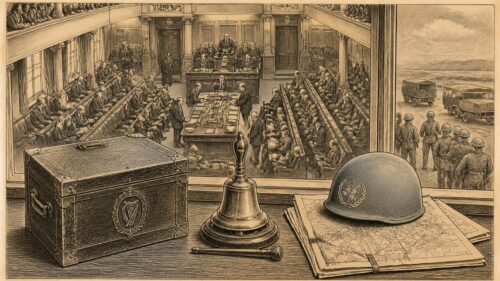


Connolly’s prominence exposes a productive tension in Ireland’s neutrality debate: is neutrality chiefly a legal policy of non-alignment, or a broader democratic ethic of independent diplomacy, peacekeeping and disarmament? The article shows that Ireland’s history resists simple narratives, from pragmatic wartime co-operation with the Allies to United Nations deployments and European security partnerships. It also suggests that public expectations may carry political weight even where constitutional text leaves room for governmental adaptation. As threats such as cyber security and maritime surveillance evolve, how should Ireland balance operational co-operation with its independent judgement and United Nations-centred role amid new security pressures?