

Primate Power
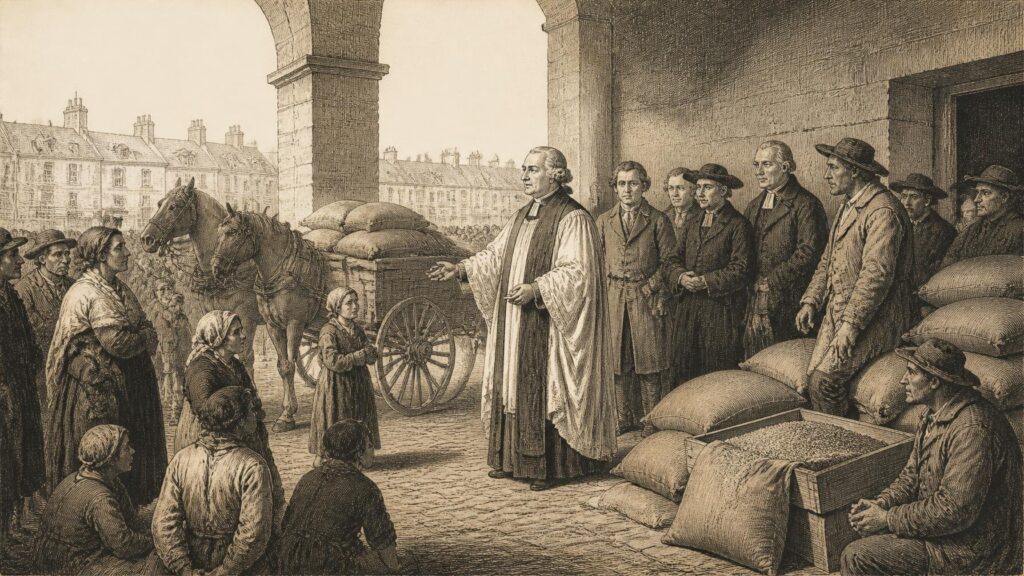
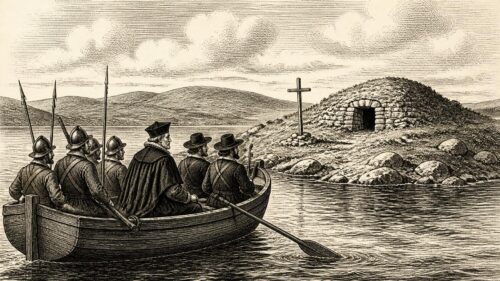
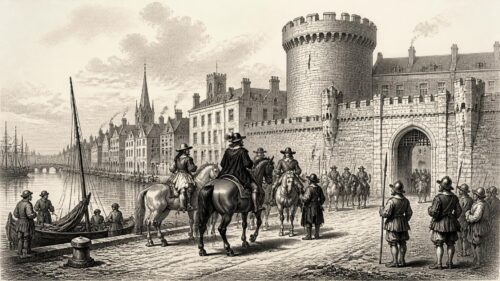
AI generated historical illustration, not a contemporary photograph.
At a Glance
Hugh Boulter was an English-born Anglican churchman whose eighteen years as archbishop of Armagh made him one of the most consequential figures in early eighteenth-century Ireland. He was neither an Irish patriot in the later constitutional sense nor merely a remote ecclesiastical dignitary. As Primate of All Ireland, a trusted correspondent of ministers in London, a substantial landowner and an active dispenser of patronage, he stood at the meeting point of church, government and economy. His career illuminates the workings of Protestant power after the Williamite settlement, while also exposing the human cost and confessional assumptions of that order.
London Origins
Hugh Boulter was born in London on 4 January 1672, the son of John Boulter, a man connected with the parish of St Katharine Cree. His origins matter because they shaped later perceptions of him in Ireland. Boulter was not an Irish cleric elevated through local service, nor a member of an old Anglo-Irish political family. He arrived at Armagh as a well-connected English prelate, appointed by the crown at a moment when the Hanoverian state wished to reinforce its authority in Ireland. Subsequent critics treated this foreign birth as evidence of political detachment; admirers could regard it as proof of independence from local factions. Both responses contain part of the truth, but neither alone explains his influence.
He was educated at Merchant Taylors’ School before entering Oxford. He matriculated at Christ Church in 1687 and soon transferred to Magdalen College, where he proceeded through the usual degrees and became a fellow in 1696. The clerical and intellectual world in which he formed himself was closely tied to national politics. Oxford was then still absorbing the effects of revolution, the establishment of William and Mary, disputes over oaths and the difficult definition of a loyal Church of England. Boulter belonged to a generation for whom Protestant succession and the security of the established church were not abstract principles. They were safeguards against the return of Catholic monarchy and against political disorder.
His Oxford associations later acquired a literary gloss because he knew Joseph Addison, his contemporary at Magdalen. Boulter contributed to The Freethinker, the short-lived periodical associated with Addison and others. This does not make him a man of the Enlightenment in any simple modern sense. His surviving public character was primarily that of a disciplined church administrator and political servant. Yet the connection suggests a capacity to move in metropolitan circles where polite letters, state service and ecclesiastical advancement overlapped. He was familiar with an England in which bishops could be advisers, patrons, authors and agents of government.
Before he held high office, Boulter served as chaplain to Sir Charles Hedges, a secretary of state, and later to Thomas Tenison, archbishop of Canterbury. Such appointments gave a talented clergyman access to the networks through which preferment operated. Patronage in the eighteenth-century church was not a minor private matter; it was a means of forming dependable administrations. Clergy with courtly or ministerial connections could rise swiftly, and those who did so were expected to recognise the political responsibilities of their rank. Boulter’s career was therefore conventional in one respect: he advanced through the patronage of powerful men. It was unusual in the extent to which he turned later office into political authority.
In 1708 he became rector of St Olave’s, Southwark, and he subsequently held the archdeaconry of Surrey. Accounts of his English ministry emphasise pastoral application and administrative energy. These habits would remain apparent after his removal to Ireland. They should not, however, be romanticised. Early Georgian pastoral reform operated within a hierarchy that was socially unequal and politically established. The ideal bishop was expected to improve clerical discipline, repair churches, promote charity and provide moral leadership; he was not expected to question the legal ascendancy of his own communion. Boulter’s practical benevolence and his attachment to Protestant supremacy developed together, not in opposition.
Episcopal Ascent
Boulter’s advancement accelerated after the Hanoverian succession. In 1719 he became both bishop of Bristol and dean of Christ Church, Oxford, and he also served George I as a chaplain at Hanover. The combination of deanery, bishopric and royal service marked him as a dependable Whig churchman. His sermons and episcopal charges endorsed the Protestant succession and the royal family. This was a period in which loyalty to the Hanoverian dynasty was repeatedly tested by Jacobite fears, clerical party conflict and disputes about toleration. Boulter’s convictions, or at least his public language, aligned unmistakably with the governing interest.
The years at Bristol also show why he was attractive to ministers seeking an Irish primate. He had administrative experience, court access and an established reputation for reliability. He was not a celebrated theologian or an original religious writer. His importance rested instead upon political judgement, organisational capacity and a willingness to treat ecclesiastical office as a practical instrument of public order. In a composite monarchy, Ireland required governors and officeholders who could communicate fluently with London. Boulter’s later letters demonstrate that he did so with exceptional frequency and confidence.
His appointment to Armagh followed the death of Archbishop John Stearne in 1724. The appointment was contentious because William King, archbishop of Dublin, was older, experienced and widely regarded as the obvious Irish claimant to the primacy. King’s age was an official consideration, but politics lay behind the decision. He could be unpredictable, possessed an independent mind and was not fully trusted by the English ministry. Boulter, by contrast, was thought dependable. The crown nominated him in August 1724, and he received the legal instruments for the translation before the end of that month.
The choice was politically expressive. It indicated that the primacy of Armagh, the senior dignity of the Church of Ireland, could be used to secure the preferences of the British government even against the expectations of prominent Irish Protestants. That did not mean that every English-born officeholder was simply imposed upon a passive Irish elite. Irish politics involved negotiation among landowners, bishops, borough interests, officials and great families. Nevertheless, Boulter’s arrival became a powerful symbol of a policy later described as support for the “English interest”: the belief that key posts should be occupied by men whose primary political loyalty lay with government in London.
Contemporaries did not use modern categories such as colonial administration with consistent precision, and historians continue to debate how far the Irish governing class was subordinated or collaborative. Boulter’s own correspondence nevertheless leaves little doubt about his assumptions. He worried that powerful Irish Protestant families might use office and parliamentary influence to create a semi-independent interest. He feared Catholic numerical strength and the possibility, however remote, of a Jacobite revival. He believed that crown service required vigilance in appointments. His record therefore belongs to the history of both Irish Protestant self-government and British executive control.
Armagh Authority
The archbishopric of Armagh was more than a ceremonial position. Its holder was metropolitan of the northern province, possessed extensive estates and patronage, and ranked as Primate of All Ireland. Boulter inherited an office whose wealth and jurisdiction enabled a forceful incumbent to act far beyond the boundaries of a diocese. He travelled on visitation, issued charges to clergy, supervised ecclesiastical business and took an active interest in the material condition of church property. He also used his household as an administrative centre, employing secretaries and maintaining a correspondence that linked provincial Ireland to Dublin and London.
His residence at Drogheda gave a practical geographical basis for this activity. Although Armagh was the seat of his archiepiscopal authority, Drogheda was a major town and port, with ready access to Dublin and the east coast. Boulter’s presence there illustrates the working geography of elite government. Authority was exercised through estates, roads, couriers, ports, parliamentary sessions and personal meetings rather than through a modern professional bureaucracy. A powerful bishop could become unusually influential because information travelled through personal networks and because political office remained concentrated among a relatively small number of men.
In church affairs, Boulter advocated regular pastoral care and more effective clerical service. His visitation charges stressed the duties of ministers and the moral responsibilities of lay leaders. Such language was common in Anglican reforming discourse, but Boulter appears to have pursued it with genuine persistence. He sought improved provision for poor livings, promoted individual clergy when he felt a duty of patronage, and treated ecclesiastical administration as a field in which negligence could damage religion and government alike. His charitable account books and later will also point to personal generosity, although private almsgiving cannot by itself measure the consequences of the system he defended.
His episcopal priorities reveal a central tension of the established church in Ireland. The Church of Ireland was legally privileged but represented only a minority of the population. In many districts its clergy were thinly spread, its revenues uneven and its parish structures weak. Boulter’s answer was not to imagine a multi-confessional public order. He sought to make the established church more efficient, better resourced and more visibly paternal. The objective was religious improvement as he understood it, but it was also political consolidation. A stronger Protestant church was meant to support social hierarchy, crown loyalty and the stability of the post-1691 settlement.
This explains why Boulter combined ordinary diocesan concerns with far wider programmes. He could lobby for a clergyman, comment on parliamentary management, recommend a government appointment, report a food crisis and discuss the condition of public works. These activities may seem disparate to modern readers, but they were coherent within eighteenth-century assumptions. Churchmen of high rank were expected to participate in public life; in Ireland, where the established church was intertwined with the Protestant political nation, the primate’s intervention carried particular weight. Boulter’s strength lay in treating this broad jurisdiction as normal rather than exceptional.
English Interest
Boulter’s political reputation rests chiefly on his defence of the English interest. The phrase did not simply mean affection for England. It referred to a programme of maintaining the authority of the crown and British ministry in Ireland by ensuring that offices, judicial posts and ecclesiastical promotions did not fall under the durable control of locally rooted political interests. Boulter believed that Irish officeholders with family, electoral and property connections could become difficult to direct. He therefore favoured appointments of men whose careers depended upon the crown and whose attachments, as he saw them, were less entangled with Irish parliamentary combinations.
His correspondence gives this policy a personal voice. He wrote to ministers and senior officials in England about appointments, legislation, personalities and rumours. The letters are an indispensable source, but they must be read critically. They are not neutral reports from an observer standing above Irish society. They are interventions by a participant seeking to shape decisions. Boulter selected facts, interpreted motives and presented his own recommendations as necessary for public security. The very richness of the letters can tempt readers to accept his perspective too readily. They illuminate elite politics exceptionally well, but they reveal the poor, Catholics and dissenters mainly when their lives became objects of official concern.
He was especially wary of the political class often called the undertakers: influential Irish Protestant figures who could help a lord lieutenant manage parliamentary business in return for patronage and influence. The undertaker system was neither wholly stable nor wholly independent from London. It depended on continuing bargains between ministers, governors and local magnates. Boulter wished to restrain the autonomy of such arrangements. He did not reject Irish Protestants as a class; indeed, he worked with many of them. What he distrusted was their capacity to turn the institutions of the kingdom into a political interest not readily controlled by the crown.
The controversy over William Wood’s copper halfpence formed the setting for Boulter’s arrival. In 1722 Wood had obtained a patent to manufacture copper coin for Ireland. Opposition became widespread, partly because of anxieties about the quality and quantity of the proposed coin and partly because the patent seemed an affront to Irish political and commercial interests. Jonathan Swift’s Drapier’s Letters gave the resistance a brilliant popular language. By 1724 the affair had become a major constitutional and political crisis. The British government withdrew the patent, but it had been reminded that Irish opinion could be mobilised against apparently arbitrary decisions made across the Irish Sea.
Older historical interpretations have sometimes described Boulter’s appointment as a straightforward punitive response to the halfpence affair: London lost faith in its Irish servants and therefore installed English outsiders. Modern scholarship is more cautious. The crisis certainly sharpened ministerial concerns, but appointments resulted from several calculations, including King’s age, Boulter’s qualifications and existing political relationships. The evidence supports the conclusion that Boulter’s translation strengthened executive influence; it does not require the claim that one controversy alone caused it. Historical explanation is stronger when it resists a single dramatic cause.
Boulter’s public position was thus paradoxical. He could describe Irish hardship, support local projects and dispense extensive charity, while also working to limit the political independence of Ireland’s Protestant elite. His programme was not anti-Irish in the simple language of later nationalism, because it was framed within a shared Protestant and monarchical world. Yet it undeniably privileged British ministerial direction over broader local autonomy. His career helps explain why later generations could remember him as a symbol of external control, even though his day-to-day work was rooted in Irish institutions.
Famine Years
Boulter’s first decade in Armagh coincided with severe food scarcity. Bad harvests in the later 1720s created a subsistence crisis, especially acute in areas where grain was central to the diet and where poverty had left households with little margin for failed crops or rising prices. The crisis of 1727 to 1729 should not be confused with the catastrophic famine of 1740 and 1741, but it was still grave. Evidence for mortality is incomplete, and historians properly avoid claiming a precise national death toll. Contemporary accounts, including Boulter’s letters, nevertheless record hunger, migration, high prices and fear that many people would perish.
Boulter reported that households had left their homes in search of food and that thousands might die before the next harvest if relief proved inadequate. His words are important evidence, though they are not a complete social survey. He wrote from the perspective of a northern archbishop, and his information depended upon correspondents, local officials and personal observation. Even so, the letters demonstrate that scarcity was visible to government and that the crisis could not be dismissed as an isolated local problem. The plight of the poor entered elite correspondence because hunger threatened lives, public order and the economic stability of the kingdom.
The state response was limited by the institutions of the age. There was no national poor-law system in Ireland comparable to the English parish framework, no modern welfare administration and no dependable apparatus for nationwide emergency provisioning. Relief therefore relied on a mixture of private subscription, charitable giving, local action, market regulation and legislative measures. Authorities sought to discourage profiteering, regulate bread and encourage tillage. Such interventions might relieve immediate pressure, but they could not remove the structural vulnerability of labouring families dependent on insecure earnings and volatile food prices.
Boulter used his position and resources in relief efforts. This was not an insignificant gesture. Elite subscriptions could purchase grain, fund distribution and encourage others to contribute; an archbishop’s advocacy could also lend urgency to appeals. Yet historical judgement must retain proportion. Charity alleviated suffering without changing the social relations that made subsistence precarious. Boulter’s compassion was real enough in documented acts, but it existed within a political order that offered little democratic voice to the people receiving aid and that maintained sharp confessional exclusions. To praise relief without considering those limits would make philanthropy do too much explanatory work.
His response also demonstrates the connection, in his mind, between food supply and economic improvement. He promoted tillage, feared depopulation and viewed agricultural productivity as a condition of social peace. In letters from the period he worried about land given over to pasture where corn might be grown. Such views were common among contemporaries, who believed that more tillage could reduce dependence on imported grain and lessen exposure to bad seasons. The practical outcomes were complicated: agricultural decisions responded to prices, rents, labour, soil and market access, not simply to episcopal recommendations. But Boulter’s concern places him among the eighteenth-century advocates of improvement.
The famine years must also be separated from later folklore. No reliable evidence supports treating Boulter as a lone saviour of the Irish poor, and no need exists to invent spectacular episodes to establish his significance. The documentary record is sufficient: he described scarcity in urgent terms, raised and directed assistance, pressed for measures intended to increase food security, and made his northern province a particular focus. The limits of that record are equally important. We cannot reconstruct every recipient of relief or calculate with confidence its total effect. The responsible conclusion is that Boulter was an energetic charitable actor during a serious crisis, not that he mastered the crisis.
Material Improvement
Boulter’s interest in improvement extended beyond hunger. He took a close interest in currency, transport, markets and urban amenities. These concerns were not peripheral distractions from his ecclesiastical duties. In eighteenth-century political thought, economic order was often understood as a moral and governmental question. Sound coinage was linked to fair dealing; navigable waterways promised commerce and employment; markets could be defended as protections against scarcity; buildings and charitable institutions advertised paternal authority. Boulter’s public works should therefore be read as part of his wider attempt to make Protestant rule appear useful as well as secure.
Currency was particularly contentious in Ireland after the Wood’s halfpence dispute. Boulter supported efforts towards a more satisfactory monetary settlement and advocated reforms despite resistance from interests accustomed to existing arrangements. His role should not be exaggerated into sole authorship of policy. Coinage involved British ministers, Irish officeholders, merchants and changing commercial circumstances. Nevertheless, the primate’s sustained attention is notable. He saw defective currency as a practical burden upon trade and ordinary exchange, and he was willing to devote political capital to the question. That willingness distinguished him from a bishop whose public activity ended at the diocesan boundary.
He supported the projected Newry Canal, an enterprise designed to improve communication between inland districts and the coast. The canal itself was completed after his lifetime, and it would be misleading to credit Boulter with creating it. His importance lies in advocacy at an early stage, when schemes for navigation required parliamentary backing, technical confidence and the support of influential patrons. Such projects embodied the language of improvement: natural resources were to be connected to markets, agriculture stimulated, employment created and regional isolation reduced. They also reveal how closely political power and infrastructural ambition were joined.
At Armagh, Boulter funded a market house incorporating a substantial granary. This was a practical response to the memory of scarcity. The inclusion of grain storage suggests that food security had become an enduring concern rather than a brief episode in his correspondence. Market buildings were also statements of civic order. They organised trade, marked the authority of the lord or patron who built them, and made an urban centre more legible to officials, merchants and inhabitants. Boulter’s works in Armagh thus combined utility, commemoration and control.
His charitable foundations in Drogheda offer a related example. Using resources derived from personal and primatial estates, he established and endowed almshouses. These institutions gave durable form to a style of Anglican philanthropy that valued disciplined relief for selected poor people. They deserve recognition as material benefits to their residents. At the same time, almshouses were not substitutes for broad social provision. Admission was restricted, numbers were limited and donors determined the moral terms of assistance. Their history is best understood neither as cynical display nor as uncomplicated benevolence, but as a real charitable provision shaped by the inequalities of its age.
Boulter also supported the Dublin Society, founded in 1731, and the linen board. Both reflected a belief that economic development could be fostered through organised knowledge, premiums, manufactures and agricultural change. Linen occupied a special place in Protestant plans for Ireland because it promised export income, employment and a more settled rural economy, particularly in Ulster. Whether every hoped-for benefit reached the poor is another question. Improvement was often promoted from above, and its profits were unevenly distributed. Still, Boulter’s involvement shows that his concept of government extended to the material conditions through which loyalty and order might be maintained.
Confessional Education
The most troubling element of Boulter’s reforming programme was his support for the charter-school project. The schools were intended to educate poor Catholic children in English, vocational habits and the doctrines of the established church. Boulter and other supporters represented the scheme as benevolent: poverty would be relieved, useful skills taught and children led towards what they believed to be true religion. By modern standards, and by the standards of religious liberty subsequently developed in Ireland, the programme was overtly coercive in its confessional purpose. It tied educational opportunity to cultural and religious transformation.
The schools must be set against the legal and social setting of the penal era. Catholics formed the overwhelming majority of Ireland’s population but faced restrictions on political power, landholding practices, education and religious organisation that varied over time and in enforcement. The Church of Ireland hierarchy did not create every penal measure, nor did Boulter personally direct all policy affecting Catholics. Yet he supported a system in which the established church was privileged and Catholic allegiance was viewed through the lens of danger and deficiency. His advocacy of charter schools shows how that outlook entered the intimate sphere of childhood and language.
Boulter’s reasoning joined religion to political loyalty. He believed that English-language Protestant instruction would create more orderly and dependable subjects. This was not merely a proposal for literacy. Irish language and Catholic belief were treated as barriers to incorporation into the desired political culture. The objective was assimilation into an Anglican, English-speaking framework. It is important not to project a later nationalist understanding backwards without qualification, but it is equally important not to conceal the cultural hierarchy embedded in the scheme. English was promoted not only for utility but as a medium of religious and political remaking.
The long history of charter schools gives reason for caution about founders’ claims. Later investigations exposed neglect, harsh conditions and institutional failure in parts of the system. Those later abuses cannot simply be laid in full upon Boulter’s doorstep, since he died in 1742 and the schools developed over many decades. But neither can his role be detached from their original purpose. He helped legitimise an organisation built upon the assumption that poor Catholic children should be drawn away from their inherited religious and linguistic communities. The initial ideology is part of the institution’s history, even where later practices went beyond its founders’ immediate actions.
This aspect of Boulter’s career sharply qualifies any portrait of him as a universal philanthropist. His charitable concern was expansive within the limits of a Protestant paternalism. He could assist the hungry and endow the poor, yet still believe that social improvement required Catholic children to be remade in the image of the established church. The contradiction is not accidental. It reveals the character of eighteenth-century confessional governance, in which care and control frequently travelled together. A historical article should acknowledge both terms rather than choosing the easier story of either saintly benevolence or unrelieved oppression.
Letters Evidence
The principal printed source for Boulter’s political life is the collection known as the Boulter Letters, first published after his death and edited from correspondence preserved by his secretary, Ambrose Philips. The letters cover crucial years from the mid-1720s into the late 1730s and address ministers, officials and churchmen in England. They remain essential because they record the informal communications through which government actually operated. Formal statutes and official appointments show decisions; Boulter’s letters show the lobbying, anxiety, private intelligence and personal judgement that preceded or accompanied them.
Yet the letters are not equivalent to a diary. They were written for recipients who could grant offices, influence policy or protect Boulter’s position. They therefore present a carefully managed self-portrait of a useful servant. Boulter made himself appear informed, diligent and indispensable. He stressed dangers that required attention and portrayed his recommendations as prudent safeguards. This does not make the correspondence unreliable. It means that its reliability must be assessed by genre. A political letter is evidence of events, but it is also evidence of the writer’s purpose and of the relationship between writer and recipient.
His language about Irish society is especially revealing. He often divided the population into political categories: government supporters, local interests, Protestants, Catholics, office-seekers and potential sources of disorder. Such categories were practical tools of administration, but they also simplified complex lives. Catholics appear most often as a population to be managed rather than as political actors with their own reasoning; poor people appear in moments of hunger or mobility; women are rarely visible except in elite familial or charitable contexts. The archive is rich, but its silences are part of the evidence.
Boulter’s letters also show the extent to which eighteenth-century government depended upon personal patronage. He recommended clerics, reported vacancies, supported candidates and sought rewards for allies. Modern readers may instinctively treat this as corruption. Patronage could certainly be self-serving and exclusionary, but it was also a normal mechanism for staffing institutions before competitive public service. The historical question is not whether Boulter used patronage; he plainly did. It is how he used it. His pattern indicates an effort to build a network of loyal officeholders capable of strengthening church discipline and executive authority.
Other evidence modifies and checks the correspondence. Clerical databases establish the chronology of his offices. Account books and charitable records provide traces of expenditure. Parish and diocesan material can reveal the more local consequences of ecclesiastical policy. Scholarship on famine, currency and parliamentary politics places his individual initiatives within broader structures. Portraits, engraved soon after his death, show how he was publicly commemorated as a figure of authority. No single source should bear the whole weight of interpretation. Boulter is best understood by moving between his own voice and evidence generated by institutions, communities and later historians.
Final Reckoning
Boulter died in England on 27 September 1742 and was buried in Westminster Abbey. His death ended an unusually active primacy but not the political arrangements with which he had been associated. The eighteenth-century Church of Ireland continued to be a central institution of Protestant ascendancy, and the relationship between Dublin politics and British ministerial control remained contested. Boulter’s successors inherited an office of immense prestige, although few matched his combination of energy, access and sustained correspondence. His memorial presence in Westminster, Dublin and Oxford reflects the British and Irish worlds through which his life had moved.
His reputation has often been compressed into a single verdict. Some accounts cast him as an able improver and benefactor, citing famine relief, almshouses, market buildings and support for economic development. Others remember him chiefly as the outsider who entrenched English control and advanced the conversionist charter schools. Both images rest upon documented elements of his career. Neither is sufficient alone. He was charitable, but his charity did not question the confessional hierarchy he served. He promoted material improvement, but he did so as a means of strengthening a political order built upon exclusion. He was a church reformer, but his reforming ambition was inseparable from state power.
It is also necessary to avoid a misleading modern contrast between Ireland and Britain as though Boulter stood wholly outside Irish life. He lived, governed, built, corresponded and gave money in Ireland for nearly two decades. His decisions affected Irish clergy, townspeople, labourers, merchants, landowners and poor families. His administrative world was Irish in its immediate substance. What made him distinctive was the direction in which he sought to connect that world: towards the priorities of the crown and the ministry in London, rather than towards a more autonomous Irish Protestant political interest.
Folklore and retrospective political memory have sometimes magnified the primate into a virtual ruler of Ireland. The phrase captures his influence but should not be taken literally. Ireland was governed through lord lieutenants, lords justices, the Irish parliament, revenue officials, judges, military forces, borough corporations and landed networks. Boulter controlled none of these alone. His authority depended on persuasion, correspondence, patronage and his ability to make himself valuable to others. The more accurate judgement is that he was one of the kingdom’s most influential unelected political actors, not its solitary governor.
For Irish history, his significance lies precisely in this mixture of power and limitation. Boulter reveals how institutions could be made effective by capable individuals while still serving unequal purposes. His career documents a period when the established church functioned as a political armature of the state, when famine prompted both genuine charity and inadequate structural remedies, and when improvement could mean canals, granaries and schools as well as discipline, anglicisation and confessional control. He remains an essential figure not because he personifies one simple lesson, but because his life makes the contradictions of Hanoverian Ireland unusually visible.




Boulter’s career complicates any simple division between benevolent local leadership and external control. The article shows him responding to famine, promoting public works and supporting educational schemes, yet also using patronage to reinforce London’s authority and assuming that Catholic language and loyalty required management. His letters are valuable precisely because they reveal administrative activity and the limits of his perspective. This raises a question about how historians assess reforming figures within political systems: when practical relief and improvement coexist with confessional exclusion, how should we weigh achievements against their role in sustaining Protestant ascendancy and British influence in eighteenth-century Ireland?