Saxolb and the Sixty Ships837 CE
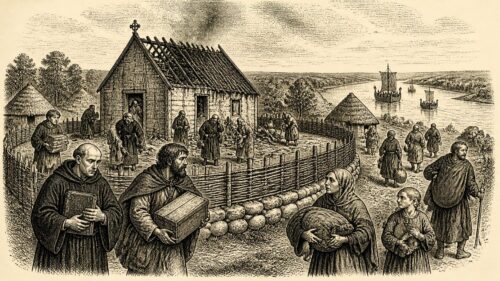
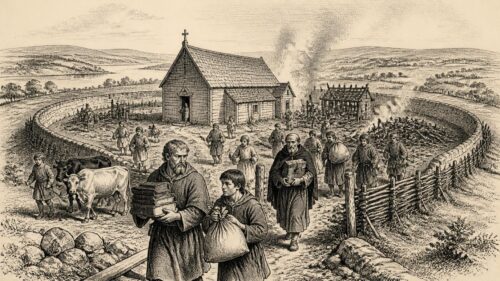
In 837, coordinated Scandinavian forces markedly intensified attacks on Ireland. Two fleets of sixty ships operated on the Boyne and Liffey, plundering Mag Life and Brega, including churches, forts and settlements. Brega’s men defeated raiders at Deoninne and killed leader Saxolb, but the foreigners routed the Uí Néill at Inber na mBárc. Inland ecclesiastical centres, including Inis Cealtra and Lough Erne churches, suffered destruction or plunder. The heathens first took Áth Cliath, though no permanent Dublin settlement is proven before the 841 longphort. Political rivalries and provincial deaths compounded a fragmented response, making 837 an exceptional escalation in river-based raiding.
Dateline
A year of converging fleets
The events conventionally placed in 837 mark a sharp escalation in the Scandinavian assault on Ireland. They are recorded most fully in the Annals of Ulster and Chronicon Scotorum, although medieval Irish annals do not always align their year headings with the modern calendar. The Annals of Ulster, for example, places the principal campaign under its entry U837 but labels that entry AD 836; Chronicon Scotorum assigns the same sequence to 837, while the Annals of the Four Masters preserves it under 836. Modern historical practice therefore connects this coherent group of notices with calendar year 837. The discrepancy is a feature of annalistic transmission, not evidence for separate campaigns.
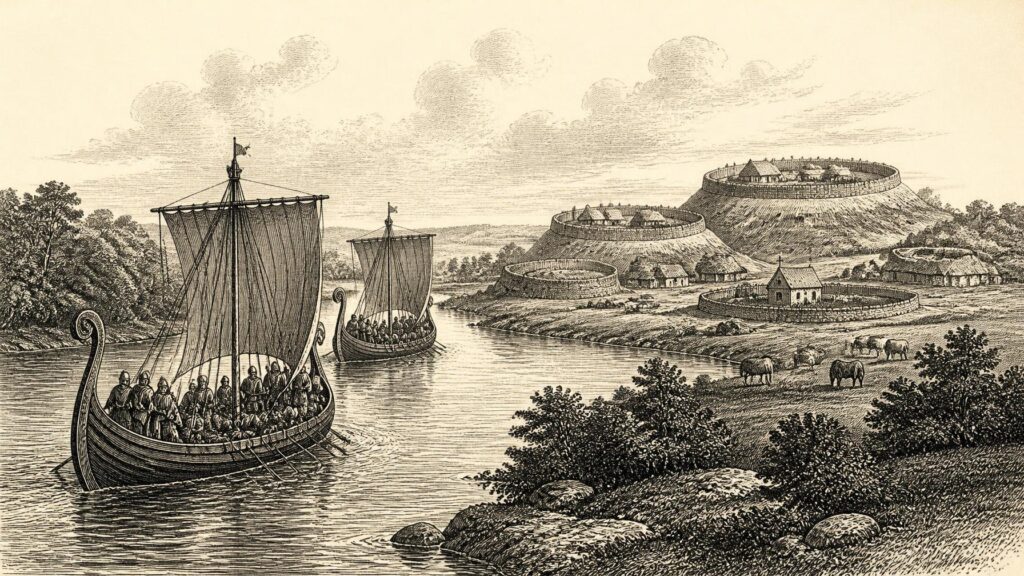
The core report is unusually precise in one respect. A Norse force of sixty ships entered the Boyne, while another sixty ships were on the Liffey. The annalists were not offering a neutral naval inventory: round numbers may have conveyed exceptional scale as well as arithmetic fact. Yet the repeated figure, preserved in more than one chronicle, makes the central point secure. Ireland faced two substantial mobile forces operating simultaneously along waterways that opened the fertile and politically important east Midlands.
These were not expeditions confined to exposed monasteries on the coast. The fleets plundered Mag Life, the plain of the Liffey, and Mag Brega, the rich lowland region north of the river and centred on the wider hinterland of Tara. The Annals of Ulster specifies churches, forts and dwellings; the later Four Masters expands the picture to include people, cattle and other livestock. Exact details in the later compilation must be treated with care, but both accounts show that raiding struck the productive resources on which lordship rested: grainland and pasture, herds, settlements, ecclesiastical wealth, and the dependants whom kings were expected to protect.
Brega fights back
The campaign was not a story of effortless Norse success. The men of Brega defeated the foreigners at Deoninne in Mugdorna Brega, and the annals put the Norse dead at six score, or 120. Such casualty figures should not be read as a modern battlefield return, but the entry is important because it preserves a local victory. Communities under attack were capable of rapid armed resistance, probably through the retinues and client networks of regional rulers rather than a national army.
That success did not decide the year. At Inber na mBárc, the foreigners won a battle against the Uí Néill, the dominant royal kindreds of much of northern and central Ireland. The annalist’s formula is stark: an uncounted slaughter occurred, though the principal kings escaped. The location is not absolutely certain; it has plausibly been associated with the Shannon estuary, but the identification remains interpretative rather than firmly demonstrated. What is firm is the annalist’s sense of a defeat stretching across the political geography “from the Shannon to the sea”. It was a major reverse for the Uí Néill world, not merely a raid on a single settlement.
Ireland in 837 was not a unitary kingdom that could answer invasion under one command. Niall Caille of Cenél nÉogain was king of Tara and the leading Uí Néill ruler, but his authority depended on the cooperation, submission and rivalry of many regional kings. Feidlimid mac Crimthainn, king of Munster, was another formidable claimant to island-wide influence. The annals do record Feidlimid’s plundering of Cenél Cairpri Cruim in this same campaign year, a reminder that Irish political conflict continued alongside the Norse attacks. They do not, however, record a general Irish alliance against the fleets in 837. Later royal negotiations between Niall and Feidlimid belong to 838, not to this year.
Rivers, islands and churches
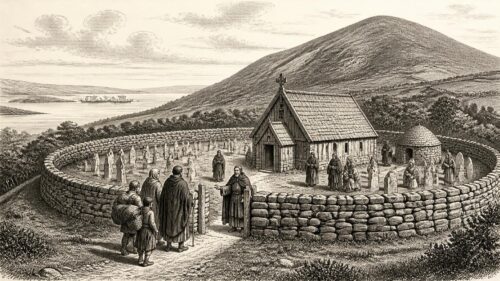
The attacks reveal why rivers mattered so much. The Boyne and Liffey led directly into densely settled eastern territories. The Shannon system gave access to the western and central interior, while Lough Erne linked routes through the north-west. Ships could deliver armed men, take away plunder and captives, and shift quickly between river mouths, islands and lakeshore settlements. A monastery on an island might be sheltered from ordinary overland warfare yet dangerously reachable by a raiding force with boats.
Inis Cealtra, now Holy Island in Lough Derg on the Shannon, was plundered by the heathens according to the Annals of Ulster. The site was an established ecclesiastical community, not an isolated hermitage without wider connections. Its island position, its religious standing and its access to the Shannon made it valuable as well as vulnerable. The basic contemporary notice says “plundered”; Chronicon Scotorum says that Inis Cealtra and Clonmacnoise were burned, while the Four Masters, compiled much later, adds Laichtín and Cell Finnche to the churches burned. These divergent lists should not be flattened into a falsely exact itinerary. They nevertheless agree that ecclesiastical places across a broad area suffered severely.
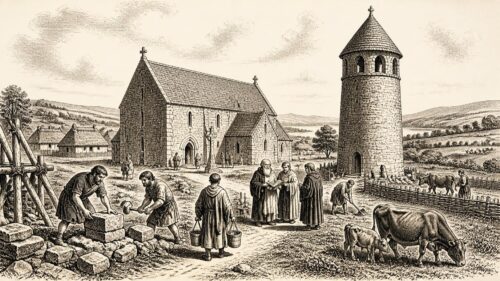
The same contemporary annal reports the destruction of the churches of Lough Erne, specifically including Cluain Eóis and Daiminis. “Destroyed” is an annalistic judgement that need not mean every building was reduced to ashes. It does mean that the communities’ resources, sacred spaces and capacity to function were attacked on a scale worth memorialising. Churches were attractive targets because they concentrated portable precious goods, food renders, livestock, manuscripts, skilled personnel and the patronage of surrounding dynasties. They were also social centres: places of worship and burial, but also estates, schools, workshops and stores of legal and historical memory.
For ordinary people, the year’s violence was therefore more than a clash between rulers and foreign crews. The destruction of a church settlement could disrupt seasonal labour, hospitality, food storage, local exchange and protection. The annals’ concern with churches does not mean lay households were untouched; rather, monasteries were the institutions most able to preserve written notice of trauma that spread through the countryside.
Saxolb’s death and Dublin’s first taking
One foreign leader is named: Saxolb, described as toísech, chief or leader of the foreigners. He was killed by the Ciannachta, a people of the Brega region. The notice is brief, and it would be unsafe to assign him command of either named sixty-ship fleet or to identify him with a legendary Viking conqueror. Its significance lies elsewhere. The annalist knew a Norse leader by name and recorded his death at Irish hands, showing that these expeditions had identifiable commanders as well as anonymous crews.
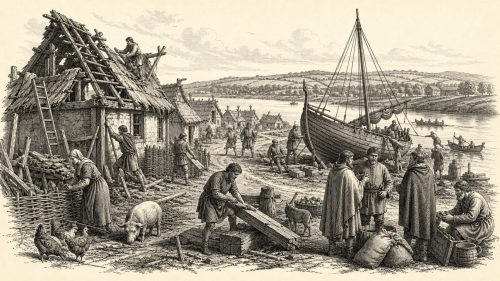
Chronicon Scotorum and the Four Masters also preserve a terse but consequential notice: the first taking of Áth Cliath by the heathens. Áth Cliath, “the ford of the hurdles”, was the settlement beside the Liffey from which modern Dublin takes one of its Irish names. The statement should not be made to say more than it does. It records an initial seizure or occupation in 837; it does not prove that a permanent Scandinavian town had already been founded. The annals first explicitly record a longphort, a fortified ship-base, at Duiblinn in 841. That later development is crucial context, but it must not be pulled back four years and presented as an established fact for 837.
Nonetheless, the taking of Áth Cliath belongs to the same strategic pattern as the Boyne and Liffey fleets. Control, even temporary control, of a river-side crossing and harbour zone offered access to Leinster, Brega and routes inland. The raids of 837 demonstrated the potential of Irish waterways for repeated operations. They did not yet create the later Hiberno-Scandinavian port kingdom of Dublin, but they helped expose the military and commercial value of the site that would become its centre.
Political losses and an uncertain future
The year also brought deaths that mattered to regional politics. Riacán son of Fínnechta, one of the two kings of Leinster, died. Cathal son of Muirgius, king of Connacht, also died after inflicting a rout on the Munstermen, according to the annalistic sequence. These notices do not permit a full reconstruction of succession struggles, but they show that provincial leadership was changing while external attacks intensified. In a fragmented political landscape, the death of a co-ruler or provincial king could alter the ability of a people to organise defence, exact resources or pursue old rivalries.
No harvest failure, epidemic or exceptional weather is securely recorded for Ireland in 837. Nor should the year be presented as a simple turning point at which every earlier pattern ceased. Scandinavian raids had struck Ireland since the late eighth century, and Irish kings had long fought one another. Yet the coordinated appearance of large fleets on both Boyne and Liffey, the Uí Néill defeat, assaults on inland ecclesiastical centres, the killing of a named Norse leader, and the first recorded taking of Áth Cliath make 837 exceptional. It was the year in which raiding became visibly entangled with Ireland’s main rivers, richest plains and most contested centres of power.
Primary Sources
- The Annals of Ulster: Year U837
- The Annals of Ulster: Year U838
- The Annals of Ulster
- Chronicon Scotorum: Annal CS837
- Chronicon Scotorum
- Chronicon Scotorum: Navigator
- Annals of the Four Masters: Annal M835–M836
- Annals of the Four Masters: Annal M836, Irish text
- Annals of the Four Masters: Annal M837
- Annals of the Four Masters
- Irish Texts at CELT
- Annals of Inisfallen
- Vikings in Ireland and Scotland
- Vikings in Early Medieval Ireland: Church-Raiding, Politics and Kingship
- The Vikings in Ninth-Century Ireland: Sources and Settlements
- Britain and Ireland 900–1300
- The Vikings in Ireland
- Baile Átha Cliath – Dublin
- Gazetteer of Ireland / Gasaitéar na hÉireann
- Fedelmid (Feidlimid)
- Cormac
- Memory, Belief and Identity: Remembering the Dead on Iniscealtra, Co. Clare
- Inis Cealtra: Appendix 2: Detailed Support Material
- Cath Maighe Léana and Some West Munster Placenames
- Inis Cealtra Excavation Report, 1970