Bangor and Mag Aí823 CE
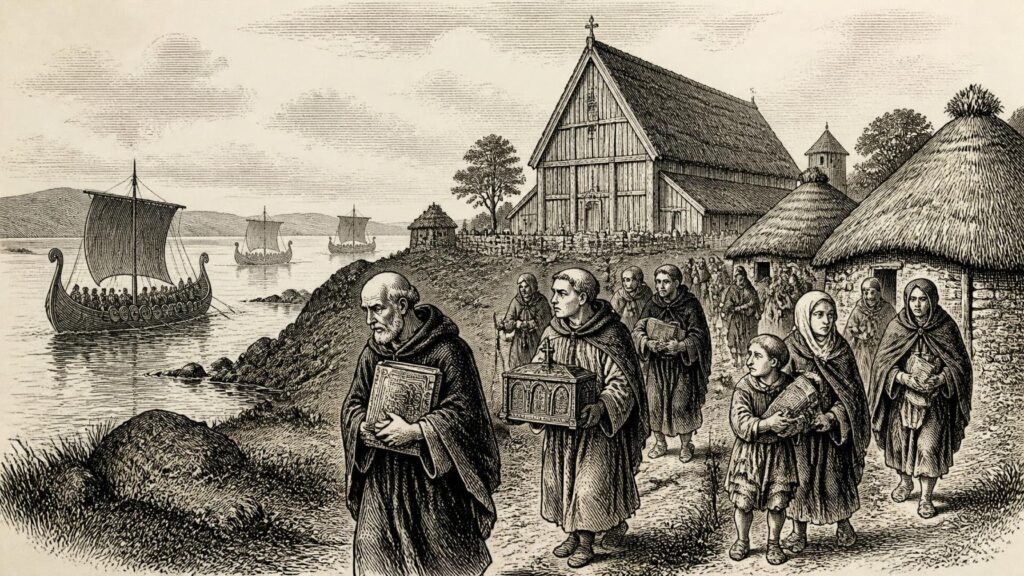
In 823, the Irish annals record Viking raiders attacking Bangor, breaking Comgall’s shrine, plundering its oratory and killing churchmen, though the monastery survived. Feidlimid of Munster and Armagh’s bishop asserted Patrick’s law in Munster, while Feidlimid also burned Galinne and suffered defeat at Mag Aí against Cathal of Uí Maine. Conflict around Clonmacnoise involved resignations, deaths, the killing of a tanist-abbot and compensation in churches. In the north, Niall son of Áed displaced Murchad as ruler of Ailech. Other deaths, including Tethba’s king and lightning fire at Armagh, underline Ireland’s interconnected yet contested ecclesiastical and political landscape across the island.
Dateline
For Ireland, 823 is remembered chiefly through a handful of compressed annal entries: a northern monastery attacked from the sea, a Munster king extending both force and religious authority, a dynastic overthrow in the north, and violent disputes around Clonmacnoise. These notices are unusually revealing, but they require care. Medieval Irish annals are not daily records, and their year-numbering does not always align perfectly from one compilation to another. The Annals of Ulster, Chronicon Scotorum and Annals of Inisfallen place several key events together under 823, while the later Annals of the Four Masters places some of them under 822. The events can responsibly be associated with this calendar year, but no month or day should be invented for them.
A Raid on Bangor
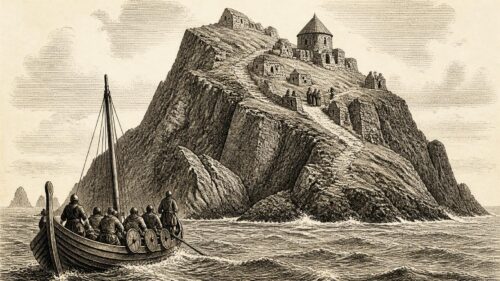
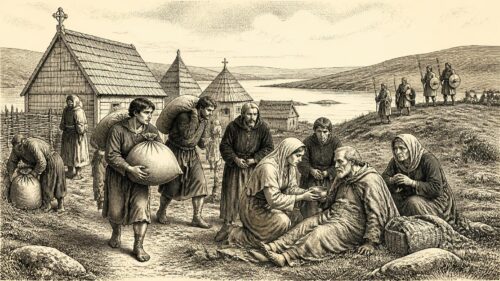
The clearest and most shocking event was the attack on Bangor, or Bennchor, on the south shore of Belfast Lough. The Annals of Ulster states simply that “heathens invaded Great Bangor”. Its word gentiles, like the Irish annalists’ related vocabulary, identifies non-Christian overseas raiders rather than giving a modern national label. They are conventionally described as Vikings, but the sources do not identify a named leader, fleet or homeland.
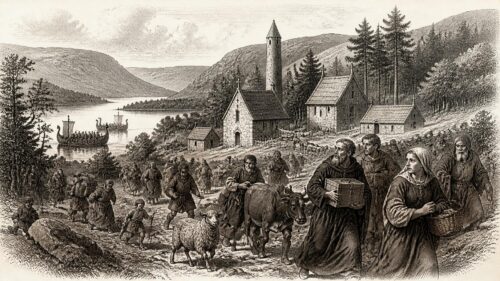
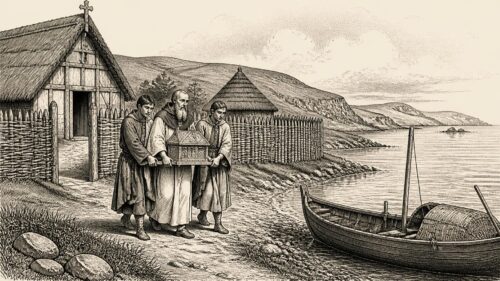
The Annals of Inisfallen preserves a much fuller version. It says that Bangor was invaded, that the shrine of its founder, Comgall, was broken, and that learned men and bishops were put to the sword. A related record, placed one annal later in Ulster and in the Four Masters, says that the oratory was despoiled and Comgall’s relics were shaken from their shrine. The overlap confirms a grave assault on the community, though it does not permit us to reconstruct its sequence precisely or to calculate casualties.
Bangor was not an isolated chapel. Founded in the sixth century and associated with St Comgall, it had long been a centre of teaching, worship and manuscript culture, with links extending across the Irish Sea and, through Columbanus and other churchmen, to continental Europe. Its waterfront setting offered access to maritime networks, but made it exposed to raiders moving through the North Channel. The 823 attack therefore struck a place where religious devotion, learning, landholding and seaborne communication met. Shrines were not merely devotional objects: they embodied a saint’s presence, institutional prestige and claims to protection. Their violation was a material and symbolic humiliation.
Yet it is important not to turn the raid into a tale of instant extinction. Bangor appears in later records, and its ecclesiastical life continued in some form. The immediate evidence supports disruption, killing and plunder; it does not support the claim that the monastery permanently disappeared in 823. Nor is there reason to suppose that every Irish church was equally vulnerable. This was an early phase of Scandinavian activity in Ireland, before the better-documented fortified coastal settlements of later decades.
Feidlimid’s Munster Programme
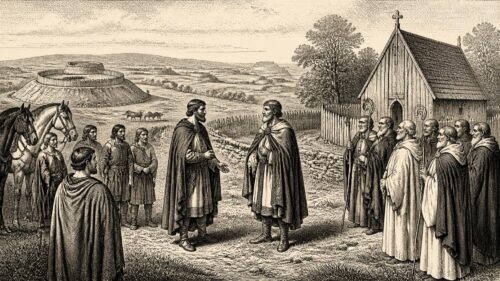
In the same annal year, Feidlimid son of Crimthann, king of Cashel and of Munster, joined Artrí son of Conchobor, bishop of Armagh, in imposing the Law of Patrick on Munster. The wording is terse, but its political significance is considerable. A “law” of a saint was not a modern statute enacted by a central parliament. It was a church-backed body of privilege, protection and dues, asserted through agreement, ritual, travelling ecclesiastics and the authority of a saint’s cult. To proclaim Patrick’s law in Munster was to acknowledge Armagh’s Patrician authority in a province governed by an ambitious southern king.
The partnership was therefore a diplomatic act as well as a religious one. Feidlimid had become king of Cashel only a few years earlier, amid uncertainty within the Eóganacht dynasties. Armagh was the pre-eminent church of the northern Uí Néill political world. By acting with its bishop, Feidlimid could associate his kingship with the island-wide prestige of Patrick without surrendering Munster’s independence. Later in his career he would pursue a far more aggressive involvement in the midlands and the north; in 823, however, the annals show him using ecclesiastical authority to strengthen his position.
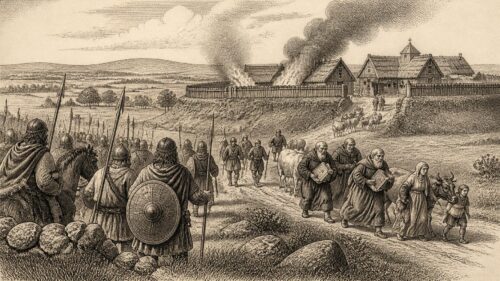
His conduct was not consistently conciliatory. The Annals of Ulster and Chronicon Scotorum record that Feidlimid burned Galinne of the Britons, with all its dwellings and its oratory. The exact location of Galinne is not wholly secure, and the annal gives neither motive nor date. What is firm is the scale of the description: homes and a church were attacked together. That combination is a reminder that early medieval churches were embedded in settlements rather than standing apart from ordinary life. Burning an oratory could harm a religious community; burning its dwellings also damaged households, food stores, labour and local authority.
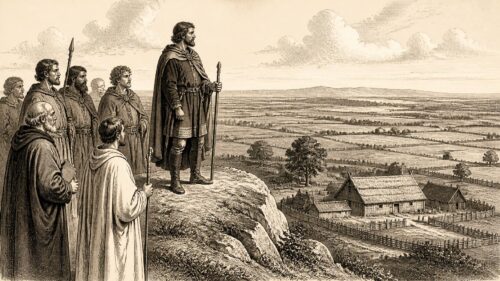
Chronicon Scotorum adds a significant but less widely repeated notice: Cathal son of Ailill, king of Uí Maine, inflicted a defeat on Feidlimid at Mag Aí, the great plain in what is now central County Roscommon, and many men fell. Because this battle is not preserved in every parallel annal, its details must remain limited. Nevertheless, it shows that Feidlimid’s reach beyond Munster met armed resistance in Connacht. His promotion of Patrick’s law and his resort to destructive force were not contradictory in the political culture of the period. Kings were expected both to uphold churches and to lead warbands; the practical question was which churches, territories and allies benefited.
Clonmacnoise and Connacht Rivalries
Clonmacnoise, on the Shannon, lay close to the contested frontier between Munster, Mide and Connacht. Its importance made internal office-holding politically consequential. The Ulster annals say that Rónán, abbot of Clonmacnoise, resigned his superior’s office. Chronicon Scotorum records the death of Congalach son of Írgalach, described as tanist-abbot, an office indicating a designated successor or senior deputy. These notices may represent distinct transitions within the same ecclesiastical household rather than a simple peaceful succession.
The same chronicle describes a more violent dispute. Cathal of Uí Maine was said to have violated Clonmacnoise against Flann son of Flaithbertach, a tanist-abbot from Munster, and to have thrown Flann into the Shannon, where he died. It then says that seven churches were adjudged to Clonmacnoise as settlement. The entry is too compressed to establish who judged the case, where the churches lay, or whether their transfer was permanent. Still, it offers a rare glimpse of redress: an assault on a major churchman generated a settlement expressed in control of churches and their resources. Ecclesiastical institutions could be victims of aristocratic violence, but they also possessed legal standing and property valuable enough to form compensation.
This episode should not be treated as a simple conflict between secular warriors and passive monks. Abbots, bishops and their leading families operated within the political order; major churches held land, clients, livestock, learning and rights of sanctuary. A dispute over Clonmacnoise could draw in kings from Uí Maine and Munster because control of people and resources was at stake. The annals’ combination of resignation, death, killing and adjudication makes 823 a particularly vivid year for seeing that interdependence.
Ailech Changes Hands
Far to the north, Murchad son of Máel Dúin was deposed by Niall son of Áed and the Cenél nÉogain. The annal does not describe a battle, negotiation or assembly; “deposed” is all it says. Even so, the result mattered. Niall became ruler of Ailech, the northern Uí Néill kingship based around Inishowen and the north-west. He is known to later history as Niall Caille, from the River Callan near Armagh where he drowned in 846.
The change did not make Niall high king of all Ireland. Ireland had no single continuously effective monarchy, and power rested in overlapping provincial, dynastic and local lordships. But Ailech was one of the island’s foremost northern kingships, and Niall’s accession placed a capable member of Cenél nÉogain at its head. The contrast with Feidlimid is striking: while the Munster king sought standing through an alliance with Armagh’s bishop and campaigned into Connacht, Niall’s position arose from a successful internal replacement backed by his own kindred.
The year also brought the death of Conaing son of Congal, king of Tethba, a region spanning parts of the midlands. Diarmait of Ros Ech, Dub dá Crích of Cell Achaid and Sechnasach of Loch Cendin—identified as bishop and anchorite—also died. Such notices are brief, but their concentration across churches and small kingdoms maps a densely organised society. Authority was exercised through local rulers and ecclesiastical communities, not from one capital.
Fire at Armagh
The final Ulster notice is ominous: “fire from heaven” struck and burned the abbot’s residence at Armagh. In modern terms, lightning is the most likely explanation, but the annalist’s phrasing matters. A destructive natural event was interpreted through a religious world-view, especially when it damaged the household of Patrick’s leading church. It is a small entry, yet it evokes the built environment of authority: timber buildings, stored goods, dependants and administrative work could all be endangered by one sudden fire.
There is no annalistic report for 823 of harvest yields, prices, disease or ordinary domestic routines. That silence should be respected. What survives instead is a sharp record of exposure and authority: communities on the coast faced raiders; inland churches could be caught in dynastic conflict; rulers sought legitimacy through saints’ laws; and even Armagh’s abbot was vulnerable to the elements. Bangor and Mag Aí, Clonmacnoise and Armagh show an Ireland connected by sea routes, river corridors, church networks and competing kingships—energetic, learned and dangerous in equal measure.
Primary Sources
- The Annals of Ulster
- The Annals of Ulster: diplomatic text
- Annals of Inisfallen, Annal AI823
- Annals of Inisfallen
- Chronicon Scotorum
- Chronicon Scotorum: editorial and bibliographical information
- Annals of the Four Masters
- Vikings in Irish Chronicles, 794–902: Data
- Fedelmid (Feidlimid)
- Niall Caille
- Saint Patrick and the Landscape of Early Christian Ireland
- Malachy's Wall, Bangor Abbey
- The Archaeology of Early Christianity in the North of Ireland, Volume 2
- Bangor and the Early Medieval Irish Sea World
- The Céli Dé and Ecclesiastical Government in Ireland
- The Practice of Irish Kingship
- Early Irish Law
- Ecclesiastical Settlement in Ireland in the Early Medieval Period
- Cáin Adomnáin and the Laws of War
- The Earliest Wave of Viking Activity? The Norwegian Evidence Revisited
- Exploring the Irish Annals
- Notes on Terminology in the Annals of Ulster, 650–1050