Glendalough and the Inland Raids890 CE
In 890, Scandinavian raiders, described in the annals as Gaill, plundered the ecclesiastical centres of Ardbraccan, Donaghpatrick, Dulane and Glendalough. Although the record supplies few details, the attacks exposed the vulnerability of wealthy, politically connected monasteries in Meath, Leinster and the Wicklow uplands. Probably operating within Dublin’s sphere, the raiders exploited river, coastal and overland routes amid shifting Irish-Scandinavian alliances. The raid occurred during Flann Sinna’s contested kingship and demonstrated limits to Tara’s influence. Plundering disrupted religious, economic and social life without proving wholesale destruction. Further raids followed in 891, while Dublin’s Scandinavian settlement was expelled in 902 by allies.
Dateline
In 890, a recorded attack linked places far apart in the Irish landscape: Ardbraccan, Donaghpatrick and Dulane in the rich central and eastern districts of what is now County Meath, and Glendalough deep in the Wicklow mountains. The annalistic notice is brief but consequential. It says that these ecclesiastical settlements were plundered by Gaill, ‘foreigners’—the term commonly used for Scandinavian raiders and settlers. It offers no commander, no casualty total, no date within the year, and no description of the route. Yet the choice of targets shows that the raid was not a random coastal foray. It reached into communities that were centres of worship, landholding, learning and political connection.
Dating a Sparse Record
The principal notice survives in the Annals of the Four Masters, whose internal year-numbering for this period does not correspond straightforwardly with modern calendar dating. There it appears under an earlier annal-heading, but comparison with other annalistic chronologies and modern scholarly reconstruction places the raid in 890 CE. That distinction matters. The event can responsibly be assigned to 890, but no source permits a claim about its season, duration, perpetrators’ names or the sequence in which the four sites were struck.
The same caution applies to the word ‘plundering’. An early medieval annalist did not mean simply the taking of a portable treasure chest. A raid could involve seizure of food, cattle, metalwork, cloth, books, vessels, weapons and valuable church furnishings; it could include the capture of people, disruption of cultivation and intimidation of a community’s patrons. It does not, however, prove that every church was burned down or that each settlement ceased to function. The surviving record gives the fact of an attack, not a full inventory of its effects.
A Corridor of Wealth and Authority
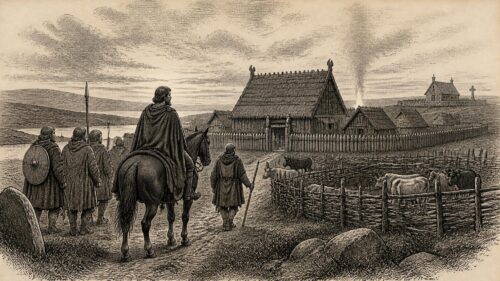
Three of the named places—Ardbraccan, Donaghpatrick and Dulane—lay in or close to the fertile plains of Brega and Mide. This was a densely inhabited region of royal estates, churches, rivers and routeways, with access towards the Irish Sea through the Boyne system and the eastern coast. Ardbraccan was an important church site near Navan; Donaghpatrick stood in the Boyne Valley; Dulane, known in Irish as Tuilén, lay near Kells. Their inclusion together suggests an operation directed through a well-connected inland zone rather than a set of isolated assaults.
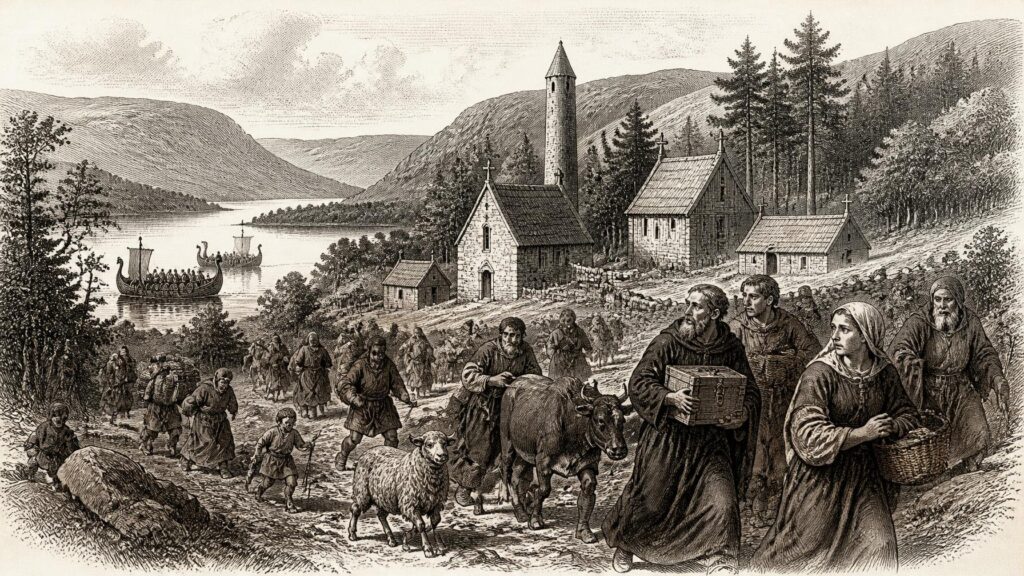
Glendalough was different in setting but no less attractive as a target. Situated in the valley of the two lakes in the Wicklow uplands, it had long been associated with St Kevin and had become one of Ireland’s most renowned religious centres. A mountain valley did not make it immune. Roads, paths, livestock movements, pilgrimage and ties to Leinster connected Glendalough to the wider world. Its remoteness may have given it spiritual prestige; its community’s resources and reputation made it worth reaching.
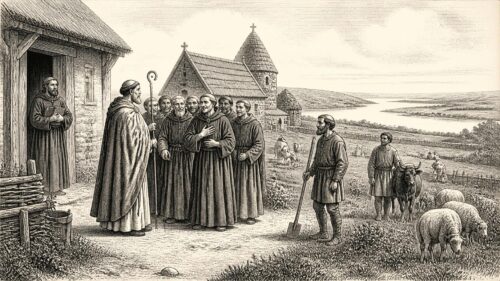
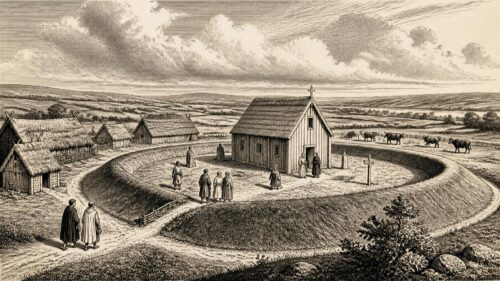
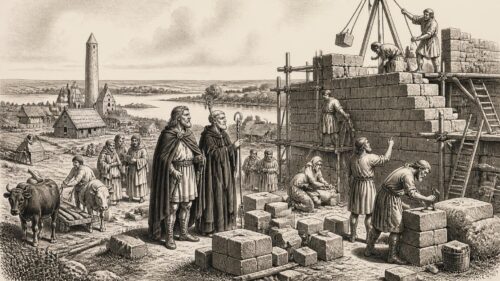
These were not merely groups of praying clergy. Irish monasteries were complex settlements, though their precise scale varied greatly. Around churches and burial grounds lived clerics, scholars, craftspeople, labourers, dependants and visiting laypeople. Communities managed land and livestock, received gifts from kings and aristocrats, preserved relics and manuscripts, and exercised claims over tenant populations. The wealth visible in crosses, metalwork and church buildings was only one aspect of their importance. To raid a monastery was to strike an institution embedded in local society and regional politics.
Raiders from the Eastern Seaboard
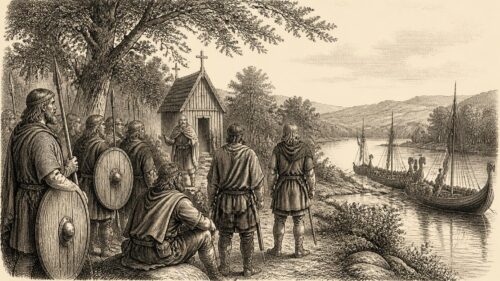
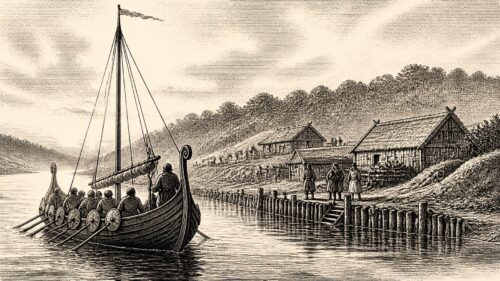
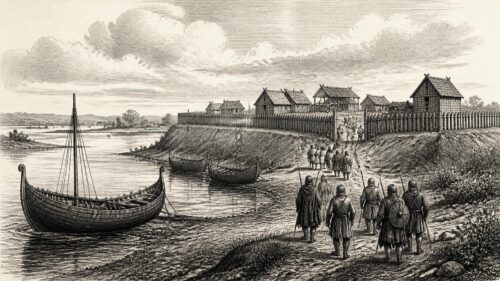
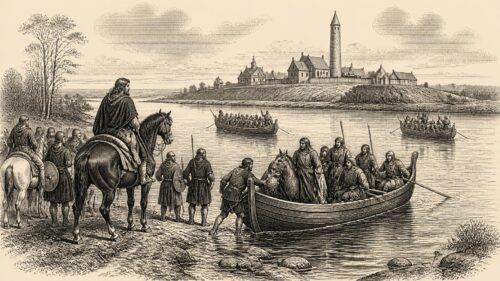
The annal does not identify the raiders’ base. Nevertheless, the geography makes Scandinavian groups associated with Dublin a strong historical possibility, rather than a certainty stated by the text itself. Dublin had developed from a ninth-century Viking longphort, a defended naval base, into the leading Scandinavian power-centre on Ireland’s east coast. Its rulers and warbands were part of a wider Irish Sea world, with connections reaching Britain, the Isles and Scandinavia. Ships and rivers gave raiders mobility, while overland marching extended their reach beyond shorelines.
By 890, Scandinavian power in Ireland should not be imagined as a single invading nation confronting a united Irish people. Alliances crossed cultural and political lines. Irish kings at times employed Scandinavian forces; Scandinavian leaders pursued their own rivalries; and groups described collectively as ‘foreigners’ in the annals could differ in origin, allegiance and purpose. The Dublin leadership had endured internal conflict in the later ninth century, but it retained the capacity to menace the surrounding countryside. The 890 raid demonstrates that a period sometimes described as a lull in Viking activity was not a period of safety for eastern Irish churches.
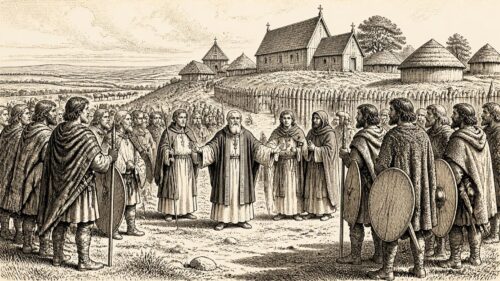
Raiding also had a political logic. Monasteries held accumulated wealth, but repeated attacks on prominent church sites may have exerted pressure on the kings, dynasties and populations that protected or patronised them. In a society where authority rested on personal relationships, hostage-taking, tribute, protection and reputation, the violation of a holy place could be a public demonstration of force. The targets in 890 were close enough to Dublin’s sphere of action to make the attacks meaningful as assertions of influence in the Irish midlands and Leinster.
Flann Sinna’s Uneasy Kingship
The principal Irish ruler of the period was Flann Sinna of Clann Cholmáin, king of Tara from 879. His kingship gave him major standing among the Southern Uí Néill and substantial influence in Mide, but it did not make Ireland a centralised kingdom. Regional rulers governed Munster, Leinster, Connacht, Ulster, Brega, Osraige and numerous lesser territories. A king of Tara had to sustain dominance through assemblies, marriages, hostage arrangements, military expeditions and relationships with churches. The vulnerable corridor attacked in 890 lay close to the heartlands from which Flann’s authority was projected.
Recent years had already exposed the limits of that authority. In 888, Flann suffered a serious defeat at the hands of the foreigners of Dublin, and important Irish allies and churchmen were killed. The following year, the annals record Domnall son of Áed leading men of northern Ireland and foreigners against the Southern Uí Néill. Such entries reveal a political world in which Dublin’s armed groups could be enemies, allies or both, depending on circumstance. The plundering of churches in 890 therefore belongs within a wider contest for power, rather than outside Irish politics as a purely external invasion.
Religion, Learning and Recovery
The attacks were alarming precisely because churches were central to public life. Relics linked communities to saints and sacred ancestry; clerics could be counsellors, diplomats, scribes and estate managers; ecclesiastical sites offered places for burial, dispute settlement and commemoration. A monastery’s books and liturgical objects had religious value, but they were also products of skilled labour and signs of status. The loss or threatened loss of such things affected both devotion and prestige.
It would be misleading, however, to portray 890 as the destruction of Irish learning. The annals themselves, copied and continued over generations, are evidence of resilient literate institutions. Monastic communities rebuilt, adapted their defences, shifted valuables and renewed patronage after attacks. Archaeological remains visible at Glendalough today mostly belong to later phases of a settlement whose history extended for centuries after the ninth-century raid. Round towers are often associated with refuge and safeguarding valuables, but they should not be treated as simple Viking-proof fortresses or as proof that a particular tower stood ready in precisely its present form in 890.
Ordinary Lives Behind the Annal
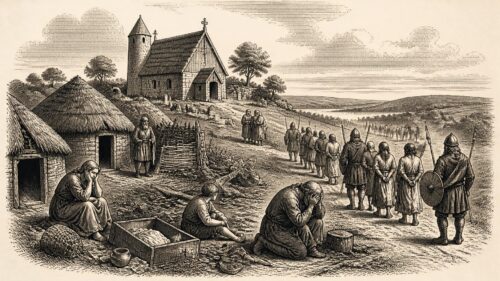
No contemporary source tells us what an individual family at Ardbraccan or Glendalough did on hearing of a raid. Still, the nature of early medieval settlement allows some cautious conclusions. Most people depended on mixed farming, above all cattle and dairying alongside grain cultivation. A sudden armed incursion could threaten stores gathered for winter, animals essential to household wealth, and the people who worked ecclesiastical land. Clerics and lay dependants alike had reason to flee, conceal goods, seek protection from local lords or retreat into difficult terrain.
The attacks may also have affected movement and exchange. Churches drew visitors for worship, fairs, legal business and seasonal labour; monastic estates connected upland and lowland districts through rents and food renders. Disruption in one settlement could therefore spread beyond those physically present at the assault. Yet the record does not justify claims of island-wide famine, mass depopulation or a general collapse in 890. The year is best understood through the sharply local but politically resonant experience of the four named communities.
A Year of Warning
The raid of 890 foreshadowed further attacks on major ecclesiastical centres nearby. Kildare and Clonard were plundered in 891, showing that the pressure on the church-rich lands of the east and midlands continued. Within little more than a decade, in 902, Dublin’s Scandinavian settlement was driven out by a coalition of Leinster and Brega. That outcome was not visible in 890. At the time, the lesson was harsher and more immediate: even celebrated inland sanctuaries, linked to powerful kings and protected by their social importance, remained exposed to mobile raiding forces.
For Ireland, 890 is therefore not a year of a famous pitched battle or a royal succession. Its defining securely dated development is a raid recorded in only a sentence. But that sentence opens onto the realities of late ninth-century Ireland: powerful yet vulnerable monasteries; contested kingship in Mide and Leinster; a Dublin-based Scandinavian presence capable of striking inland; and communities whose religious, economic and political lives could not be separated.
Primary Sources
- Annals of the Four Masters
- Vikings in Irish Chronicles, 794–902: Data
- Vikings in Ireland and Scotland
- Vikings in Ireland
- The Annals of Ulster: Year U890
- The Annals of Ulster
- Chronicon Scotorum: Annals CS888–CS892
- Chronicon Scotorum
- Annals of Inisfallen: Annals AI890–AI899
- Annals of Inisfallen
- Fragmentary Annals of Ireland
- List of Published Texts at CELT
- Flann Sinna
- Vikings in Early Medieval Ireland
- Church-Raiding and Politics in the Later Ninth Century
- Church-Raiding and Politics in the Era of Amlaíb and Ímar
- Glendalough Monastic Site and Visitor Centre
- High Crosses
- Early Monastic Churches
- The Vikings in Ireland: 795 AD onwards
- Viking Activity in Ireland by County in the Annals
- The Vikings in Ninth-Century Ireland: Sources and Settlements
- Glendalough, Co. Wicklow
- Patrician and Early Christian Architecture
- Dulane, County Meath: Census Records and Annalistic References