Muirgius’s Luigni Reckoning809 CE
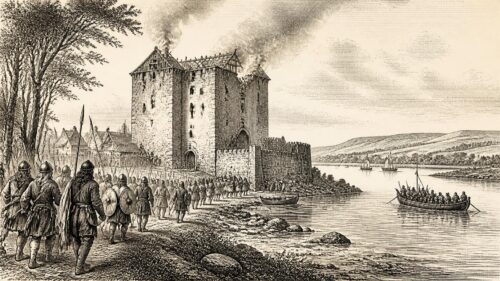
In 809, Muirgius, Uí Briúin overking of Connacht, devastated the Luigni after they killed his sons Tadc and Flaithnia, demonstrating how dynastic loss prompted collective military punishment. The episode reflected Connacht’s fragmented politics, where alliances, kinship and armed followings underpinned authority. Annals also record deaths of regional kings, churchmen and officials, highlighting unstable personal networks of power. Notices concerning Glendalough and Lorrha indicate ecclesiastical leadership changes, though sources disagree on names and chronology. Rural communities sustained kings and churches through cattle, grain and labour, while warfare endangered livelihoods. No securely dated Viking raid is recorded anywhere for Ireland that year.
Dateline
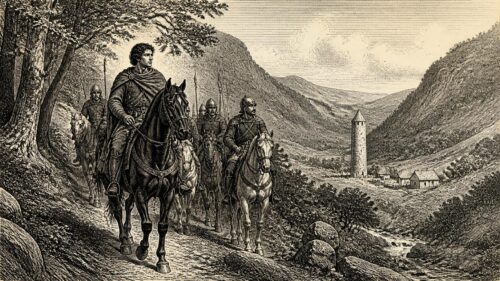
The clearest political event securely attached to 809 concerns a family disaster in Connacht and a violent royal response. The Annals of Ulster, whose entry for 810 corresponds to AD 809, report that Tadc and Flaithnia, two sons of Muirgius son of Tommaltach, were killed by the Luigni. The same terse notice immediately records the “devastation of the Luigni by Muirgius”. Chronicon Scotorum preserves the same sequence. It is a compact annalistic statement, but it exposes much about the stakes of rule in early ninth-century Ireland: the vulnerability of a ruler’s heirs, the political importance of kin, and the capacity of an overking to answer a killing with organised destruction.
Two Sons and a Retaliation
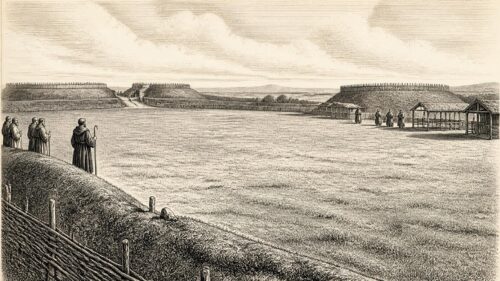
Muirgius was overking of Connacht, drawn from the Uí Briúin Aí, a leading dynasty based in Mag Aí, the fertile plain spanning parts of modern north Roscommon and north-east Galway. He had emerged amid competition between several Connacht dynasties and had established himself as one of the island’s more forceful provincial rulers. In 808 he had supported Conchobar son of Donnchad of Mide in resistance to Áed Oirdnide, king of Tara. That intervention ended in retreat, but it demonstrates that Connacht’s ruler could participate in politics far beyond his own province.
The killing of Tadc and Flaithnia in 809 therefore cannot be treated as an isolated private feud. Sons were not merely members of a royal household: they were potential successors, commanders, marriage allies and embodiments of their father’s standing. The annals do not say where the killing took place, which branch of the Luigni was responsible, whether the brothers were slain in battle or by ambush, or what immediate dispute lay behind it. Those omissions matter. It would be wrong to invent a battlefield, a motive or a dramatic death scene. Yet the reported devastation shows that Muirgius regarded the act as an affront requiring a public and collective answer.
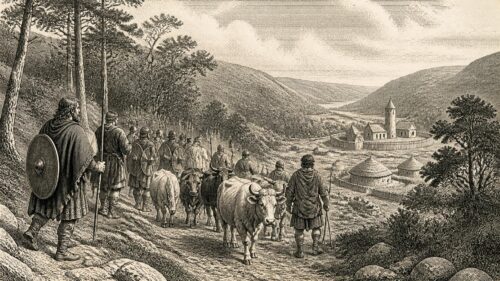
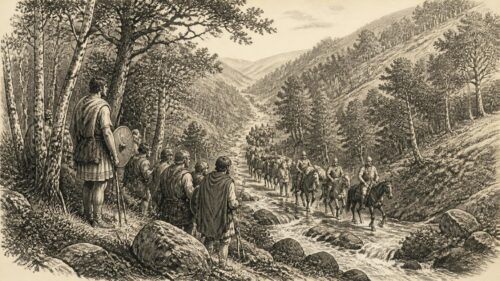
“Devastation” was not a neutral word. A hosting could seize cattle, burn or dismantle food stores and buildings, destroy crops, take captives, and kill those who resisted. Such operations were both punitive and economic. They reduced an opponent’s resources while demonstrating that a king could mobilise followers, guide them through contested country and distribute the gains of war. The victims were not necessarily confined to the men who had killed Tadc and Flaithnia. As so often in early Irish conflict, the burden of retaliation fell across a people and its territory.
Connacht’s Fractured Kingship
The Luigni occupied territories in the northern and eastern Connacht world and were not peripheral spectators in provincial affairs. Connacht was not a single centrally governed state. It was a mosaic of túatha, smaller peoples and lordships, connected through overlordship, tribute, fosterage, church patronage and shifting military alliances. Uí Briúin expansion had brought Muirgius into conflict with older regional powers, including the Uí Fhiachrach and Uí Ailello, and towards the frontier zone of Bréifne. In that setting, a blow against the sons of the Connacht overking could become a challenge to the wider political order he sought to uphold.
The retaliation in 809 also foreshadowed a succession problem that Muirgius did not live to resolve. He died in 815. Tadc’s loss proved particularly consequential in retrospect, for his son Conchobar later became overking of Connacht and ancestor of the principal line from which the O’Connors, MacDermotts and MacDonaghs descended. But this later lineage should not obscure the uncertainty of 809. The deaths of Tadc and Flaithnia removed two living sons from Muirgius’s immediate circle; they did not determine the provincial kingship automatically. Connacht’s rulers still had to contend with rival branches of the Uí Briúin and with other powerful peoples.
Elsewhere in Ireland, Áed Oirdnide remained the dominant Uí Néill claimant to paramount authority. His position, often expressed through hostings, settlements and interventions in neighbouring kingships, was formidable but not absolute. Muirgius’s support for the Mide revolt in the previous year had shown the limits of Tara’s reach. In 809, the revenge against the Luigni was a local Connacht action, yet it belonged to this larger political climate: kings secured authority not through permanent bureaucratic government, but through personal alliances, ritual status, armed followings and the credible threat of reprisal.
Deaths Across the Political Map
The annal for 809 is crowded with deaths. Cathnia, abbot of Damlíag; Tigernach, founder of Daire Meilli and abbot of Cell Achaid; Máel Fothartaig, a scribe and superior of Airecal Do-Chiaróc; Cathal, king of Ráith Airthir and Fir Chúl; Echaid, king of Ulaid; Máel Dúin, steward of Armagh; Anluan, king of Aidne; and other named figures are recorded together. This is not a complete obituary roll for Ireland. It is a selection shaped by the interests and information networks of annalists. Even so, it conveys the density of authority in the island: kings of small territories, administrators of major churches, abbots, founders and scribes all counted as people whose passing deserved record.
Echaid’s death is especially revealing. Ulaid was a regional kingship in the north-east, but its ruler sat within a political landscape already unsettled by conflict. The previous annalistic year had seen Áed Oirdnide invade Ulaid after the killing of Dúnchú beside Patrick’s shrine at Tulach Léis. In 809, the death of Echaid and the simultaneous recording of other royal figures point to the regular turnover on which early medieval politics depended. A kingship was not an impersonal office: it was held through a living network of kin and clients. Death could quickly rearrange a province’s alliances and vulnerabilities.
Glendalough’s Uncertain Succession
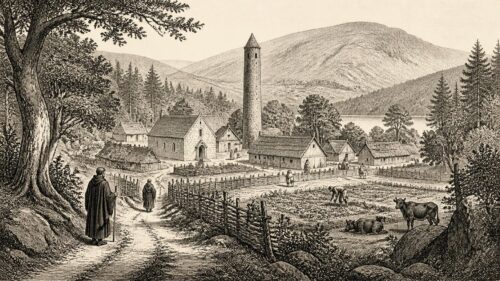
Church leadership was equally important. The Annals of Ulster place the death of Guaire, abbot of Glendalough, in 809. Glendalough, set in the Wicklow mountains’ valley of the two lakes, was already a major religious centre, associated with the cult of its founder Cóemgen or Kevin. Its location offered spiritual seclusion, but it was not detached from society. Roads and paths linked the valley to Leinster; its community required food, labour, patronage, tenants and protection. An abbot’s death thus had practical as well as devotional consequences.
There is, however, a necessary chronological caution. The Annals of Inisfallen, under its own entry for 809, records the deaths of Coibdenach, described as a learned abbot of Lothra, and Échtbrann, abbot of Glendalough. The surviving annal collections were compiled at different places and times, and their chronological headings and personnel notices do not always align neatly. It is not responsible to force Guaire and Échtbrann into a single invented succession sequence. What can safely be said is that the year, and the closely related annalistic record, preserve evidence of significant turnover among church leaders at Glendalough and Lorrha.
These notices also correct an overly simple picture of Irish religious life. Major churches were communities of worship and learning, but also landholders and employers. Their leaders might be abbots, bishops, scribes, stewards or founders; titles could overlap rather than fit a modern diocesan hierarchy. Literacy gave ecclesiastical institutions a special role in preserving law, genealogies, saints’ cults and political memory. The annals themselves are evidence of that work: brief, selective records produced from networks in which churches and rulers were deeply entangled.
Work, Food and Movement
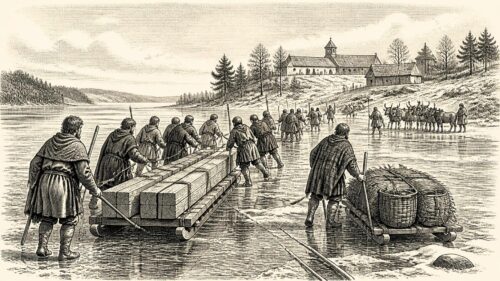
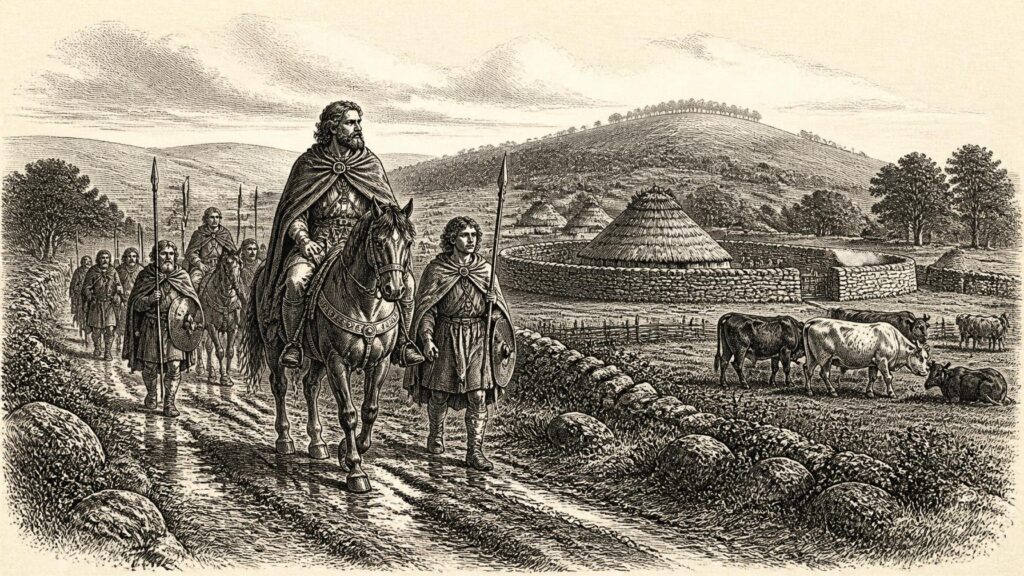
For most people, 809 was experienced less through the named deaths of rulers than through farm work and local obligations. Ireland remained overwhelmingly rural. Families lived in dispersed settlements, including ringforts, crannógs and unenclosed farmsteads, amid a managed landscape of pasture, fields, routeways and woodland. Cattle retained exceptional social and legal value, but cereals had become increasingly important from the eighth century. Oats, barley and other grain supported households and supplied rents, hospitality and exchange; watermills and cereal-drying kilns indicate investment in processing crops and producing surplus.
Warfare could interrupt this seasonal world with particular cruelty. A devastating hosting threatened herds, stored produce and the security of people whose names never reached the annals. Conversely, the ability to feed armed followers and offer hospitality was integral to a king’s reputation. The same agricultural base underpinned churches such as Glendalough and Lothra, which depended on the labour and contributions of surrounding communities. Political violence, ecclesiastical succession and ordinary food production were therefore not separate histories.
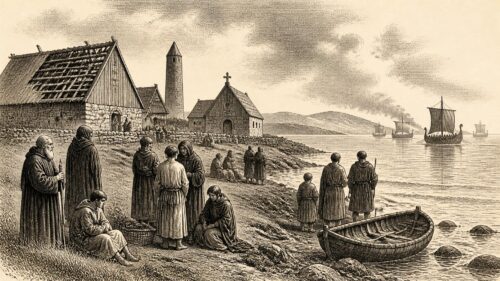
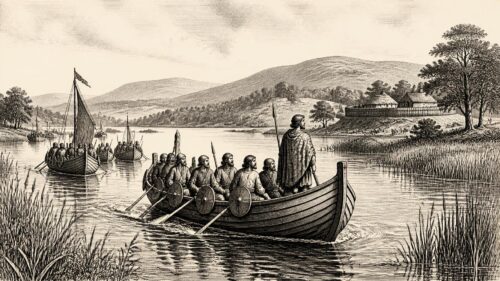
The year’s record contains no securely dated Viking raid in Ireland. Scandinavian raiders had already attacked Irish islands and churches in the decades since the 790s, and their earlier assaults remained an inescapable coastal danger. But silence for 809 is not evidence that every shore was peaceful, nor does it permit a raid to be inserted where the sources record none. The documented story of the year is instead predominantly Irish: a Connacht king’s revenge, the deaths of regional rulers, and changes within the leadership of important churches.
A Year of Consequences
809 was not marked by one island-wide battle or a single royal settlement. Its significance lies in the sharp glimpse it gives of how authority worked. Muirgius’s devastation of the Luigni shows a ruler turning bereavement into political action. The annalists’ long list of deaths shows how many local and ecclesiastical offices sustained the wider order. The notices from Glendalough and Lothra reveal institutions whose continuity depended on people, property and remembered authority. Behind every recorded king, abbot and scribe stood the unrecorded cultivators, herders, craftworkers and dependants whose labour made both kingship and church possible.
Primary Sources
- The Annals of Ulster
- Chronicon Scotorum, Part 77
- Annals of Inisfallen, Part 37
- Annals of Inisfallen
- Annals of the Four Masters, Part 64
- Annals of the Four Masters
- Vikings in Irish Chronicles, 794–902: Data
- Muirgius
- Áed Oirdnide
- Fínshnechtae Cetharderc
- Glendalough Monastic Site and Visitor Centre
- Glendalough Monastic Site and Visitor Centre Highlights
- High Crosses
- Agriculture, Settlement and Society in Early Medieval Ireland
- Early Medieval Ireland: Investigating Social, Economic and Settlement Change, AD 400–1100
- The Economy of Early Medieval Ireland
- The Archaeology of Livestock and Cereal Production in Early Medieval Ireland, AD 400–1100
- Early Medieval Ireland: Archaeological Excavations, 1930–2009
- Early Medieval Archaeology Project: The Early Medieval Church
- The Vikings in Ninth-Century Ireland: Sources and Settlements
- Reassessing the Irish ‘Monastic Town’
- Exploring the Irish Annals