

Tuam Reckoning
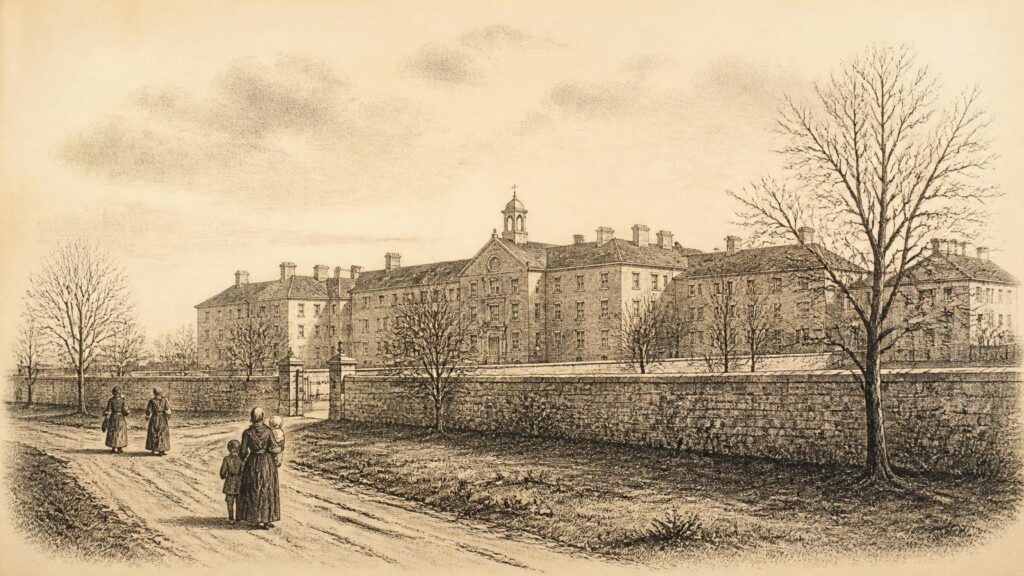
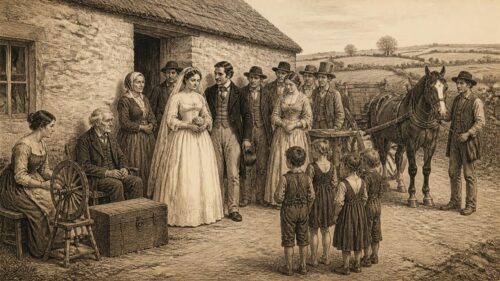
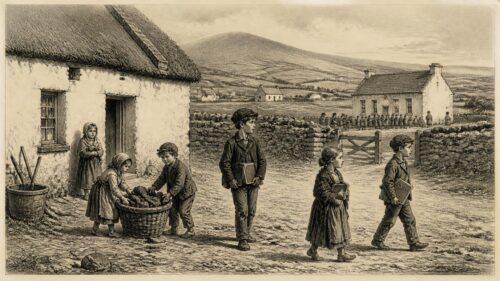
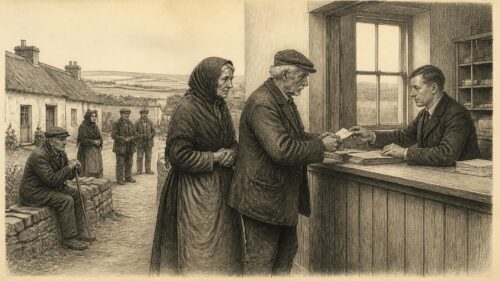
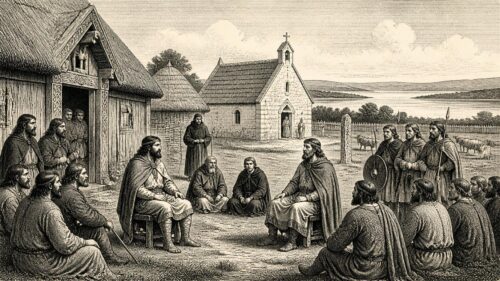
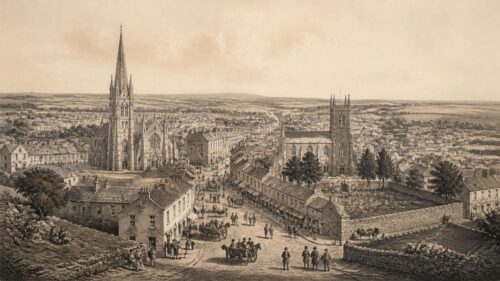
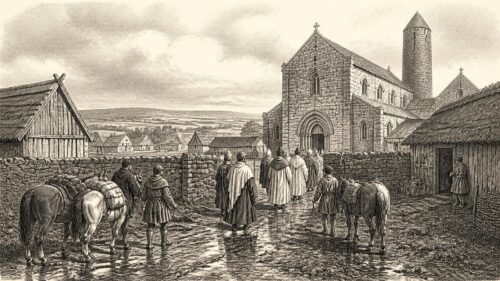
AI generated historical illustration, not a contemporary photograph.
At a Glance
The Tuam Mother and Baby Home was a publicly funded institution in County Galway, operated by the Bon Secours Sisters between 1925 and 1961. Its history joins local Poor Law administration, religious care, stigma around unmarried motherhood, infant mortality, adoption and fosterage, and changing ideas of citizenship and family. Catherine Corless’s research exposed a grave absence in the documentary record and prompted national investigation. The evidence confirms grave institutional failures and disrespectful burial practices, while leaving some individual histories unresolved. Forensic excavation, begun in 2025, makes Tuam an ongoing history of recovery, identification, memory and accountability in modern Ireland today still.
Historical Setting
The story of the Tuam Mother and Baby Home belongs unmistakably to Irish history, but it cannot be reduced to a single institution, one religious congregation or one shocking site. It arose from a long inheritance of poverty administration, social hierarchy, sexual regulation and institutional care. By the time the home opened in 1925, the old Poor Law workhouse system was being reorganised in the new Irish Free State. The former workhouse at Tuam, a building associated with the nineteenth-century relief system, was adapted to a new purpose: accommodating unmarried mothers and children regarded by official systems as dependent, troublesome or in need of supervision.
That transition matters. It shows that the home was not created in a vacuum, nor simply as an expression of private religious charity. The building and institution were the responsibility of Galway County Council, while the Sisters of Bon Secours operated it. The arrangement joined public finance and local-government responsibility to the work of a Catholic religious congregation. Later public shorthand often described Tuam as simply “church-run”, but that phrase is too imprecise for historical purposes. It can conceal the State and county authority’s roles in ownership, funding, oversight and welfare policy, while also obscuring the separate authority exercised by the congregation that managed daily life.
The home’s residents were mostly women who had become pregnant outside marriage and their children. In twentieth-century Ireland, unmarried pregnancy could bring acute shame, estrangement from relatives, economic precarity and loss of employment. These pressures did not affect everybody in the same way. Class, family resources, place of residence, health, age and the willingness of relatives to offer support could alter a woman’s options. Yet the institutional solution was widespread: women could enter homes, maternity facilities, county homes or related establishments, and children could remain in institutions, be boarded out, fostered, adopted or returned to family.
Tuam therefore needs to be read both as a local institution and as a window onto a national system. It was one of the institutions examined by the Commission of Investigation into Mother and Baby Homes and Certain Related Matters, established in 2015. The Commission considered the period from 1922 to 1998 across named institutions and selected county homes. Its work placed Tuam in a broader history of state welfare, religious administration and the marginalisation of women and children whose lives did not conform to dominant expectations of marriage and family.
Poor Law
The former Tuam workhouse was part of the institutional landscape inherited from the nineteenth century. Workhouses had been intended to provide relief to the destitute under a system that often distinguished harshly between deserving and undeserving poverty. They separated families, imposed discipline and made the receipt of relief conditional on entry into an institution. In Ireland, the workhouse became especially associated with the catastrophe of the Great Famine, though its history extended before and after those years. That association gave the Tuam site a particular historical weight long before the mother and baby home became known internationally.
After independence, Irish administrations did not simply discard inherited welfare structures. They altered and repurposed them. The Commission’s account records that the Tuam building ceased operating as a workhouse in the early 1920s and was briefly occupied by the Free State army. A predecessor children’s home at Glenamaddy, also in County Galway, accommodated unmarried mothers and children from 1922. It was run by the Bon Secours Sisters and owned by Galway County Council, but its accommodation was judged poor. In 1925, the children were moved to the former Tuam workhouse. The Commission treated Glenamaddy and Tuam as parts of one institutional history.
The continuity was more than architectural. The new institution inherited assumptions that people in poverty could be managed collectively and that women without marital support might be dealt with outside ordinary community life. Such arrangements were not uniquely Irish, nor were all residents passive victims without family ties or agency. Some women sought admission because circumstances gave them few alternatives; some may have received practical assistance that was otherwise unavailable. But the availability of shelter or medical attention does not remove the coercive social environment that made institutionalisation appear necessary. A historical account must hold both facts together.
Nor should the old workhouse be imagined as an unchanging relic. The Tuam home operated for thirty-six years, through the consolidation of the Irish State, the Emergency, post-war austerity, changing public-health policy and the beginnings of a more modern welfare administration. Conditions, staffing, medical practices and the possible futures of residents altered over that period. The enduring feature was that unmarried mothers and their children remained subject to a system in which social respectability, local authority expenditure and religiously inflected moral judgement could profoundly affect private lives.
Institutional Authority
Names are important in this history because they reveal how institutions represented themselves and how others remembered them. The Commission noted that its terms of reference used “Bon Secours Mother and Baby Home”, but that this did not appear to have been the ordinary historical title of the institution. Galway County Council generally called it the Tuam Children’s Home; the Sisters used St Mary’s Children’s Home; locally, it was often known simply as “the Home”. These names indicate that the institution was not solely a maternity home. It housed children as well as mothers, and many children remained after their mothers departed.
The distinction between owner, operator and religious authority must be made carefully. Galway County Council owned the institution for the relevant period and bore ultimate responsibility for residents in a public administrative sense. The Bon Secours Sisters managed the home and supplied or organised staff under financial arrangements involving capitation payments from local authorities. The Archdiocese of Tuam did not administer the home, although clergy had pastoral roles and the institution existed within a Catholic social culture. The congregation’s later apology accepted that its sisters had failed to respect the dignity of women and children in its care. That acknowledgement is historically significant, but it does not make the council’s responsibilities disappear.
Authority was dispersed rather than absent. Council officials, medical officers, inspectors, departments of government, religious superiors, doctors, nurses, chaplains, families and adoption or fostering agencies all had some place in the wider machinery affecting residents. A dispersed system can be difficult to hold to account because each participant may point elsewhere: to funding constraints, professional judgement, inherited custom, legal ambiguity or the decisions of another body. Tuam became a powerful symbol partly because it revealed how easily responsibility can dissolve when care is divided among institutions.
The ordinary paper trail reflects this complexity. Surviving material includes admissions and discharge information, maternity registers, records concerning children who were boarded out or adopted, statistical returns and death records. Yet records are neither complete nor morally neutral. They were created for administrative purposes, not to preserve residents’ own accounts. Crucially, the absence of burial records for the children whose deaths were registered became central to the later historical investigation. A system capable of registering death could nevertheless fail to provide a traceable, dignified record of burial.
Women Arriving
Women entered Tuam in circumstances that were often shaped by stigma. In a society where sexual respectability was closely tied to marriage, pregnancy outside marriage could expose women to condemnation from family, neighbours, employers and clergy. The stigma was social as well as legal or institutional. It operated through gossip, dependence, the fear of disgrace and economic vulnerability. For a domestic servant, farm labourer, shop worker or young woman with little independent income, pregnancy could threaten housing and livelihood at once.
The term “unmarried mother”, widely used in official documents of the period, carries the assumptions of the system it describes. It identified women through marital status and motherhood while leaving fathers less visible. The language could imply that the woman herself was the problem to be managed. Modern readers should not reproduce that judgement uncritically. These were women with individual histories: some were adults, some very young; some had family support, others did not; some entered voluntarily in a narrow practical sense, but under conditions in which refusal might mean homelessness, hunger or public disgrace.
The Commission gathered documentary and testimonial evidence about the wider mother and baby home system. Its final report, and especially the confidential committee’s testimony, recorded accounts of emotional pain, denigration, separation and loneliness. Such testimony is essential evidence, though it must be interpreted with care. An oral account given decades later may not settle every date or administrative detail, but it conveys experiences frequently omitted from official records. The fact that a register gives a woman’s name, age and admission date does not reveal how she was treated, what she feared or whether she felt she had any meaningful choice.
It would be historically careless to state that every woman’s path through Tuam was identical. Evidence differs from case to case and many personal files remain private for good reasons. Nonetheless, the institutional setting was one in which women’s autonomy was constrained. The home placed pregnancy, childbirth and early motherhood under supervision. It could separate women from ordinary family networks and made the futures of children dependent on decisions shaped by welfare procedures, resources and prevailing moral attitudes. That broader structure is documented even where the intimate details of individual lives are not.
Children Remaining
Children were at the centre of Tuam’s purpose, but not always at the centre of public memory until the twenty-first century. The home admitted infants and children, and its designation as a children’s home reflected that function. Some children were born there; others arrived with their mothers or were transferred from elsewhere. When a mother left, a child might remain. The paths that followed could include boarding out, foster care, adoption, transfer to another institution, return to relatives or death in the home.
Boarding out was a longstanding form of child welfare in Ireland and Britain, involving placement with foster families who received payments. It should not be treated as identical to adoption. Adoption created, or purported to create, a new legal family relationship; boarding out was a care arrangement, often supervised by local authority structures. In practice, the distinction could be blurred in public memory because both involved separation from birth families. For those seeking relatives today, the different systems also produced different types of records and different obstacles to tracing origins.
The Adoption Authority of Ireland identifies Tusla as the record-holding body for the Tuam Mother and Baby Home, while also listing the related Bon Secours institution in its national guide to records. Tusla has stated that relevant files include admissions, discharges, maternity registers, boarding-out and adoption records, and quarterly returns. Such material is valuable but sensitive. The modern right of affected people to seek information about themselves is a significant reversal from an older culture in which secrecy was embedded in welfare and adoption practice.
It is tempting to write a single, totalising account in which every child was removed against a mother’s will or every placement was unlawful. The evidence does not justify that simplification. What can be said is that the system gave mothers limited power at moments of profound dependence, that many families were separated, and that children’s futures were decided within institutions designed around the perceived problem of unmarried motherhood. The scale of later tracing and access-to-information demands demonstrates that separation was not a closed event. It endured across lifetimes and generations.
Health Conditions
Tuam operated during decades when infant and child mortality in Ireland was much higher than it is now, infectious disease remained dangerous and medical resources were unevenly distributed. That context must be acknowledged, but it cannot be allowed to explain away the conditions recorded at the home. Historical comparison is not exculpation. The question is not whether children everywhere were vulnerable; it is whether residents received adequate care, nutrition, warmth, hygiene, supervision and medical attention within an institution maintained for their welfare.
Documents examined in later investigations indicate substantial concerns. Inspection material and official correspondence pointed to problems with accommodation and standards at different points in the home’s history. Accounts of the later 1950s described a poorly maintained building, inadequate heating and accommodation that was unsuitable for children. The physical fabric of the former workhouse was itself a problem. A building designed for a punitive nineteenth-century relief system was ill suited to the needs of pregnant women, infants and young children.
Staffing and finance were also central. Institutions caring for large numbers of dependent children require sustained investment and skilled labour. The Commission’s wider findings described homes as often understaffed, regimented and inadequately resourced, especially in earlier decades. At Tuam, local authority responsibility for building upkeep and oversight existed alongside the Sisters’ management of staffing from capitation payments. This division did not produce a reliable safeguard. Instead, responsibility could become fragmented, with financial limitations translated into poor daily conditions.
In historical writing, words such as neglect require precision. A death certificate may give a medical cause; it does not automatically demonstrate the whole chain of causation, still less establish individual criminal liability. But a catalogue of deaths from measles, respiratory illness, gastroenteritis, congenital conditions, malnutrition-related conditions and debility can be read alongside records of overcrowding, poor facilities and weak oversight. The cumulative picture is one of children living in a highly vulnerable setting where institutional shortcomings mattered. That is a stronger and more supportable conclusion than treating every death as either inevitable or deliberately caused.
Mortality Records
The numbers associated with Tuam have become emblematic, but they need careful handling. Catherine Corless’s research identified death certificates for 796 children who died in connection with the home between 1925 and 1961. The figure represented a major archival achievement: she assembled names and death information that had not been publicly brought together in this way. It gave individual identities to children who had largely vanished from public record and revealed the exceptional scale of mortality across the institution’s thirty-six years.
The figure is not, however, a ready-made count of those buried in any one location. Death registration and burial registration are different records. Some children may have been buried elsewhere, perhaps with relatives; evidence must establish burial location separately. Later reporting has sometimes used nearby but different totals drawn from different institutional datasets or definitions of residence and death. Such variation does not undermine the seriousness of the historical problem. It reinforces the need to state what each number measures and to avoid turning a documented mortality total into an unsupported forensic conclusion.
The mortality pattern was uneven. Some years were markedly worse than others, reflecting outbreaks of infectious illness and the broader fragility of infant health. The early decades were especially severe. This was not unique to Tuam, and the Commission found high infant mortality across many mother and baby homes. Yet comparison is not consolation. Children in institutional care were entitled to proper protection precisely because they were dependent on adults and public bodies for every aspect of their wellbeing.
Death certificates record causes in the medical vocabulary of their time. They may list conditions such as congenital debility, measles, gastroenteritis, tuberculosis, pneumonia or heart disease. These entries are evidence, but not transparent windows into clinical reality. Diagnostic standards changed; certifying doctors had limited tools; terminology could be broad. Historians should therefore resist both extremes: dismissing the certificates as meaningless, or claiming that they alone prove a specific institutional cause. Read with inspection reports, correspondence, testimony and mortality comparisons, they establish a grave pattern requiring explanation.
Burial Evidence
The absence of burial records was the question that transformed Tuam from a little-known local history into a national matter. Deaths had been registered, but researchers could not locate corresponding burial records for the great majority of children identified in the home’s death certificates. This was not simply an archival inconvenience. Burial is an act of dignity, kinship and public recognition. When the location and treatment of the dead cannot be established, bereaved families are denied knowledge and the deceased are denied an identifiable place in communal memory.
Local accounts had long referred to children’s remains at or near the former home. Those accounts must be distinguished from verified fact. Oral memories can preserve important knowledge, particularly where official records are incomplete; they may also change as stories are repeated. It was therefore essential that subsequent investigation proceed through archaeological and forensic methods rather than through rumour alone. The question was not whether a dramatic story could be told, but what the physical evidence could demonstrate.
In March 2017, the Commission of Investigation confirmed that significant quantities of juvenile human remains had been found in subsurface chambers associated with a historic sewage system at the former institution. This finding established far more than the early, inaccurate shorthand of a “septic tank grave” allowed. The remains were not a media invention, nor was the matter confined to folklore. At the same time, the finding did not support every claim made during the controversy. The site was archaeologically complex, and the precise number, identities and circumstances of those buried there required further work.
The distinction is morally important. Calling the chambers merely a “septic tank” can imply a simple and sensational narrative; calling them only part of a historic sewage system can risk minimising the horror of human remains being present there in significant quantities. Both the physical context and the human significance must be retained. The State’s later decision to undertake a full forensic excavation recognised that the site required investigation as a burial place, not simply preservation as an unresolved memorial.
Local Memory
Tuam’s history was not discovered from nowhere in 2014. It persisted in local memory, in stories about the home, in the knowledge of residents and in the physical geography of the former site. After the home closed in 1961, the building was eventually demolished and a housing estate developed nearby. The transformation of institutional ground into an ordinary residential landscape made the earlier history easier to overlook, but it did not erase it.
Some people recalled children’s remains being encountered at the site in the 1970s. Others recalled a small memorial area or traditions concerning burials. Such recollections are part of the evidence base, though they must be treated as testimony rather than as self-proving fact. The persistence of local concern is significant because it helps explain why the later discovery did not arrive as an entirely unfamiliar idea to many in Tuam. It also complicates the notion that everybody knew, or that nobody knew. Knowledge can be partial, private, class-bound, dismissed or treated as something better left unspoken.
For decades, no coherent official response joined death records, burial questions, local memory and site evidence. That silence was institutional as well as personal. People who had been residents, relatives or neighbours may have lacked access to files, confidence that they would be heard, or a public language in which to raise the subject. The social shame attached to unmarried motherhood did not end when an institution closed. It could continue to inhibit testimony and family discussion.
Local memory also deserves respect without romanticisation. A town is not a single moral actor. Tuam included former residents, families, religious personnel, officials, workers, neighbours and later householders, all with different degrees of knowledge and power. To blame an entire community for failures of institutional administration would be historically lazy. Equally, it would be wrong to portray the community as only a passive witness. Local researchers, campaigners and residents helped ensure that questions about the dead were not permanently buried with the records.
Research Breakthrough
Catherine Corless’s work was decisive because it combined local historical curiosity with persistent documentary research. Her 2012 article on the home in the Journal of the Old Tuam Society drew attention to its history. She then pursued death records for children who had died at the institution, assembling the names and certificates associated with 796 deaths. Her research did not establish that all of those children lay in one place. What it did establish was the scale of death and the striking absence of documented burials for most of those children.
The distinction between discovery and proof is central to Corless’s achievement. She did not simply repeat local lore; she tested questions against records. Her findings brought together evidence that had existed in dispersed state archives but had not been meaningfully connected. This is a familiar function of local history at its best. A local researcher can notice gaps in the official narrative, know the terrain, pursue overlooked records and ask questions that larger institutions have failed to ask.
Her work also demonstrates the limits of archival systems. Records do not speak by themselves. A death certificate might remain a bureaucratic fact until someone compares it with cemetery registers, institutional files and the remembered landscape. The absence of a record can be as historically important as its presence, though absence has to be interpreted cautiously. Records may have been lost, never created, held elsewhere or remain inaccessible. Corless’s work showed that the missing burial trail deserved formal investigation, not that every unanswered question had already been resolved.
The public response to her research was intense. International reporting often favoured sensational images and simplified phrases. Some reports overstated what was known in 2014; others gave inadequate attention to the conditions that had made the question possible. Yet public attention also created pressure for action. It prompted the Irish Government’s initial interdepartmental inquiry, contributed to the establishment of the Commission of Investigation and ensured that a local history became part of the country’s larger reckoning with institutional abuse and exclusion.
Public Controversy
The controversy surrounding Tuam shows why historical precision matters in public life. The phrase “800 babies in a septic tank” circulated widely after 2014. It expressed public shock and conveyed the scale of loss, but it was not an accurate summary of the evidence then available. The 796 figure referred to registered deaths over the home’s lifespan, not a proven count of remains in one chamber. Nor was the site a conventional operating septic tank. Later forensic findings confirmed juvenile remains in chambers associated with a disused sewage system, but the exact relationship between all deaths, all burials and all remains was not settled by a headline.
Correcting such language must not become a means of denying the scandal. There is no contradiction between rejecting exaggeration and recognising the profound wrong of unrecorded, disrespectful burial practices. Indeed, accuracy protects the dignity of the dead. It keeps their history from being turned into a grotesque symbol detached from names, families, medical records, institutional decisions and the particularities of the site.
Controversy also arose around responsibility. Some commentary treated the home as entirely an institution of the Catholic Church; others reacted by stressing local authority ownership as though that settled the issue. The historical record requires a more demanding account. The Bon Secours Sisters operated the home. Galway County Council owned it and was responsible within the public system. State departments shaped policy, funding and inspection. The wider Catholic culture of the period helped create and sustain the stigma in which unmarried mothers were judged. Responsibility was shared but not therefore diluted.
Another dispute concerned how to respond to the burial site. Survivors, relatives, local residents, campaign groups, archaeologists and public bodies did not always agree whether remains should be left undisturbed, recovered, identified where possible or memorialised in a particular manner. These were not merely technical differences. They involved competing understandings of kinship, consent, religious respect, forensic obligation and the rights of people whose relatives may be buried there. The eventual intervention was shaped by consultation, legislation and recognition that no simple remedy could undo the original failures.
State Inquiry
In February 2015, the Irish Government established the Commission of Investigation into Mother and Baby Homes and Certain Related Matters. Its remit was broader than Tuam, covering fourteen named institutions and a sample of county homes over the period from 1922 to 1998. The Commission was chaired by Judge Yvonne Murphy, with Dr William Duncan and Professor Mary E. Daly. It examined entry routes, care, mortality, burial, exit pathways, adoption, boarding out and the role of public authorities.
The Commission’s establishment marked an important change in official language. What had often been framed as private shame or isolated misfortune was treated as a matter requiring public investigation. The inquiry accumulated records, received testimony and issued interim reports before delivering its final report to the Minister in October 2020. The report was published on 12 January 2021. The Commission was subsequently dissolved, but its records and findings remain central to understanding the institutions.
Commissions are not courts of universal memory. They work within statutory terms, evidence rules, time limits and available documentation. The mother and baby homes inquiry was criticised by some survivors and advocates, particularly over its conclusions, treatment of testimony and language about coercion and responsibility. Those criticisms are themselves part of the historical record of reckoning. A report can be authoritative as a major state investigation without being the final word on every experience or every moral judgement.
For Tuam, the Commission confirmed the forensic significance of the site and provided an institutional history grounded in council, religious and departmental records. It also made clear that mother and baby homes must be understood within a wider system. The question was not simply why conditions were poor in one Galway building. It was why Irish society and its public authorities developed arrangements that segregated unmarried mothers and their children, accepted high mortality and failed to ensure traceable, dignified burials.
Commission Findings
The Commission’s final report offered a complex, sometimes contested account. It found that unmarried mothers and their children were treated harshly by Irish society over the period examined, and that the institutions reflected a broader social culture of condemnation and exclusion. It did not depict the homes as isolated worlds detached from families, local communities or government. Rather, it described systems in which women’s lack of support, poverty and social stigma made institutional entry more likely.
In relation to mortality, the Commission found that infant mortality in mother and baby homes was very high, particularly before the 1960s. It considered factors including the vulnerability of infants born to mothers facing disadvantage, infectious disease, medical knowledge, nutrition and institutional conditions. The report’s comparative approach is important: it tried to distinguish mortality patterns common in the period from those made worse by institutional arrangements. Yet the moral force of its findings remains. Children in the homes were not abstract statistical cases. Their deaths occurred while bodies charged with their care had responsibilities that extended beyond registering causes of death.
For Tuam specifically, the Commission documented the former workhouse setting, the transition from Glenamaddy, the roles of Galway County Council and the Bon Secours Sisters, and the history of the burial issue. Its 2019 interim report devoted a chapter to the Tuam Children’s Home. It identified the home’s local administrative framework and reviewed the evidence then available concerning burial practices. The 2017 test excavation had already demonstrated that the matter required specialist forensic treatment.
The report did not resolve every personal case. It could not identify every child, establish every family relationship or reconstruct the decisions behind every separation. Historical justice often confronts that limit: the documentary record was produced by institutions that did not consider future truth recovery a priority. Nevertheless, the Commission assembled an evidential foundation on which later policy, access to records, redress, memorialisation and forensic work could proceed.
Evidence Limits
Tuam has generated a strong desire for definitive answers. That desire is understandable, but the available evidence imposes limits. The first limit is numerical. The 796 registered deaths identified by Catherine Corless are not automatically the number of bodies at the site. The number of remains recovered, the number of individuals represented and the number who can be identified through DNA may all differ. Stillbirths, infants buried elsewhere, incomplete documentation and commingled remains complicate every calculation.
The second limit concerns cause and responsibility. Poor conditions, inadequate oversight and high mortality are documented. It does not follow that every individual death can be attributed to a single act of neglect, a particular person or a criminal offence. Medical records may be incomplete and historical diagnoses uncertain. Careful language does not weaken condemnation of the system; it ensures that moral and legal claims rest on evidence rather than inference alone.
The third limit concerns testimony. Survivor accounts have great value and deserve serious attention, especially because official files frequently excluded residents’ voices. Yet memories may be partial, traumatic or shaped by events learned later. Historians should neither dismiss testimony because it is personal nor demand that it function like a complete administrative ledger. The best approach is corroborative: place testimony alongside registers, letters, inspection reports, maps, archaeological evidence and the social conditions of the period.
Finally, there is a limit in language. “Home” can sound benign; “institution” can sound impersonal; “mother and baby home” may conceal the presence of older children. “Burial ground” can suggest a recognised cemetery; “septic tank” can suggest an oversimplified forensic picture. Each term carries implications. Precision is not pedantry in this subject. It is a form of respect for people whose lives were too often reduced to administrative categories or erased entirely.
Moral Responsibility
The history of Tuam raises questions of moral responsibility that cannot be answered by assigning all blame to one institution. Galway County Council had public responsibility for the home and its residents. The Bon Secours Sisters ran the institution and exercised immediate authority over daily care. State departments set the legal and policy framework and had inspection roles. Medical professionals made clinical decisions and certified deaths. The wider culture of church, family and community helped stigmatise unmarried mothers and make their exclusion appear normal.
Shared responsibility must not become an excuse for vagueness. Different actors held different forms of power. The council controlled ownership and public welfare arrangements. The religious congregation managed the home. Government had the capacity to regulate, fund, inspect and reform. Religious and social authorities shaped the norms by which women were judged. Families sometimes acted with compassion, sometimes with rejection, and often within difficult material circumstances. Historical responsibility should be apportioned according to authority, knowledge and capacity to act, not according to the convenience of later institutions.
The Sisters of Bon Secours publicly apologised after the Commission’s report was published. They acknowledged their role in a history in which women and children experienced hardship, loneliness and hurt, and specifically recognised that infants and children who died at the home had been buried in an unacceptable and disrespectful way. Such an apology cannot restore a lost childhood, resolve an unknown burial or heal every family separation. It does, however, represent an institutional recognition that the language of charity cannot excuse a failure of care and dignity.
The State apology delivered in the Dáil in January 2021 likewise mattered because it recognised official failure towards people who had spent time in these institutions. Apology is not the end of responsibility. It gains substance through records access, health supports, redress, historical preservation, participation by survivors and relatives, and respectful treatment of the dead. Tuam remains a test of whether public acknowledgement can become practical accountability.
Legal Response
The path from discovery to intervention was lengthy. After the 2017 finding of juvenile remains, an Expert Technical Group considered possible responses to the site. Its work emphasised the exceptional forensic challenges: remains were in confined subsurface chambers, were commingled, and existed within a landscape that had changed since the institution closed. The Government decided in October 2018 that a phased forensic excavation, recovery and identification programme should be pursued, followed by respectful reinterment.
That decision required legislation. Ordinary cemetery law and archaeological processes were not designed for a site where human remains may have been buried in a manifestly inappropriate manner, where relatives might seek identification, and where work would involve substantial disruption to a modern residential environment. The Institutional Burials Act 2022 provided a specific legal framework for intervention. It enabled the appointment of a Director of Authorised Intervention, recovery and analysis of remains, a DNA identification programme, consultation with relatives and arrangements for final burial.
The legislation reflected a difficult balance. Forensic recovery can offer knowledge and possible identification, but it also disturbs a burial site. DNA testing can reconnect families, but it raises questions of consent, privacy and expectations. Some relatives may prioritise recovery; others may fear that excavation will cause further distress. The law did not eliminate these ethical questions. It created a structure in which they could be addressed through an independent office, scientific standards and engagement with affected people.
In March 2023, the Office of the Director of Authorised Intervention, Tuam was formally established. Its mandate is not merely archaeological. It combines excavation, recovery, scientific analysis, identification where possible, return of identified remains to families and memorialisation. The wording is significant: the work is intended to accord dignity to people whose burials were regarded as manifestly inappropriate. The legal response therefore recognises that the site is both evidence and a place of mourning.
Forensic Recovery
Full forensic excavation of the former Tuam institution site began on 14 July 2025. This was not a symbolic dig and should not be understood as a search for a single chamber or a predetermined number of bodies. The Office of the Director of Authorised Intervention is excavating the full available site using forensic archaeological methods. It is working from historical maps, ground-penetrating radar, documentary material, witness information and the findings of the earlier test excavation.
The scientific tasks are formidable. Human remains may be fragmented or commingled. Soil conditions, earlier construction, demolition, landscaping and the presence of historic structures can complicate recovery. Archaeologists must distinguish remains connected to the mother and baby home period from other possible burials or material associated with the older workhouse landscape. Specialists must document context meticulously, because location, stratigraphy and association with artefacts can be crucial evidence even where DNA identification proves impossible.
Identification is necessarily qualified. The office aims, where possible, to individualise recovered remains and compare DNA with samples provided by relatives. But identification may not be possible in every case. DNA can be degraded; close relatives may be unavailable; the reference database may not yield a match; and commingling makes individual separation difficult. The ethical importance of the work does not depend entirely on matching names to remains. Recovery, analysis and respectful reburial can acknowledge personhood even where individual identity remains unknown.
Forensic work also revises public understanding as it proceeds. Earlier claims, maps and memories must be tested against what is physically found. That process may confirm some beliefs and unsettle others. It is therefore important not to announce conclusions in advance. The dead at Tuam deserve more than an outcome designed to fit a pre-existing narrative. They deserve a method capable of producing reliable evidence, preserving uncertainty where it remains and communicating findings honestly to relatives and the public.
Survivor Voices
For survivors and relatives, Tuam is not only a historical subject. It concerns origins, separation, bereavement and identity. Many people who spent time in mother and baby homes grew up without complete knowledge of their birth family, the circumstances of their adoption or fostering, or the place where a sibling or child died. The administrative secrecy of earlier decades became an intergenerational burden. A person may learn late in life that they had a brother or sister, that their mother had been in Tuam, or that a relative’s burial place remains uncertain.
The University of Galway’s Tuam Oral History Project recognises that official reports cannot contain every life story. Its purpose is to record and preserve testimony from survivors, relatives and others connected to the institution, allowing people to tell their histories in their own terms. Oral history is especially important where formal documents have treated people as cases. It restores names, emotions, family relationships and agency to a history that bureaucratic files often flatten.
Survivor testimony should not be used merely to add pathos to an institutional narrative. It can change the questions historians ask. Instead of asking only how many children died, it asks what it meant to be separated from a mother; instead of considering adoption only as procedure, it asks what lifelong uncertainty feels like; instead of treating a home as a building, it examines how rules, routines and shame were experienced by children and women. Such testimony may challenge official conclusions and should be allowed to do so.
There is also an ethical obligation not to demand disclosure. Some survivors may not wish to speak publicly, revisit trauma or have their identities attached to an institution. Silence can be a choice deserving respect, not evidence that harm was absent. A humane historical culture provides opportunities for testimony without insisting that those harmed must continually prove their suffering for the benefit of others.
Historical Meaning
Tuam has become one of the defining sites of modern Irish historical memory because it concentrates several national questions in one place. It raises the legacy of the Poor Law and the survival of institutional welfare; the role of Catholic religious orders and public authorities; the treatment of women outside marriage; the vulnerability of children in care; the limits of official record keeping; and the struggle to recover dignity after decades of silence.
It is also a warning against simple stories. A narrative that blames only nuns overlooks public administration and social complicity. A narrative that stresses only high historical infant mortality overlooks institutional conditions and failures of care. A narrative that repeats only sensational claims can obscure the actual, documented facts. A narrative that demands perfect certainty before acknowledging wrong can use archival gaps to prolong injustice. The task is to retain complexity without surrendering moral clarity.
In that sense, Tuam belongs alongside other Irish reckonings with industrial schools, Magdalene laundries, county homes, illegal adoption practices and institutional abuse. Each has its own history and evidence; they should not be collapsed into one undifferentiated story. Yet they share themes: the regulation of vulnerable people through institutions, the authority of church and State, the insufficiency of oversight, secrecy around sexuality and family, and the belated importance of survivor testimony.
Historical understanding does not mean judging the past solely by present standards. It means identifying the standards, alternatives and responsibilities that existed at the time. People in the 1920s, 1930s or 1950s did not possess today’s legal language of children’s rights, but they understood illness, grief, family bonds, poverty and the obligation to bury the dead with respect. Contemporary concern about poor conditions and inadequate facilities existed in records of the period. The failures at Tuam were not invisible merely because they occurred in another age.
Continuing Questions
Many questions remain open. How many individuals are represented in the remains recovered from the site? Which, if any, can be identified through DNA? How many children who died in the home were buried elsewhere? What can forensic evidence reveal about dates, treatment of remains and the circumstances of burial? How should final reinterment and memorialisation reflect the wishes of relatives, survivors and the Tuam community? These are questions for evidence, consultation and time, not speculation.
Other questions are archival. Records held by Tusla, the Adoption Authority of Ireland and State bodies may help people trace personal histories, but access must respect privacy and data protection. The challenge is to make information available to those entitled to it while protecting the sensitive details of living people. For individuals affected by Tuam, a register or file can be more than historical evidence. It may be the first official recognition of a relationship that secrecy had obscured.
There is also the question of how Ireland will teach this history. It should not be taught as a detached scandal caused by people unlike ourselves, nor as an excuse for national self-condemnation without understanding. It should illuminate how social values become institutions, how administrative systems can fail those in their care, and how local research and survivor persistence can force public authorities to act. It should also preserve the individuality of women and children whose lives were too often classified, transferred or forgotten.
Tuam’s final historical meaning cannot yet be fixed because the forensic intervention continues. But its broad significance is already clear. The home was not an aberration outside Irish society; it was created and sustained within it. Its history demands accuracy, humility and compassion. Above all, it demands that the people connected with the institution be remembered not as an anonymous number, an image or a controversy, but as mothers, children, siblings and relatives whose lives carried value then and carry meaning now.
Tuam’s history raises an issue about dispersed responsibility. Galway County Council owned and funded the home, while the Bon Secours Sisters managed daily life, and other officials, professionals and families influenced decisions affecting women and children. This arrangement helps explain how poor conditions, missing burial documentation and unresolved personal histories could persist without a single locus of accountability. The 2025 forensic excavation transforms archival absence into responsibility, linking identification with memory, repair and recognition. How should Ireland distinguish the responsibilities of public authorities, religious operators and wider welfare systems when interpreting Tuam’s legacy and pursuing accountability for survivors and descendants?