Fedlimid’s Meelick Captivity1231 CE
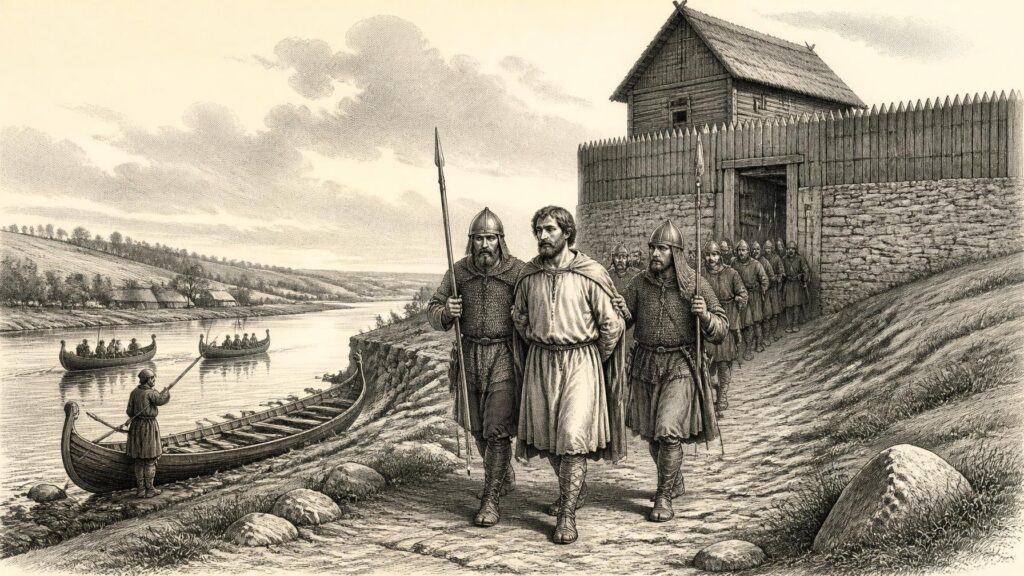
In 1231 Richard de Burgh captured Fedlimid mac Cathail Chrobdeirg Ó Conchobair at Meelick, despite guarantees, exposing the fragility of Gaelic rulers’ alliances with Anglo-Norman power. Imprisoned in strategically placed Shannon castle, Fedlimid’s fate left Connacht contested; his release and later victory belonged to subsequent years. Annals also record Connacht’s religious and local life: deaths among ruling families, Boyle Abbey’s pilgrim connections, episcopal succession at Elphin, and Dionysius Ó Mórda’s death on Trinity Island. They note learned status, Mac Diarmata’s market project, a waterborne Breifne raid, and Ualgarc Ó Ruairc’s fatal Holy Land pilgrimage, revealing active networks amid political instability.
Dateline
In 1231, the most consequential Irish political event securely assigned to the year was the seizure of Fedlimid mac Cathail Chrobdeirg Ó Conchobair, claimant and recent ruler of Connacht. He was taken at Meelick by Richard de Burgh, known in Irish annals as Mac William Burke. The capture was more than a sudden reversal for one king: it exposed the precarious bargain by which a Gaelic ruler could gain power with Anglo-Norman backing, only to find that backing turned into custody. Around Lough Key and across Connacht, meanwhile, the year’s annals preserve a denser local world of monastic deaths, episcopal succession, pilgrimage, learned families, raiding by water and an attempt to establish a market settlement.
A King Taken at Meelick
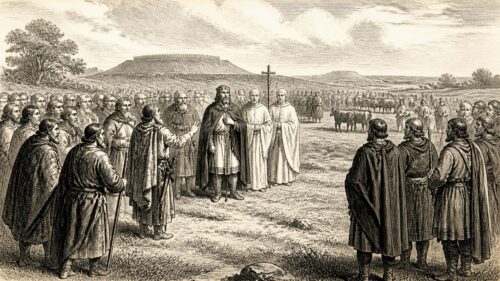
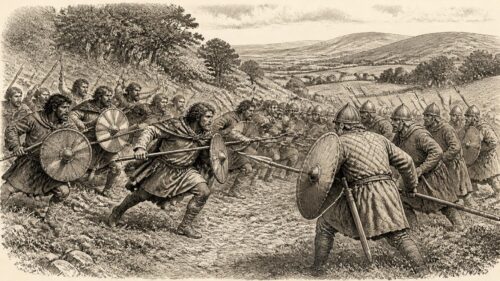
The Annals of Connacht state that Fedlimid was taken prisoner at Meelick “in violation of the guarantees of the leading Galls of Ireland”; the Annals of Inisfallen similarly call the act treacherous and shameful. Such wording records the chroniclers’ moral judgement, but it also identifies a practical political point: guarantees or safe-conducts mattered. They were instruments through which rulers, magnates and churchmen negotiated meetings, submissions and settlements. Breaking one could bring an immediate advantage, but damaged the trust on which alliances depended.
Fedlimid was the son of Cathal Crobderg Ó Conchobair, the formidable king of Connacht who had died in 1224. Cathal’s death had opened a prolonged contest within the Ó Conchobair dynasty, while the Anglo-Norman lordship sought to turn that division to its own advantage. Richard de Burgh, justiciar of Ireland and holder of royal claims in Connacht, had helped Fedlimid displace his rival Áed mac Ruaidrí in 1230. That arrangement did not mean that Fedlimid was merely a client. He had his own royal following and his own interest in ruling Connacht rather than administering it for de Burgh. By 1231 their partnership had collapsed.
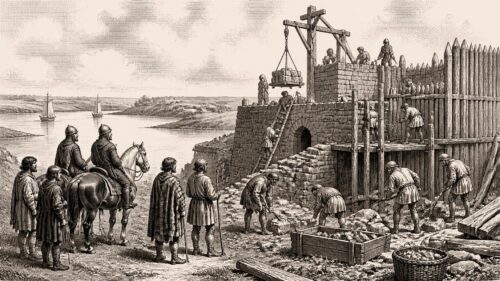
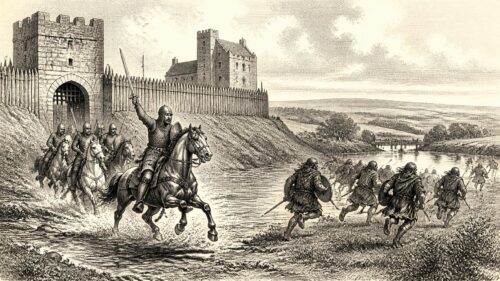
The precise circumstances of the arrest are not supplied by the surviving annals. It should not therefore be embroidered into a scene of a particular meeting, betrayal or battle. What can responsibly be said is that Fedlimid was imprisoned in de Burgh’s castle at Meelick, on the Shannon frontier in what is now south-east County Galway. The site was strategically well chosen: it lay at a crossing zone between Connacht, Meath and Thomond, where river movement, roads and military power met. Possession of a castle there allowed de Burgh’s administration to hold a royal captive while projecting authority into a disputed province.
The wider political outcome belongs chiefly to 1232 and 1233, rather than to 1231 itself. The fall of Richard’s uncle Hubert de Burgh from power in England weakened Richard’s position; the king ordered Fedlimid’s release in 1232. Fedlimid eventually returned to the struggle and killed Áed mac Ruaidrí in 1233. Those later developments clarify why the capture mattered, but they must not be mistaken for events of 1231. In that year, Connacht’s future was unresolved: its leading Gaelic ruler was in an Anglo-Norman prison, while his rival was again useful to de Burgh.
Connacht’s Religious Landscape
Much of what survives for 1231 comes from the learned and ecclesiastical communities of northern Connacht. This is partly an accident of record-keeping, but it is revealing. The annals name Feth fo lige, daughter of Conchobar Mac Diarmata and wife of Muirchertach Muimnech Ó Conchobair, who died during the year. Her obituary praises rank, generosity and reputation, and names her sons, including Toirrdelbach, prior of the church of Saints Peter and Paul. Elite women were central to the alliances that linked dynasties, but annalists also remembered them as patrons, mothers and figures of moral standing.
Boyle Abbey appears repeatedly. Dub Chablaig, another daughter of Conchobar Mac Diarmata, died there; Flaithbertach Ó Flannacáin, chief of Clann Cathail, died there while on pilgrimage after taking the cross. Boyle was a Cistercian foundation under the patronage of the Mac Diarmatas of Moylurg, and its substantial church had recently been completed. It was not a remote spiritual refuge apart from politics. It was tied to ruling families, received pilgrims and housed religious personnel whose deaths and careers were worth recording. The annalistic tradition itself was deeply connected with Boyle and the religious houses around Lough Key, so its unusually close attention to this district is understandable.
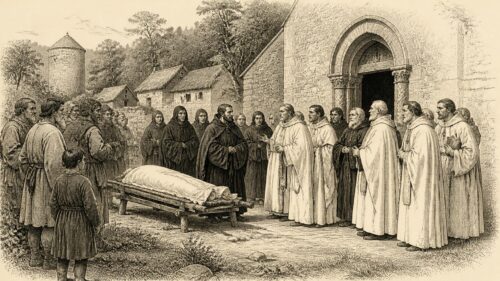
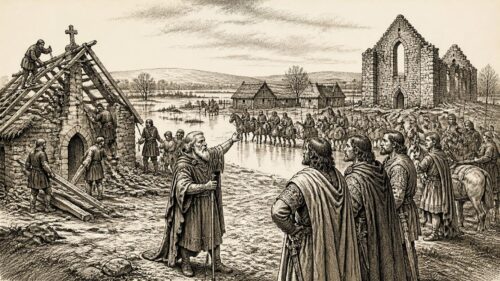
The year also brought changes in the church of Elphin. Dionysius Ó Mórda, formerly bishop of Elphin, died on Trinity Island in Lough Key on 15 December. The annal says that he had resigned his bishopric “for the love of God” and ended his life in devotion to God, to Clarus Mac Máelín, archdeacon of Elphin, and to the canons established on the island. His successor was Donnchad Ó Conchobair. The date is one of the few exact dates preserved for 1231, and it offers a glimpse of a well-connected religious household: a retired bishop, a prominent archdeacon, a community of canons and a lake-island monastery sustained by aristocratic and clerical patronage.
Trinity Island was the home of a Premonstratensian community founded in 1215 by Clarus Mac Máelín. Its location in Lough Key did not make it inaccessible. Inland lakes and rivers were working routes for people, livestock and goods, while islands provided defensible and symbolically powerful settings for churches. The choice of the island as Dionysius’s final residence illustrates the attraction of a penitential religious retirement, but also the practical importance of this small institutional centre within the political landscape of Moylurg and Elphin.
Learning, Markets and Local Lordship
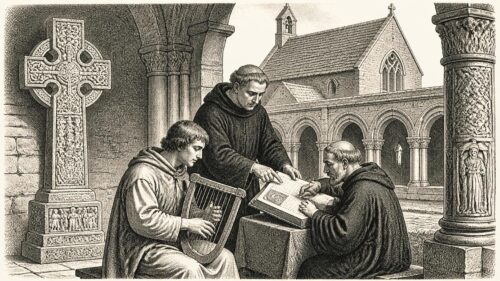
The death of Duinnín Ó Máelchonaire, described as ollam of Síol Muiredaig, is a reminder that learned status had public value. An ollam was a master in a recognised field of learning, a rank associated with the professional hereditary learned families who preserved genealogy, legal expertise, historical memory and literary culture. The annals do not specify Duinnín’s precise specialism, so it would be unsafe to assign him a particular office. Yet his notice shows that the political communities of Connacht valued scholarship alongside martial leadership and ecclesiastical office.
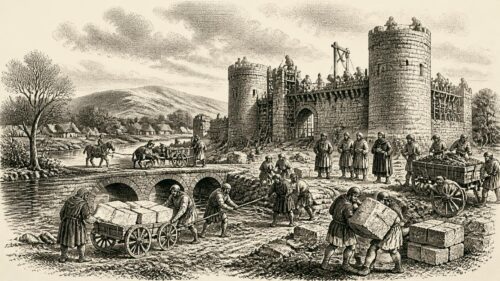
Another entry points more directly to economic change. Cormac son of Tomaltach Mac Diarmata began to make a market-town at Rockingham, recorded in Irish as Port na Carraige. The statement is concise but significant. A market required a place where producers, merchants, tenants and travellers could meet under a lord’s protection. It could draw tolls and dues, concentrate exchange, and turn an existing route or landing-place into a more regular settlement. The word “began” is important: the annal reports an undertaking, not a completed urban foundation, and it gives no basis for imagining a finished town laid out in a single year.
This initiative belonged to the Mac Diarmatas, rulers of Moylurg, whose authority was reinforced by their association with Boyle Abbey and the Lough Key region. In a period when Connacht’s kingship was disputed and de Burgh’s forces were active, local lordship remained capable of sponsoring settlement and trade. Political insecurity did not halt economic life; rather, control of markets, roads, cattle and waterways formed part of the competition for power.
War by Lake and Pilgrimage Abroad
Conflict was not confined to Connacht. Domnall Ó Domnaill, king of Tír Conaill, and Aengus Mac Gilla Finnein led an expedition against Cathal Ó Raghallaigh. They brought ships onto Lough Oughter, raided Eanish, slaughtered a celebrated white horse, and carried away valuables, treasure and other goods. The colourful detail about the horse is the annalist’s, and may indicate an animal of exceptional prestige rather than a routine military objective. The wider point is firmer: the attack used water transport to strike a lakeside or island community in the contested lands of Breifne.
The same annal records the death of Ualgarc Ó Ruairc, king of Breifne, while travelling on pilgrimage towards the River Jordan. Such a journey demonstrates the international horizon of elite Irish religious life. Pilgrimage to the Holy Land was arduous, expensive and dangerous, demanding ships, guides, money and connections beyond Ireland. Ualgarc’s death also marked the passing of a ruler whose kingdom had been squeezed by rival Irish dynasties and the expanding English lordship. The annal does not permit an exact place or date of death, only that it occurred on the journey in this year.
Thus 1231 is not best understood as a year of one dramatic arrest alone. Fedlimid’s captivity at Meelick revealed the unstable politics of Connacht under Anglo-Norman pressure. Yet the annals also show communities continuing to organise worship, commemorate the dead, train and honour learned men, make pilgrimages, raid by water and invest in places of exchange. Ireland’s political map was fragmented, but its religious, economic and cultural networks remained active across the very frontiers that warfare sought to control.
Primary Sources
- Annála Connacht: Annal 1231
- Annála Connacht: Irish Text and Edition Profile
- The Annals of Inisfallen: Annals 1228–1237
- The Annals of Ulster: Annal U1231
- Annals of the Four Masters: Annals 1222–1231
- Annals of the Four Masters: Irish Text
- The Annals in Cotton MS. Titus A. XXV: Source Description
- O'Connor (Ó Conchobair), Fedlimid
- Burgh, Richard de
- O'Connor (Ó Conchobair), Áed
- FitzGerald, Maurice fitz Gerald
- O'Rourke (Ó Ruairc), Ualgarc
- Trinity Abbey
- Boyle Abbey, Boyle
- School of the West
- Boyle Cistercian Abbey
- County Roscommon Urban Archaeology Survey
- County Cavan Urban Archaeology Survey
- CELT Project: Annála Connacht
- CELT Project: Annals of the Four Masters
- CELT Project: The Annals of Ulster