Samhain on the Ríg781 CE
In 781, men of Brega defeated a Leinster force at the battle of the Ríg during Samhain, killing Cú Chongalt, king of Ráith Inbir. Annals name four Bregan leaders and preserve a verse recalling an unwelcome Leinster visit and encampment beside the river. The conflict reflected contested borderlands, dynastic rivalry and pressure from Tara under Donnchad Midi, without proving his involvement. Autumn warfare affected farming, tribute, livestock and local authority. Society remained rural, bound by clientship and ecclesiastical institutions. The evidence records no Viking activity, permanent conquest, or precise location, illustrating both the political significance and limits of surviving sources.

Dateline
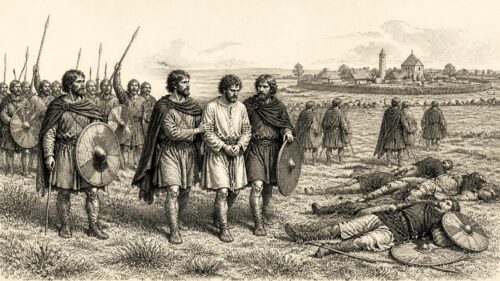
For Ireland in 781, the surviving record turns on a brief but telling notice of war at Samhain. The principal annalistic entry says that the men of Brega defeated the Laigin at the battle of the Ríg, where Cú Chongalt, king of Ráith Inbir, was killed. It also identifies the victorious leaders: Diarmait son of Conaing and Conaing son of Dúngal, both grandsons of Conaing, together with Máel Dúin son of Fergus and Fogartach son of Cumuscach, both grandsons of Cernach. A short verse attached to the notice remembers the Leinster force going to the house of a man they did not love and remaining by the bank of the Ríg.
The event is securely connected with this point in the early 780s, but the exact modern year needs a caution. The Annals of Ulster preserve the battle under their heading U781, while their chronological apparatus places that entry one year earlier than the reconstructed sequence usually followed by modern historians. Modern prosopographical accounts accordingly place the Brega–Leinster border fighting in 781. The annal supplies a liturgical date, All Hallows’ Day, but not a modern place-name for the Ríg, nor an explanation of why the armies met. It would be unsafe to manufacture either. What can be said is that the encounter belonged to a sustained struggle over the political borderlands between Brega and Leinster.
A Battle at Samhain
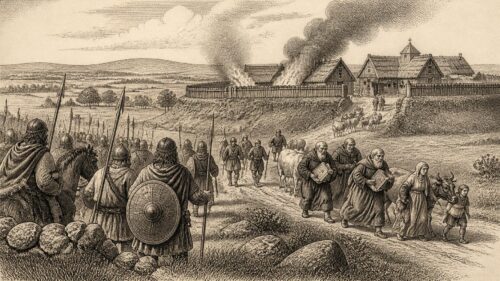
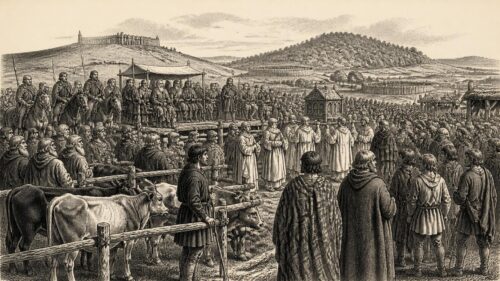
All Hallows’ Day fell at the opening of Samhain, the season that marked the transition from summer to winter in the Irish calendar. It was an important moment for assemblies, rents, hospitality and the movement of people and livestock. A campaign at that time was therefore not merely an episode of fighting before the weather closed in. It could affect the autumn collection of food-renders, the security of herds, and the standing of local rulers expected to protect their clients. Yet the annal does not call the action a raid, name any spoil, or describe a siege. Its language is more restrained: a battle won by Brega over the Laigin.
The named casualty nevertheless shows that the encounter was politically consequential. Cú Chongalt was styled king of Ráith Inbir, a title indicating that he was more than an anonymous fighting man. His death removed a ruler from the Leinster side, while the careful naming of four victors advertises the success of particular Bregan kindreds. The annalist’s genealogy is itself part of the political message. In a world where authority, land claims and military followings were organised through descent groups, naming a grandfather could establish the legitimacy and rank of those who had prevailed.
The accompanying quatrain is equally revealing. It does not offer a polished heroic celebration of the dead; instead, it alludes to an uneasy visit, plentiful drink, and an encampment by the Ríg. Its tone suggests remembered local hostility rather than a straightforward national war. The Laigin were not a united kingdom in the modern sense, and neither were the men of Brega. Both labels could contain several competing dynasties, lesser kings and client populations. The battle was a conflict between political groupings whose alliances could alter rapidly.
Brega, Leinster and Tara
Brega, spread across the fertile lands north of the River Liffey and around the lower Boyne, lay close to the heartland of the Southern Uí Néill. Leinster’s northern approaches, meanwhile, reached towards the Liffey plain and the routes leading to Kildare and Meath. Control of this zone mattered because it joined productive farming districts, royal sites and overland roads. A victory there could strengthen a ruler’s claim to tribute and submission without producing permanent territorial conquest.
The wider balance of power made such a confrontation especially charged. Donnchad Midi of Clann Cholmáin was king of Tara and the most formidable Irish overking of his generation. His authority was not that of a monarch ruling a centralised state: Ireland remained a patchwork of kingdoms. But Donnchad could lead major hostings, enforce alliances, and intervene in Leinster and Brega. In 780 he had defeated Ruaidrí son of Fáelán, king of Leinster, near Kilcock, on the Kildare–Meath frontier. The Brega–Leinster fighting of 781 followed in a landscape already unsettled by that assertion of Uí Néill power.
There is no annalistic statement that Donnchad commanded the battle of the Ríg, and his name should not be inserted into it as though that were fact. Still, the victory of Bregan groups over Leinster fitted a political environment in which Leinster was under intense pressure from Tara. Ruaidrí’s position was also insecure within his own province. His cousin and rival Bran Ardchenn of the Uí Muiredaig was emerging as a major contender. Their open clash at the Curragh near Kildare belongs to 782, not 781: Ruaidrí won that battle and took Bran captive. The later struggle helps to explain why a Leinster force in the previous year may not have represented a stable, united provincial leadership.
For Brega, too, unity should not be assumed. The families named as victors belonged to the tangled political world of the Síl nÁedo Sláine, a powerful Uí Néill grouping whose branches repeatedly fought one another as well as their neighbours. The battle of the Ríg was therefore part of overlapping contests: Brega against Leinster, rival Leinster dynasties against one another, and the king of Tara’s continuing effort to keep the eastern midlands within his orbit.
Rural Power and Seasonal Work
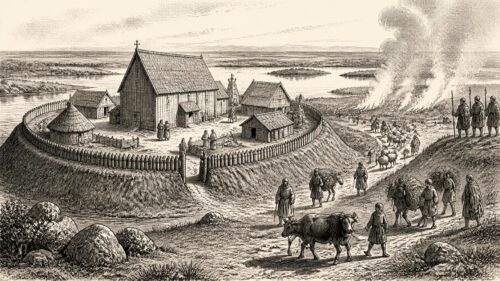
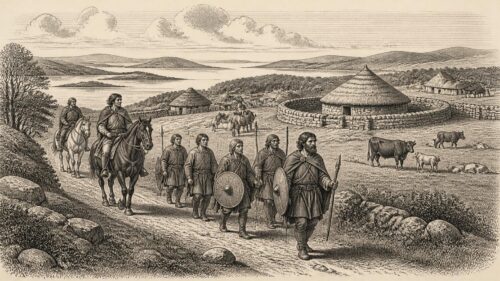
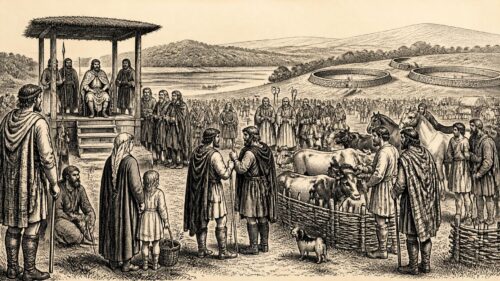
Behind the compressed record of kings and battles stood a predominantly rural society. Most people lived in dispersed enclosed settlements: raths bounded by banks and ditches, stone-walled cashels in suitable regions, lake dwellings or crannógs, and smaller farmsteads. Houses and byres, workshops, wells, yards and cultivation plots formed parts of working households rather than separate villages in the later medieval or modern pattern. Ecclesiastical settlements could be larger and more densely occupied, but even these were tied closely to their estates, livestock and grain supplies.
Cattle remained the chief visible measure of wealth and status. They supplied milk, meat, hides, traction and a means of payment, while their ownership underpinned relationships between lords and clients. By the eighth century, however, cereal production was increasing in importance. Archaeological and documentary evidence points to more varied crops, watermills and improved grain-drying technology. The people affected by the battle at the Ríg would therefore have inhabited a mixed farming world in which pasture, dairying and arable labour all mattered.
Political obligation reached deep into this countryside. Lords supplied land, animals or equipment to clients; clients owed food-renders, labour, hospitality and, when called upon, military service. An army did not consist solely of aristocratic warriors. It required followers, servants, food, animals and local logistical support. A defeat might mean deaths among leading men, but it could also bring disrupted grazing, confiscated cattle, broken patronage ties and fresh demands from the winners. The sources do not record these consequences at the Ríg, so they cannot be asserted as particular outcomes; they are the practical setting in which such a battle had meaning.
Churches, Learning and Authority
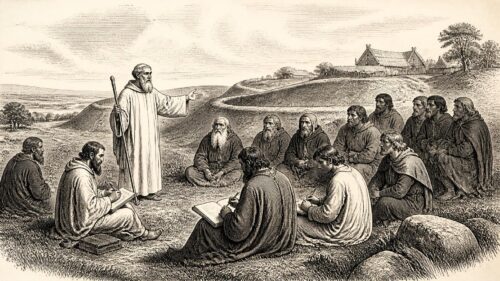
Christian institutions were woven into these same political and economic networks. Monasteries were places of worship and learning, but also landholders, employers and hosts to travellers. Their communities included not only clerics and scribes but labourers, tenants and dependants. Abbots and bishops could be members of ruling families, and the church’s protections, relics and legal claims carried real weight in negotiations between secular powers.
In Leinster, Tallaght was already an active example of a reforming ecclesiastical community. Máel Ruain had founded it in 774, and its later associated texts preserve an ideal of disciplined enclosure, celibacy, prayer, study and manual work. That programme should not be projected as the daily experience of every Irish church in 781, but it demonstrates that religious reform and intellectual life were not abstractions remote from politics. Communities such as Tallaght depended on land, labour and the security of local rulers, while rulers sought spiritual prestige and institutional allies.
The annals themselves are products of this learned world. Their spare notices preserve deaths, battles, weather, disease, church affairs and royal actions because such matters mattered to the communities compiling and transmitting memory. The verse on the Ríg shows that annalists could preserve poetry alongside prose chronology. It is a small survival, but an important one: 781 was not a silent year, even if its surviving evidence is thin.
What 781 Does Not Show
It is tempting to make every year in the late eighth century a prelude to the Viking Age. That would distort 781. No Scandinavian raid on Ireland is recorded for this year; the first recorded attacks come only in 795. The conflict at the Ríg was an Irish one, involving established Gaelic kingdoms and their internal rivalries. Nor does the battle demonstrate that Brega permanently conquered part of Leinster, or that Donnchad Midi personally directed every movement on the frontier.
Instead, the year offers a sharp view of early medieval Irish politics at ground level. On or around Samhain, a Leinster force met men of Brega beside the Ríg. A local king died; several Bregan leaders gained a victory worth recording; and an uneasy verse kept the memory of the encounter alive. In the background stood the power of Tara, dynastic competition within Leinster, and a farming society for which autumn warfare could carry consequences well beyond the battlefield. The surviving record is brief, but its limits are part of its value: it shows precisely how much can be known, and how much must remain unknown, about one hard-fought day in 781.
Primary Sources
- The Annals of Ulster
- The Annals of Ulster, Year U781
- The Annals of Ulster, Year U782
- Annals of the Four Masters
- Annals of the Four Masters, Annal M781
- Annals of Inisfallen
- Annals of Inisfallen, Annals AI769–AI779
- The Annals of Tigernach
- Bran Ardchenn
- Donnchad Midi
- Máel-Ruain
- The Martyrology of Oengus the Culdee
- Early Medieval Ireland: Investigating Social, Economic and Settlement Change, AD 400–1100
- Agriculture, Settlement and Society in Early Medieval Ireland
- The Economy of Early Medieval Ireland
- Early Medieval Settlement Enclosures in Ireland: Dwellings, Daily Life and Social Identity
- Early Medieval Ireland, AD 400–1100: The Evidence from Archaeological Excavations
- Churches and Ecclesiastical Enclosures
- Early Medieval Rural Settlement Archaeology in Ireland and the Impact of Large Infrastructural Developments
- Félire Óengusso: Problems of Dating